
Ten Hurdles for Marketers in 2026
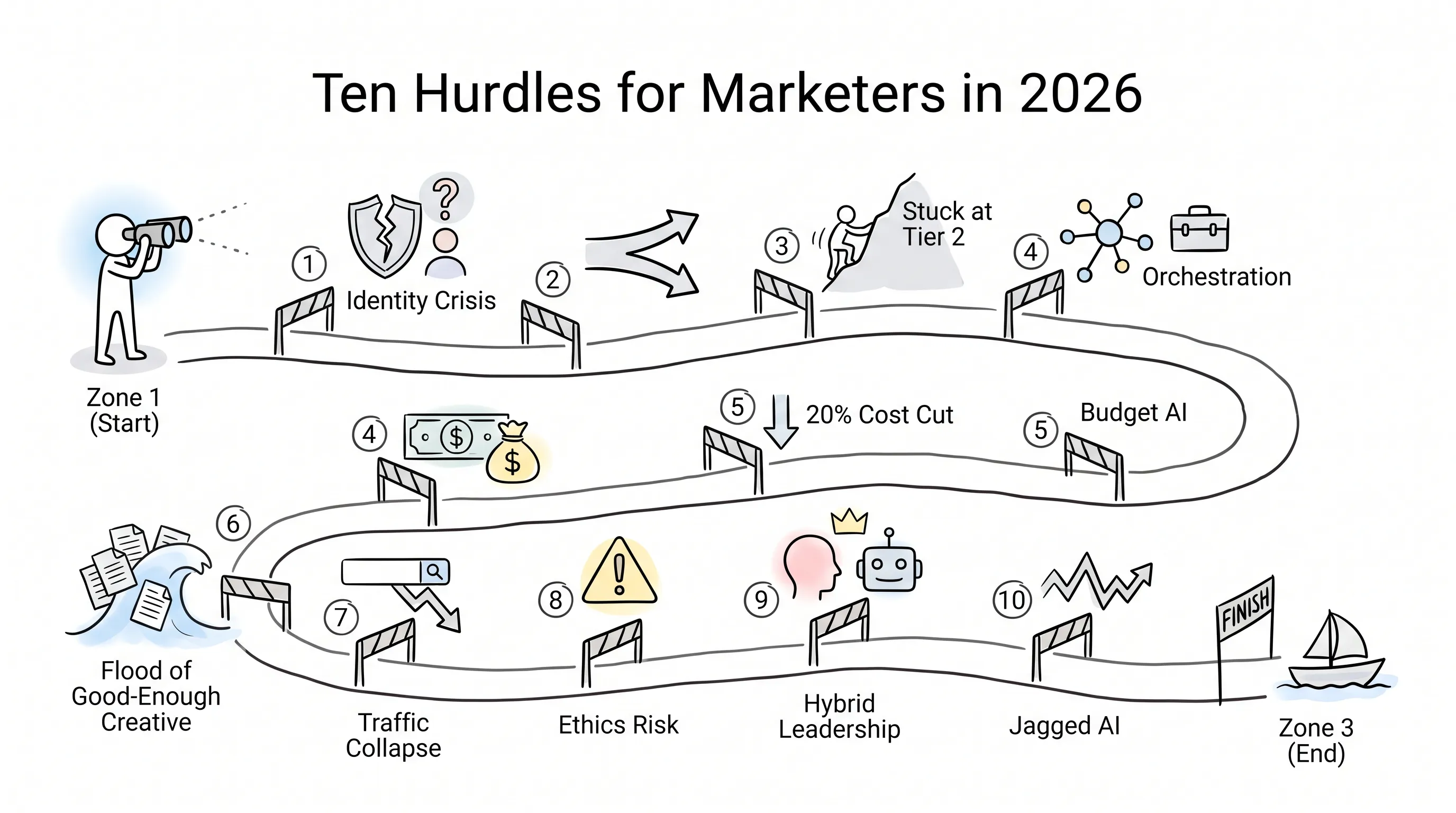
A long-form analysis outlines ten hurdles marketers face with AI in 2026, including shifting roles and identity, organizational adoption gaps, AI-generated creative flooding, AEO and search disruption, ethics governance, and leading hybrid human-AI teams.
A few days ago I had dinner with an old friend, a chief marketing officer. The dishes had barely landed on the table when he set down his chopsticks and asked me: "Tell me — this time next year, which seats on my team should still have a person in them?"
Before I could come up with an answer, he added something that cut deeper: "Honestly, I'm not even sure what should be sitting in my own seat."
We're now in the final quarter of 2026. All year, the marketing world has stopped debating whether to use AI; the conversation is about what's left for us. I've pieced together the cases and research I've come across lately, plus a steady drip of dinner-table complaints, and they all point to ten hurdles.
Let's take them one at a time.
The First Hurdle: The Jobs Haven't Changed Yet, but Identity Is Already Cracking
First, let me tell you about a race.
The Oxford–Cambridge Boat Race has been run since the 1830s, once a year, never missed except for war and pandemic. The 2002 edition was especially dramatic: the day before the race, one crew's star rower was injured and had to be replaced at the last minute. Four point three miles of river, two boats across the line, half a second apart.
Rowing is widely considered one of the most brutal endurance sports on earth. The division of labor in a boat is crisp: the coxswain calls the commands, the rowers are the engine room, some mind the balance, some mind the course. There is never one second of ambiguity about who is who.
Why do I bring this up? Picture this: half the seats in that boat are people, half are AI agents. How would you line them up?
Who gets the rudder? Who keeps the engine room? And who strikes the balance between data and instinct? If you can't answer, that's normal. It is precisely the hardest problem facing marketing teams right now: while everyone is still arguing over whether the department shrinks by 10% or 50%, the first thing to actually collapse is our sense of our own roles. Am I still "the content person"? Still "the channel person"? Where, exactly, does my expertise — the value I bring — live on the org chart?
The first cut AI makes doesn't land on your job. It lands on your identity.
The org chart can sit untouched for a year; the map in people's heads is already caving in.
The Second Hurdle: AI Is Now Frighteningly Concrete, While Our Plans Still Hang in Mid-Air
Marc Benioff, CEO of Salesforce, has a verdict: AI may be the most important technology of "any era." Note the wording — any era. Not our generation's, not our children's. If you're still reaching for the comparison to the internet or the smartphone, you're probably underestimating its weight.
That's not politeness. This year, multiple media outlets ran the test, and nearly every mainstream reasoning model blew straight through the CFA exam (a notoriously difficult credential for financial analysts). What struck the observers was that the models weren't leaning on memorized past papers but on their own reasoning. In other words, these systems genuinely "think" — and the thinking keeps getting stronger.
Which raises the question: the models have been sprinting ahead — have our marketing organizations kept up?
Not even close. In December 2025, the executive search firm Spencer Stuart surveyed several hundred chief marketing officers at large and mid-size brands: more than half the companies were piloting AI projects, yet hardly any had actually begun to scale. The pilots are like fish raised in a lab tank — thriving, but never once released into the lake.
What does that gap mean? It means a five-person startup in the Bay Area can be born AI-native and cover in three months the ground a large company covers in three years — while marketing departments with history and headcount clutch sharper tools and still run the processes they ran five years ago.
The gap isn't about who is smarter. It's about organizational form. And organizational form happens to be the hardest thing there is to change.
The Third Hurdle: Most Companies Will Get Stuck Halfway Up the Mountain
Since we're on organizational form, let's unpack it. Corporate AI maturity comes in roughly four tiers.
Tier one: experimentation. Hand out accounts, open sandboxes, and everyone enthusiastically runs little pilots. The buzz is real — but ask how much money those pilots saved or how many extra orders they brought in, and nobody can answer.
Tier two: tool adoption. Midjourney, ElevenLabs, Adobe Firefly slot into the daily workflow, and on the insights side there are now dedicated tools that track how a brand shows up inside answer engines. Every department has a few eager volunteers clearing obstacles. Most companies stop at this tier.
Tier three: rebuilding the workflow. Creative, media, and operations stop fighting solo with their own toolkits and get rearranged around AI into one connected system, built for speed and consistency.
Tier four: fully AI-native. From strategy and insights to briefs, creative, media buying, and measurement, the entire value chain gets re-sequenced, and every link answers one question: should a human sit here, or an agent?
Sounds like a staircase, each tier higher than the last, right? The reality: most brands are stuck on tier two, and they'll most likely still be stuck there in 2026. Not because they don't want to climb, but because tier three breaks too many bones: cutting processes, rewiring collaboration, moving other people's cheese — it hurts too much for anyone to go first.
The Fourth Hurdle: From Stockpiling Tools to Orchestrating a Campaign
For the past two years, the habit has been stockpiling tools. One for copywriting, one for images, another for video editing — like snapping together building blocks, or patching holes.
This year the game changed, and the keyword is orchestration.
The players offering orchestration have multiplied overnight: foundation-model vendors, enterprise platforms, vertical startups, low-code agent builders, and the custom agents companies assemble in-house. Most marketing teams are mixing and matching — whatever works, they use.
Orchestrate what? Brand guardrails and compliance monitoring, content production and personalization, conversational agents (the chat window is becoming the new interface for nearly everything), the command center for campaigns and media, real-time research, landing page builds — it can all be strung together.
Where's the biggest payoff? My call: orchestration of campaigns and media. Point-solution efficiency gains are a matter of tens of percent; a whole campaign coordinating itself is a ten-x order of magnitude.
There's one precondition: you first have to get over that halfway-up-the-mountain hurdle.
The Fifth Hurdle: The 20% Cost-Cut Math Problem Will Land on Your Desk Sooner or Later
Since last fall, several CMOs have privately vented to me: their CEOs and CFOs are making them rebuild their budgets for 2026 and 2027, all with the same uniform rationale — the savings go toward buying AI subscriptions and research.
That same Spencer Stuart survey holds one more number: more than 40% of marketers said leadership expects marketing to cut more than 20% of AI-related costs within the next one to two years.
Do a quick gut check: has this question landed on you yet? If it hasn't, don't count yourself lucky — it's only a matter of time. Whenever the board talks about where costs can come out, marketing is always near the top of the list.
My advice is unromantic: starting today, try to answer "how would I cut 20%" — or "how would I find 20% more output." On this problem, sooner beats later.
The Sixth Hurdle: A Flood of "Good-Enough" Creative Will Cheapen Great Creative
There's a Puma ad you may have scrolled past. It pushes back on the old "greatness through grinding" narrative and argues that greatness comes from play. Beautiful visuals, complete story, emotion intact.
Here's the key: the spot was made end to end by a chain of AI agents. From insight and brief to storyboard, then a second set of agents doing evaluation, then rough cut and final polish — produced by the agency Monks. At every step, humans just watched.
This means ad capacity is about to flood the zone. More junk content? No surprise. The genuinely painful detail is this: a growing share of the stuff that "looks like junk" performs just fine in market.
Coca-Cola shows it. Its Christmas ads of late 2024 and 2025 leaned heavily on AI and still held their own on the performance metrics System One measured. Maybe it's no match for a human masterpiece, but it's faster, cheaper, more controllable, and produced at scale — spinning up ten thousand different versions is a click away.
"Good enough" is precisely the thing that kills "great."
Great creative won't disappear. But from now on, it has to prove, on its own, why it deserves the premium.
The Seventh Hurdle: The Traffic-Collection Business Is Being Pulled Up by the Roots
The story of Chegg deserves a read from anyone living off traffic dividends. The company used SEO to draw in high schoolers and sold them study content — a booming business in its day. ChatGPT stepped on stage, and the ground under Chegg came loose; today it's practically an empty shell.
The logic is simple: students used to have a question, open a search box, and the search box handed its traffic to Chegg. Now they ask a large model directly and skip the search box entirely. Any business arbitraging information asymmetry tends to be among the first to fall.
Other categories are slower, but the direction is the same. After large models crashed the party, SEO's predictability has visibly deteriorated. Word from Google is that the highest-intent users are still in the search box for now, but across the long middle of the purchase journey, decisions are quietly sliding into chat windows.
One side statistic: on Black Friday 2025, AI-driven referral traffic to US retail sites grew 805%. The base is small; the slope is terrifying.
So Answer Engine Optimization (AEO — optimizing content so AI answer engines cite it) will go from buzzword to required course. Search, the channel marketers lean on most, is about to get a lot messier.
The Eighth Hurdle: Ethics Risks Arrive Uninvited, and the Bill Lands on You
This one, I want to take seriously.
In late autumn 2025, Google released Gemini 3.0 and swept the benchmarks. OpenAI, stung, issued a "code red" — Sam Altman ordered the whole company to rally around firefighting for ChatGPT.
On competitive terms, nothing wrong with that move. But I keep feeling the alarm OpenAI really needed to sound was a different one.
In July 2025, a teenager in the US was in a long overnight conversation with ChatGPT that slid, step by step, toward his wish to end his own life. The chatbot's reply, at that moment, was a farewell along the lines of "go in peace, King." That November, the boy's parents took OpenAI to court.
What does this have to do with marketing? On the surface, nothing. In reality, a great deal: any brand that uses AI at scale is signing for a pile of risks it never signed up for. Rumors, bias, product misuse, child safety — which industry or which scenario they detonate in is not up to you.
And every one of those risks eventually smashes into the brand's face. Who owns the brand? Marketing.
Risk never asks permission in advance. It only shows up on time.
In 2026, governance moves from a compliance-team sidebar to a standing item on the weekly marketing meeting.
The Ninth Hurdle: Leaders Good at Managing AI Are Also Better at Leading People
There's a study that isn't famous but richly worth chewing on. It looks at two kinds of managers: those running purely human teams, and those leading teams blended with AI agents.
The core finding is counterintuitive: managers who are good at directing AI agents tend to be excellent at leading people too. The reverse doesn't hold. Being a well-liked human boss says nothing about whether you can keep a fleet of agents in order.
Follow the conclusion downstream and new questions surface one by one: a report starts competing with AI for territory, getting moody about it — what then? An agent does something that makes team members uncomfortable — then what? On a team that's half human, half software, how do you score performance? How do you make promotion calls?
In 2026 these stop being sci-fi tropes; they show up in the next round of management training. People who have led hybrid teams will become the most sought-after leaders on the market.
The Tenth Hurdle: Jagged AI Hides the Potholes You Can't See
The researcher Ethan Mollick has a phrase I love: AI's capability is jagged.
At its peaks, it is stunning enough to make you question everything; at its lows, it is stupid in plain sight. Believers stare at the jagged tips and say, look how brilliant. Skeptics stare into the valleys and say, look how dumb. Both are telling the truth.
The hard part: it can be jaw-dropping in scenario A and still drop the ball the moment the scene changes; it can fail at task B, and that doesn't mean you should throw the whole thing out. This unevenness makes failure arrive without warning — that's how the new invisible failure modes are born.
People's responses so far come in two postures. One is the "Centaur": AI handles only the narrowly defined tasks assigned to it, a human confirms at every checkpoint, boundaries crystal clear. The further step is the "Cyborg": human and AI work interwoven, to the point you can't say which stretch was whose. This year, more and more smart practitioners will drift into the second posture without noticing.
Accept the jaggedness, draw the boundaries, then learn to ride it. That may be the most urgent survival skill of the moment.
Back to That Dinner
At the end of that dinner, my friend asked me how, in the end, one is supposed to face all this.
I told him: ten hurdles on the table, but they boil down to three sentences.
Identity shatters first and structure moves later, so figure out early where you sit in the boat. There are plenty of tools and organizations are slow, so don't expect a few software purchases to save you. The risks will come and the bills will arrive, so put ethics governance and that 20% math problem on this year's calendar ahead of time.
As for what should sit in his own seat?
My answer: the future belongs to those who can seat humans and machines in the same boat.
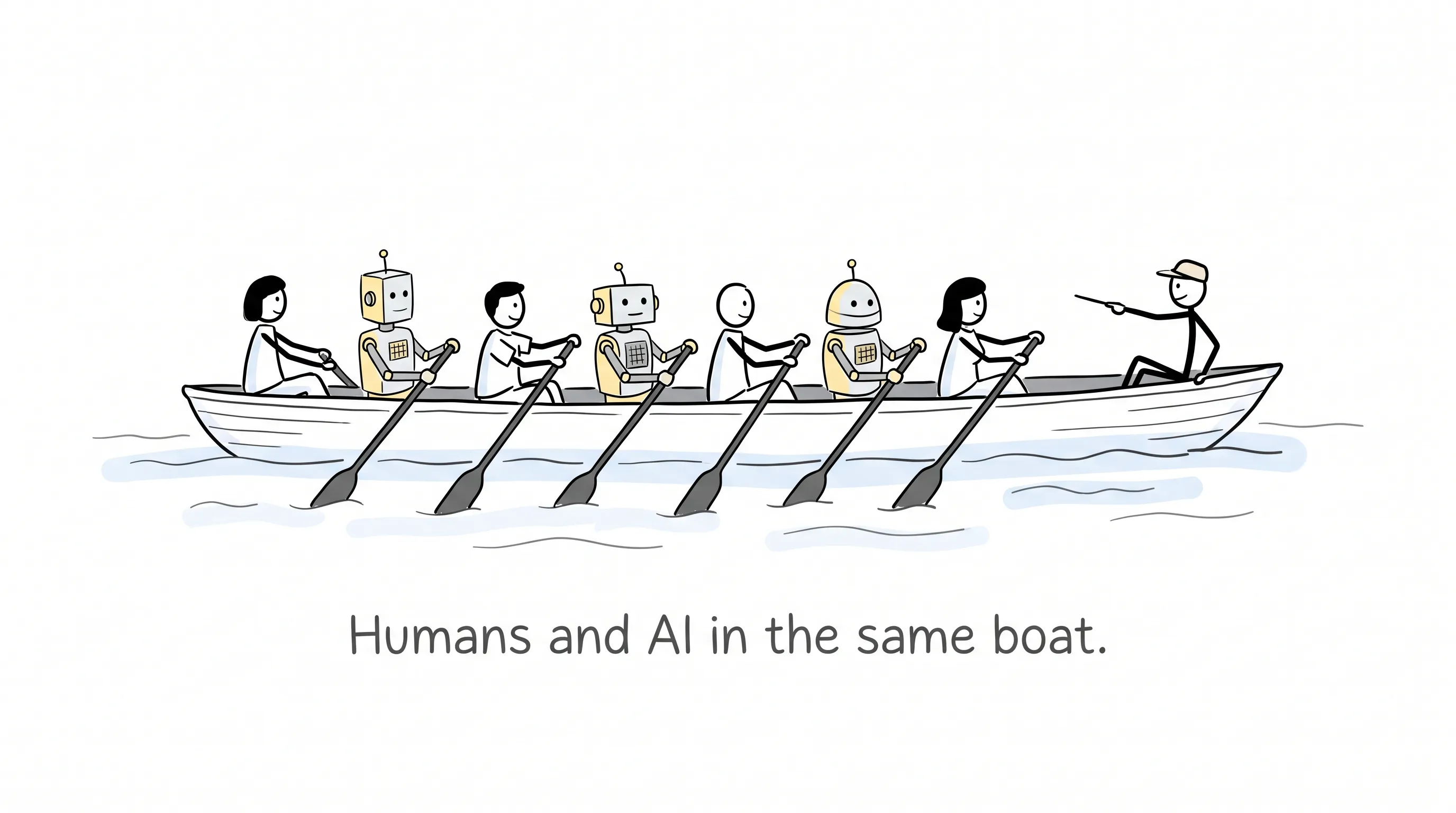
You don't have to be the one pulling hardest on the oar — but you'd better be the one who knows, stroke by stroke, whose muscle it's supposed to come from.
That may well be wrong. But you could start testing it tomorrow, from the top of your to-do list.
Continue reading
Related articles

It's 2026: Stop "Buying" AI Tools for Your Marketing Team — Start "Hiring" AI Agents
This learn article explains how AI agents differ from standalone AI tools in marketing, outlines three agent categories — build-your-own platforms, CRM-native agents, and vertical tools — and covers use cases across SEO, social media, advertising, and reporting, plus criteria for choosing one.

What Is GEO? How Your Brand Gets "Mentioned" in the Age of AI Search
An explainer on GEO (Generative Engine Optimization) for e-commerce and DTC brands: how it differs from SEO and AEO, why AI answers shape brand visibility, and eight practices covering question-focused content, consistent brand messaging, structured pages, external evidence, comparisons, and AI mention tracking.

AI Is Already Making Decisions for Your Customers. Are You on the List?
A learn article explains GEO (Generative Engine Optimization): why AI-generated answers now shape which brands customers see, and how SEO fundamentals, entity clarity, citable evidence, and monthly measurement affect visibility in AI answers.