
So What Is GEO? Let Me Tell You the Stories of 5 Companies
A learn article explaining GEO (Generative Engine Optimization) through five company case studies, covering how brands earn citations in AI answers and five recurring practices behind AI search visibility.
A while back, a friend of mine who runs a SaaS business asked me out for coffee. He sat down, and the first thing he said was: We've got a problem.
I asked what happened.
He said that a couple of days earlier, he had casually asked an AI assistant: for expense reporting at small and mid-sized businesses, which software is best? The AI answered within seconds, recommended two or three options, and made a remarkably articulate case. His company wasn't in it.
He had been at it for seven or eight years, and his keyword rankings had always held on the first page.
I told him: buddy, this isn't about something you did wrong. The table has changed.
Back then, when users searched, they got a page of ten blue links, and you competed on who stood closer to the top. Now users ask AI, and AI hands back a single answer, casually naming a few brands along the way. Ten slots on a page have become three to five mentions inside an answer.
You used to fight for rankings. Now you fight for the chance to have your name said out loud.
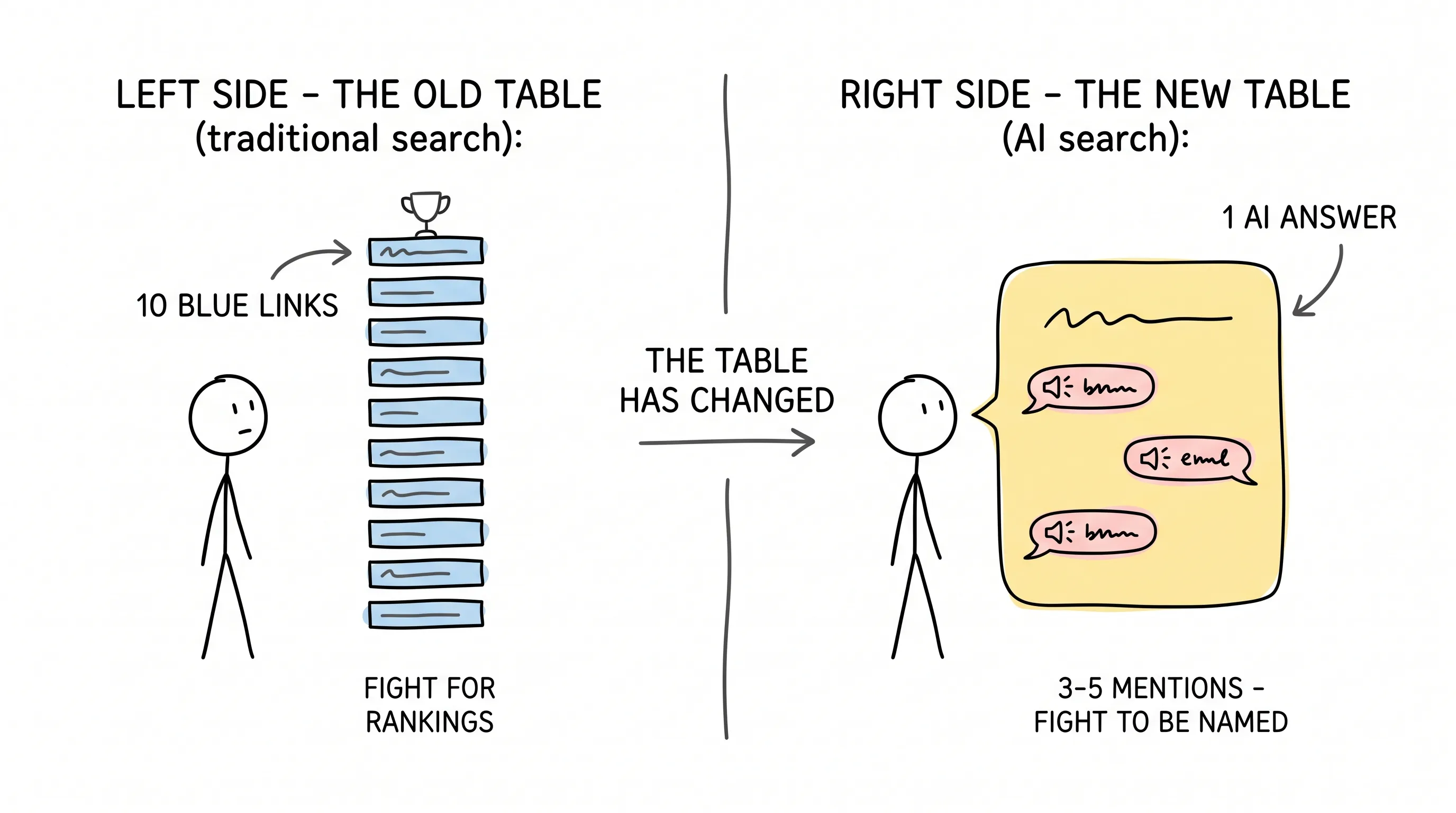
In the trade, this is called GEO — Generative Engine Optimization. Put simply: getting AI to want to cite you and recommend you when it answers questions.
The concept is easy to grasp. But my friend pressed one more question: everyone can talk concepts — does it actually work?
It works. And you don't have to argue it in the abstract — several companies have already produced results you can see. Let me tell you 5 stories.
Story One: Ramp, Fighting Its Way to Citations in a Red Ocean
Ramp is a fintech company in corporate spend management. Expense reports, corporate cards, business spending — you can guess with your eyes closed how crowded that space is. If the game were keyword rankings, it would never be the first to break through.
So it changed its playbook. Instead of chasing rankings, it chased "being cited."
How? It dug in and built content — but not marketing copy. It built the kind of content AI looks at and immediately wants to copy from: finance explainers written by experts, substantial deep-dive guides, research reports built on its own data, and steady, long-running industry observation. At the same time, it tied its brand tightly to topics like "spend management" and "corporate finance," so that whenever AI comes to these questions, Ramp is its first association.
And the result? Tracking from multiple AI visibility monitoring platforms shows that when the conversation turns to expense software, corporate cards, or financial tools for startups, Ramp's name shows up in AI answers again and again.
Notice one detail: its content wasn't "more." It was "more credible."
AI doesn't look at who shouts loudest; it looks at who dares to be copied.
Story Two: HubSpot, Even a Big Head Start Doesn't Let You Coast
You might think that a legacy content player like HubSpot, which led traditional SEO the whole way, would simply coast to an easy win in AI search.
Not that easy. The way users ask has changed — from typing keywords to asking questions. If an old player only lives off its old stock, it will just as surely fade out of the answers.
What HubSpot did boils down to "keep it fresh" plus "keep it tidy." It kept updating old content so AI never reads expired information; it kept publishing original research, giving AI material no one else has; and it reorganized its entire content library, so the structure is crystal clear and topics interlock with each other.
Add to that the brand mentions and citations it has accumulated across the web over the years, and every time AI generates an answer, reliable material is right at its fingertips.
So when the conversation turns to CRM, marketing automation, customer acquisition, or content marketing, it keeps showing up.
Who is this story for? For everyone who says "my traditional SEO foundation is solid": your track record is not a talisman. It is capital. And you have to know how to spend it.
Story Three: NerdWallet, When the Topic Is Money, AI Is Most Afraid of Getting It Wrong
Have you ever thought about this question: when AI answers "which credit card is right for me," is it afraid of getting it wrong?
Yes. Terribly.
Talk travel or recipes, and getting it wrong costs you at most some user complaints. Talk money — recommend the wrong card, miscalculate one interest rate — and people lose real money. So on high-stakes questions like these, AI applies a far stricter standard for citations: it only dares to cite sources it trusts.
NerdWallet makes personal finance content. Its playbook reads almost like it was copied straight off AI's trust checklist: content reviewed by experts, authors publishing under their real names, review methodologies that are public and transparent, comparisons detailed enough, financial education comprehensive enough.
It doesn't play games. It laid out "why should you trust me" point by point, in plain sight.
The result: on the most sensitive questions — credit cards, loans, banking, investing, financial planning — it keeps getting cited by AI.
There's a very plain truth here: in AI search, trust is not a bonus point. It is the entry ticket.
Story Four: Zapier, Don't Write Ads, Write Tutorials
Zapier does workflow automation — helping people string all kinds of software together. This market is drowning in tools, and everyone is fighting for exposure.
Zapier went the opposite way. No hawking — teaching.
A vast library of tutorials: how to set up this workflow, how to connect those two apps, how to raise your work efficiency, how to choose among thousands of tools. Users come in carrying specific problems; it solves the problem first, and leaves the selling for later.
Guess which kind of content AI prefers to cite: a manual that teaches people how to get work done, or a page of product advertising?
The answer goes without saying. AI's underlying logic for picking citation sources is the same as a human's: whoever is genuinely useful, that's who gets cited. So on questions like workflow automation, productivity tools, and app integrations, Zapier shows up steadily on AI's recommendation lists.
And here's the almost unbelievable part — the logic is that simple: what AI cites has always been content "useful to the reader," never content "useful to sales."
Story Five: Canva, Move the Brand Into the Question First
The first four stories are all about the moment when users already want to find this kind of tool. Canva thinks one step earlier: before users have even decided to buy, can they think of me first?
In the design software market it does several things: design education, building out a template library, putting out creative tutorials — while also investing heavily in brand communications, so that its mentions are everywhere in media and industry content.
The effect: when the talk is about graphic design tools, presentations, marketing assets, or social media graphics, Canva is often in the answer. And not only in final-step questions like "which design software should I pick" — in earlier, more upstream "how do I do this" questions, it shows up frequently too.
Brand share of voice looks intangible in ordinary times. But at the moment of AI citation, it carries real weight.
The number of times AI remembers a name depends on the number of times the whole world mentions that name.
After 5 Stories, the Pattern Is Hiding Inside Them
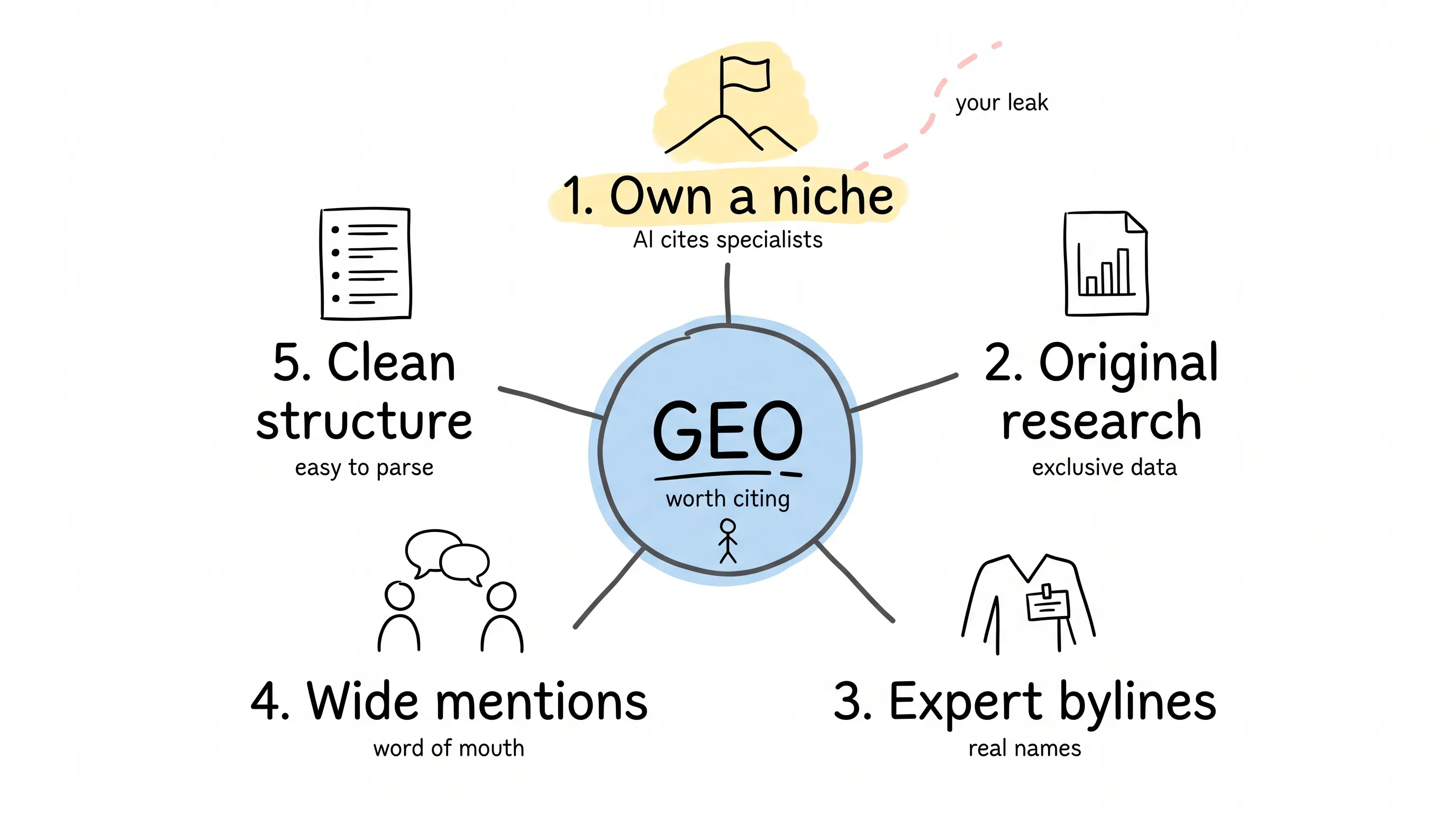
You may have noticed: these 5 companies come from different industries and different starting points, but their moves are highly consistent.
First, each of them held on to a territory of its own. AI cites specialists, not generalists.
Second, all of them produce original work. Exclusive data and exclusive research are the material AI most wants to copy.
Third, all of them dare to put experts and real-name bylines out front. AI also checks who is doing the talking.
Fourth, all of them have large numbers of external mentions. How often they appear in authoritative media and industry content is what counts as word of mouth in AI's eyes.
Fifth, all of them keep their content impeccably organized. Clear titles, clean logic, questions with answers — easy for AI to parse.
Five rules. Whichever one you're missing is exactly where you're leaking.
So How Do You Know Whether You're Doing It Right?
My friend pressed on: I understand the principles — how do I do the accounting on this?
The old accounting was easy: rankings, traffic, all crystal clear. The accounting for AI search runs on different math — it measures visibility: how often AI answers cite you; within the same category of questions, what share of mentions you capture; how much referral traffic AI platforms send you; whether brand search volume rises along with it.
There are now dedicated monitoring tools doing this accounting. As for how long until it takes effect? Most teams working seriously see changes within a few months. It isn't magic — it's slow work, but it's measurable.
Oh, and by the way, let me answer a question almost everyone asks: now that GEO has appeared, can SEO be tossed aside?
It can't. Traditional search is still here, and the traffic is still here. These two are two legs to stand on, not substitutes. Someone walking on one leg doesn't get far.
Back to That Cup of Coffee
At the end of that coffee, I told my friend: however well you defend your rankings, you are only defending the old table. At the new table, the instant AI generates its answer is the moment attention actually gets allocated.
Later, he really did start to change. He stopped piling up pages "for search engines to see" and turned instead to making the kind of content even AI can't help copying: expert-written, data-backed, clearly structured, signed with real names.
You ask: was it worth it?
Put it this way: some day in the future, when a user asks AI "who should I turn to for this kind of question," and AI smoothly says your name — in that moment you will understand that all the groundwork you laid to be worth citing paid off, not one bit wasted.
And here's hoping you're the one whose name gets said.
Continue reading
Related articles
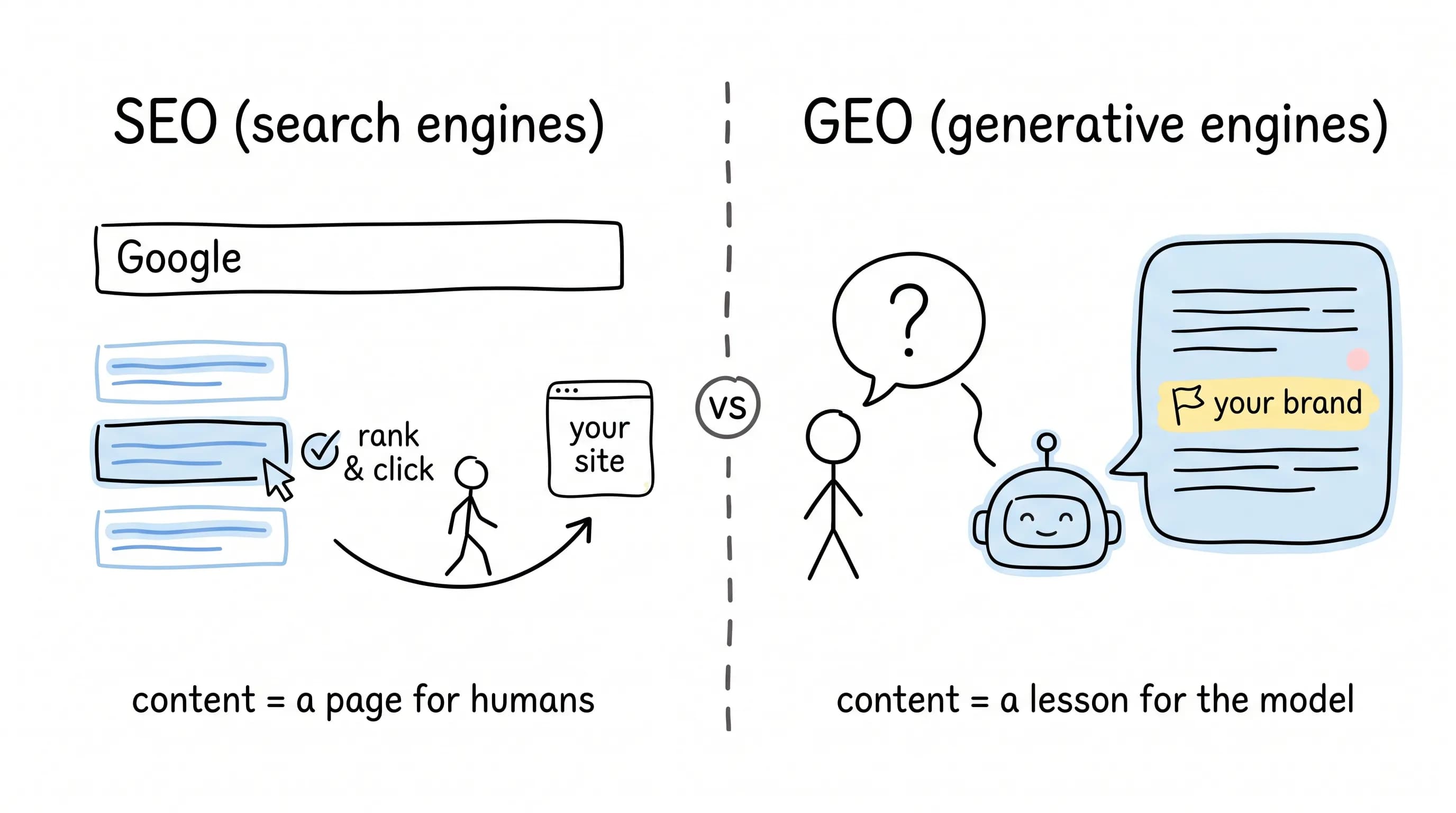
Does AI Know Your Brand? A Look at GEO, the New Craft
An explainer on GEO (Generative Engine Optimization): how AI engines like ChatGPT, Perplexity, and Gemini differ, how GEO goals and metrics diverge from SEO, and which SEO skills still carry over.
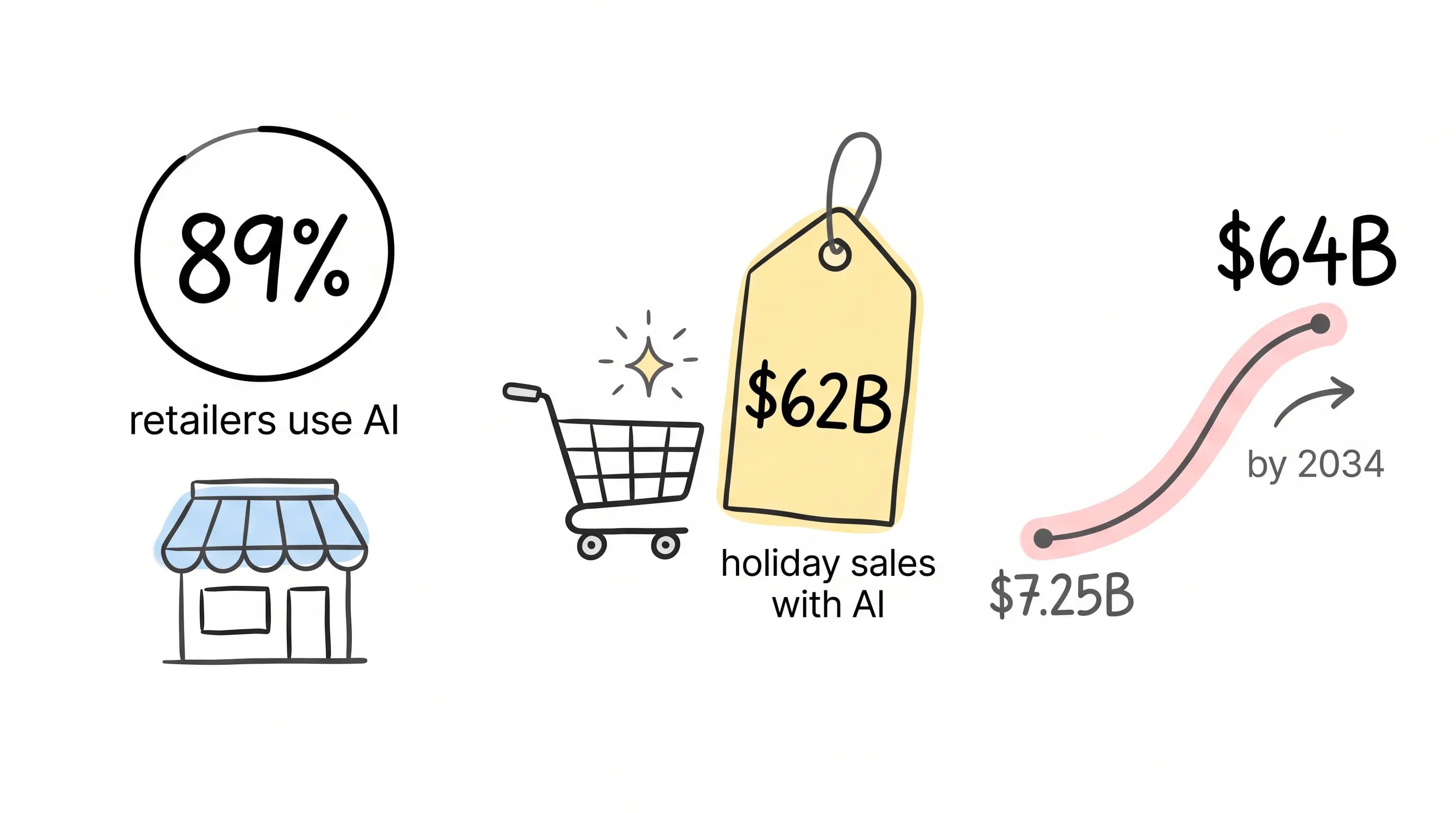
89% of Retailers Are Already Using AI. The Playbook for E-Commerce Has Changed
A learn article on AI in e-commerce: adoption context, use cases from recommendations, search, dynamic pricing, customer service, inventory, and fraud control, plus B2B applications, generative AI content, tool examples, pitfalls, and a six-step adoption path.
AI Makes Content at Lightning Speed — But Can You Answer "Who Approved This?"
This article looks at the gap between AI content speed and governance readiness in marketing teams, and outlines nine control points — prompt validation, brand guardrails, permissions, approval workflows, human review, versioning, IP checks, audit trails, and asset reuse — for brand-safe AI content.