
Privacy Laws Are Writing the New Rules for Digital Marketing
An explainer on how privacy laws like GDPR and CCPA are reshaping digital marketing, from third-party cookie loss to first-party data, consent management, and contextual targeting.
A while back, a friend of mine who runs media buying for a cross-border e-commerce business took me out for drinks. Three drinks in, he started sighing.
"I used to spend ¥100,000 on ads and precisely reach 30,000 of the right people. Now the same ¥100,000 can't even put together an audience segment."
I asked if the platforms had cut back on volume.
He shook his head: "The data is gone. The moment third-party cookies got cut off, I couldn't even tell who my users were."
Why is the data gone?
Because of privacy laws.
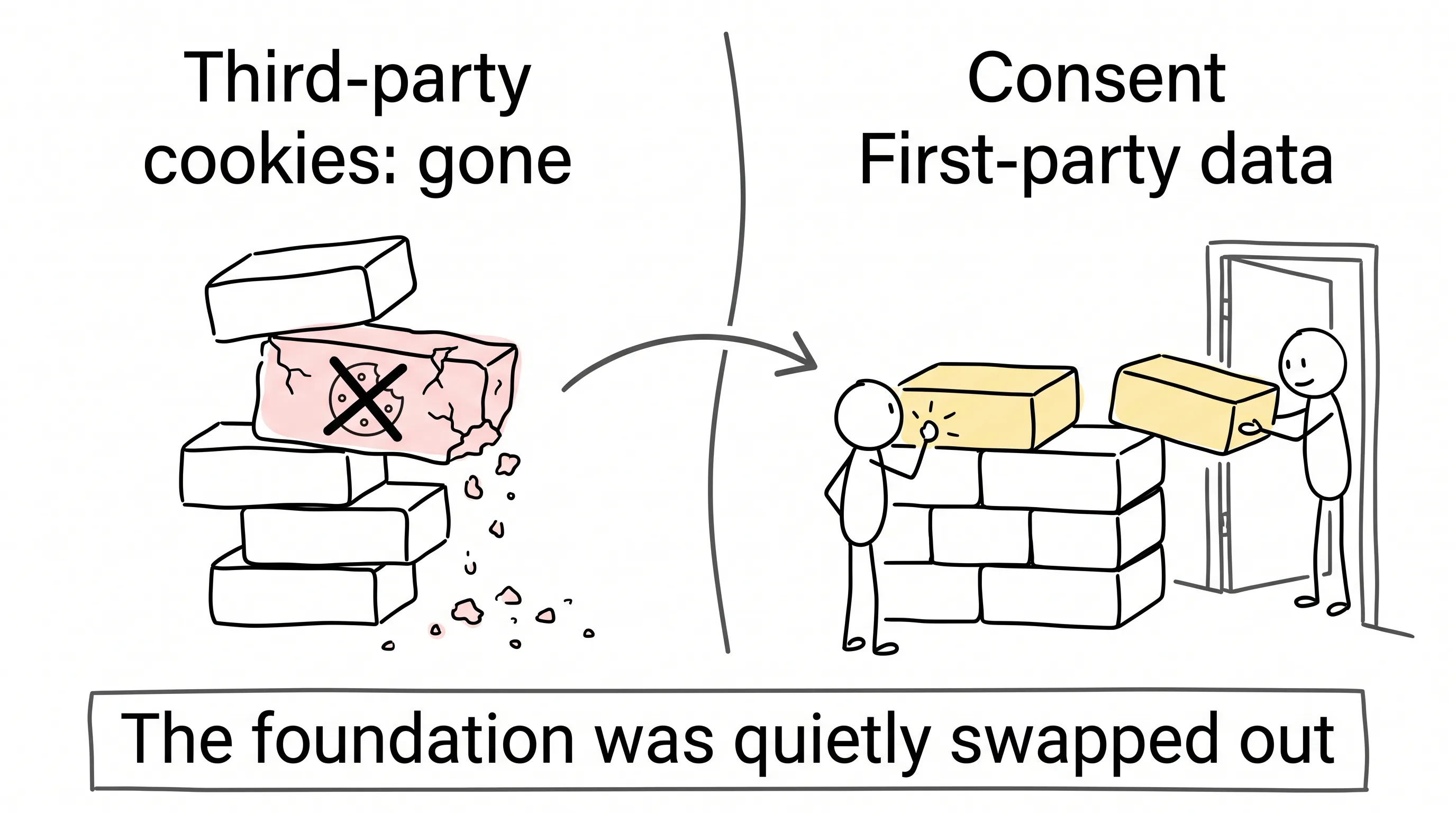
A lot of people think privacy laws are a problem for the legal department, nothing to do with marketing. I'd urge you to read this one all the way through. Because over the past few years, the very foundation of digital marketing has been quietly swapped out.
Rules First, Business Second
Of all the privacy laws in the world, the two most famous: Europe's GDPR (General Data Protection Regulation), and California's CCPA (California Consumer Privacy Act).
So what is GDPR?
A law that took effect in the EU in 2018, governing the personal data of EU residents: how it's collected, how it's stored, how it's used. It established a few very hard principles: data minimization, explicit consent, transparency, and accountability.
In plain language: if you can say it in one sentence, don't write ten; if you can collect one piece of data, don't collect ten; and if you want to use someone's data, you ask first — and only a yes counts.
And here's something most people don't know: GDPR doesn't just apply to companies inside the EU. As long as you serve consumers in the EU, even if your company is based in Shenzhen or Hangzhou, you have to comply. It's like opening a shop at the gate of a residential community: you may not be one of the residents, but if all your customers come from inside the community, then the community's rules are yours to follow.
And if you don't? What does it cost?
Fines — up to 4% of your global annual revenue.
Let's do the math. Say a company does ¥10 billion in global revenue a year. Four percent is ¥40 million. And that's just the invoice. Beyond the invoice is trust. And trust, once it's gone, is very hard to win back.
A fine is just an invoice. Losing trust is the real bankruptcy.
Now look at the CCPA. It hands California consumers three very hard rights. First, the right to know: what data of mine are you holding? I have the right to ask. Second, the right to refuse: you may not sell my data — I have the right to say no. Third, the right to delete: I say delete it, you delete it.
For businesses, this means building an honest system that catches every single one of these requests — not one can slip through.
Then you'll notice California itself rolled out the upgraded version, CPRA, in 2023; other states followed one after another with privacy laws of their own. And look beyond: Brazil has LGPD, nearly a carbon copy of GDPR; Canada has PIPEDA; Singapore has PDPA; India is pushing its own data protection law. Today, more than a hundred countries and territories have enacted something similar.
Privacy-first is going from a regional slogan to the whole world's default setting.
Privacy-First Is Not an Ethics Question. It's a Business Question.
By now you might be thinking: fine, I get it, I need to stay compliant. Isn't that just about making fewer mistakes?
That's not enough.
Treating privacy as a cost, and treating privacy as a skill, are two completely different ways of doing business.
What do I mean? Picture yourself as a guest in someone's home.
You knock first and wait for the host to answer — you don't kick the door in. Before you step inside, you say why you've come — you don't start rummaging through their cabinets the moment you're in. If the host seats you in the living room, you don't barge into the bedroom. And when you leave, you put the place back the way you found it.
Those four things are the four bottom lines of privacy-first marketing.
Saying why you've come is transparency. What data you collect, what it's for, how you protect it — tell users in plain language, don't hide behind a three-page privacy policy.
Waiting for the door to open is consent. It only counts when the user taps "Allow." If you use their data without asking, no matter how well it performs, that's kicking the door in.
Taking only what you were invited to take is data minimization. Dinner for two doesn't need a feast for eight; collect what you need, and don't empty out their fridge. The less you collect, the smaller the breach risk — and the fewer reasons regulators have to keep an eye on you.
Putting the place back the way you found it is data security. Encryption, anonymization, secure storage — all of it, done properly. Because one leak, and every ounce of trust you've built up goes to zero overnight.
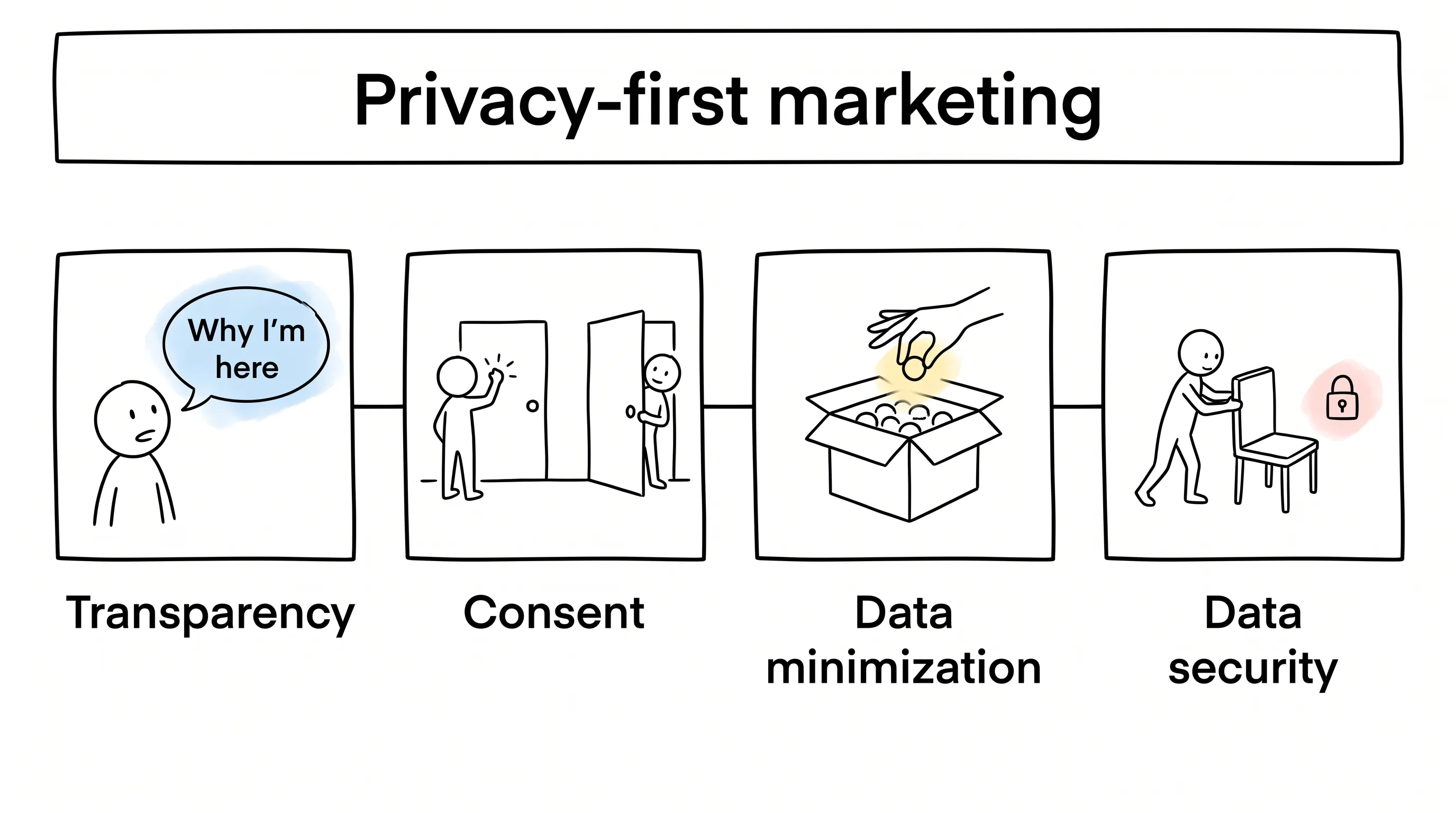
Notice: not one of these four rules stops you from doing business. They just change how you do it.
Privacy-first isn't a cost of marketing. It's the ticket in.
The Foundation of Advertising Has Been Swapped Out
So when these rules hit real-world practice, what exactly changed?
Start with the one hit the hardest: third-party cookies.
What's a third-party cookie?
You're walking through a mall, and someone is trailing you. Every store you enter, every piece of clothing you try on, everything you end up buying — he notes it all down in a little notebook. The next day, he sells that notebook to dozens of merchants. And now every store "knows" you.
That's a third-party cookie. You call it precision marketing. I call it tracking.
Once GDPR and CCPA swung into action, that little notebook was basically void. Safari and Firefox had blocked them by default ages ago, and Chrome kept tightening the screws. Ads that ran on "knowing who you are" suddenly couldn't run anymore.
So what do you do?
There are more answers than problems. Take contextual targeting: you're reading an article about running shoes, so I show you running-shoe ads. Target the content, not the person — no need to know who you are at all. There's also server-side tracking and aggregated insights: stop watching individuals one by one, and look at how a whole group behaves. The granularity gets a little coarser, but it's legal — and it's enough.
Precision no longer comes from tracking. It comes from understanding.
Next, personalization. With behavioral data constrained, more and more brands are putting their money on first-party data.
What's first-party data? Data users tell you themselves. They signed up for your membership, followed your account, ordered from your store. Clean at the source, high in quality.
One step beyond that is zero-party data: little notes users hand you on their own. "I only shop on Fridays." "I can't stand the heat — don't set the AC too cold." What people tell you on their own is a completely different thing from what you dig out of their trash.
Then there's email and CRM. The old playbook was to buy a list of 100,000 people, blast it once, and volume was taken care of. That playbook doesn't work anymore: email service providers block you, and the law watches you. What replaced it is 20,000 people who actually nodded yes to your subscription. Sounds like 80,000 fewer? You should be looking at open rates and conversion rates. 100,000 strangers add up to less than 20,000 friends who are willing to hear you out.
Same story in programmatic advertising. You used to be able to buy finely sliced audience segments; now you can't slice that fine anymore, so everyone targets with first-party data plus aggregated data.
In this round of reshuffling, there are two companies whose moves are worth remembering.
One is Apple. In 2021, iOS launched App Tracking Transparency: any app that wants to track you has to ask first, via a popup. The power to decide went from the ad platforms back to the user.
How much did that one popup cost?
In 2022, Meta did its own math: that single iOS privacy switch cost it about $10 billion in ad revenue in one year.
Ouch.
The other is Google. Restricting third-party cookies inside Chrome on one hand, testing new approaches like the Privacy Sandbox on the other, trying to find a way to measure ad performance without peeking into any individual.
See — even the companies holding the most data are changing their play on their own. This isn't idealism. It's the trend.
The Trouble Has Forced a New Business Into Being
Some people tell me privacy laws have left marketing unable to take a single step.
My view is exactly the opposite.
Take consent management platforms — CMPs for short. They work like a hotel front desk: every guest who walks in gets registered — what they consented to, when they consented, when they took it back. The consent status of millions of users, kept crystal clear; and if something goes wrong, the records speak for you.
Cookieless tracking solutions — contextual targeting, server-side analytics, covered earlier — are already mature businesses.
The most interesting one is AI. Personalized recommendations used to run on oceans of behavioral data; now many solutions train their models on anonymized data and first-party data. Performance barely dips, and the risk drops by a huge margin.
To put it bluntly, a lot of the old "precision" was built on users' privacy. That bargain was bought at the users' expense. Now the bargain is gone, and everyone has to compete on real skill: understanding content better, understanding context better, understanding the things users tell you to your face.
Compliance was never the enemy of innovation. What gets regulated to death is usually the part that had no real skill to begin with.
Even the measuring stick is changing. It used to be impressions, clicks; now more and more brands look at the quality of engagement, at trust, at interactions users have actively authorized. Short term, your list gets smaller. Long term, the users who choose to stick around are worth far more than they used to be.
Back to That Friend
Remember the friend from the beginning? What happened to him?
He stopped buying lists. He started building up his own: a membership program, content, and eventually an outright community. A year in, he had 300,000 users willing to leave their contact info behind. Slow, sure — but this foundation is his own, and no one can take it from him.
So what have privacy laws actually changed?
They turned marketing from an industry that could sneak in through the door into one that has to knock first.
Some people complain that knocking takes too long. But flip it around: the people willing to open the door for you are the customers you should truly be serving.
In the second half of digital marketing, the contest isn't who collects the most. It's who is trusted the deepest.
Here's to hoping you've long since started building your own data. Instead of waiting for a fine to teach you how.
Continue reading
Related articles
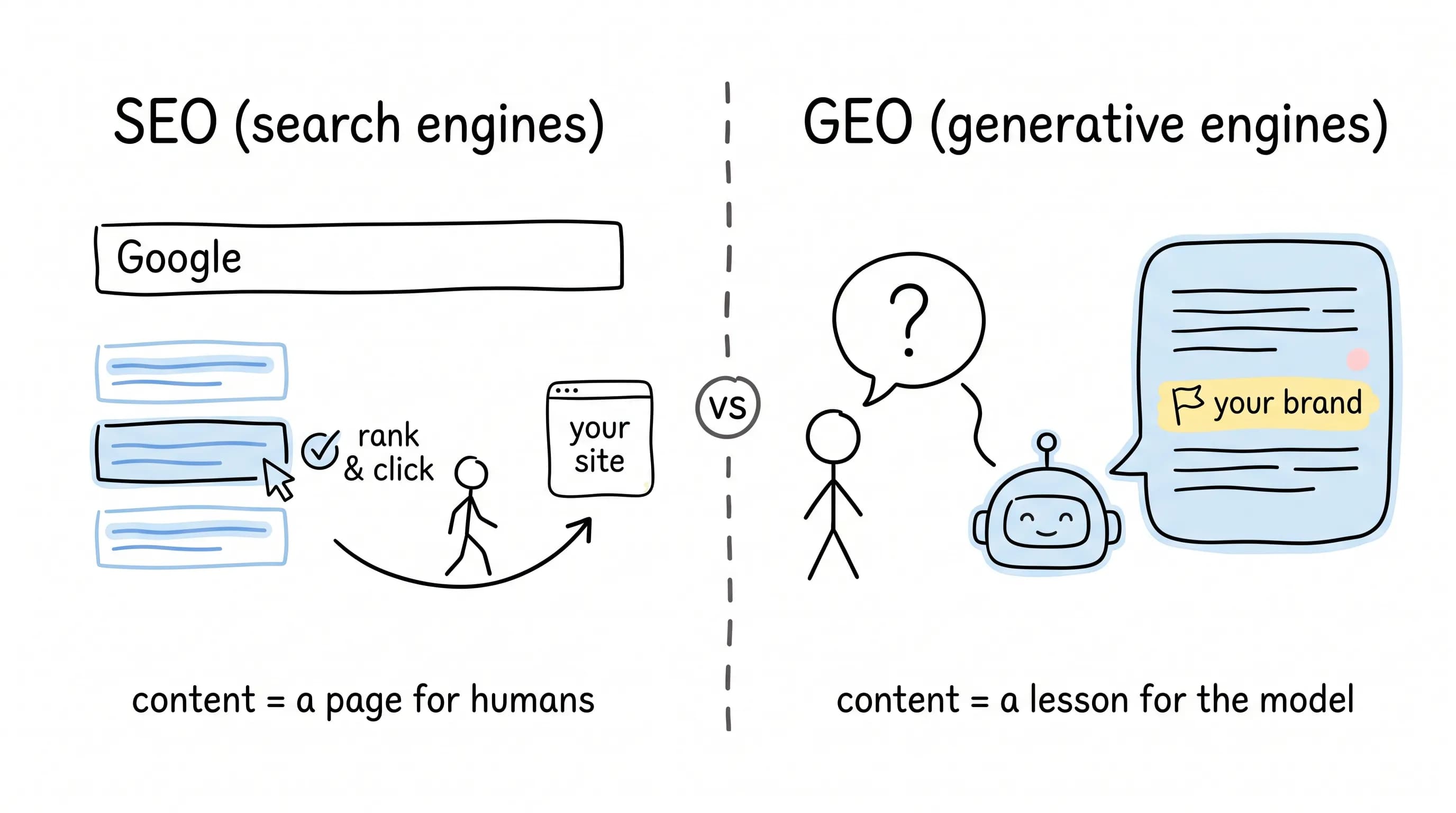
Does AI Know Your Brand? A Look at GEO, the New Craft
An explainer on GEO (Generative Engine Optimization): how AI engines like ChatGPT, Perplexity, and Gemini differ, how GEO goals and metrics diverge from SEO, and which SEO skills still carry over.
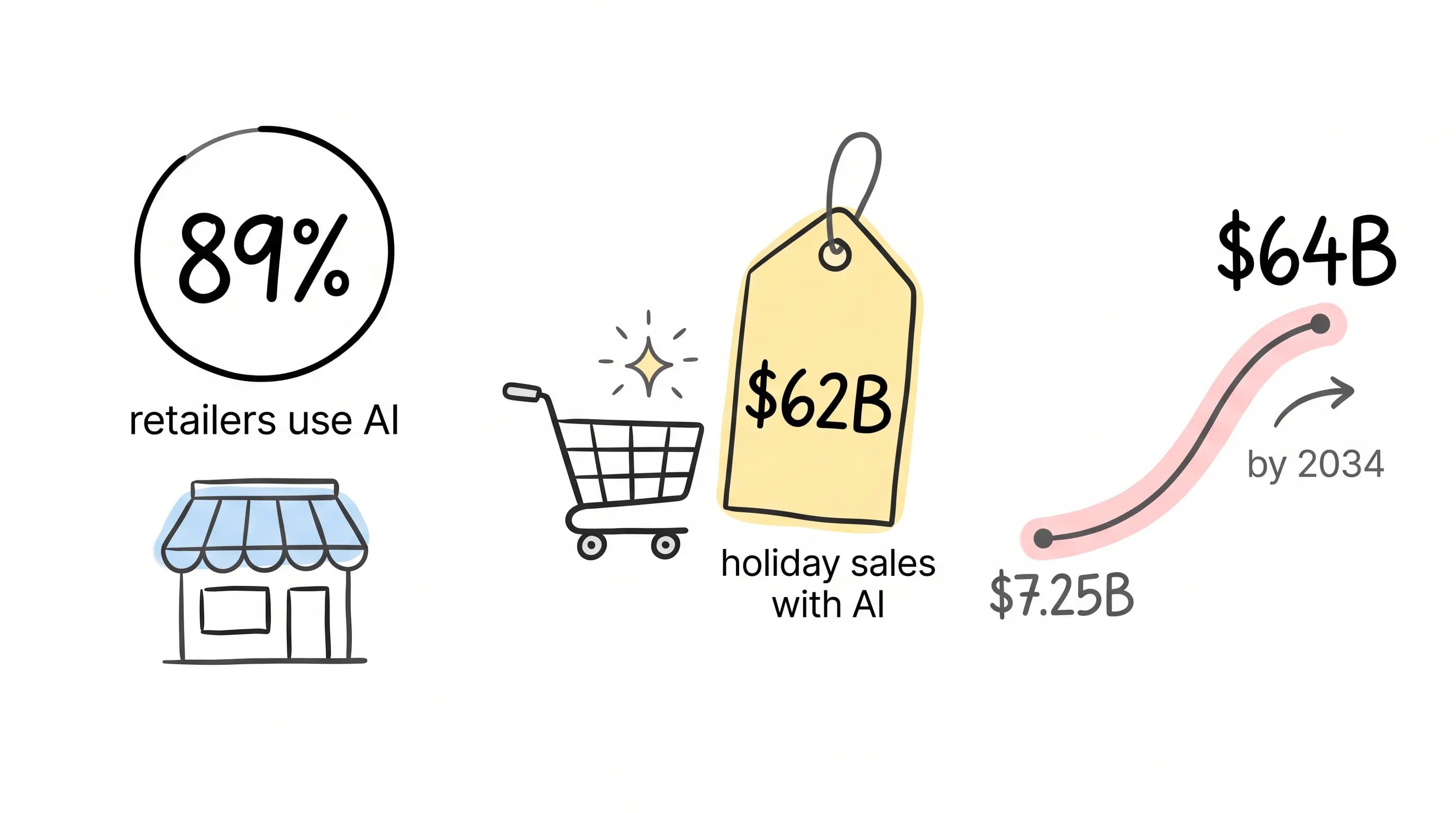
89% of Retailers Are Already Using AI. The Playbook for E-Commerce Has Changed
A learn article on AI in e-commerce: adoption context, use cases from recommendations, search, dynamic pricing, customer service, inventory, and fraud control, plus B2B applications, generative AI content, tool examples, pitfalls, and a six-step adoption path.
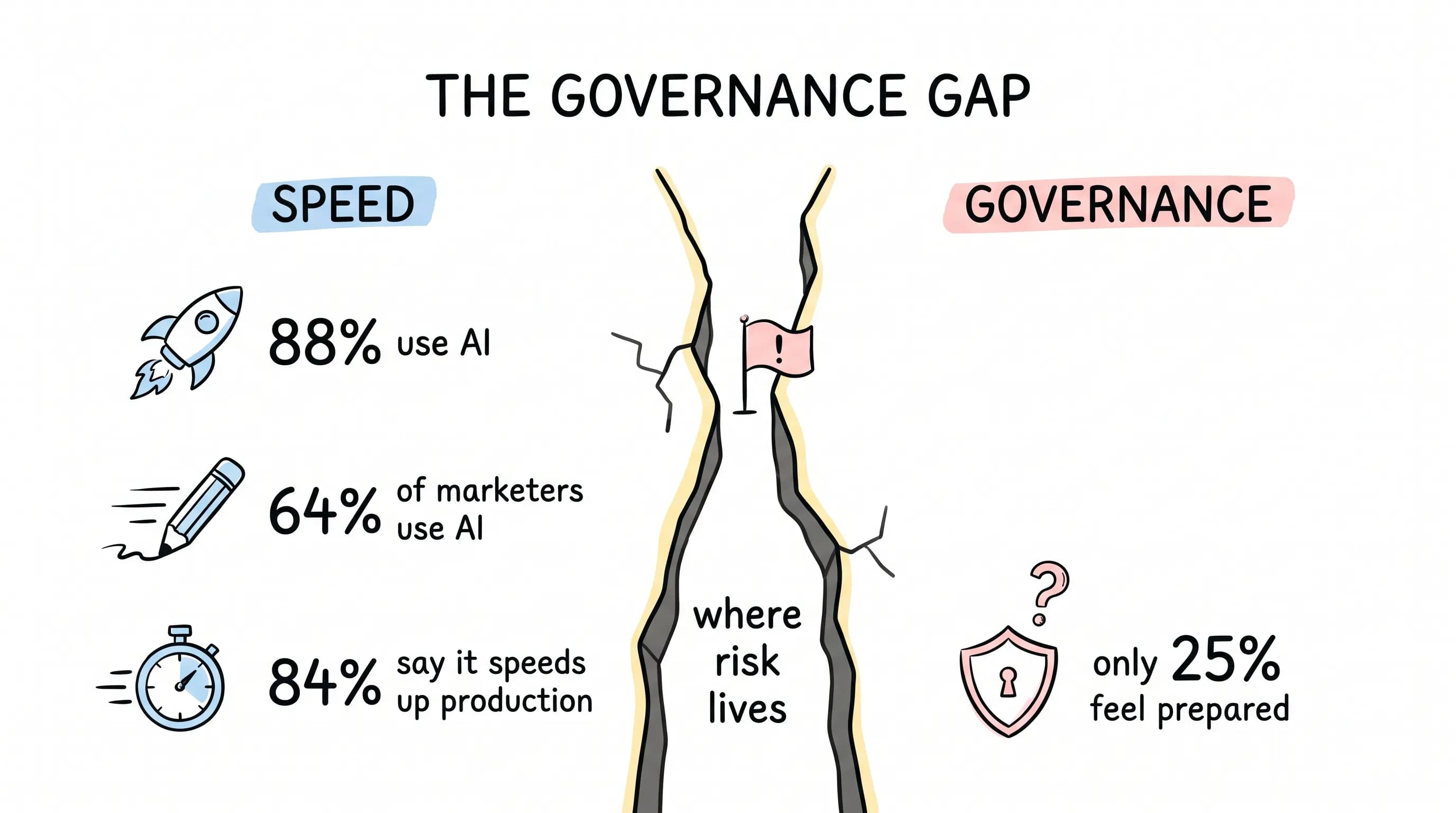
AI Makes Content at Lightning Speed — But Can You Answer "Who Approved This?"
This article looks at the gap between AI content speed and governance readiness in marketing teams, and outlines nine control points — prompt validation, brand guardrails, permissions, approval workflows, human review, versioning, IP checks, audit trails, and asset reuse — for brand-safe AI content.