
No Team, No Budget — Three Ways to Make AEO Happen Anyway
A guide for small teams on starting AEO: run an AI visibility baseline, build a mixed question bank, review weekly, and keep content fresh. It compares DIY, software, and agency paths and warns against mistaking a one-time snapshot for ongoing tracking.
A couple of days ago I had dinner with a friend who runs a company. His outfit is small — seven or eight people, with one and a half of them handling marketing. Halfway through the meal he asked me: everyone's talking about AEO now — does a team our size have to get in on it too?
My answer: it's not a question of "whether," it's a question of "you have no choice."
What is AEO? Answer Engine Optimization. It used to be that when people searched for something, they saw ten blue links, and if your website ranked high enough, you had a shot. Now? For many searches, the answer is written right at the top of the page. Google's AI Overviews does exactly this: it sits above all the organic results, sometimes even above the paid ads.
Before they ever click through to your site, the answer has already been read to them.
So as long as your business still counts on search to bring in leads and revenue, you can't dodge this. Big companies can afford a dedicated team. What about small ones?
Where to begin? Here's the conclusion up front: there are three paths in total.
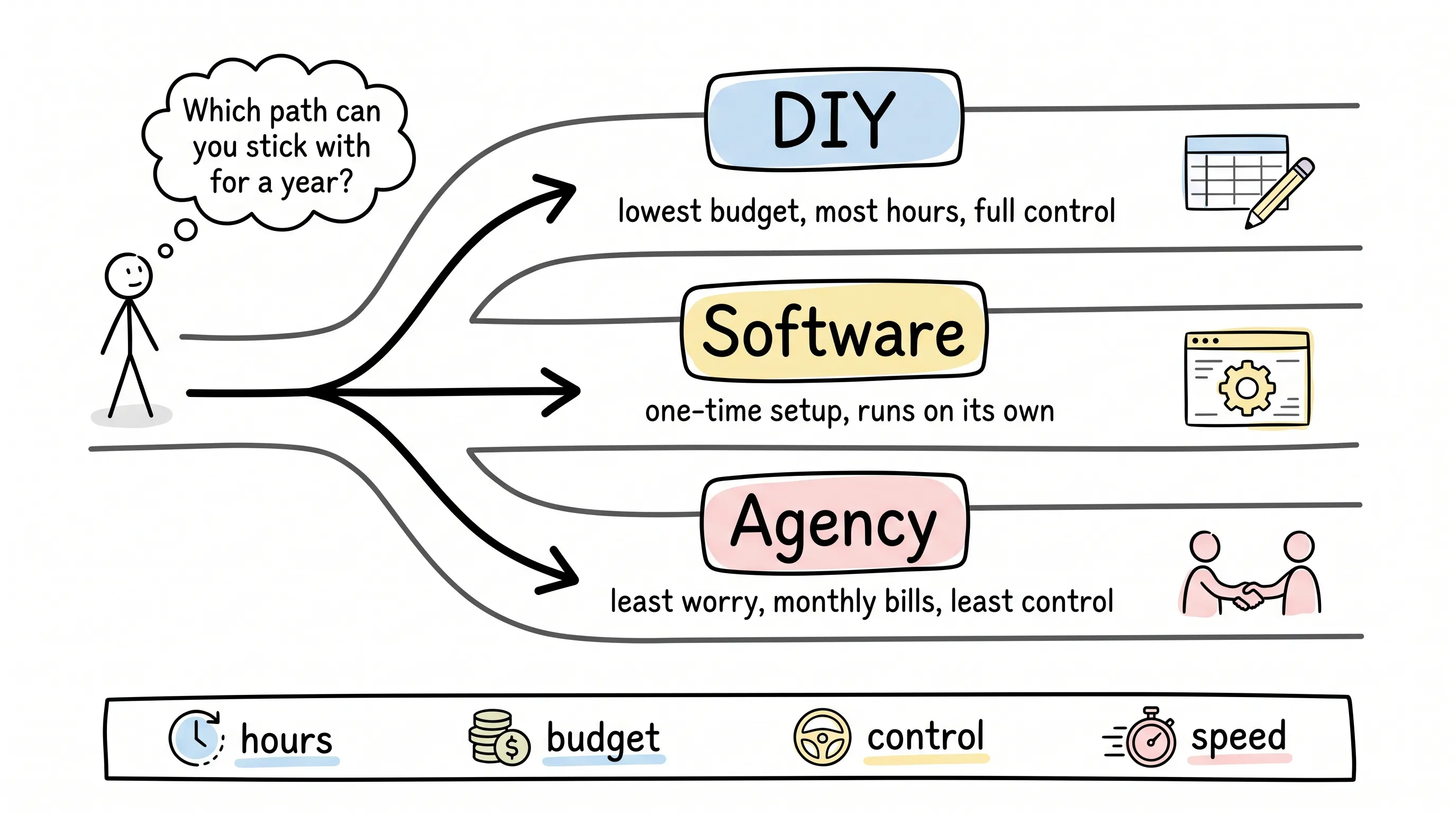
The first is DIY — use free or low-cost tools and do it yourself. The second is software, like HubSpot's AEO tool, which pulls tracking and recommendations into one place. The third is hiring an agency and outsourcing the whole thing.
Which path to pick isn't about which is theoretically the most advanced. It comes down to three practical questions: how many hours can you squeeze out each week? How much budget have you got? And can the data you surface actually turn into concrete action?
Below I'll break all three paths open for you. First, the four fundamentals you can't get around no matter which path you take; then I'll help you weigh the trade-offs.
No Matter Which Path You Take, Do These Four Things First
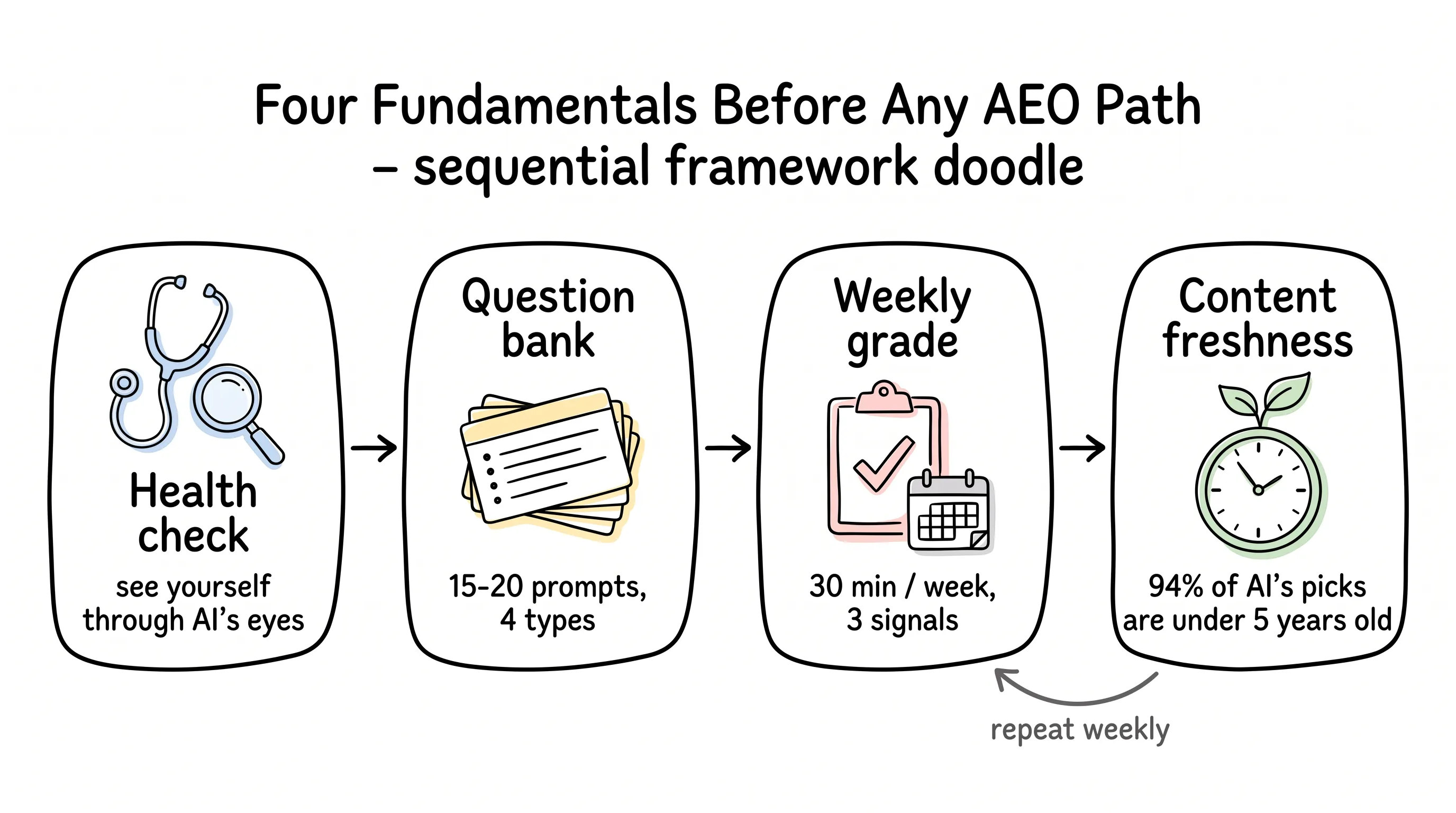
First, run a health check: see what you look like through AI's eyes.
The checkup covers three things: whether AI mentions you at all; how it describes you when it does; and when it doesn't, who gets mentioned instead — most likely your competitors.
Without this baseline, everything you do afterward has no control group. You say you've improved? Compared to what?
There are two ways to run the checkup.
The manual way: pick a batch of questions, ask them one by one on ChatGPT, Google AI Overviews, and Perplexity, and write down the answers.
The easy way: use HubSpot's free AI Search Grader, which produces a snapshot in minutes. It scores you on five dimensions: how AI feels about you (sentiment); whether what it says has substance (presence quality); whether you're recognized in AI's knowledge base (brand recognition); how much of the competitive conversation is yours (share of voice); and where you stand in your category (market positioning).
My advice: do both. The snapshot gives you a score; manual prompting gives you the raw footage. The score tells you whether you're doing well; the footage tells you why.
Second, build your question bank: prepare 15 to 20 prompts.
What's a prompt? It's the question you ask the AI on your customer's behalf.
Fifteen to twenty prompts, in four categories:
- Brand questions. Ask about you by name, like "What is XX?" or "Is XX good for XX?" These test whether AI knows you.
- Category questions. Ask about the category only, no names, like "What are the best project management tools for small teams?" These test whether you show up when a buyer hasn't thought of you yet.
- Comparison questions. Put you and your competitors in the same question. These test your share of voice and whose side AI lines you up on.
- Objection questions. Aimed straight at pain points: "Is this category even worth it?" "What are XX's weaknesses?" These test whether your content can hold up against users' doubts.
Why mix all four types? Because customers rarely start from your brand name. Think about your own buying habits: do you first learn about some company, or first discover you have a problem to solve?
HubSpot published an AI Trends report with two numbers in it: over 30% of Gen Z now look for information through chatbots or AI, and 47% of marketers are already using AI for research. The buyer's journey now starts with AI.
So if your question bank is nothing but brand questions — congratulations, you're going to get a beautiful report card. Beautiful, and deceptive.
Let me flag two pitfalls here in advance.
Pitfall one: AI answers are different for everyone. Change the city, the account, or the phone, and the results can change. What you measure may not be what your customers see.
Pitfall two: AI is extremely sensitive to wording. "The best CRM for small teams" and "the best CRM for a five-person sales team" differ by only a few words, yet the answers can be two entirely different things. Traditional search tries to infer your intent; answer engines only take literally the exact sentence you said.
So what manual testing measures is a snapshot, not a constant. But a snapshot has its own uses: once your questions are set, don't touch them. Run the same set every week, and it becomes your baseline test.
Third, grade the test every week.
The question bank is built — but not doing it isn't zero. Doing it and never looking is zero.
Every week, watch three signals:
- Any new faces? If a competitor suddenly shows up in a question where they never appeared before, they've been cranking out content lately.
- Has AI's description of you shifted? The name is still there, but the way it describes you has changed — stay alert.
- Which questions have you disappeared from entirely? This is often the loudest alarm: that page needs rescuing.
Half an hour a week is enough.
Fourth — and this is the link that breaks most easily: content has to keep up.
Why does content matter? Because an answer engine's ingredients aren't just your website. Third-party articles, forums, comment sections, social media — all of it is a source.
The key is freshness. Seer Interactive ran a study with eye-popping numbers: 94% of what LLM crawlers fetch lands on content from the last five years. And the biggest chunk of those five years is concentrated in the most recent year.
What does that mean? Your hit piece from five years ago is depreciating. The data in it is stale, the cases are stale, the statistics are stale — and AI turns around and cites someone else.
So update. And treat "publishing" and "updating" as two separate jobs: refresh hot topics frequently, give evergreen topics regular checkups, and either way, put updates on a schedule. Don't wait until traffic drops to think about it.
Here's a neat trick: an old article that performs well doesn't need to be torn down and rewritten. Turn it into a short video, make it into a LinkedIn carousel, or expand it into a guide — then add the new asset back onto the original page. Double duty from one asset.
That said, freshness carries different weight in different industries. From that same study: finance content shows a strong recency bias — AI almost only grabs the last year or two, because taxes, payroll, and regulations change every year. Travel is more forgiving: 92% of fetches land within three years, since "where to go in July" doesn't expire right away. Energy content keeps longest — explainer pieces like "what is sustainable development" keep getting cited years later.
So don't copy someone else's update cadence. Update as fast as your knowledge goes stale.
By the way: content updates for AEO don't need to be run separately from your existing SEO work. Topical authority, clear structure — traditional search and AI search both reward these. Do the work once, harvest it twice.
Three Paths — How to Choose
The fundamentals are done. Back to the opening question: DIY, software, or agency — which one?
Here are four yardsticks: how many people it costs, how much money it costs, who holds the control, and how fast it shows results.
DIY: cheapest on money, most expensive on people.
Testing prompts, filling in spreadsheets, cross-checking against SEO data — all of it is your own hours. You spend the least money and keep 100% of the control.
But the downsides are real too. First, it doesn't scale: a dozen or so prompts is fine, but once the volume grows, the spreadsheet descends into chaos. Second, the learning curve is steeper than you think. AEO is far younger than SEO — there's no decade of proven playbooks to copy, the prevailing advice out there contradicts itself, and everything has to be figured out on your own.
My verdict: DIY works as a starting point, not as a home base.
Agencies: the least worry, the most money — and the furthest removed.
Hand the whole thing over and you never lift a finger internally. Great for companies with money but no people. But you have to accept four things.
It's expensive, billed monthly. Control drops to a minimum — every insight passes through the external team's hands first. It's slow: details your own staff would spot at a glance may take an entire reporting cycle to reach the table under an agency's process. And pricing is a mess — the industry is too young, every shop's billing model is different, and comparison shopping is hard.
One tip on choosing an agency: favor ones with a search-marketing background, the ones that came over from SEO. Content quality, structured data, authority signals — the skills carry over from one to the other. An agency that already understood your SEO starts a notch ahead.
When is the right time to hire an agency? When your budget covers full managed service. If all you want is to "top up a bit of manpower," that money most likely won't come back.
Software: the optimal solution for most small teams.
Take HubSpot AEO as an example. What it does is take the most grinding parts of DIY — manually testing prompts every week, manually logging results, manually comparing — and turn them into a one-time setup that runs automatically over the long haul. Your brand's visibility, competitor appearances, cited sources, which page to fix — all in one place.
What I value most: what it hands you isn't a report destined to gather dust, but concrete recommendations. Which article to revise, which gap to fill — it tells you straight.
A marketer who is strategy, content, and reporting all in one can use this to make AEO a sustainable part of the routine, instead of another quietly dying task. Because let's be blunt: AEO's biggest enemy isn't your competitors — it's being busy. Once things get busy, weekly testing is the first thing to get cut. Software never gets busy.
Besides, it lives inside the Marketing Hub many teams are already using — no separate setup to build.
Don't Mistake a Snapshot for Tracking
One trap deserves its own section.
A snapshot answers "where am I right now." Tracking answers "am I getting better or getting worse."
A company runs its baseline checkup, sees a decent score, and is delighted. Then what? Nobody knows where things stand a month later, because nobody ever took a second look.
And manually re-running the baseline every week is precisely the kind of task that vanishes first the moment the team gets busy.
So hand tracking to a tool. HubSpot AEO watches your own brand: visibility, competitors, citations, running automatically on a cycle. Marketing Hub Pro and Enterprise tiers can also recommend prompts based on the information in your CRM, tying the data and the next action even closer together.
Also, install the free AI Search Sensor to watch the overall market temperature: how answers are fluctuating across answer engines like ChatGPT, Gemini, and Perplexity. What's it for? If your visibility suddenly drops one week, you first need to tell whether the whole industry is wobbling or whether the hole is only yours. If it's a market-wide fluctuation, panicking and rewriting your content is pure wasted effort.
Snapshot and tracking: one watches your feet, the other watches the road. A small team doesn't need both fully switched on from day one — but at the very least, don't mistake "took one look at my feet" for "been watching the road all along."
Four Question Types — Here's a Sample
For the question bank described earlier, let me list some examples. Five per type and you're ready to start.
Category questions — testing you before the buyer names anyone:
- What's the best project management tool for small teams?
- What tools are commonly used for doing XX?
- When choosing XX, what should you look at?
Comparison questions — testing your share of voice and whose side you're on:
- How does XX compare to YY?
- For XX use cases, which is better, XX or YY?
- What do YY users say about switching over to XX?
Product and use-case questions — testing specific scenarios:
- Is XX suitable for XX purposes?
- Can XX solve the problem of XX?
- How does XX handle the XX process?
Objection questions — testing whether your content can absorb the doubts:
- Is buying XX really worth it for a small company?
- What are XX's weaknesses?
- What do people dislike most about XX?
Questions You Might Still Have
Can I skip buying any tool at all?
Yes. Use the free AI Search Grader for the baseline and a spreadsheet for tracking. The cost is consistency: spreadsheet tracking is usually the first thing a marketer abandons when things get busy.
How long before I see changes in AI answers?
There's no standard timetable. Some engines pull from live web pages, some from training data, and they digest at different rhythms. Watching the weekly trend beats comparing before-and-after on any single day.
Does AEO conflict with my existing SEO?
No conflict — they run side by side. Topical authority, clean content structure — these SEO fundamentals count in AI search too. Do the SEO work solidly and AEO usually benefits along with it.
Do I need developer resources?
No. The checkup, prompt testing, content updates — a marketer can run all of it solo.
Finally, Back to That Dinner
At that dinner table, my friend's real question was actually "should I buy a tool, or hire an agency?"
I said the question was asked backwards.
None of the three paths is absolutely better; the real dividing line is: which path can you stick with for a year. DIY is nice, but it won't survive how busy you are. An agency saves you worry, but only if the budget covers full managed service. Software sits in the middle with the best value for money — but even it can't save someone who never looks at the weekly results.
You can pick cheap tools and simple methods. But "do it every week" — there's no shortcut for that one.
Here's wishing your brand shows up in every answer where it belongs.
Continue reading
Related articles

It's 2026: Stop "Buying" AI Tools for Your Marketing Team — Start "Hiring" AI Agents
This learn article explains how AI agents differ from standalone AI tools in marketing, outlines three agent categories — build-your-own platforms, CRM-native agents, and vertical tools — and covers use cases across SEO, social media, advertising, and reporting, plus criteria for choosing one.

What Is GEO? How Your Brand Gets "Mentioned" in the Age of AI Search
An explainer on GEO (Generative Engine Optimization) for e-commerce and DTC brands: how it differs from SEO and AEO, why AI answers shape brand visibility, and eight practices covering question-focused content, consistent brand messaging, structured pages, external evidence, comparisons, and AI mention tracking.

AI Is Already Making Decisions for Your Customers. Are You on the List?
A learn article explains GEO (Generative Engine Optimization): why AI-generated answers now shape which brands customers see, and how SEO fundamentals, entity clarity, citable evidence, and monthly measurement affect visibility in AI answers.