
Nine in Ten Marketers Use AI Every Day. And Then What?
A data-driven overview of AI adoption in social media marketing, noting near-universal daily use and mixed content performance across surveys. The article argues outcomes depend on workflow: human review, organized data, and how teams spend the time AI saves, plus platform differences and shifting budgets.
A while back, a friend of mine who works in social media invited me out for tea.
The first thing out of his mouth: "We adopted AI ages ago, and we're putting out twice as many posts — so why do our numbers look worse?"
I told him: don't be so quick to blame the AI.
What you should be suspecting is how you're using it.
We talked for three hours that day. On the way home, I went back over the numbers he'd mentioned, and the more I dug, the more interesting they got. In 2024, the industry was still arguing about "whether to use AI." That debate is long over. The real questions now are different ones.
Whether You Use AI No Longer Matters
First, a few numbers.
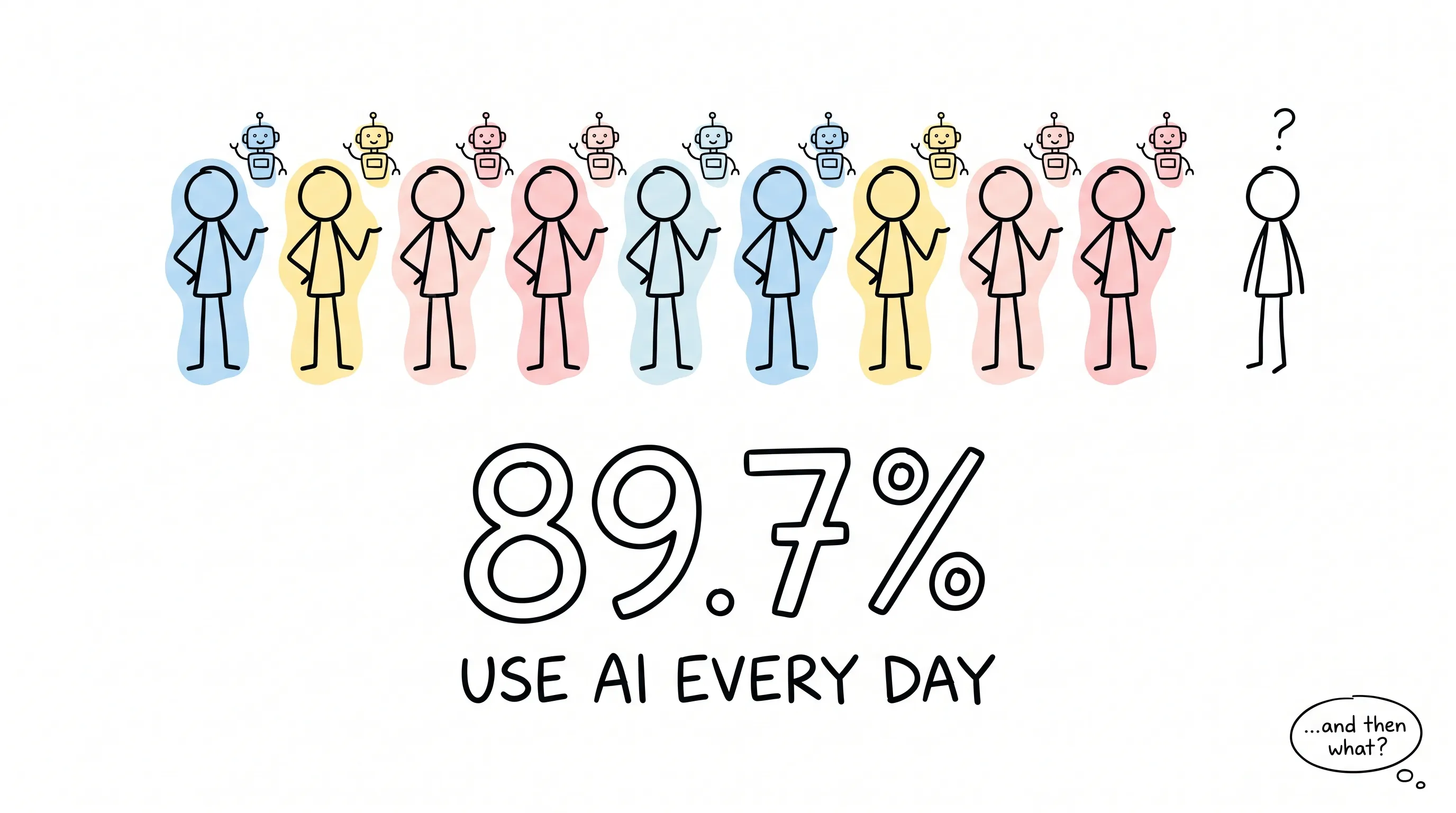
A report Sociality.io published this year says 89.7% of social media marketers use AI every day, or at least several times a week. Nine out of ten have AI within arm's reach.
SurveyMonkey's 2025 survey landed on nearly the same number: 88% of marketers admit their daily work already depends on AI. Different methodologies, same conclusion.
What does "adoption saturation" look like? This. Everyone who was going to adopt has. As for the remaining 10%, they may well not budge, no matter how hard you push.
What's more interesting is the depth. In Sprout Social's industry index this year, 71% of marketers have handed at least half of their social media work over to AI. The Digital Marketing Institute's survey points the same direction: the share who consider AI "essential to social media strategy" was only 31% in 2024 — by 2025, it had climbed to 43%.
Twelve points in a single year. In comparable tech surveys, you almost never see a jump like that.
So the picture is clear:
Whether or not you use AI, it's no longer an advantage. Nobody gets a raise for knowing how to use email.
Which raises the question: if everyone is using it, why do some get real results while others just pile up a heap of mediocre posts?
Is AI-Generated Content Actually Any Good?
What does "good" mean? Let's not argue — let's look at the data.
In HubSpot's social media trends report released this year, 72% of marketers said posts AI helped create outperform purely human ones. Madgicx tracked paid and organic traffic and found that AI content recommendations can lift engagement rates by 31%. Adobe's research reached nearly the same conclusion: an average lift of 32%.
It's even more dramatic on the ad side. In cross-platform advertising data compiled by All About AI, teams generating creatives with AI saw click-through rates 47% higher.
Impressive!
If these were the only numbers you saw, the conclusion would seem to be: hand your accounts over to AI and coast to a win.
Not so fast. Now look at another set of numbers.
In 2025, CoSchedule surveyed marketers: only 25.6% believe AI content outperforms purely human work. Meanwhile, in Content Marketing Institute's survey of tech marketers, 18% said that after adopting AI, content quality actually dropped.
Same AI — why do some soar while others crash?
Put the two sets of numbers side by side and the answer surfaces. What people are praising is really content where AI does the legwork and humans hold the quality gate. The ones truly falling flat are the teams that let AI write everything. The difference isn't the tool; it's the workflow. The winning teams all split the work three ways: which posts AI drafts and humans merely edit; which posts humans must write themselves, with AI only checking for errors; and which content AI never gets to touch — crisis communications, say, or jumping on trending topics.
The teams that crashed? One sentence: they let AI write everything.
Forbes captured an even more vivid number: 71% of images on social media pass through an AI-assisted production pipeline. Note — that doesn't mean AI paints 71% of those images from scratch. Background removal, upscaling, swapping backdrops, spinning one creative into twenty versions for testing — it all counts. AI is more like an invisible retouching apprentice standing behind every designer.
The platforms are moving even faster. A 2025 report found that 15% of the content in your Facebook feed comes from accounts you never followed — all of it pushed in by the algorithm. And by Artsmart's count, more than 80% of content recommendations across the industry are decided by AI — it's AI that determines whether you get seen at all.
So you see: the feeds consumers scroll are already AI-filtered. Whether marketers themselves use AI is, if anything, the least important link in the whole chain.
Time Saved Is the Real Budget
Now, time.
93% of marketers use AI, and the reason boils down to one word: speed. Each survey measures it a bit differently, but they all point the same way: an average of 2.5 hours saved per day. Editing a single short video? AI tools can save you 3 to 5 hours. Sprinklr's data says 83% of people saw their productivity genuinely rise after adopting AI.
What does 2.5 hours mean? Let me do the math for you.
A five-person team saving 2.5 hours per person per day frees up 12.5 hours a day, 62.5 hours a week. That's like the company picking up one and a half extra employees without spending a cent on recruiting.
And then?
BuildEZ's statistics show that companies using AI increased their monthly posting volume by an average of 42%.
Now think: you post 42% more, and so does every competitor. What does that add up to in the market?
Noise.
Where those 62.5 hours go determines whether the company laughs or cries next year. Spend them on posting more, and you've traded free money for mediocrity. Spend them on user interviews, creative testing, replying one by one in the comments — that's how time becomes an asset.
And this isn't my guess. An MIT study found that over the past year, 42% of companies abandoned most of their generative AI initiatives. In 2024, that figure was just 17%.
In one year, the abandonment rate more than doubled. AI didn't get worse. Too many teams simply mistook "having used it" for "having used it well."
On the Consumer Side, the Opposite Is Happening
While marketers are firing on all cylinders, consumers are starting to frown.
Statista's data shows consumers comfortable with brands using AI were 57% in 2023 — a year later, only 46%. Marketers' adoption is rising; consumers' comfort is falling. Two lines, one climbing, one sinking, and the gap between them keeps widening.
One more set of numbers stopped me cold the first time I saw it: in Omnibound's survey, only 4% of marketers believe AI-generated content can be trusted as-is, with no human review.
Four percent. If your own people don't trust it, why would consumers?
Machines can do the cooking. But before the dish reaches the table, someone has to have tasted it.
So what do you do? The answer hides in another set of numbers. A Magnet estimate says AI-driven personalization can lift purchase frequency by 35% and average order value by 21%. This may be the single most valuable number in the whole dataset. And a detail from Adobe: 48% of brands are already using AI for sentiment analysis, watching every flicker of emotion in the comments.
But personalization has a precondition many people miss: AI can't personalize for people it doesn't know. Your email list, your customer profiles, your on-site behavior records — all of it has to be sitting there, clean and organized, before AI has anything to work with.
Data first, intelligence second. Get the order wrong and it's all for nothing.
Where Is the Money Flowing?
Now, the money.
Grand View Research estimates the AI-in-social-media market at $2.96 billion in 2024, growing to $48.18 billion by 2033 — a compound annual growth rate of 36.4%. In Typeface's survey, 98% of marketers plan to increase their AI budgets. Virtually no one is pulling back.
What interests me most is where the money goes.
The budget AI helps teams save isn't going back into the CFO's pocket. WordStream's data shows 75% of B2B marketers are increasing budgets for creator partnerships, by an average of 61%. In SQ Magazine's figures, AI influencer marketing is already an $11.74 billion market this year.
You see, AI hasn't driven people off social media. It's just hiring them differently.
SalesGroup AI's survey says 30% of marketing roles have been redefined by AI, or eliminated outright. The ones being cut: mass image production, bulk copywriting, manual scheduling. The ones growing: strategy, community management, creator partnerships — plus a brand-new job category, AI content QA.
Real people out front, AI supplying the ammo behind the scenes.
Every Platform Has Its Own Temperament
One more thing planners often overlook: every platform has its own temperament.
Facebook and Instagram are where AI is most heavily deployed. In Sprout Social's statistics this year, platform usage among marketers: Facebook 83%, Instagram 78%. TikTok rewards AI-edited short videos. LinkedIn rewards AI-assisted long-form posts — as long as they still read like a human wrote them. X is the pickiest of all: real-time AI is fine, but blatantly synthetic content gets punished outright.
Back in 2024, Hootsuite's social media trends survey found 85% of marketers planned to use AI to write ad copy. It makes sense: ad copy is where AI delivers the highest returns. For one creative, a human writes one version; AI gives you twenty to test. Keep testing, and the winner may be a line you could never have written yourself.
Back to My Friend
Last week he sent me a message. He said he'd taken the advice: the team set one rule — every AI-drafted post must pass a pair of human eyes before it goes out. Their output stopped climbing, but engagement came back.
He asked me: is AI actually going to kill social media marketing as an industry?
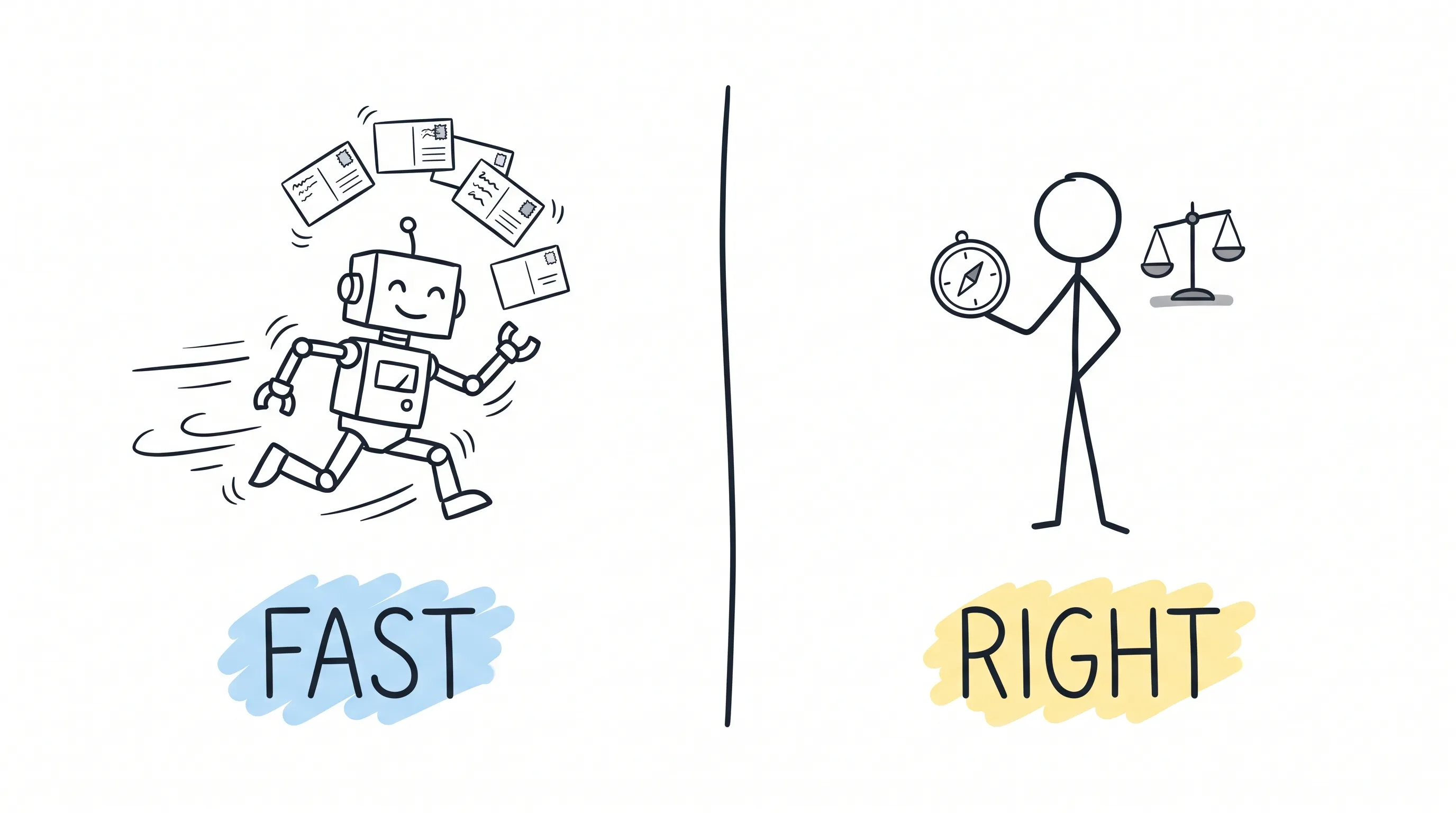
I thought for a moment and said: no. It has simply taken away the premium on being fast in this industry, and left all the returns to judgment.
AI handles fast. You handle right.
May every hour you save go to the things AI can't do.
Continue reading
Related articles
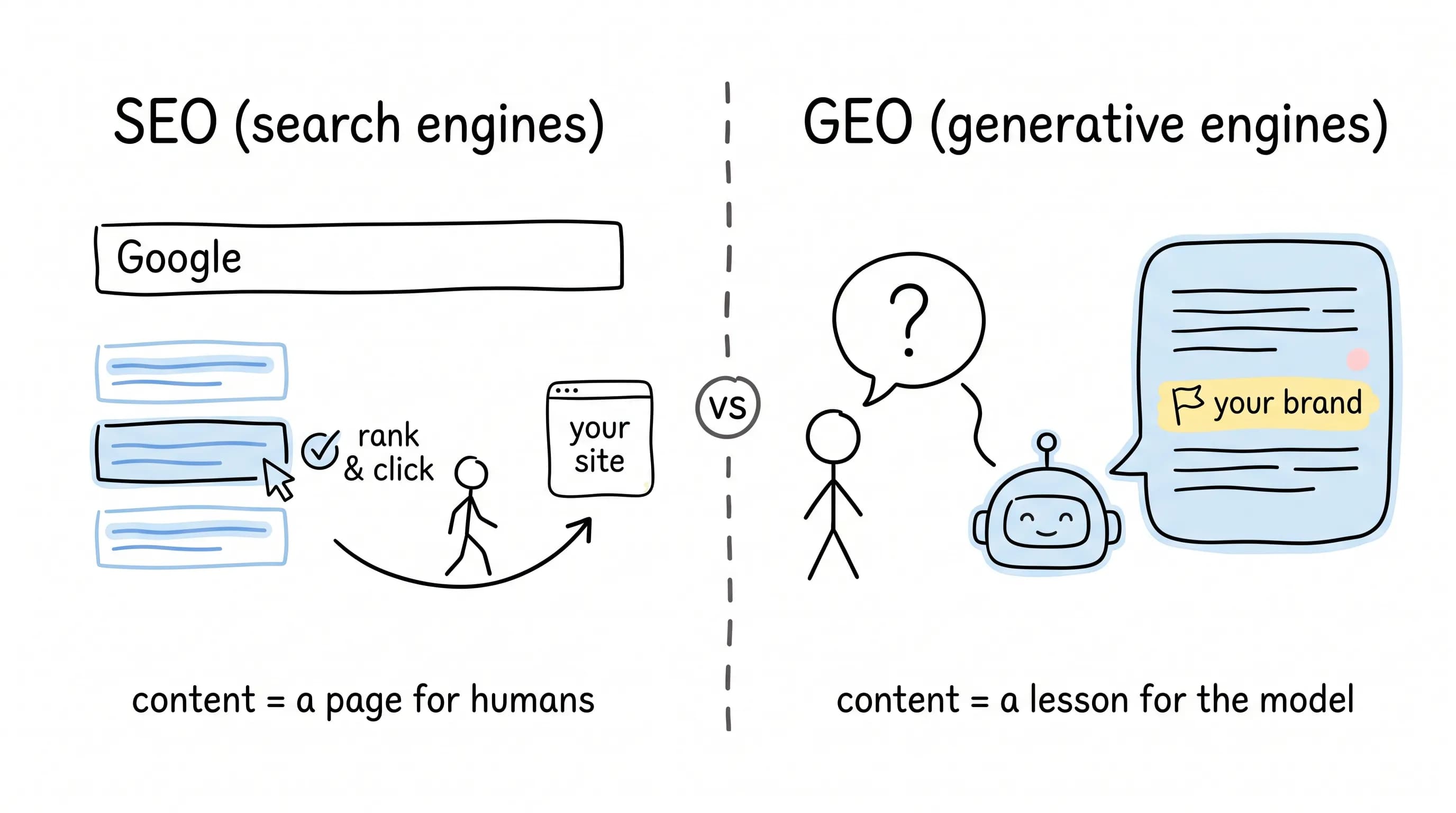
Does AI Know Your Brand? A Look at GEO, the New Craft
An explainer on GEO (Generative Engine Optimization): how AI engines like ChatGPT, Perplexity, and Gemini differ, how GEO goals and metrics diverge from SEO, and which SEO skills still carry over.
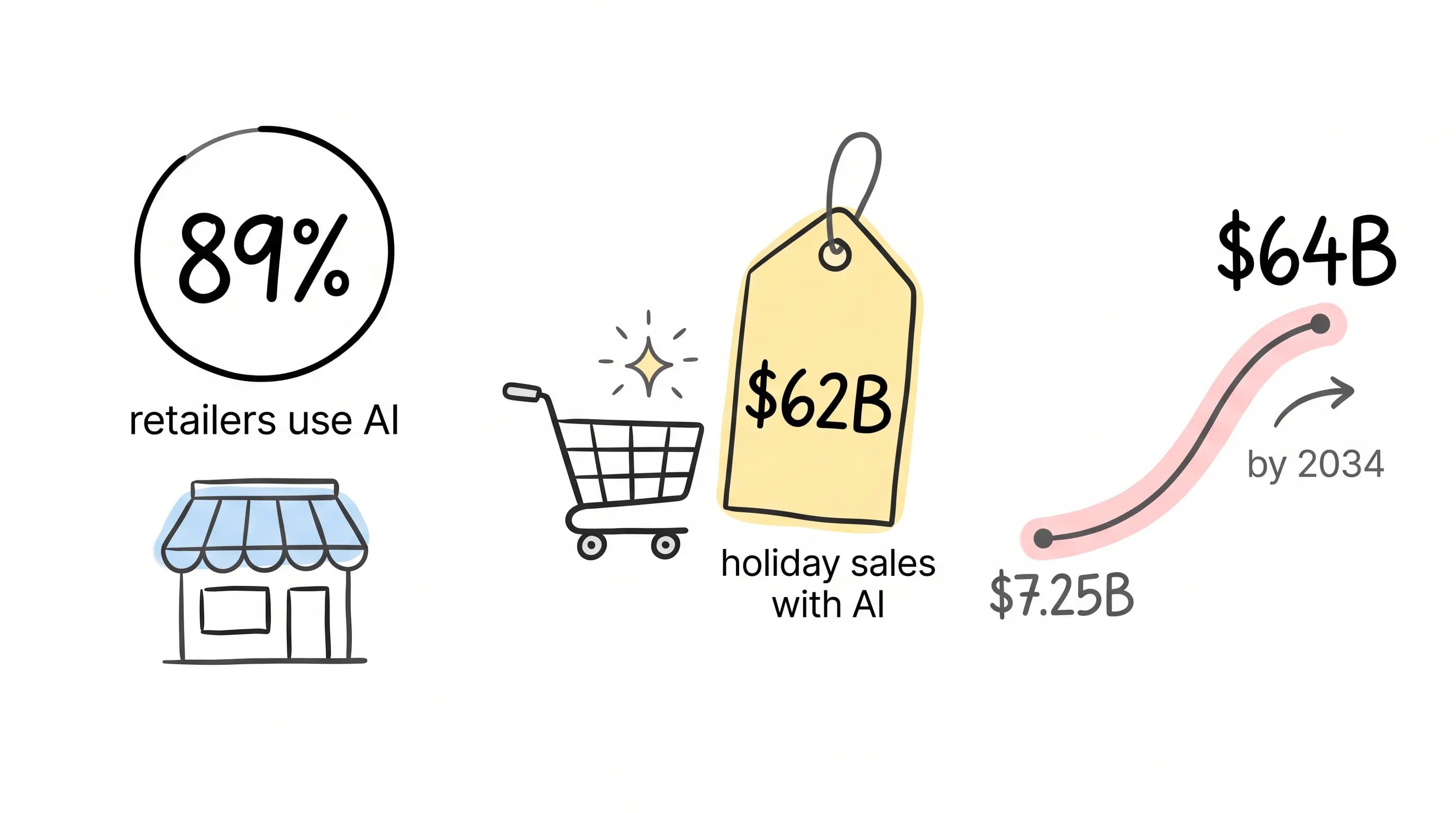
89% of Retailers Are Already Using AI. The Playbook for E-Commerce Has Changed
A learn article on AI in e-commerce: adoption context, use cases from recommendations, search, dynamic pricing, customer service, inventory, and fraud control, plus B2B applications, generative AI content, tool examples, pitfalls, and a six-step adoption path.
AI Makes Content at Lightning Speed — But Can You Answer "Who Approved This?"
This article looks at the gap between AI content speed and governance readiness in marketing teams, and outlines nine control points — prompt validation, brand guardrails, permissions, approval workflows, human review, versioning, IP checks, audit trails, and asset reuse — for brand-safe AI content.