
Meta, Google, and TikTok Ads APIs: Don't Wire Them Up One at a Time
Explains why integrating Meta, Google, and TikTok ads APIs amounts to three different jobs: differing account hierarchies, query languages, authentication, rate limits, and review hurdles. Also covers each platform's MCP server for AI agents and when to build directly versus use a unified ads API middle layer.
Last week, a friend who runs a SaaS business invited me out for tea. Before the tea had even cooled, he let out a sigh.
His team had just spent an entire quarter integrating Meta's ads API. Then a client asked: can you add Google too? They finished Google, and the client asked again: what about TikTok?
He asked me: does this work ever end?
I told him it does. But first you have to think one thing through: why integrating three ads APIs is really three completely different jobs.
What Is an Ads API?
First, a quick primer.
What is an Ads API? Simply put, it opens up the ads backend as a programmatic interface. Instead of logging into a web dashboard, your system sends requests directly — to create ads, pause ads, pull data, and generate reports.
Sounds great, right?
But anyone who has actually done this knows: the problem is never whether an interface exists. The problem is that each platform's interface looks completely different.
Three Platforms, Three Dialects
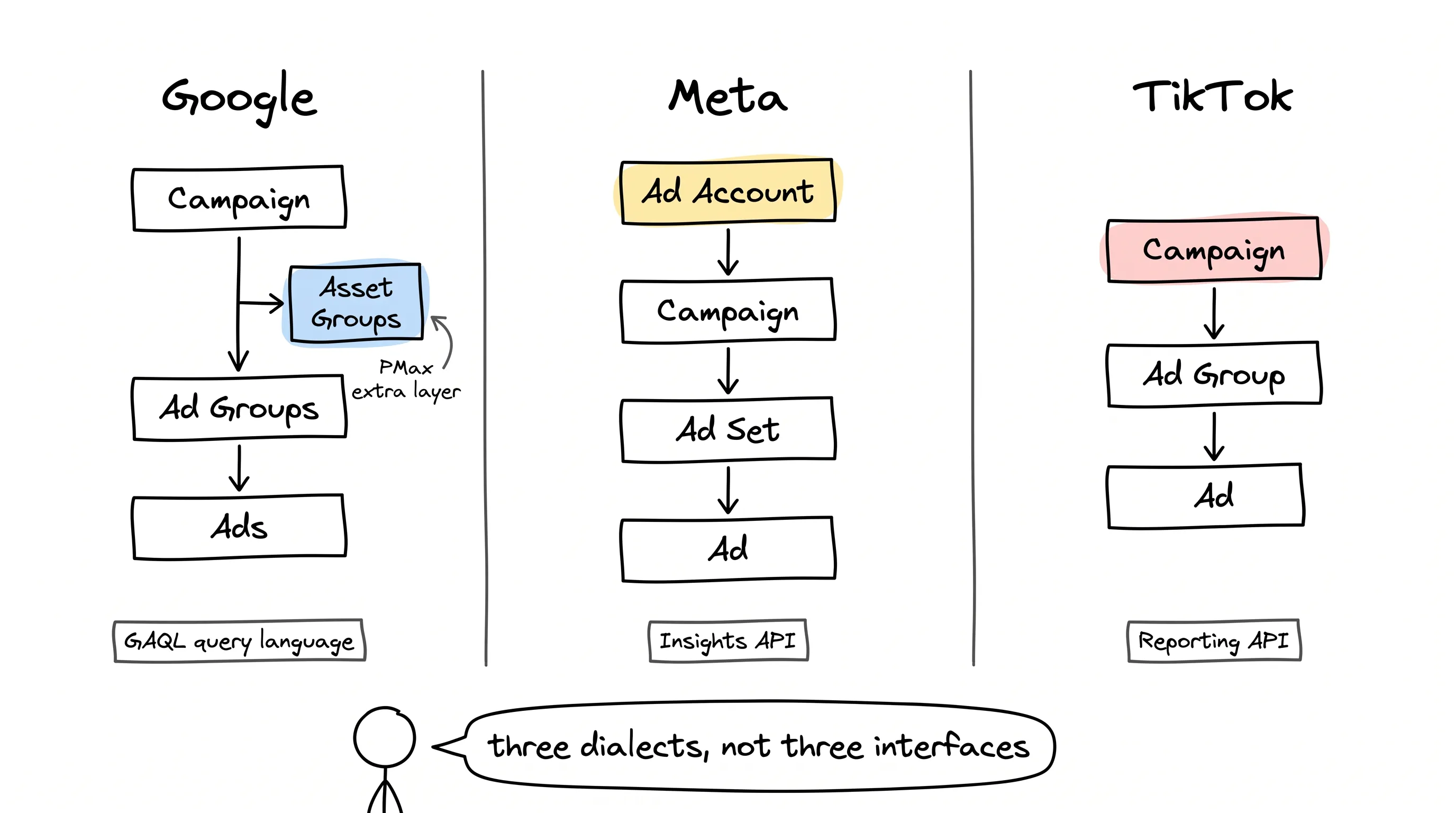
Consider this: the three platforms can't even agree on the hierarchy of an ad account.
On Google's side, a Campaign contains Ad Groups, and Ad Groups contain Ads. With Performance Max, an extra layer — Asset Groups — sits in between.
Meta? Ad Account, Campaign, Ad Set, Ad — four levels.
TikTok is the simplest: Campaign, Ad Group, Ad — three levels.
And that's just the skeleton. For data queries, Google uses its own query language, GAQL, which you have to learn specifically. Meta uses the Insights API, where you assemble requests from fields, metrics, and filters. TikTok's Reporting API has yet another set of parameters, and its reports come in many families — six report types alone, spanning everything from playable ads to e-commerce GMV.
The automation products all go by different names, too. Google calls it Performance Max, Meta calls it Advantage+, and TikTok calls it Smart+. They do roughly the same thing — hand bidding, targeting, and delivery over to the machine. But the names and the boundaries are each platform's own game.
So here's my point: these aren't three interfaces. They're three dialects.
Speaking English doesn't mean you can read a menu in Russian.
Authentication, Rate Limits, Review: One Hurdle After Another
Beyond the dialects, there are three more hurdles.
First, authentication. All three use OAuth, but Google adds a developer token, which you have to apply for and then wait to get approved. And once you're managing lots of accounts, the permission model can make your head spin.
Second, rate limits. Google sets quotas by your token's access level — so many operations per second, so many per day. Meta is the toughest: dynamic rate limits that fluctuate with your app's tier and account activity. What runs today may not run tomorrow. TikTok uses two-level limits: global plus per-endpoint.
Third, review. On Meta, ads must pass review before going live — and afterwards, changing creatives, targeting, optimization goals, or billing events can all trigger a re-review, and your ads can stop at any moment.
By the way, the API calls themselves are free on all three platforms. You only pay for ad spend.
But version updates, deprecated fields, rate-limit retries, approval workflows — all of that is your engineering team's job.
The API is free; the maintenance is not.
AI Is Starting to Manage Ads
One new development from the past couple of years deserves its own section.
All three platforms now offer MCP servers. What's an MCP server? Think of it as a door opened for AI assistants. It used to be programmers writing code to call APIs; now you just tell an AI client like Claude what you need, and it queries data and edits ads for you.
But the three platforms are moving at different speeds.
Google's MCP server is read-only, and it isn't officially hosted — you have to run it locally yourself, or deploy it to Google Cloud Run. Fine for pulling data; not for changing ads.
Meta's and TikTok's servers are both read-write. Meta's is also officially hosted — it can manage ads, manage product catalogs, run A/B tests, and pull activity logs.
The trend is clear: the ones managing ads in the future may well be AI agents.
But if you think one MCP server can span all three platforms, you're oversimplifying. Each platform's MCP still only tends its own little plot of land.
Enter the Middle Layer
Back to my friend's problem.
Three dialects, three hurdles, three MCPs — all integrated in-house? It can be done, but it's expensive. Expensive in labor, expensive in time, and expensive because whenever any platform ships a change, you have to change with it.
That's why a category of products called the unified ads API has appeared. Zernio, for example, is one such middle layer: Meta, Google, TikTok, LinkedIn, Pinterest, X, OpenAI — ads managed through a single API. Add in posting, DMs, comments, and analytics, and it covers 16 platforms in total.
It also ships with a hosted MCP server: whether you use Claude, Cursor, or another AI agent, you can plug in and query ads, edit ads, and compare data across platforms. There's also an Ad Library that lets you pull competitor ad creatives from Meta and LinkedIn, to see what others in your space are running.
I did the math. Zernio has a free tier: 2 social media accounts connected, 500 ads managed. Paid plans start at $6 a month for 3 accounts; beyond 500 ads, each extra ad costs 1 cent per month. Note that it only charges for ads that are active or under review — it takes no cut of your ad spend.
How much does it cost per year to keep an engineer on staff, integrating three APIs and tracking three version cycles? Do that math yourself.
So How Do You Choose?
My take is simple.
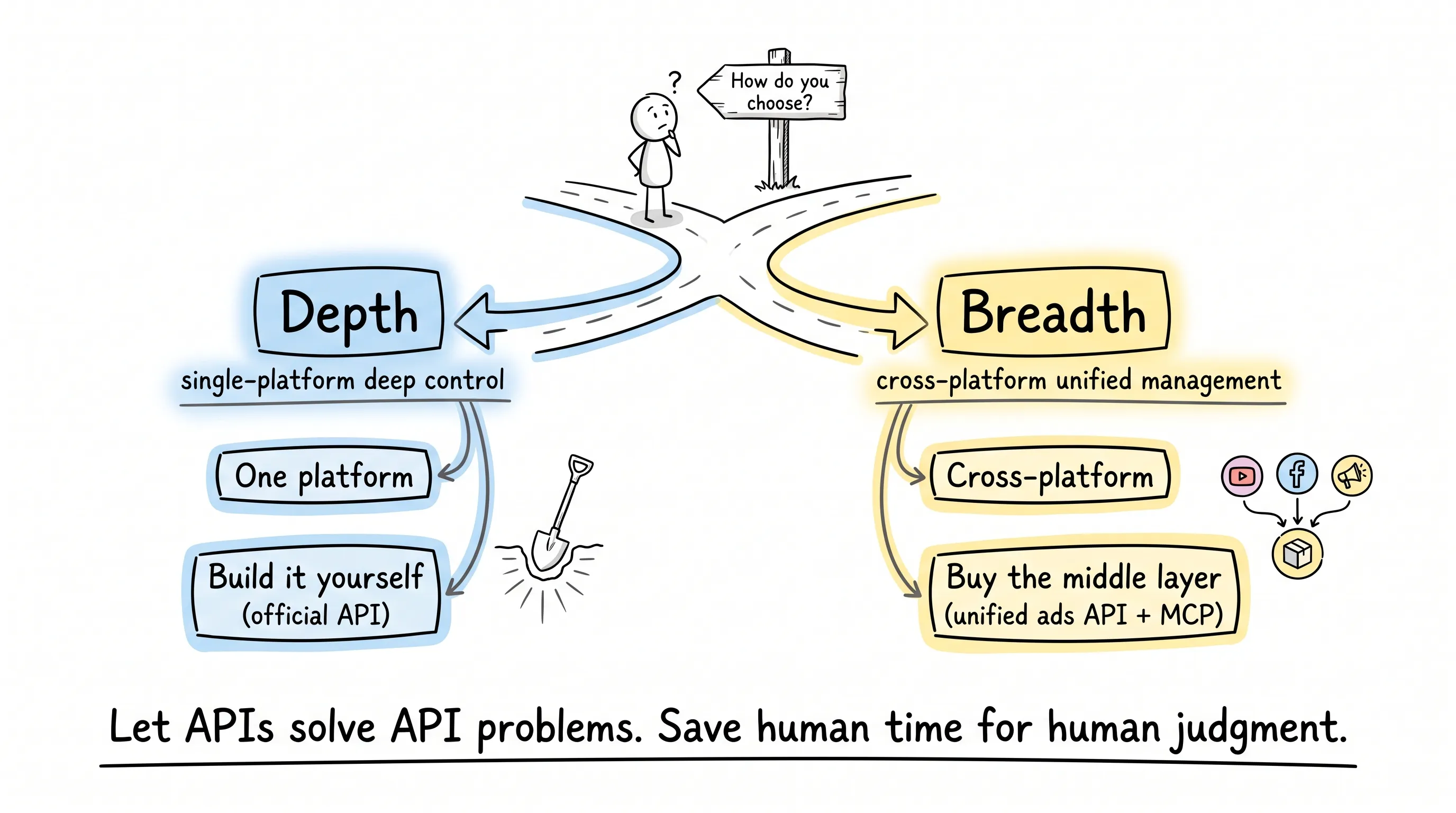
If you only do business on a single platform, and you need to fine-tune every detail of bidding, targeting, and creative — integrate the official API yourself. Go deep, and accept the integration cost.
If you're building cross-platform ad tools, a SaaS product, or unified reporting — or you don't want to keep a team that chases API versions all day — go with the middle layer.
Depth: build it yourself. Breadth: buy the middle layer.
Don't burn a quarter of engineering labor to save $6 a month. And don't wrap a middle layer around yourself when all you need is deep control.
As our tea session wrapped up that day, my friend said: got it. Next quarter, we'll cut the maintenance of three integrations down to one.
I said, exactly. Use the time you save to think about how to run the ads themselves better.
Let APIs solve API problems. Save human time for human judgment.
Continue reading
Related articles
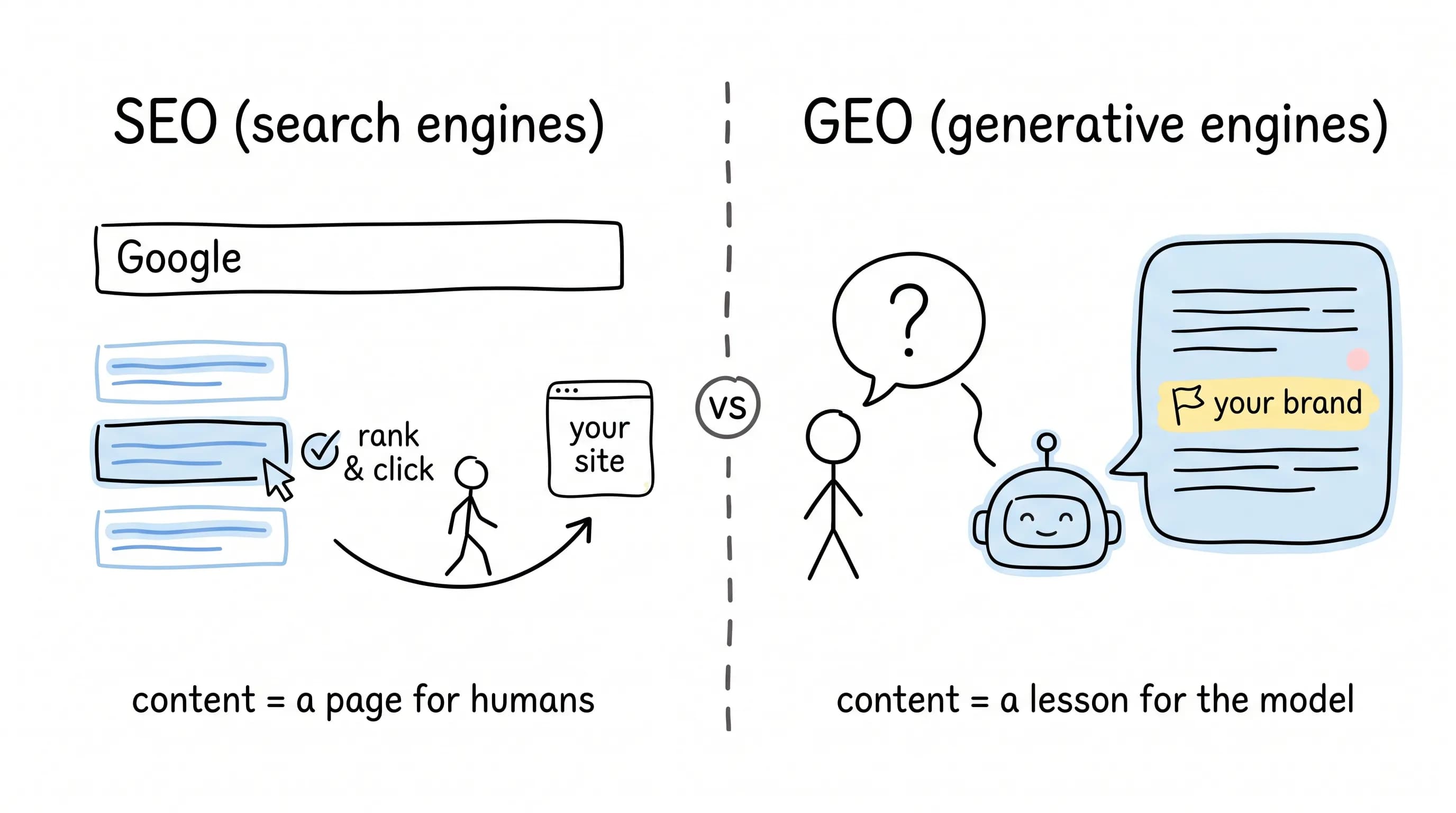
Does AI Know Your Brand? A Look at GEO, the New Craft
An explainer on GEO (Generative Engine Optimization): how AI engines like ChatGPT, Perplexity, and Gemini differ, how GEO goals and metrics diverge from SEO, and which SEO skills still carry over.
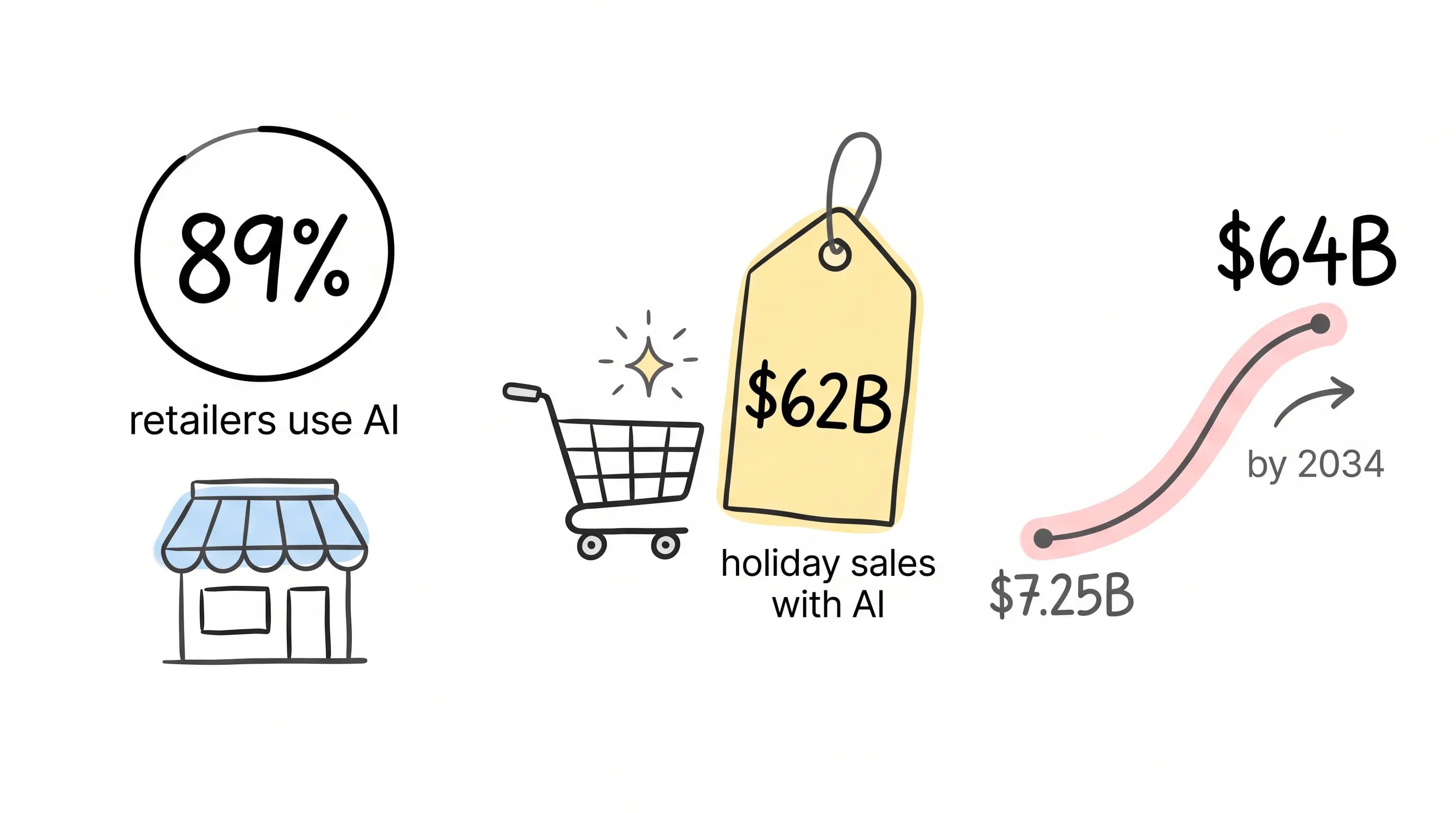
89% of Retailers Are Already Using AI. The Playbook for E-Commerce Has Changed
A learn article on AI in e-commerce: adoption context, use cases from recommendations, search, dynamic pricing, customer service, inventory, and fraud control, plus B2B applications, generative AI content, tool examples, pitfalls, and a six-step adoption path.
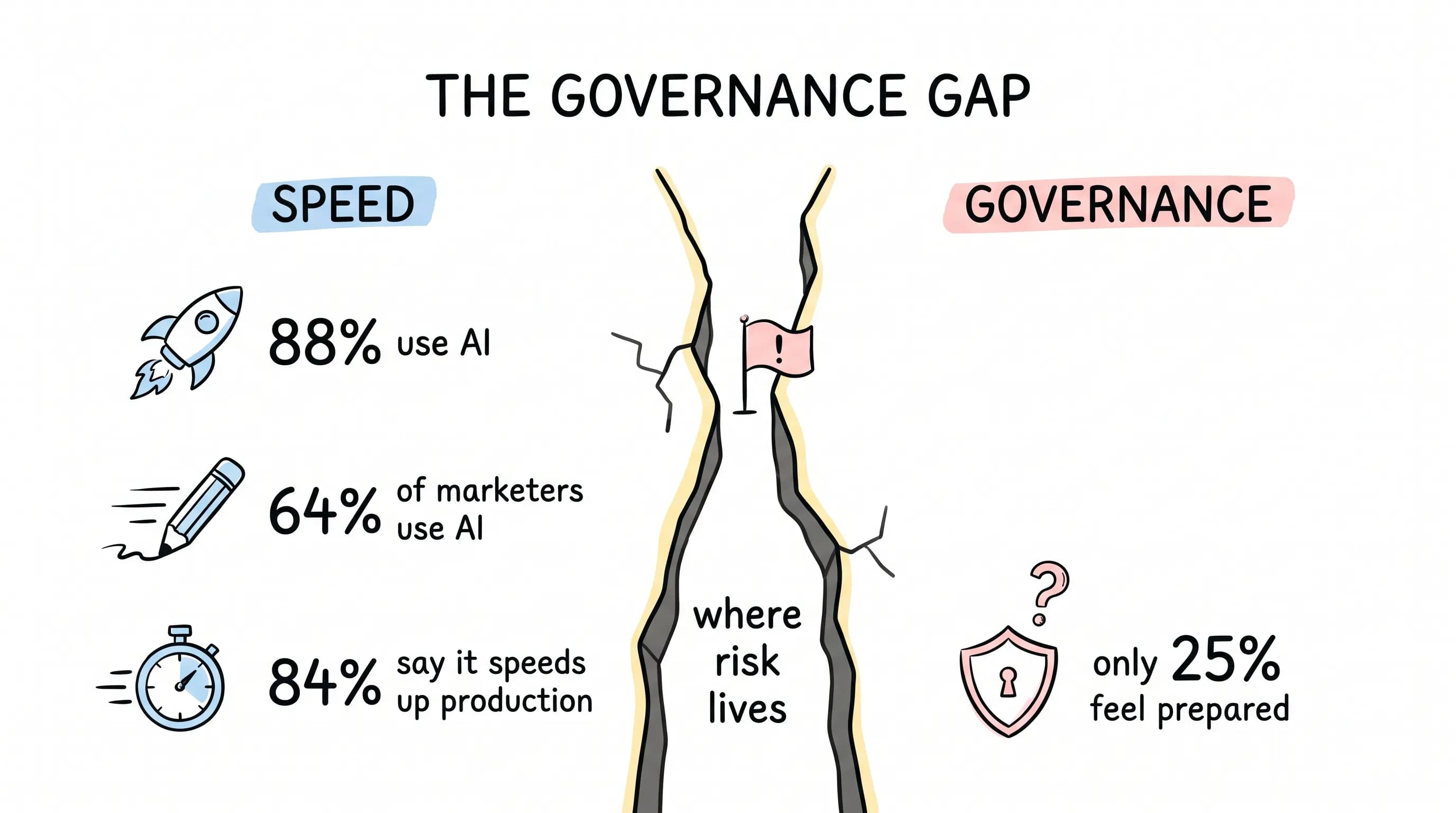
AI Makes Content at Lightning Speed — But Can You Answer "Who Approved This?"
This article looks at the gap between AI content speed and governance readiness in marketing teams, and outlines nine control points — prompt validation, brand guardrails, permissions, approval workflows, human review, versioning, IP checks, audit trails, and asset reuse — for brand-safe AI content.