
If AI Doesn't Know You, It Won't Recommend You
A learn article introducing GEO (Generative Engine Optimization): how brands can appear in AI answers, how GEO builds on SEO fundamentals, and five practices covering entity clarity, extractable content, multi-platform presence, and new metrics such as citation frequency and share of voice.
Let me tell you a true story.
There's a company called Tally that makes a form tool. The founding team never raised funding and had no money for ads. By all conventional logic, customer acquisition for a small company like that should be the hardest problem on earth.
And the result? ChatGPT became its number one acquisition channel.
Users would ask ChatGPT, "Is there a good form tool out there?" and the AI recommended Tally. Users came straight over.
No money spent. No ad campaigns. No bidding wars.
This is the single most worth-studying thing happening today: GEO, Generative Engine Optimization.
So what is GEO?
One sentence: Getting your brand to show up in AI's answers.
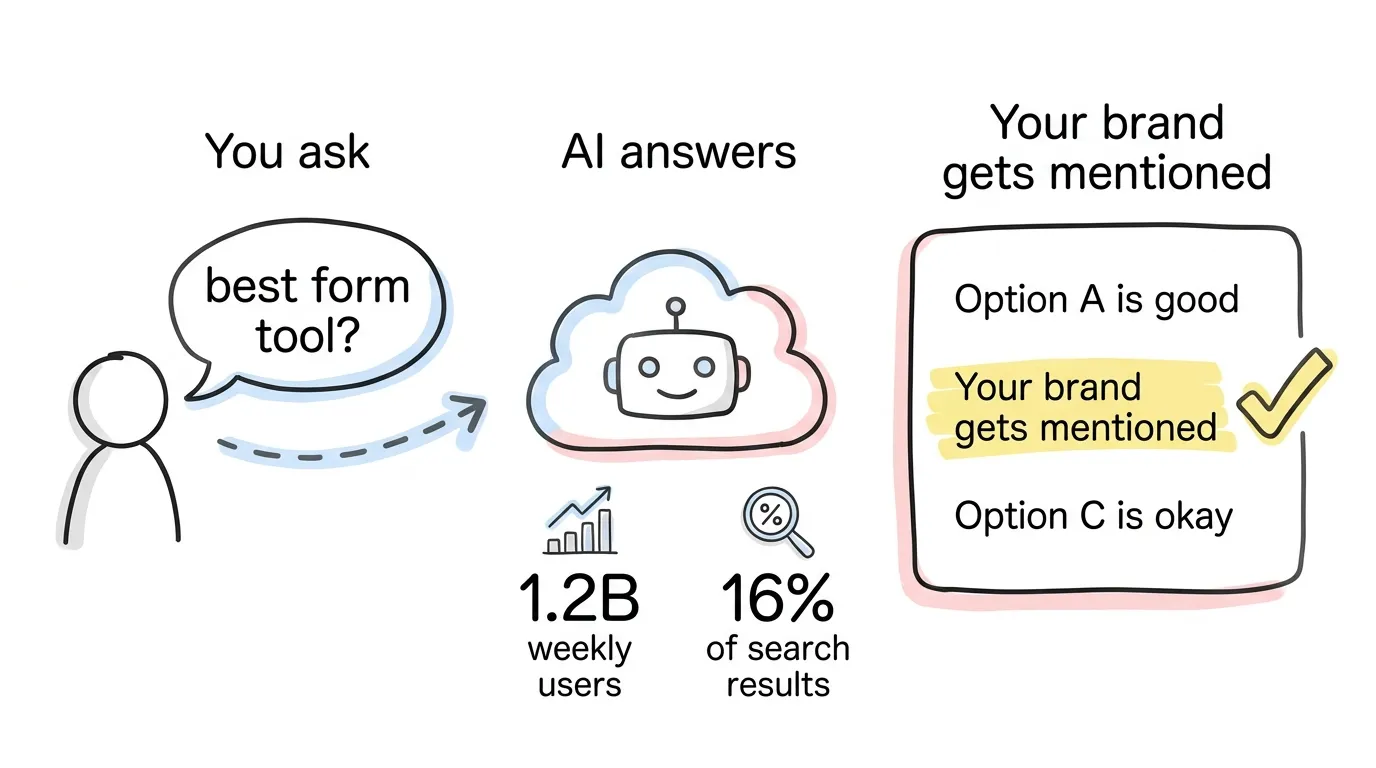
A user asks ChatGPT, Google AI, or Claude a question, and the AI produces an answer. Whether your brand gets mentioned, recommended, or cited in that answer—this is something you can deliberately build.
This isn't mysticism.
ChatGPT has more than 1.2 billion weekly users. Google's Gemini has over 1 billion monthly active users. Google's AI Overviews now appear in at least 16% of search results—and the more comparison-driven and intent-driven the question, the higher the rate.
Think about it. In the past, when users looked for a product, they searched keywords and clicked links. Now? They just ask the AI directly: "What's the best whey protein powder for a mom in her 50s?" The AI lists brands, ingredients, and reviews, and hands over an answer.
If your brand isn't in that answer, then as far as the user is concerned, you don't exist.
In the past, marketing competed for search rankings. Now, it competes for a seat in the answer.
To win that seat, you have to work on four fronts at once: content strategy (publishing content AI can discover and extract), brand presence (not just your own website), technical optimization (making sure AI crawlers can access you), and reputation building (earning credible mentions).
First, a Cold Splash of Water: Is This Even Reliable?
You might ask: AI gives a different answer every time—mentions you today, skips you tomorrow. How can you invest in that?
Fair question.
Semrush used its AI Visibility Index to track 2,500 prompts across Google AI Mode and ChatGPT. What it found: every month, 40% to 60% of the cited sources change.
Yikes. Isn't that way too unstable?
Hold on. What changes is the surface. What doesn't change is the foundation.
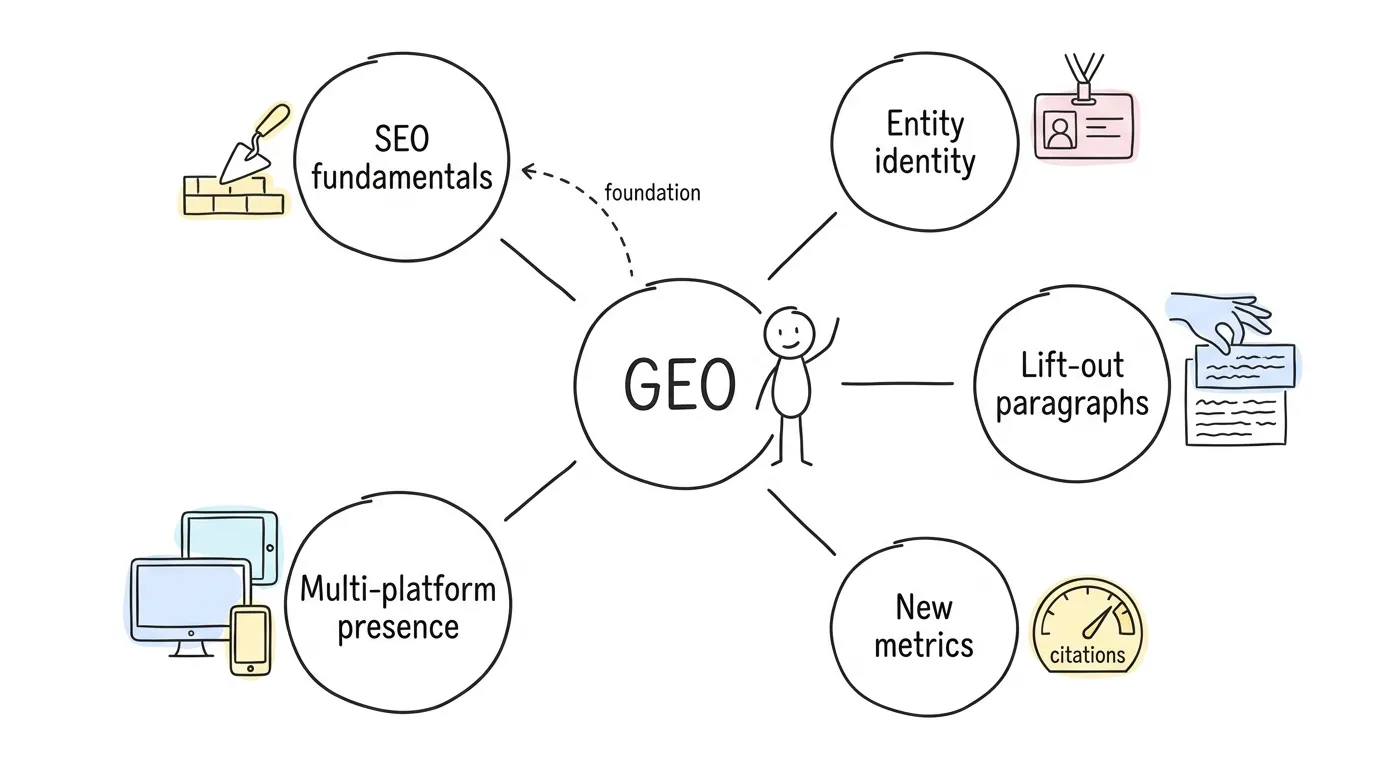
The brands that stay consistently cited by AI over the long run share three traits: clear entity identity (AI knows who you are), extractable content (AI can lift ready-made passages from you), and multi-platform presence (AI can run into you everywhere).
The volatility is the waves. Those three traits are the seabed. Waves move; the seabed doesn't.
GEO and SEO: What's the Actual Relationship?
One sentence: GEO doesn't overturn SEO—it stands on top of it.
Your old SEO fundamentals—good content, a crawlable site, trust signals, understanding user intent—none of that can be dropped. What AI cites is precisely the authoritative, well-structured, easy-to-understand content. And that has always been SEO's job.
What changes comes down to three things.
First, where you exist. Before, you only managed your own website. Now, discussions on Reddit, demos on YouTube, coverage in industry media, reviews on review sites—all of it is raw material for AI.
Second, how you organize content. Before, the goal was comprehensive coverage. Now, the goal is paragraphs that can be "lifted out."
Third, what you measure. Before, rankings, clicks, traffic. Now, citations, mentions, share of voice.
Five Principles to Put GEO into Practice
Principle One: SEO Fundamentals Are the Foundation
For AI to cite you, it first has to access your content, understand your content, and verify that the content is yours.
Each of those three steps rests on old-school SEO.
Technical accessibility goes without saying. If your content can't be crawled or rendered, AI stumbles at the retrieval layer. One special warning: many AI crawlers still, to this day, handle pages heavily dependent on JavaScript poorly. If your core information is assembled with JS, AI may genuinely fail to read it.
Then there's E-E-A-T—Experience, Expertise, Authoritativeness, Trust. Content backed by real experience and verifiable authors is easier for AI to trust, and when AI does cite it, it frames you more favorably.
Principle Two: Make AI Know "Who You Are"
AI doesn't just read words—it is classifying the world.
Here's a brilliant example: monday.com. When AI crawls web pages, the word "monday" is everywhere—Monday the day of the week is also "monday." How does AI know monday.com is project management software and not a day of the week?
It relies on this: on the website, on LinkedIn, on Crunchbase, on review platforms—everywhere, the description is identical. Same category, same positioning, same value proposition. When signals agree, AI has confidence. When signals conflict, AI pulls back and stops mentioning you.
Same goes for a dog food brand. You have to make AI place you firmly in "pet nutrition," not "groceries" or "pet supplies." When a user asks "What's the best grain-free dog food?" AI will only mention brands it has classified cleanly.
On the product page itself: name, description, price, attributes, availability, variants—every element must be crystal clear. Then use Schema in JSON-LD format to mirror that structure for machines, and keep the product data in Google Merchant Center consistent with the page.
Remember one thing: Your page, your Schema, and your product data must all be describing the same thing.
The goal isn't "add a Schema." The goal is to make your information logically structured, so machines can read you no matter which system they're operating in.
Principle Three: Make AI Able to "Lift Out" Your Paragraphs
This is the biggest technical point where GEO differs from traditional SEO.
How does AI actually use your content? It slices web pages into "chunks," converts the chunks into vectors, and when answering a question, retrieves the most relevant chunks and assembles them into an answer.
Note: when assembling the answer, it often leaves your context behind. It takes just one passage.
So paragraphs containing definitions, explanations, comparisons, and key data must be able to "stand alone"—read on their own, they should still be complete and coherent.
What does "can't stand alone" look like? Say you're writing about eggplant: "This method has many benefits, and everyone who's tried it thinks eggplant tastes better, so many chefs do it this way."—AI extracts that, and it's nothing.
What does "standing alone" look like? "Salting eggplant for 15 minutes before cooking removes bitterness and excess moisture, improving the texture."—Method, time, benefit, all in one sentence. AI lifts it out and can use it immediately.
Add four more rules: each paragraph makes one complete point; use concrete numbers, not vague words like "many" or "significantly"; headings should state what the section is about; put the key point at the beginning, not the end.
One important distinction here: this principle applies mainly to "retrieval-augmented" systems—Google AI Mode, Perplexity's grounding, ChatGPT with browsing enabled. These fetch content from the web in real time. Knowledge in a model's "training data," on the other hand, comes from long-term, sustained authoritative publishing—structure matters less there. You need to walk on both legs.
Principle Four: AI Looks at More Than Your Website
When AI assembles answers, YouTube, Reddit, review sites, industry media, and social media are all among its sources.
In October 2025, Reddit, LinkedIn, and YouTube ranked among the most-cited sources across major LLMs. That's remarkable.
So your territory comes in two kinds.
Owned presence: your YouTube channel, your company's participation in relevant subreddits, executives' LinkedIn newsletters, podcasts, public courses. These are the "raw ingredients" you feed AI.
Earned mentions: genuine reviews on G2, Capterra, and Trustpilot, coverage by industry journalists, users spontaneously recommending you on Reddit and Quora. You don't control these—but precisely because you don't control them, they carry more credibility.
Use both together. Owned content proves you know your field; earned mentions prove you're trustworthy. AI looks at both and forms its complete judgment of you.
Principle Five: Swap in a New Measuring Stick
Traditional SEO's strength was clean attribution: the user clicked, arrived, bought—or didn't. The whole chain was visible.
AI has cut that chain.
The user asked an AI, the AI recommended you, and the user clicked nothing. A week later, on their own, they searched your brand name on Google and signed up. In your GA4, that conversion is "direct traffic." But what actually closed the deal was that one AI recommendation.
Your value isn't the click. It's becoming the answer itself.
So how do you measure it? Four metrics:
- Citation frequency: how often AI mentions you when answering relevant questions.
- Share of voice: AI answers "best CRM" 100 times—how many times do you appear, and how many times do competitors?
- Context tracking: which questions trigger mentions of you? Which topics leave you completely invisible?
- Sentiment: when AI mentions you, is it good or bad? High volume is worthless if AI says you're "too expensive" or "buggy"—that's a negative asset.
The trouble is, GA4 and Google Search Console can't see any of this. They only see what happens after the click. You could be the most-mentioned brand in ChatGPT while your backend dashboard stays dead quiet.
This is the "measurement blind spot." Tools like Semrush's AI Visibility Toolkit exist to fill exactly this gap: in brand performance reports, you can see your visibility in AI answers, comparisons against competitors, and whether mentions are positive or negative.
Going forward, a complete search strategy means watching two dashboards: one tracking your website's rankings and traffic, one tracking your brand's mentions across AI. Missing either one, you're seeing half the world.
Finally, Some Straight Talk
GEO raises the probability of being mentioned by AI. It is not a guarantee.
AI citations fluctuate by nature, platforms weight sources differently, and user context affects what gets cited. When a model updates, today's playbook may change tomorrow.
So don't treat GEO as "grabbing a ranking." Treat it as "building a brand": you're steadily raising your win rate across countless moments where you might be seen. There's no "number one" to grab—there's only "continuous presence" to accumulate.
Some say the biggest misconception is "AI answers are too unpredictable to optimize." It's exactly the opposite: the answers are unpredictable, but the underlying signals—authority, clarity, trust—are not. Brands with clear entity identity and credible sources get mentioned, again and again.
One more thing: big brands have the head start, but they don't have a monopoly. A small website that goes deep on one niche topic, keeps its structure clean, and shows up across platforms earns AI's trust just the same. Expertise is your leverage.
So how do you position yourself in the big game of AI search? Three layers:
AI search is the environment. SEO + GEO is the playbook. Brand visibility is the outcome.
Don't obsess over winning over any single model. What you want is this: wherever people ask, AI can find you, read you, and trust you.
In this era, the definition of "presence" has changed. It used to be that users could search and find you. Now, it's that AI is willing to speak on your behalf.
And for AI to speak on your behalf, you first have to say things clearly, do the work solidly, and make sure it can recognize you everywhere.
Here's to your name showing up in every one of AI's answers.
Continue reading
Related articles

It's 2026: Stop "Buying" AI Tools for Your Marketing Team — Start "Hiring" AI Agents
This learn article explains how AI agents differ from standalone AI tools in marketing, outlines three agent categories — build-your-own platforms, CRM-native agents, and vertical tools — and covers use cases across SEO, social media, advertising, and reporting, plus criteria for choosing one.

What Is GEO? How Your Brand Gets "Mentioned" in the Age of AI Search
An explainer on GEO (Generative Engine Optimization) for e-commerce and DTC brands: how it differs from SEO and AEO, why AI answers shape brand visibility, and eight practices covering question-focused content, consistent brand messaging, structured pages, external evidence, comparisons, and AI mention tracking.

AI Is Already Making Decisions for Your Customers. Are You on the List?
A learn article explains GEO (Generative Engine Optimization): why AI-generated answers now shape which brands customers see, and how SEO fundamentals, entity clarity, citable evidence, and monthly measurement affect visibility in AI answers.