
How to Choose an AI Marketing Platform? Start With Three Questions
A learn article that sorts mainstream AI marketing platforms into three types—specialists like Plai and Madgicx, connectors like Lindy and Gumloop, and agents like Hyper—and offers three self-check questions on budget scale, missing capabilities, and marketing scope before choosing a tool.
A few days ago, an old friend of mine in cross-border e-commerce invited me out for tea. He sat down and opened with: "Bro, which AI tool should I be getting on right now?"
I told him to slow down. "First, list every tool you're using right now, one by one."
He listed them. One stack for ads, one for making images, one for SEO, one for reports, plus an entire separate setup for compliance. Five platforms, a dozen-plus accounts.
I said, that's not what having a lot of tools looks like. That's a company being shredded into fragments by its own tools.
He froze for a second, then shot back: so what do I do?
I've been asked this question a lot lately. So today I'm walking through the mainstream AI marketing platforms out there and making one thing clear: the right choice depends on how far you want AI to go for you.
The Players in This Market Really Only Have Three Ways to Play It
What counts as an AI marketing platform?
Simply put: software that uses AI to do marketing for you. But "doing" can mean very different depths of doing.
After surveying the landscape, I found that every player basically lives one of three lives: the specialist, the connector, or the agent.
One at a time.
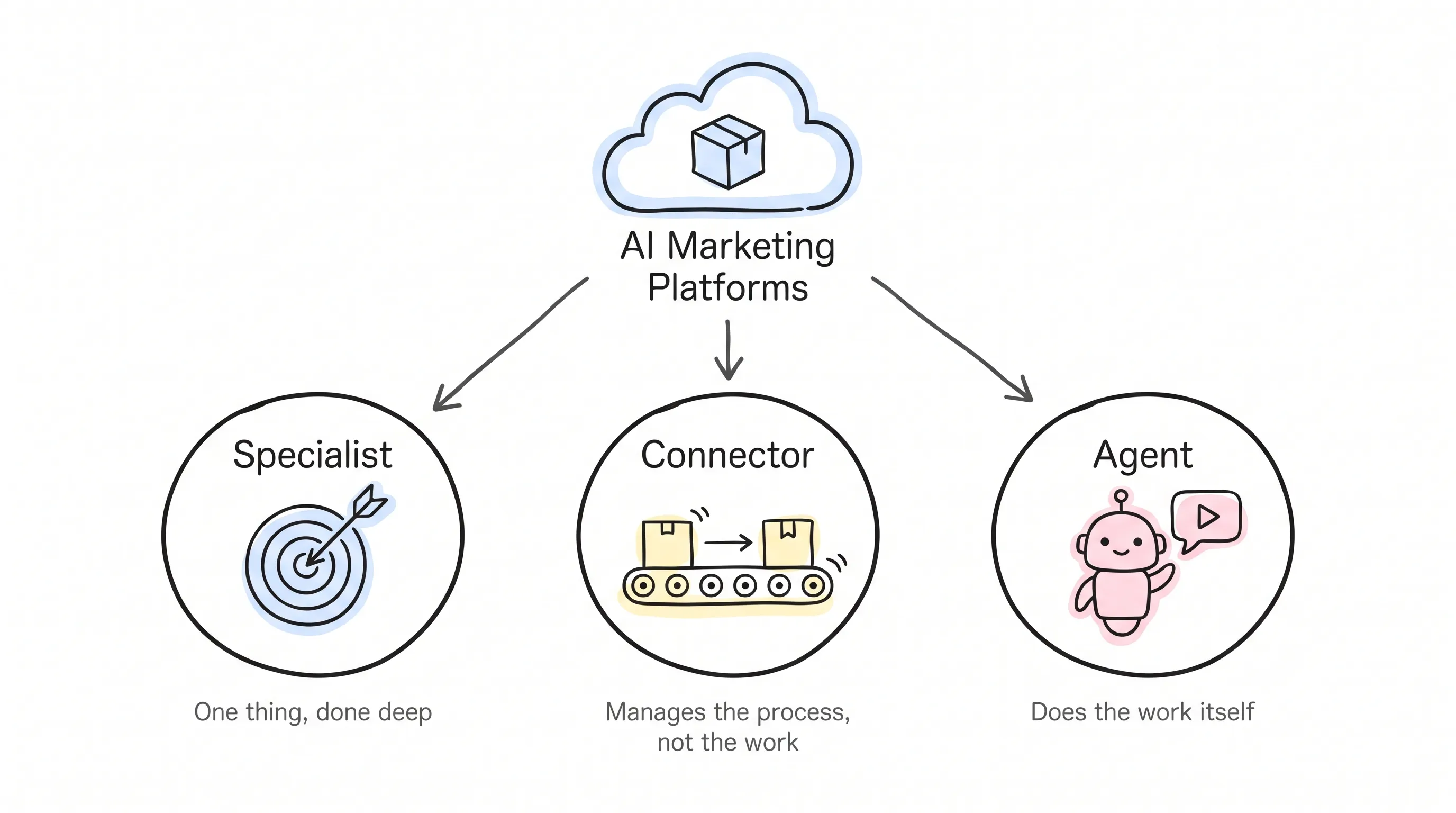
Type One: The Specialist. Does One Thing Only — and Goes Hard at It
Start with Plai.
What this one does is beautifully simple: from a single dashboard, you can run ads across Meta, Google, TikTok, and LinkedIn at the same time — it even covers Spotify. The AI generates your ads, builds your audiences, writes your social posts, then optimizes across platforms automatically.
The results? More than 100,000 campaigns have already run through it. Some users report ad costs down by 90 percent, with click-through rates more than doubling.
Impressive!
Who is it for? Local businesses, marketing agencies, chain brands. In one sentence: understaffed, multi-location, and wants zero hassle.
Now look at Madgicx.
This one is even more extreme: it only does Meta, focusing exclusively on Facebook and Instagram ad optimization, touching nothing else. You can call it narrow, but it took narrow and made it deep: the AI analyzes which elements of which creatives perform, finds high-value audiences, then automatically moves money to the winning side. E-commerce brands' ROAS (return on ad spend) generally lifts 20 to 40 percent.
There's exactly one precondition: you spend at least $10,000 a month on Meta. Below that, don't bother looking.
See, the specialist's logic is simple: fewer dishes on the menu, so it goes deep on every one.
There's also AdsGency, which takes the audience route. It doesn't start by managing your ad buying — it starts by profiling your customers "down to the molecule": 360-degree profiles, with behavior, interests, and demographics all split apart. You're not targeting "people interested in fitness"; you're targeting a specific pattern of behaviors and engagement signals. More than 150 companies run on it, over $50 million in ad spend has passed through it, and some customers report conversion rates up more than threefold.
Data-driven teams should take a hard look at this one.
Finally there's Markifact, which thinks differently: it doesn't make judgments for you — it hands you ready-made marketing process frameworks to follow step by step. Good for teams that haven't built a marketing system yet: copy the playbook first, innovate later.
Type Two: The Connector. Manages the Process, Doesn't Do the Work
Now the other kind: Lindy and Gumloop.
What is workflow automation?
Here's an analogy. Say your warehouse is full of goods — that's your various tools. Lindy is the conveyor belt that moves them. You tell it in plain language: "The moment ad spend goes over budget, pull the Meta data and ping me in Slack." And it installs that conveyor belt for you.
And it connects a lot — more than 3,000 tools plug in.
Gumloop takes another road: visual. Over 120 nodes you drag and drop, assembling workflows like Lego, then inserting AI nodes to process data. 80-plus integrations, and any department can put them to use.
But.
Notice anything? There's one thing neither of them ever does: they don't do the marketing for you.
No campaigns built, no creatives produced, no SEO data touched. They are excellent movers of goods, managing only the gaps between your marketing actions. The work is still yours.
That's not a flaw — it's a positioning. If your pain point is connecting the process, they're enough.
Type Three: The Agent. Actually Does the Work
Alright, the third kind — the one I most want to untangle for you.
The poster child here is Hyper. What is it? An AI agent plus workflow automation platform.
Where's the essential difference from the first two?
You say one sentence in a chat box, and it goes to work.
Want to run a campaign? Connect your ad account, describe what you want in the chat box, and it goes straight into the backends of Meta, Google Ads, and TikTok, builds the campaign, generates the creatives with top-tier AI models, and puts it live. You never once opened Ads Manager.
From idea to launch, the official number is under five minutes.
Want an automation workflow, or a custom agent built just for you? Say it in the chat box, and it builds it on the spot. To me this is the most interesting part: the distance between idea and execution has been compressed into a single sentence.
What about depth in marketing itself? There's depth too.
On the content side, it has a built-in data system that handles SEO, handles content, and handles one thing many teams haven't taken seriously yet: your brand's presence in AI search. The way people look things up has changed — they ask ChatGPT, Claude, Perplexity directly. What your brand looks like to these AIs, and whether it gets mentioned — it watches that for you.
On the data side, it gets even more ruthless. Its agents have their own virtual machines and sandboxes, can write code, and can run SQL directly against your data warehouse. Campaign performance breakdowns, creative fatigue modeling, trend forecasts — all computed for you. It's like having an on-call data team, except this one doesn't draw a salary.
Oh, and the agents have memory and a knowledge base. They remember your business context — they don't treat you like a stranger every time.
Is it marketing-only? No. Operations, customer service, client work — the same platform takes those on too. Which happens to cure my friend's biggest pain: tools are no longer fragments, but one system.
How to Choose? Look at Which Layer You're Stuck On
Back to that cup of tea.
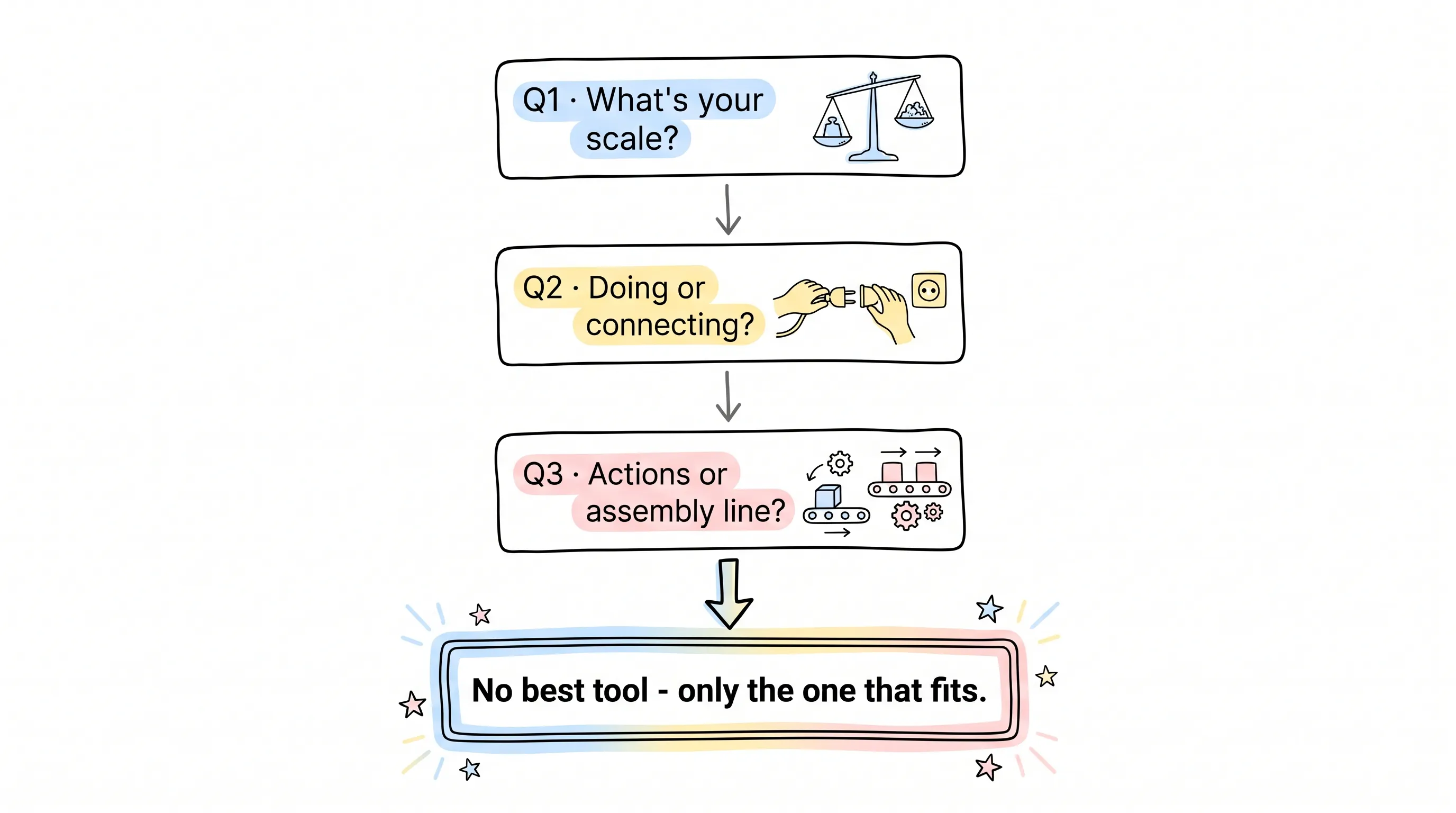
I ran the numbers for him. You should too — before spending, ask yourself three questions.
Question one: what's your scale?
A few thousand yuan a month in ad spend, and you want one dashboard covering Meta and Google? A specialist like Plai — cheap, easy, good enough.
E-commerce, only on Facebook and Instagram? Madgicx, no hesitation. But remember its monthly spend threshold.
Question two: do you lack the "doing" or the "connecting"?
You have your own media team and content team, you can lift everything yourself — it's just that data and process are scattered across ten systems? Then what you need is a connector. Lindy and Gumloop stringing your tools together is their greatest value.
Conversely, if you're short-handed and wish AI would just do all the work? Then what you want is an agent.
Question three: is marketing, to you, a few actions or an assembly line?
Ads only — that's actions. From media buying, creative, SEO, and AI search all the way to analytics and reporting — that's a whole chain. The longer your front line, the more an all-in-one platform pays off; keep the line short, and specialists stay sharper.
Take Hyper as an example: if you advertise across several platforms and want AI to produce creatives, watch your brand exposure in AI search, run deep analysis, generate reports automatically, even handle operations beyond marketing — then one platform covering it all gives you a solid case for choosing it. But if you only run ads on one or two platforms, dedicated tools may be handier, and cheaper.
There's no best tool — only the one that fits.
Finally, Back to That Cup of Tea
That day, once the math was done, my friend asked: by your logic, should I swap out half my tools?
I said, it's not a question of swapping.
Specialists solve single points. Connectors solve process. Agents solve the work itself. First get clear on which layer is holding you up today — then act.
He nodded, pulled out his phone, and canceled the monthly subscriptions of three platforms on the spot.
May every dollar of your budget land where it cuts deepest.
Continue reading
Related articles

What Is GEO? How Your Brand Gets "Mentioned" in the Age of AI Search
An explainer on GEO (Generative Engine Optimization) for e-commerce and DTC brands: how it differs from SEO and AEO, why AI answers shape brand visibility, and eight practices covering question-focused content, consistent brand messaging, structured pages, external evidence, comparisons, and AI mention tracking.

AI Is Already Making Decisions for Your Customers. Are You on the List?
A learn article explains GEO (Generative Engine Optimization): why AI-generated answers now shape which brands customers see, and how SEO fundamentals, entity clarity, citable evidence, and monthly measurement affect visibility in AI answers.

Google Is Stuffing Ads Into AI Search: These Recent Stories Are Really One Story
A news roundup linking recent AI marketing stories—Google adding ads to AI Mode, Amazon's Ads Agent, ChatGPT image updates, a UK startup tracking brand mentions in AI answers, and an AI ransomware warning—arguing that control over ad data and visibility is shifting toward platforms.