
How Search's Traffic Logic Is Being Rewritten
An analysis of how AI Overviews are rewriting search traffic logic: rankings persist while clicks decline, foundational SEO still matters, and brand mentions, answer-style content, and AI-assisted writing with human judgment shape whether AI cites your pages.
A few days ago, I caught up with an old colleague over tea. He spent more than a decade doing SEO, building several websites from zero to millions of visits. I asked him: is it still going well?
He gave a bitter smile: back in the day, you'd write an article, rank on page one, and get a few hundred clicks a day, steady as clockwork. Now? The rankings are still there — the clicks are gone.
I said, I know why.
Because the search box itself has been swapped out.
What Are AI Overviews?
What are AI Overviews, exactly?
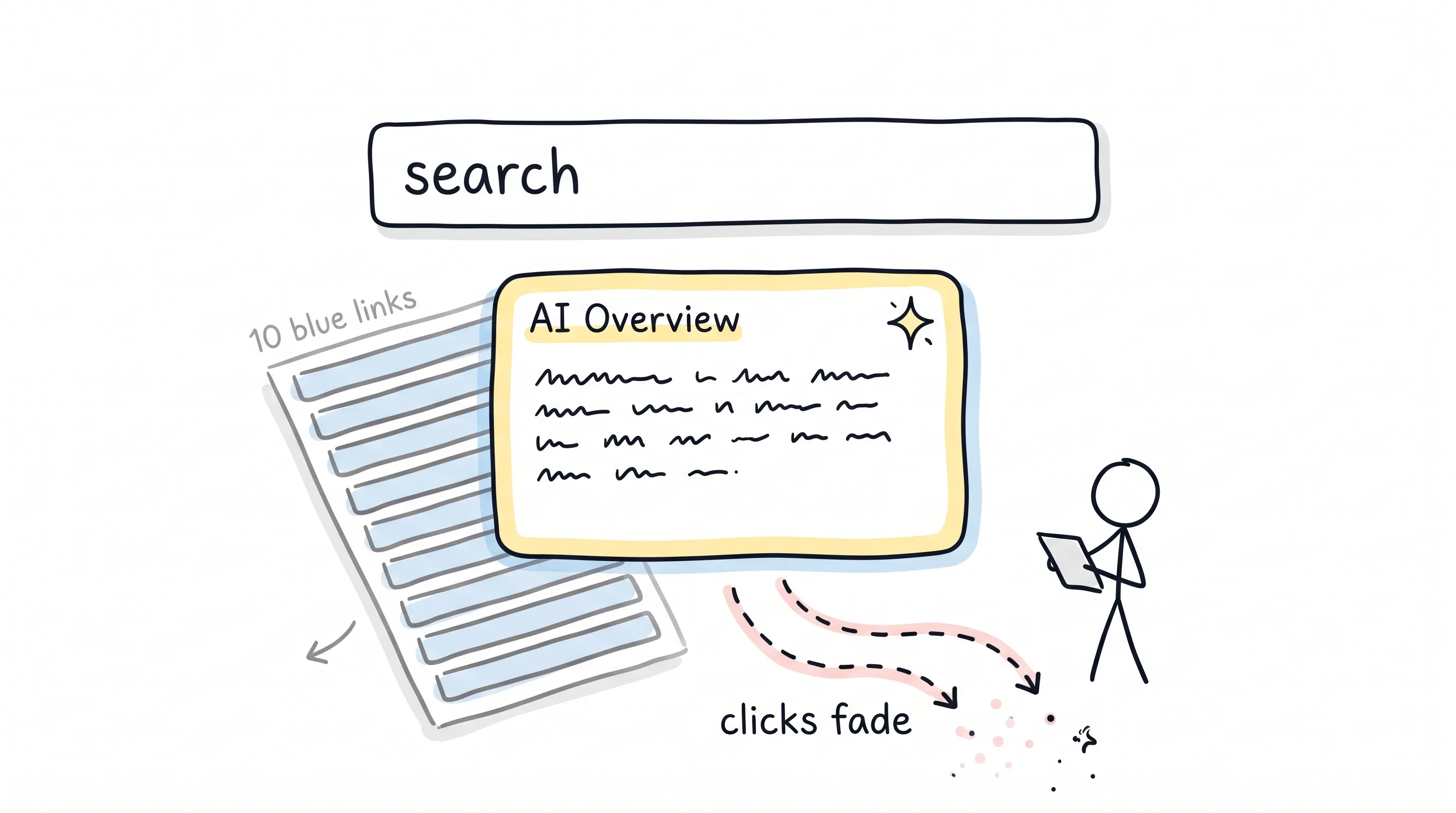
Put simply: Google reads the entire web, summarizes the answer for you, and puts it right below the search box. Search "how to choose a CRM" — Google used to hand you ten links and let you dig through them yourself. Now it hands you a paragraph of answers: which one suits small and medium-sized businesses, which suits enterprises, what to look for when choosing.
You've read it. And then? Chances are, you won't click any of the links below.
This change looks small, but it flips search's underlying logic from "helping you find information" to "giving you the information directly."
Finding information means you have to click through — that's where traffic comes from. Getting the information directly means no click — and no traffic.
That is the single biggest variable to hit the marketing world in the past year or so.
How Big Has It Grown?
First, a few numbers to give you a feel for the speed.
In July 2024, AI Overviews appeared in 7.47% of US search results. By November of that year, it was 18.76%. Roughly one in five searches had it on the page.
In March 2025, Semrush data showed 13.14% of desktop queries triggered AI Overviews. Two months earlier, that number was 6.49%.
It doubled in sixty days.
Now consider the user base. In Q2 2025, Google CEO Sundar Pichai announced that AI Overviews had reached 2 billion monthly active users, across more than 200 countries and regions.
What does 2 billion monthly active users mean? Practically everyone on Earth who searches the web has been pulled in.
And the pace of that rollout — staggering.
Users' Hands Have Already Changed
Rapid rollout is just the surface. What's really deadly is that user behavior has changed.
A Pew Research Center survey in March 2025: 58% of US adults have seen at least one AI-generated search summary.
The key part comes next.
Without an AI summary, 15% of users click a link in the search results. With an AI summary, only 8% do.
Nearly cut in half.
And how many people click the cited links beneath the AI summary?
1%.
Picture the scene: Google takes the content you worked so hard to create, condenses it into a paragraph, and serves it to the user. The user reads it, nods, closes the page. Meanwhile, you're backstage, supplying raw material for Google.
This isn't just about one feature called AI Overviews. In 2024, roughly 60% of Google searches ended in zero clicks.
The page ranked #1 takes the hardest hit. Ahrefs calculated it: once AI Overviews appears, the click-through rate for the #1 position drops from 7.3% to 2.6% — a 34.5% decline.
A decade-plus of SEO craft, rankings untouched, traffic cut in half. My old colleague's bitter smile is written all over the data.
But there's a fascinating exception hiding here. TrustRadius data shows that 90% of B2B buyers click through to the sources AI Overviews cites.
Why? Because they're actually there to buy. The AI summary is their starting point, not their destination.
Search is still here — the traffic isn't. But for people seriously hunting for answers, the entrance remains.
So, Is SEO Useless Now?
Don't jump to conclusions. There's a major twist in this story.
One organization that broke down large volumes of AI Overviews citation paths found that 92.36% of cited links point to pages ranking in the top 10 organic results. In another tally, 76% of citations also came from the top 10.
What does that mean?
AI hasn't kicked you out of the game — it has made the table smaller.
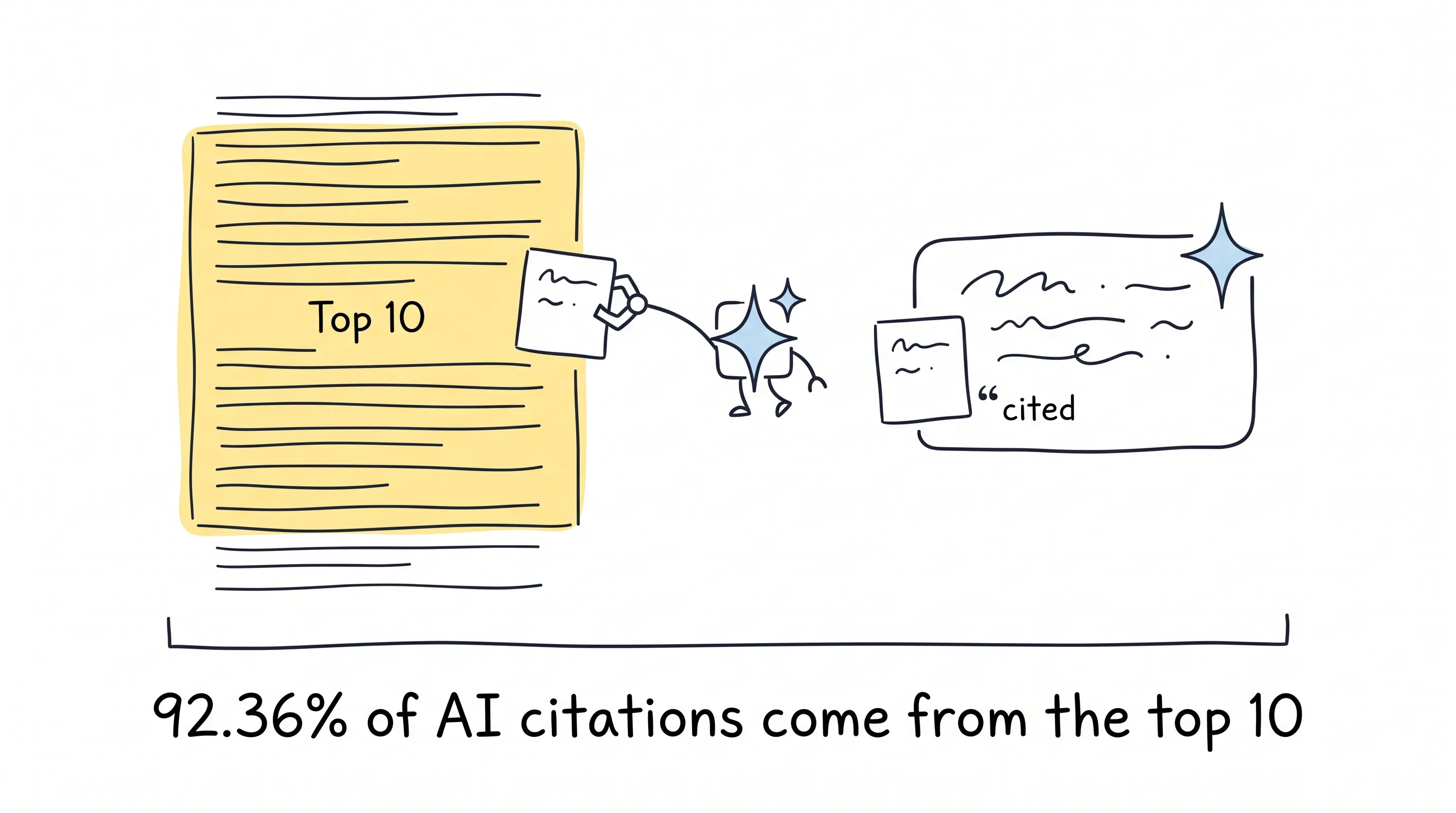
Used to be, ranking 8th or 9th still got you fed. Now AI only picks material from the top 10; outside the top 10, you don't even qualify to be cited.
So foundational SEO can't be thrown away — if anything, it needs to be more solid than ever. But solid alone isn't enough anymore. On top of it, you need a new layer of craft. Which layer?
I'll give you three directions.
-
Build brand mentions, with or without links. One statistic found that the signal most correlated with AI citations is neither backlink count nor keyword density — it's how often your brand gets mentioned, including places with no link at all, where your name is merely dropped in passing. AI remembers names more deeply than it remembers links.
-
Write content that looks more like an answer. Queries of four or more words trigger AI Overviews 60.85% of the time. 88% of AI summaries cite three or more sources. AI loves content with clear structure that thoroughly answers one question. 61% of AI Overviews output their answers as lists — it's even chosen the format for you, so when you write, you'd better write to its taste.
-
Don't shun AI writing — but layer human judgment on top. One sobering number: 91.4% of pages cited by AI Overviews contain AI-generated content themselves. Fully hand-written is no longer a badge of honor, and fully machine-made isn't the answer either. AI as the base layer, with human-exclusive experience and judgment added on — that's content that gets cited.
The Competitive Gap Is Widening
Search is changing, and marketing teams are changing with it.
SurveyMonkey's survey: 88% of marketers use AI every single day. HubSpot's figures say 73% of marketing teams use AI tools. There was a time when using AI was a bonus point. Now it's table stakes.
Is it producing results? Plenty of companies have done the math: costs down 37%, revenue up 39%, customer engagement up 55%. 75% of marketing leaders say their AI investment is paying positive returns; only 4% say it's negative.
Sounds like everyone wins. But inside that rosy picture sits an even bigger divide.
Among large enterprises, 57% have already put AI to work. Small companies with fewer than 1,000 employees?
40%.
A 17-percentage-point gap. The number looks unremarkable, but that's the nature of efficiency tools: the earlier you adopt, the faster you run. By the time you chase, the gap is no longer one step — it's acceleration.
Interestingly, small companies hold a counterweight too. In Salesforce's survey, 91% of small and medium-sized businesses using AI said revenue grew, and 78% called it a game changer. AI has turned capabilities that once only big companies could afford — analytics, copywriting, design — into subscriptions anyone can sign up for. Small teams that adopted early can now win battles they could never have taken on before.
Where the Money Goes Says It Best
Budgets are honest. Where the money flows, the industry flows.
McKinsey has a projection: by 2030, AI systems' share of marketing budgets will rise from 25% to 40%. And human creativity's share will fall from 40% to 25%.
Ten years ago, who would have dared think that? Today, it's the default script of a serious consulting firm.
The performance-side gap is just as real. McKinsey's math: AI-driven marketing campaigns deliver 22% higher ROI, 32% higher conversion rates, and 29% lower customer acquisition costs.
And the pie itself keeps rolling. In 2024, global digital ad revenue hit $258.6 billion, with AI-driven programmatic advertising up 18%, climbing to $134.8 billion. The overall AI marketing market is projected to grow from $47.3 billion to $107.5 billion by 2028 — a 36.6% compound annual growth rate.
The money has already voted, and the answer is written.
But One Number Made Me Pause
Dozens of numbers in a row, and most of them tell the same story: fast, fast, fast.
Only one made me stop.
McKinsey's survey: only 19% of organizations are setting and tracking KPIs for generative AI.
What does that mean? 88% of people are using AI, but fewer than one in five know whether it's worth what they're paying.
That's the reality for most teams: decisive when buying tools, vague when asked about results. AI wrote you a hundred drafts — how many hours did that save? How many extra leads did it bring? Nobody can say.
Using it isn't the same as using it well. And using it well isn't the same as being able to measure it.
This gap may be more dangerous than not using AI at all. If you don't use it, you know you're falling behind. If you use it blindly, you only think you're moving forward.
2026 Is Already Standing at the Door
Gartner offered a prediction a few years back: by 2026, traditional search engines' search volume will shrink by 25%, as everyone runs off to ask AI chatbots instead.
Now 2026 is standing at the door. Whether the prediction lands, it's too early to say. But the direction is probably right.
Gartner also says more than a third of web content will be optimized specifically for AI search. And by 2030, 80% of marketing teams will direct autonomous AI systems that generate their own ideas, execute on their own, and optimize themselves.
Where the technology ultimately lands, nobody can say. But two things you can start on right now.
One: shift your content from "written for rankings" to "written for AI to read." Make AI want to cite you; get your name into its answers.
Two: do the accounting. Set a KPI for every dollar put into AI: hours saved, leads gained. Don't be one of the 81%.
That day, after tea, I asked my old colleague: so what do you do now?
He said, I'm still writing articles, as seriously as ever. Only now, before I put pen to paper, I ask myself one question: will AI cite this piece, or pass it by?
I froze for a beat.
That may be what SEO looks like in the new era: getting people to click in is no longer the goal — being chosen by AI is what counts.
Traffic won't disappear. It's just dealing the cards from a new table.
Here's to you landing a seat at it.
Continue reading
Related articles

What Is AI Marketing Automation? It Starts With a 40-Point Gap
A learn article explaining what AI marketing automation is: how learning-based systems differ from rule-based automation, how AI decisioning optimizes message, channel, and timing choices, what data it depends on, and where it applies across the customer lifecycle.

It's 2026: Stop "Buying" AI Tools for Your Marketing Team — Start "Hiring" AI Agents
This learn article explains how AI agents differ from standalone AI tools in marketing, outlines three agent categories — build-your-own platforms, CRM-native agents, and vertical tools — and covers use cases across SEO, social media, advertising, and reporting, plus criteria for choosing one.

What Is an AI Marketing Agent? From "Using AI" to "Delegating to AI"
A learn article explaining what an AI marketing agent is, how it differs from rule-based automation, and which repetitive tasks such as lead qualification, reporting, and campaign monitoring can be delegated while humans keep key decisions.