
Half Your Ad Budget May Be Going to Bots
An explainer on bot and AI traffic in marketing analytics: how non-human visits inflate traffic reports, distort conversion rates and budget allocation, and why the author recommends measuring real purchases and repeat buyers instead of clicks.
A few days ago, I had dinner with a friend who works in brand marketing.
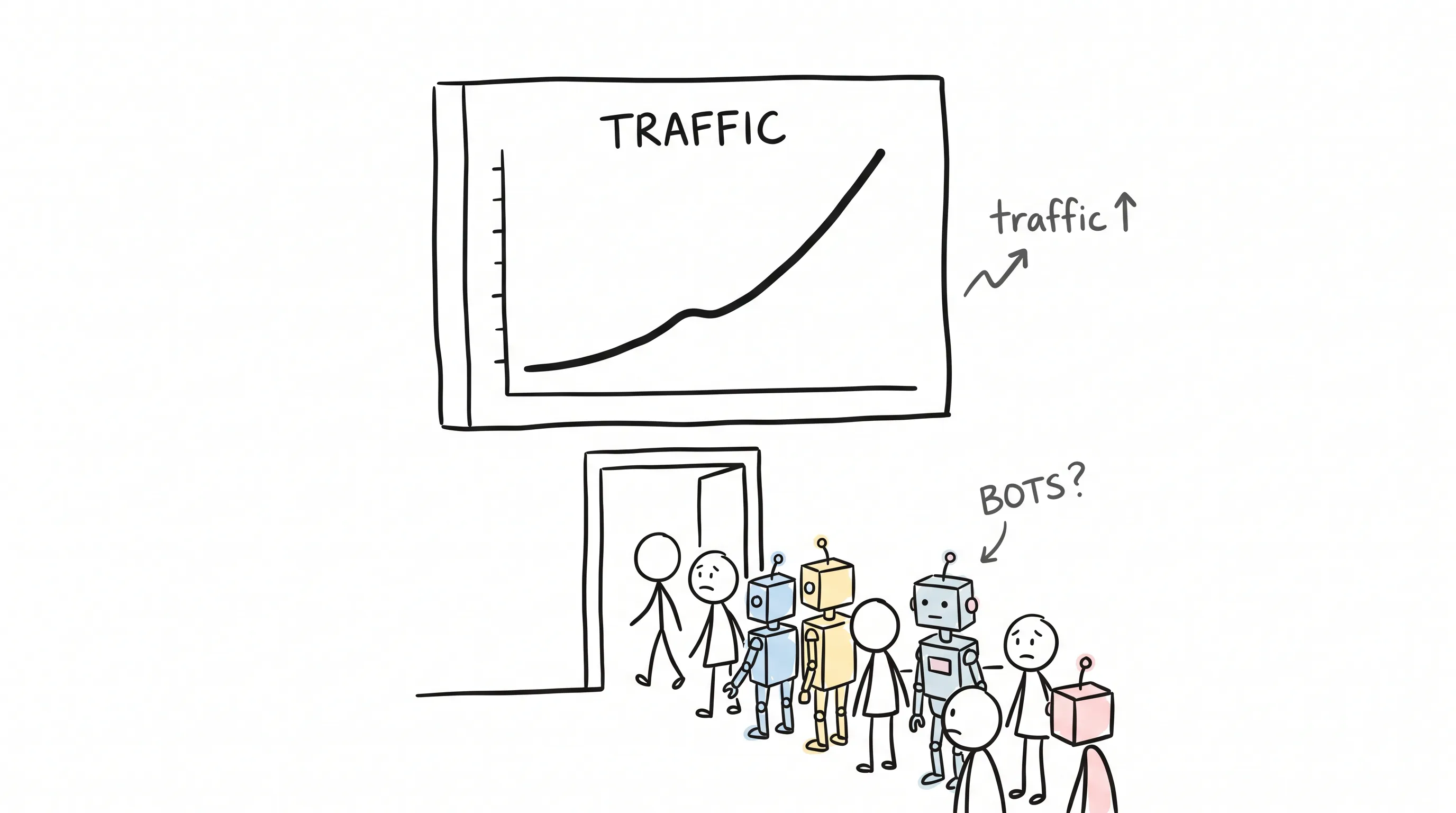
He's spent a decade-plus buying media — a real veteran. But that night he wore a bitter smile and told me: "These days, when I look at the traffic reports on my dashboard, it gives me chills."
I asked, what's wrong? Isn't traffic growing nicely?
He said, exactly — it's growing too nicely. That's what scares me.
It took me a second to catch on. Traffic going up — isn't that a good thing?
He said, think about it. Are all these visitors actually people?
What Is Bot Traffic?
So what is bot traffic?
It's visits that don't come from human beings. Crawlers, automated scripts, AI tools… They open your web pages too. They "linger." They "click." They chip in a little on every metric you track — every metric but one: they never pay.
Put bluntly, it's a crowd of freeloaders packing your store shoulder to shoulder — and not one of them ever buys.
None of this sounds new. Crawlers have been around forever. But this wave is different. Before, machines came sneaking in quietly. Now, AI arrives en masse. AI assistants need to read your pages, AI agents need to scrape your content, and the harvesting of training data never stops. The scale is enormous, and the behavior looks more and more human.
Digiday, a publication that covers the digital marketing industry, put out a report last month on exactly this: traffic from bots and AI keeps climbing. Marketers are stuck in a genuine bind.
I read the whole piece and wanted to say just one thing: I've felt exactly what he's feeling.
Where Are We Stuck?
Where are we stuck? It comes down to three words: can't see clearly.
Think about it — what do all your digital marketing decisions rest on today?
Data. That string of numbers on your dashboard.
But that string of numbers is humans and machines stirred together. It's like a pot of soup — rice and sand, simmering together. You know the soup has gotten "fuller" — you just don't know whether it's more rice or more sand.
And so the trouble begins.
The first trouble: your reports stop telling the truth. Why did your conversion rate drop? Maybe your landing page didn't get worse — maybe the denominator is filling up with machines that will never convert. The harder you optimize the page, the more it feels like answering a fake question.
The second trouble: your money lands in the wrong places. You allocate budget by traffic — whichever channel is growing gets more. But what if what's growing on that channel is bots?
Let's do the math. Say you spend 1 million a month, and half your traffic is machines. That's 500,000 — spent on tickets for bots, inviting them to tour your ads.
Half a million. You could hire someone to count bots all day, every day, and still never account for a cost that big.
The third trouble is the sneakiest: your judgment gets contaminated. The "users" you see may not be users at all. The profiles you build, the copy you write, the strategies you set based on these "users" — all of it is modeling phantoms.
Data is the foundation of digital marketing. When sand gets into the foundation, the taller you build on top of it, the more dangerous it gets.
The Dilemma
So what do you do? Block the bots?
Not that simple.
Because not all of that traffic is the enemy.
When an AI assistant reads your page, it may be reading on behalf of a real human behind it. Today it won't open its wallet — but its owner might place an order tomorrow. Slam the door shut, and you've turned away a future customer along with its translator.
That's the dilemma.
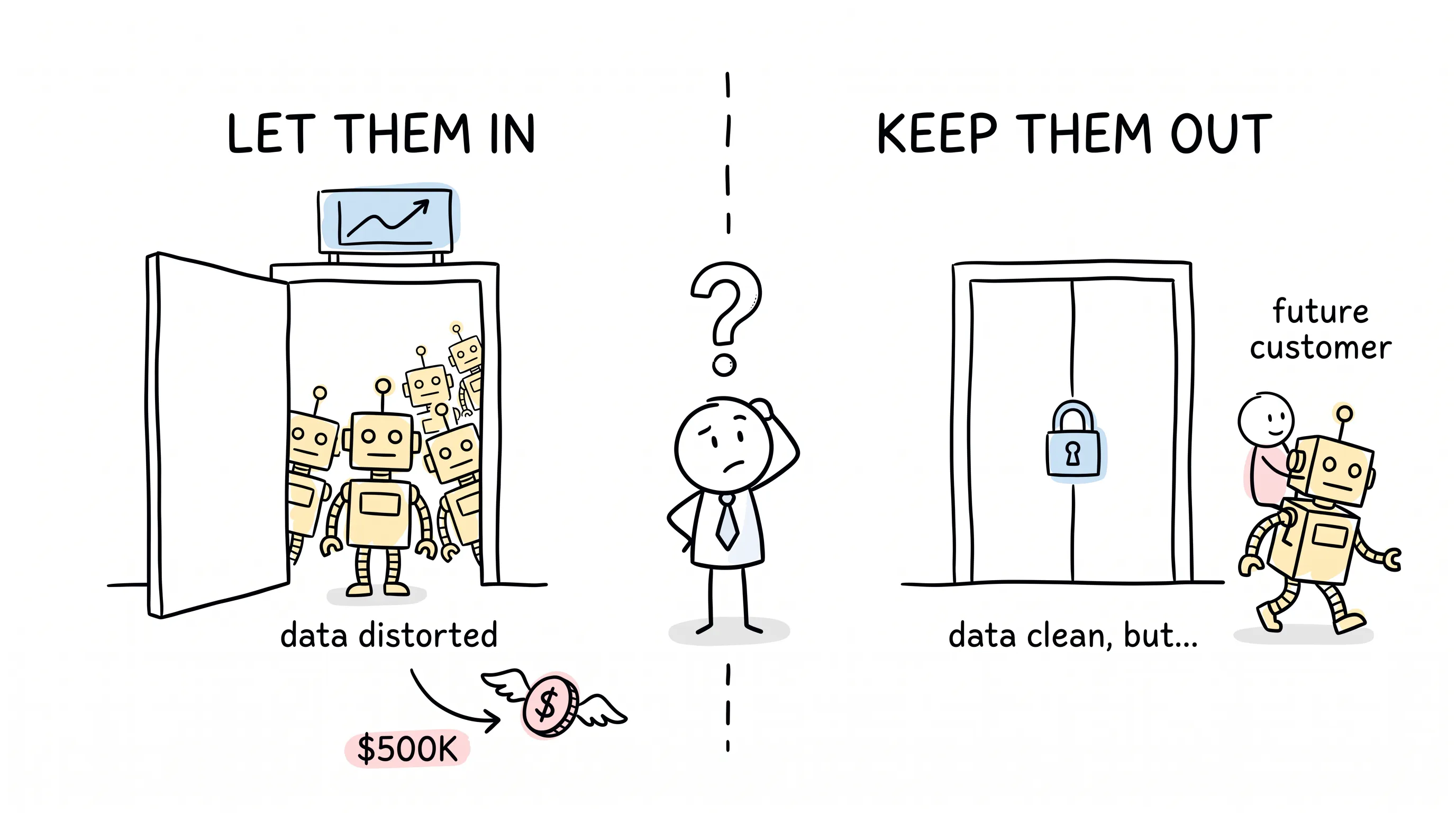
Let every bot in, and your reports look great — but your data is distorted and your budget goes down the drain.
Keep every bot out, and your data gets clean — but you may also be shutting the door on the next generation of traffic.
Let them in, or keep them out? There's no standard answer.
Where I Stand
My take: don't rush into an either-or. Run the numbers first.
There was a time when traffic roughly equaled users, and that equation more or less held. Now the equation has collapsed.
What you should really care about is no longer "how much traffic showed up" but "how many people showed up who can pay."
That means moving the anchor of measurement. From traffic, to people. Away from impressions and clicks — metrics machines can fake too — toward the places machines can't fake: real purchases, real repeat purchases, the real questions real customers ask.
Bots can fake clicks. They can't fake paying.
For every single channel, ask the question all over again: of its growth, how much was actually brought by humans?
That question is expensive and a hassle. But you don't get to choose. Because reports can lie to you, bots can lie to you — only your wallet never will.
One Last Thing
Look back, one more time, at my friend's bitter smile.
What he fears isn't traffic falling. He fears traffic rising — rising so much he no longer knows who to believe.
This industry has always stared at traffic. But traffic has always been, at its core, people. People are still here. It's just that now, the ones knocking on your door aren't necessarily human.
Whoever sees this first won't be led around by the nose by their dashboards.
And may every penny of your ad budget buy you a real, living human.
Continue reading
Related articles
What Is AI Marketing Automation? It Starts With a 40-Point Gap
A learn article explaining what AI marketing automation is: how learning-based systems differ from rule-based automation, how AI decisioning optimizes message, channel, and timing choices, what data it depends on, and where it applies across the customer lifecycle.

It's 2026: Stop "Buying" AI Tools for Your Marketing Team — Start "Hiring" AI Agents
This learn article explains how AI agents differ from standalone AI tools in marketing, outlines three agent categories — build-your-own platforms, CRM-native agents, and vertical tools — and covers use cases across SEO, social media, advertising, and reporting, plus criteria for choosing one.

What Is an AI Marketing Agent? From "Using AI" to "Delegating to AI"
A learn article explaining what an AI marketing agent is, how it differs from rule-based automation, and which repetitive tasks such as lead qualification, reporting, and campaign monitoring can be delegated while humans keep key decisions.