
Google's Core Update Rolls Out and ChatGPT Opens a Merchant Dashboard: What Happened in Search This Week
A weekly roundup of search news covering Google's November core update rollout, new Gemini models in AI Search and AI Mode, and the ChatGPT Business Hub beta for managing business presence. It also touches on CDN migration guidance, Search Console reporting bugs, and how brands appear in AI answers.
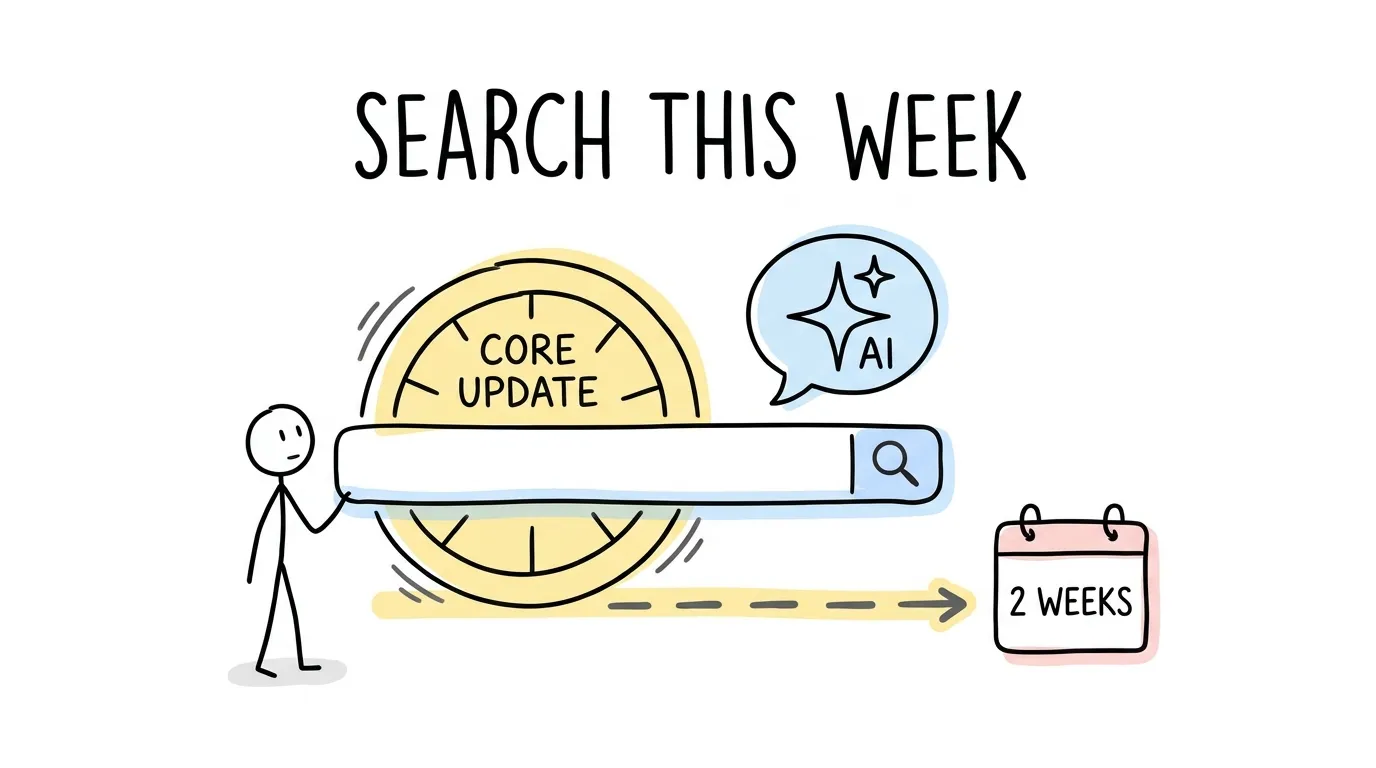
Last week, a friend who runs an e-commerce business texted me in the middle of the night: "My rankings dropped. Should I overhaul the site?"
I replied with just one line: Don't touch anything yet.
Why? Because on November 10, Google officially began rolling out its November core update, expected to run for a full two weeks.
Making changes now is like switching your formation halfway through a match. By the time the dust settles in two weeks, you won't even know why you lost.
So today, let me walk you through the big events in search this week. Eleven of them in total — some confirmed, some backed by data, some just noise. By the end, you'll know exactly where you stand.
First, the Biggest News: The Core Update Has Started Rolling Out
What is a core update?
It's Google recalibrating its entire scoring system from top to bottom. It doesn't target anyone, and it doesn't punish anyone. Everything changes at once, across all regions and languages.
I often use this analogy: it's like the school swapping in a new exam writer. Students who used to ace tests by guessing the questions may suddenly struggle, while those who genuinely mastered the material start to rise.
So for the next two weeks, there is only one thing you should do: watch the data in Search Console, broken down by landing page, keyword, and country. Take notes. Don't make changes.
Redesigns during a recovery period are poison. Waiting is the best strategy this week.
Google's AI Search Just Got a Smarter Brain
On November 12, Google put Gemini 4 Hydrogen into Search.
Faster, better comprehension, clearer source citations, more visual answers. Available globally.
Oh, and one point of confusion to clear up: this upgrade improves the "answering ability" of AI search, not traditional ranking signals. Your organic rankings won't change directly because of this model. But how AI finds you and cites you — that will change.
Original content, clear structure, and trustworthy sources are only going to become more valuable in AI search.
ChatGPT Is Opening a "Merchant Dashboard" Too
On November 10, OpenAI launched the beta of ChatGPT Business Hub.
What does that mean? Until now, businesses that wanted to manage their online presence essentially had one option: Google Business Profile. Now ChatGPT has opened a door of its own: you can claim your business identity, manage your information, and see analytics — how users mention you, how often they click on you, and in what contexts they cite you.
Wow. That signal is enormous.
The battleground for visibility is shifting from Google alone to one AI platform after another. Whether your information is accurate and consistent now has to pass the test on ChatGPT too.
When the Ruler Is Broken, Don't Blame Your Body
There was also a mix-up this week worth covering on its own.
From November 9 to 11, the AI performance report in Search Console had a logging bug that quietly reduced impression counts. Google confirmed it: the recording was wrong, not the actual performance.
Where's the trouble? The glitch landed exactly as the core update started rolling out.
Think about it. If you were watching your reports and saw "AI impressions collapsed," then saw "core update," you'd probably panic: It's over, the algorithm hit me.
But what actually happened? The ruler was broken. You didn't get thinner.
Data problems belong to data. Performance problems belong to performance. Don't mix the two ledgers.
Switching CDNs? Don't Crush Your Own Warehouse
On November 11, Google published a technical guide on the pitfalls of CDN migrations.
What's a CDN? Think of it as a network of distribution warehouses. Content stored in locations closer to users loads faster.
But when a new warehouse first opens, it's empty. The cache is cold, and every request gets pushed back to your origin server. Even better: because your site gets faster, Googlebot may crawl it harder, making things worse.
Google also offered a warning: blanket firewalls and human-verification challenges can block genuine search crawlers too.
You stopped the bots. You also stopped Google.
During a migration, watch four things: cache hit rate, server response, crawl frequency, and firewall logs.
In the Eyes of AI, "Big Brands" Are Just Shelves
On November 11, Ahrefs analyzed roughly 5.5 million ChatGPT answers from U.S. users to see which brands got mentioned most.
The top five: Walmart, Target, Apple, Amazon, Home Depot.
Notice anything? Four of the five are retailers. Across the entire top 100, retail brands made up 35%, and automotive brands about 14%.
What does this tell us? In AI's recommendation logic, the brands that come up again and again are the ones with the strongest "shelf presence" — the ones that are always there when users shop and compare products.
Of course, this sample covers only U.S. data, so it doesn't translate directly to every market. But the direction is clear:
Stop counting how many times AI cited you. Count whether AI vouched for you in purchase-related questions.
Just 15 Videos, and AI Retrieval Rose 359%?
There was a fascinating little experiment this week.
Peec AI ran a study: of roughly 60 YouTube videos, 15 got optimized descriptions and timestamps while the rest were left untouched. The result: the optimized group saw a 359% jump in AI retrieval; the untouched group rose just 17%; YouTube overall rose 25%.
359% versus 17%. Big gap, right?
But don't rush to copy the homework. Even the researchers said it: they couldn't isolate "edited descriptions" as the single proven cause. And the sample was small — just 60 videos.
My advice: structured descriptions, accurate timestamps, and clear topic summaries are worth doing, because they cost almost nothing. But don't treat 359% as a promise.
Get the direction right. Don't worship the number.
63% of Buyers Got Interception-Steered by AI Midway
Here's a survey anyone doing B2B needs to see.
In a study of 200 software buyers, nearly 63% of those who already had a shortlist of vendors added a brand-new vendor to their consideration set through AI-assisted research.
Think about what that means. However polished your website's pitch is, it's already too late. AI rewrote the shortlist before the buyer ever reached your site.
AI recommendations happen before you can see the traffic. If you're not on its list, you're not in the game at all.
Subscribers Got a Brain of Their Own
The same week, Google also put Gemini 4 Carbon into AI Mode, available to AI Ultra subscribers.
This model specializes in complex reasoning, long tasks, and multi-turn conversations. It's a different thing from Hydrogen, which rolled out fully two days later.
What it means for businesses: the way users do research is starting to look like "chatting continuously with an advisor" rather than "search once and scan ten links." Your content needs to answer a connected chain of questions, not a single isolated keyword.
Three Ledgers That Must Reconcile
On November 12, Google also published a document explaining how to use the HTTP Referer header to identify Google search traffic in your analytics tools and server logs.
It sounds technical, but the underlying message is simple: Search Console, GA4, and your server logs are three separate ledgers. When they don't match, that's normal — not a malfunction.
Before you assess the impact of a core update, reconcile the three ledgers first. If the books don't balance, your judgment will be crooked.
Foreshocks Are Not the Mainshock
One last thing — a cold splash of water for the attribution lovers.
On November 8 and 9, before Google officially announced the core update, plenty of SEO communities were already discussing ranking volatility.
Many will say: See? That was the core update!
But the official announcement of the mainshock doesn't prove every foreshock was caused by it. Volatility can have many causes.
Logging timestamps is fine. Drawing conclusions requires evidence. Attribution without evidence is just guessing.
So What Does This Week Actually Tell Us?
Four sentences.
First, the core update is still rolling. For the next two weeks, keep your hands off and protect your baseline data.
Second, AI search is evolving fast: Hydrogen rolled out fully, Carbon arrived for subscribers, and ChatGPT opened a merchant dashboard. The way users discover you is being rewritten.
Third, brand visibility deserves its own ledger. Mentions, recommendations, citations, and shortlist appearances are one set of accounts; visits, leads, and revenue are another. You need to read both.
Fourth, the technical foundation must not crumble. Migrate CDNs carefully, reconcile the three ledgers, and document bugs clearly.
If your business is local services, keep your business information, service areas, and reviews in shape. If you run e-commerce, get your product specs, inventory, pricing, and structured data solid. If you're in B2B, articulate your capabilities, differentiators, and use cases clearly.
Search is shifting from "getting Google to find you" to "getting Google and every AI to be willing to speak up for you in every conversation."
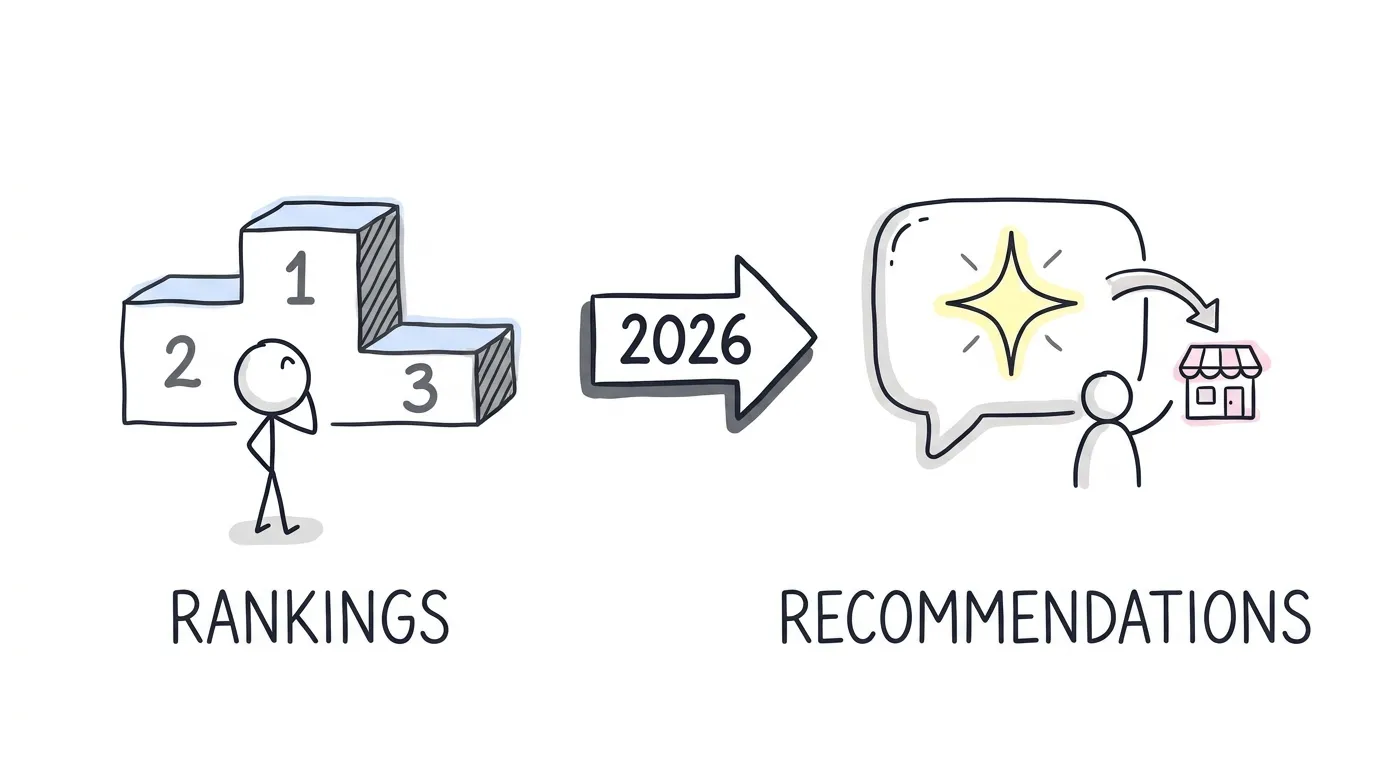
You used to optimize rankings. Now, you optimize recommendations.
Here's to being seen not only in search results, but being the first name AI brings to mind.
Continue reading
Related articles

It's 2026: Stop "Buying" AI Tools for Your Marketing Team — Start "Hiring" AI Agents
This learn article explains how AI agents differ from standalone AI tools in marketing, outlines three agent categories — build-your-own platforms, CRM-native agents, and vertical tools — and covers use cases across SEO, social media, advertising, and reporting, plus criteria for choosing one.

What Is GEO? How Your Brand Gets "Mentioned" in the Age of AI Search
An explainer on GEO (Generative Engine Optimization) for e-commerce and DTC brands: how it differs from SEO and AEO, why AI answers shape brand visibility, and eight practices covering question-focused content, consistent brand messaging, structured pages, external evidence, comparisons, and AI mention tracking.

AI Is Already Making Decisions for Your Customers. Are You on the List?
A learn article explains GEO (Generative Engine Optimization): why AI-generated answers now shape which brands customers see, and how SEO fundamentals, entity clarity, citable evidence, and monthly measurement affect visibility in AI answers.