
Give Meta a URL, and It Runs Your Ads for You
An explainer on Meta's AI-driven advertising stack, covering automated bidding, creative generation, customer service, and a phased rollout plan, with a caution that most cited performance figures come from Meta and its vendors.
A couple of days ago, I had dinner with a friend who runs a cross-border e-commerce business.
He oversees an annual ad budget in the tens of millions. Every morning, the first thing he used to do after opening his eyes was check yesterday's numbers, then adjust bids, shift budgets, and chase designers for creative.
But this time, he told me one thing: "My main job now is watching AI run the ads."
I asked him what "watching" meant.
He said the bids are set by the system, the creative is swapped by the system, the budgets are moved by the system. His job is to decide, once a week, which direction those systems should run in.
I paused for a second. Isn't this exactly where Meta has been pushing the entire industry, step by step, over the past two years?
Today, in plain language, I'll walk you through what I've seen of this system.
One URL, One Budget
What does fully automated advertising actually mean?
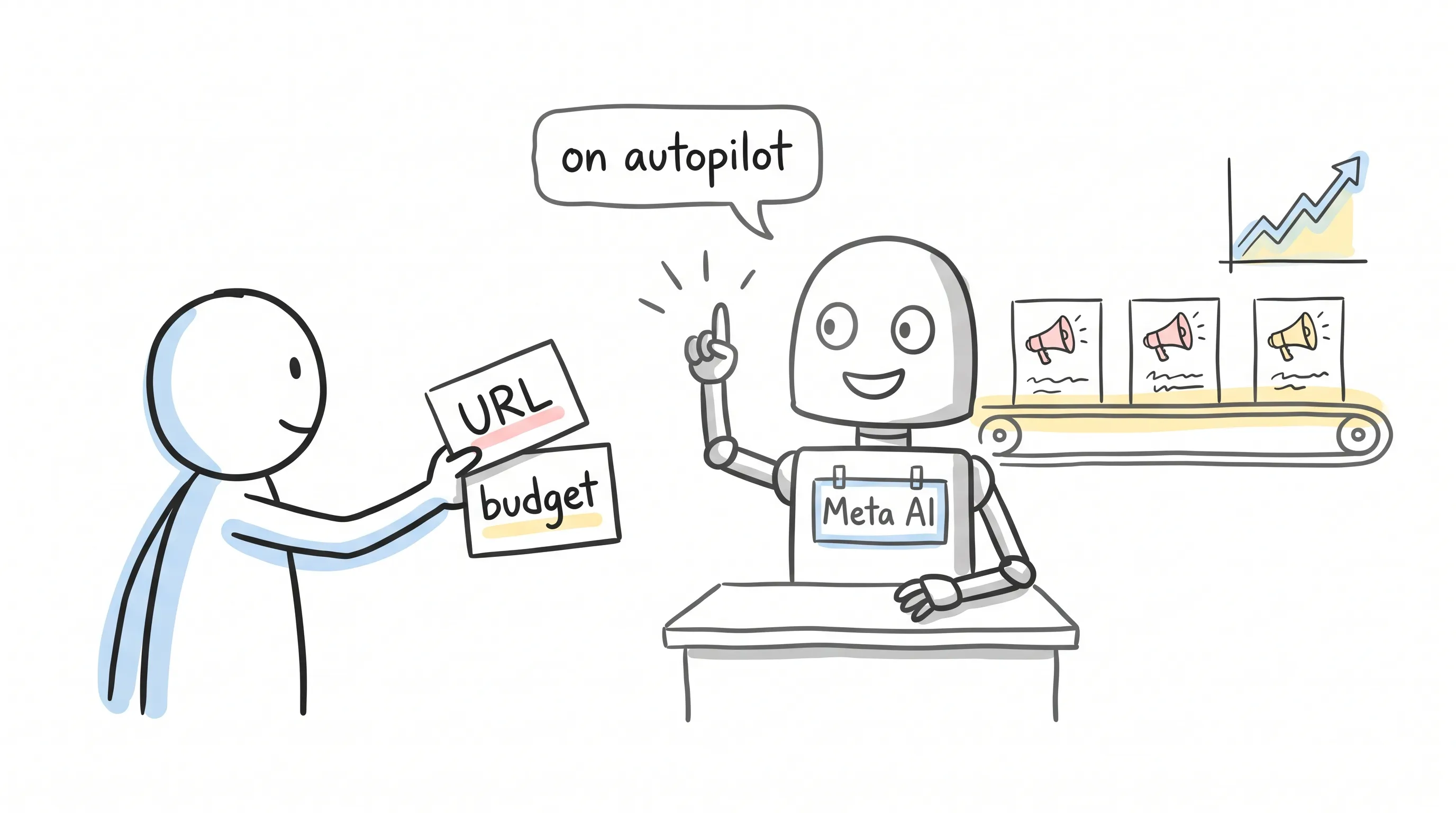
Mark Zuckerberg has painted the picture: an advertiser fills in just two boxes — one for a URL, one for a budget. Everything else — making the creative, finding the audience, setting the bids, watching the conversions — goes to AI.
You might be thinking: isn't this just "smart bidding"? We've had that for years.
Fair — the name sounds similar. But Meta's ad platform in 2026 is a different animal. It no longer just tunes a bid for you; it has taken over the entire campaign-ops assembly line.
On that assembly line stand five kinds of AI.
Meta's AI Is Like a Complete Team
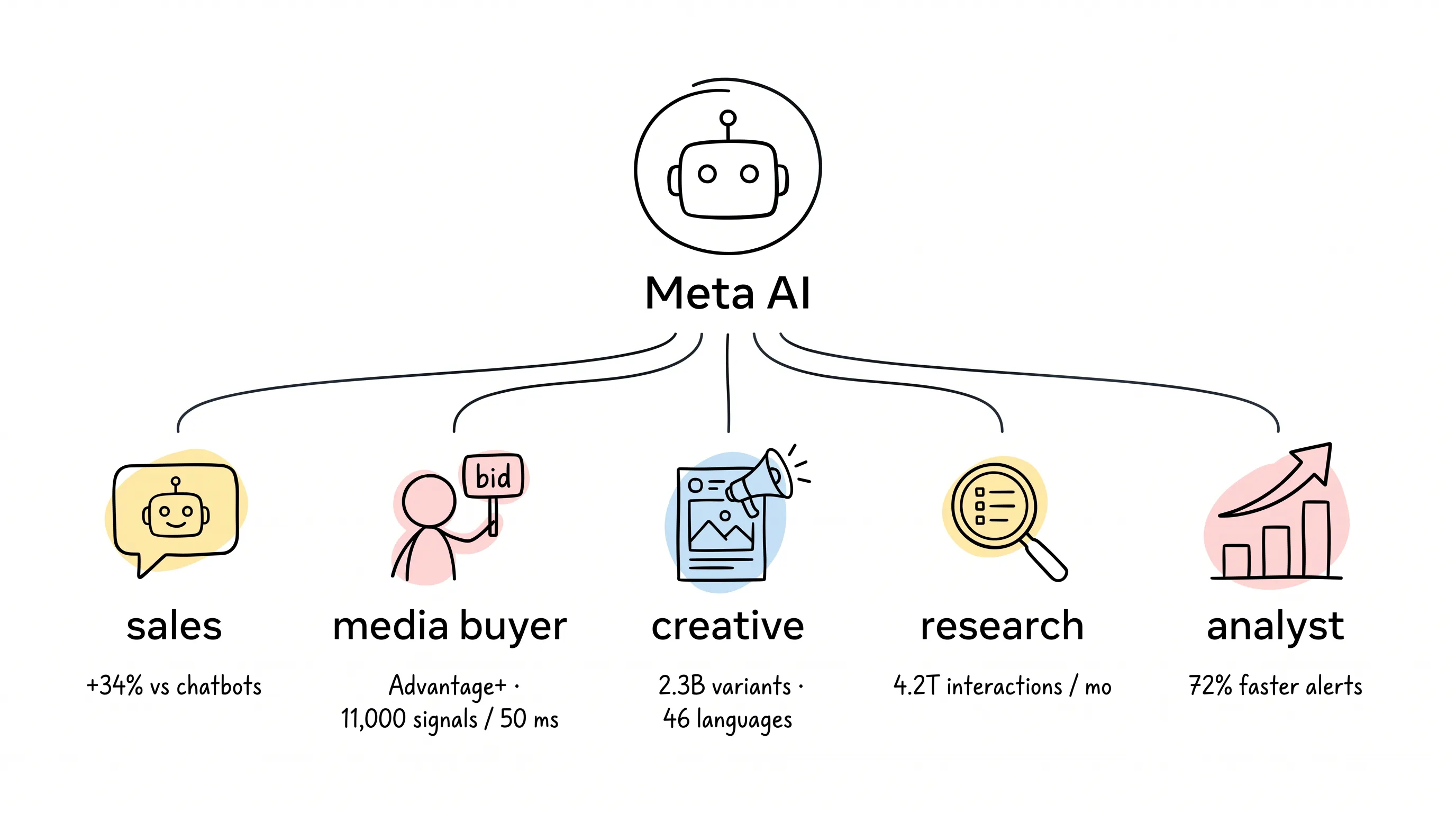
Picture Meta's system as a company. In this company, five roles — every one of them now staffed by AI.
Role one: sales.
Meta calls it Business AI. It lives inside Messenger, Instagram DMs, and WhatsApp, greeting customers around the clock: ask whether the pants come in another color, and it checks the product catalog to answer; say you'll take them, and it places the order and takes payment on the spot; want to return them? It handles that too.
By Meta's own beta numbers, it converts 34% better than traditional chatbots, with an average response time under 2.3 seconds.
Hmm — beta data. Note it down; we'll apply the discount later.
For now, it's open only to eligible US merchants. Meta expects that by Q4 2026, it will handle 40% of these merchants' customer-service interactions. Forty percent. Think about how many "customer-service seats" that replaces.
Role two: the media buyer. You've probably heard the name: Advantage+.
How fast is it? For every single ad impression, it evaluates more than 11,000 signals within 50 milliseconds: when you scrolled past, what device you're on, what you just looked at, where you live, whether you resemble the people who've bought. Then, roughly every 100 milliseconds, it adjusts the bid.
For a single campaign, that adds up to more than 150 adjustments a day.
Now think about a human media buyer juggling 20 campaigns — how many times a day can they adjust each one? Once or twice, tops.
That's not a gap in diligence. That's a gap between species.
Meta's own published claim: Advantage+ cuts customer-acquisition cost by 23% versus manual buying, lifts return on ad spend (ROAS) by 43%, and advertisers run more than $12 billion a year through it.
Role three: the creative department.
Upload one product photo, and it generates 50-plus versions of the ad — different copy, different visuals, aimed at different audiences. It does video too, automatically adding voiceovers and subtitles in 46 languages.
Meta says that since the start of 2026, its creative AI has generated 2.3 billion ad variants, cut average production cost by 67%, and beaten human-made ads on engagement by 18%.
2.3 billion. Good grief. A human designer couldn't draw that many images in a lifetime.
Role four: market research.
It processes 4.2 trillion user interactions every month to answer a classic question: who is most likely to buy?
Meta says it can predict, 14 days ahead, that a user is "about to order." You think you're just idly scrolling your phone; in the system, you're already on the "will buy within two weeks" list.
Role five: the data analyst.
It watches every campaign, spots anomalies 72% faster than a human, and gives concrete recommendations — not empty phrases like "fluctuation detected, please keep monitoring." And when someone gets sold on a product on their phone by day and places the order on their computer at night, it can still do that math.
Sales, media buying, creative, research, analysis. A company lives on these five roles. Now the hands-on part of all five belongs to AI.
Take These Numbers at Half Face Value
At this point, I have to stop and pour some cold water.
Have you noticed? The numbers above — 34%, 43%, 2.3 billion — come almost entirely from the same mouth: Meta itself. The rest come from software vendors that build automation tools for Meta. Not one of them is a neutral referee.
Vendors talking up their own kids: every one is top of the class.
So my advice: take every number at half face value. 2.3 billion variants might really be 1.1 billion; ROAS up 43% might really be 20%. That's fine. Because even fully halved, the direction is clear enough: machines taking over ad operations is genuinely happening, and it's moving barely slower than you could change jobs.
If You Really Want In, Don't Go All-In at Once
So should you hand over the entire budget?
Not yet. The ones who got burned are mostly the ones who went all-in.
The steadier path is to give the machine about 8 weeks, in three steps:
Step one: lay the foundation. Merge overlapping audiences, or your campaigns will end up bidding against each other; install the Conversions API and get it verified, so the data flowing back is clean. Remember, these AI systems run on data — feed them dirty data, and even a god couldn't get the targeting right.
Step two: run a pilot. Give Advantage+ 20 to 30 percent of the budget first, running alongside your manual setup as the control. Feed it plenty of creative — 6 to 10 versions. And set a scaling rule: add budget only once ROAS clears 3.0.
Step three: only then comes creative generation, automated customer service, and letting the system take over budget allocation across the whole account. Most accounts need a full 6 to 8 weeks of data before they hit their best form.
The saddest case I've seen: no miracle by week three, switch the system off, then tell everyone automation doesn't work.
It's not that the system couldn't. It's that it wasn't fed enough.
So What's Left for Humans?
One agency has shared its math (the numbers came from a tool vendor — keep discounting): with the same team, it went from serving 12 clients to 35, average ROAS rose from 2.1 to 4.3, and time spent on manual operations dropped by 80%.
The common industry sentiment: a senior strategist who used to handle 5 to 8 clients can now handle 15 to 20.
So what do the people who remain do all day?
One comparison is telling. Fully manual buying takes one person 15 to 20 hours a week of monitoring; hand it all to AI, and 2 to 4 hours is enough. But the best results come neither from handing over everything nor from keeping everything — they come from the middle path: AI runs execution, humans set direction. In that same comparison, the hybrid model cut acquisition cost the most and posted the highest ROAS, at 3.8.
What machines take over is operations. What they can't take over is judgment.
Which market to enter, what story the brand tells, whether a category is worth burning money on — the machine only gives you options. You're still the one pressing the button.
Finally, Back to That Dinner
As the meal wound down, I asked him: so what keeps you busy now?
He said he now holds one meeting a week: reviewing what the system did over the past week, which calls it got right, which audiences it hasn't cracked yet — then setting the direction for the week ahead.
And he said one thing I still remember: "I used to fear my hands were slow. Now I only fear my thinking is slow."
The trade of media buying is being split in two: the work of the hands goes to AI; the work of the mind stays with people. The earlier you make that split, the better your odds.
Here's wishing you an early handoff: give away the work of the hands, keep the work of the mind.
Continue reading
Related articles
Does AI Know Your Brand? A Look at GEO, the New Craft
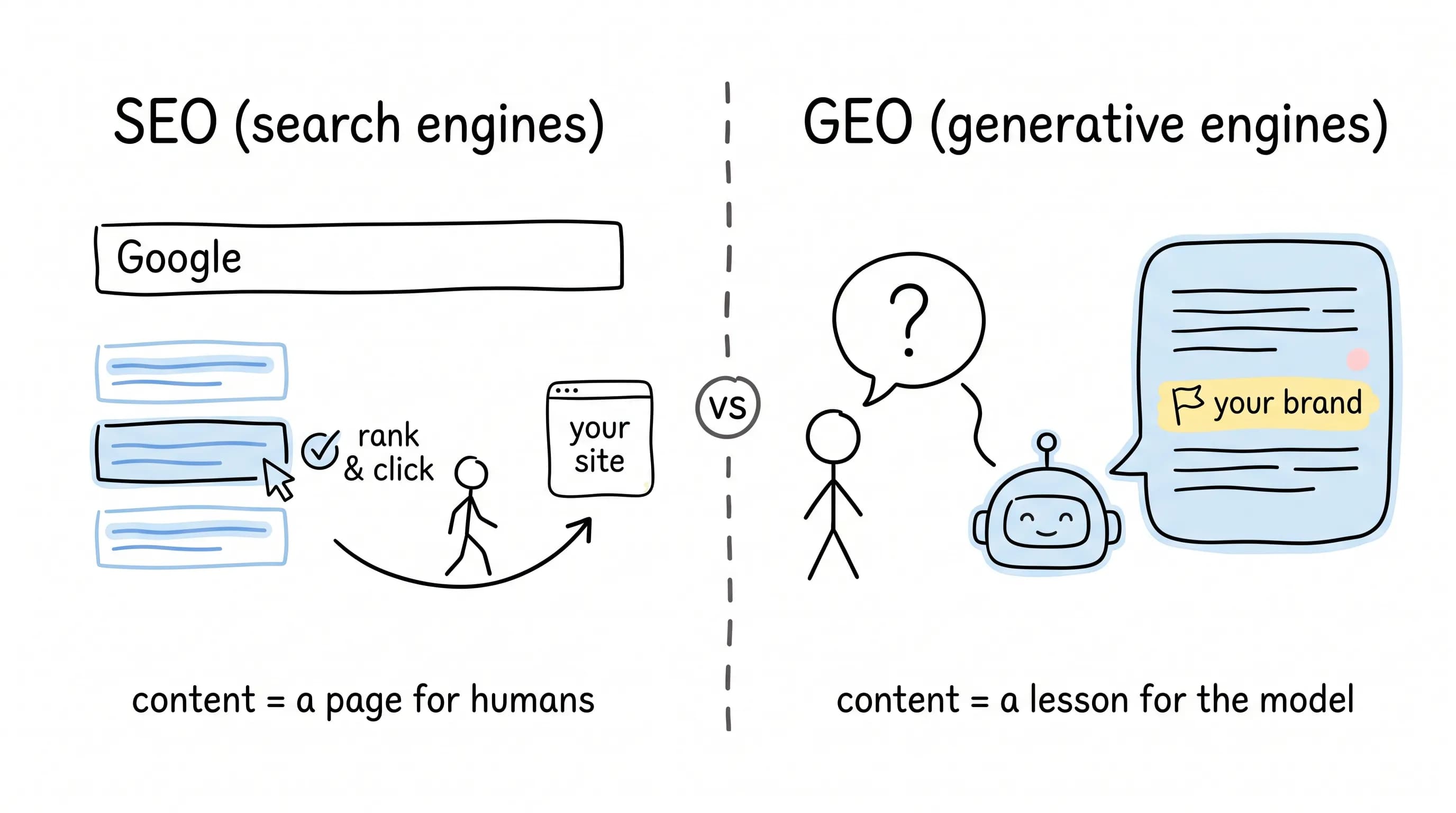
An explainer on GEO (Generative Engine Optimization): how AI engines like ChatGPT, Perplexity, and Gemini differ, how GEO goals and metrics diverge from SEO, and which SEO skills still carry over.
89% of Retailers Are Already Using AI. The Playbook for E-Commerce Has Changed
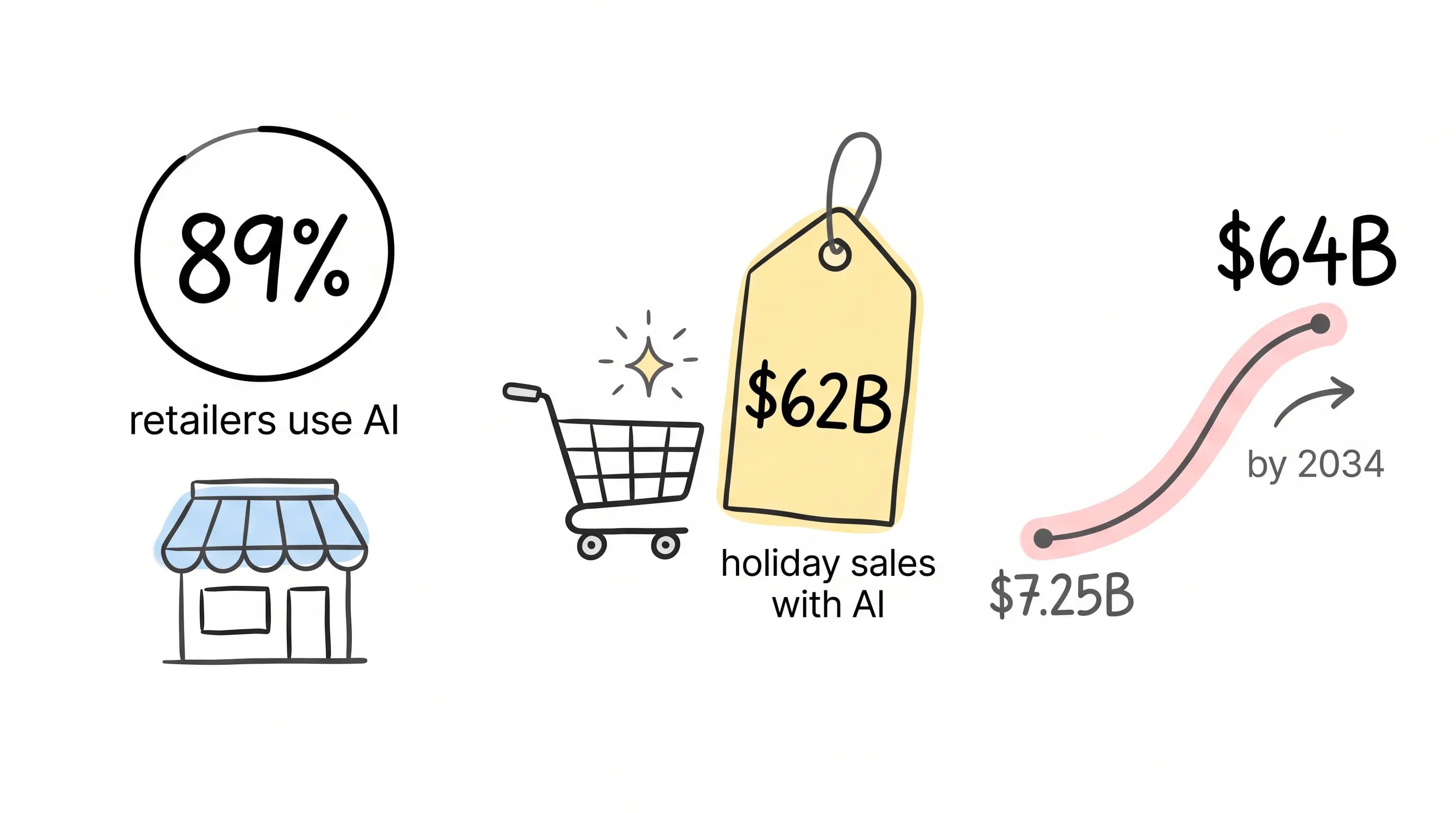
A learn article on AI in e-commerce: adoption context, use cases from recommendations, search, dynamic pricing, customer service, inventory, and fraud control, plus B2B applications, generative AI content, tool examples, pitfalls, and a six-step adoption path.
AI Makes Content at Lightning Speed — But Can You Answer "Who Approved This?"
This article looks at the gap between AI content speed and governance readiness in marketing teams, and outlines nine control points — prompt validation, brand guardrails, permissions, approval workflows, human review, versioning, IP checks, audit trails, and asset reuse — for brand-safe AI content.