
Fivefold in Five Years: AI Is Rewriting the Social Media Business
An analysis of the AI-in-social-media market, projected to grow nearly fivefold to $10.33 billion by 2029, covering influencer marketing, content generation, and content devaluation.
A few days ago, I was flipping through a market research report published in 2025. When I hit one number, I stopped scrolling.
In 2024, the global "AI in social media" business was worth $2.2 billion. By 2029, it is projected to reach $10.33 billion.
That's staggering. Five years, nearly a fivefold increase. Convert it into a compound annual growth rate (CAGR), and you get 36.2%.
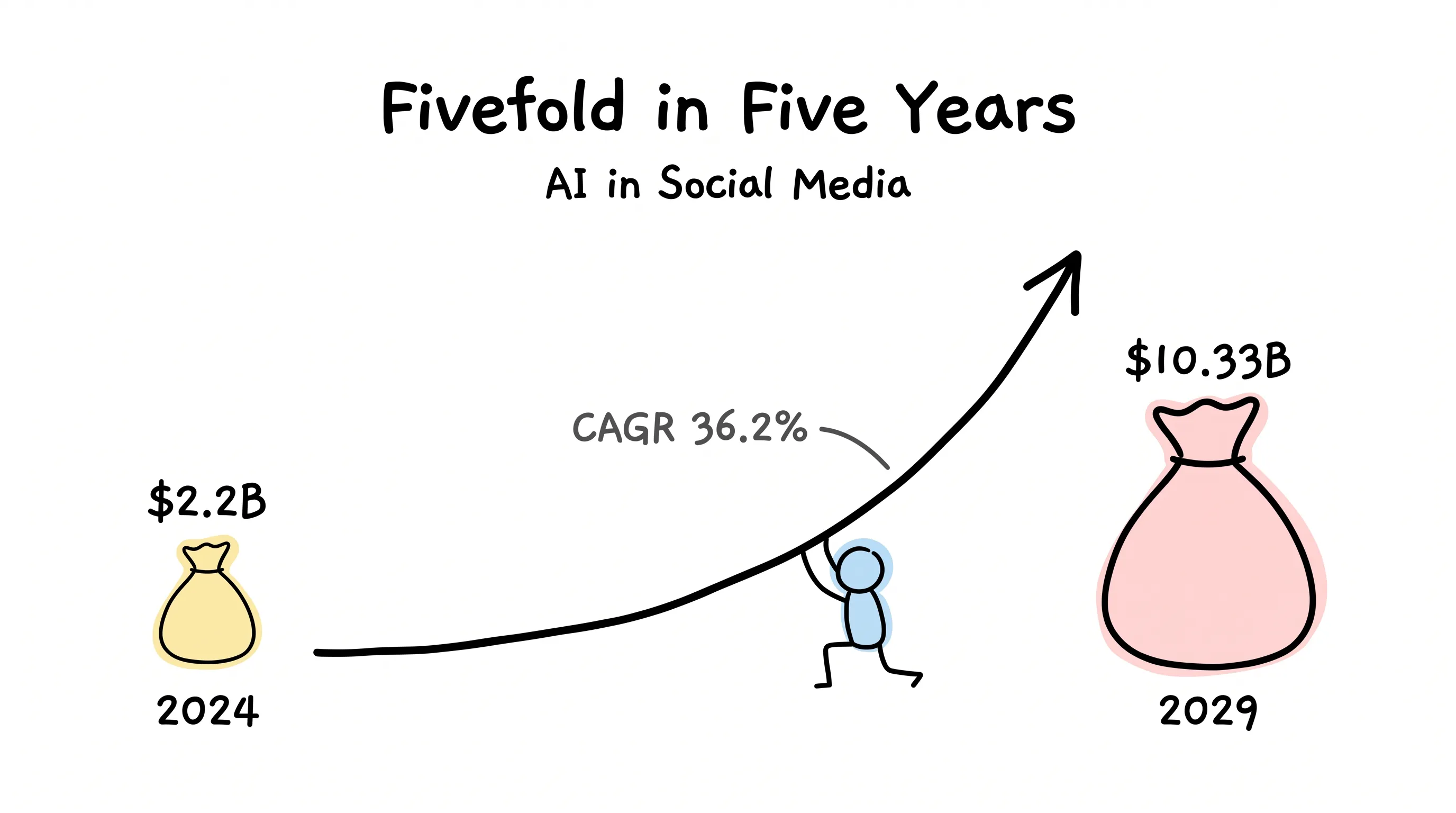
What does that kind of growth mean in practice? Put 1 million into a pool growing 36.2% a year, and five years later you have nearly 5 million.
An industry that has been running for over a decade, one that looked like its hierarchy was already settled, is still growing at this pace. This is worth sitting down to talk through properly.
What exactly is this business?
Put simply: almost everything you scroll through every day has AI behind it.
Every recommendation you see was chosen by AI. Many of the posts businesses publish were written by AI, illustrated by AI, and posted at an AI-chosen time. When you DM a brand to ask "has my order shipped?", chances are an AI customer-service agent is the one answering.
You think you're the one scrolling your phone. Actually, AI is deciding what you scroll.
Giants like Google, Meta, IBM, Microsoft, AWS, and Adobe are all in. So is a roster of specialist players — Sprout Social, Sprinklr, HubSpot, LivePerson — selling nothing but tools and services.
The cake is big enough and growing fast enough that everyone wants a slice.
Where does the fivefold growth come from?
Having read the report, my take is that three forces are doing the pushing.
First, everyone wants "made for me". What you like, what you just searched, those shoes you hesitated over at 2 a.m. — platforms want to push each of them to you with precision. Personalization at this granularity can't be built by piling up human labor; only AI can do it.
Second, generative AI crashed the cost of creation. A brand video or poster used to take budget and lead time. Now tools like Jasper, Canva, and Midjourney hand you a batch of candidate options in half an hour. When creation gets cheap, content floods the market — and flooded content needs managing.
Third, however deep the water goes, that's how deep the probe needs to go. As AI content multiplies, fakery follows — deepfake videos are already everywhere. So outfitting platforms with "deepfake detection" has become a new business in its own right. Pollution and water purifiers are forever a pair of twin opportunities.
Where does the money flow first?
The cake is growing, but not evenly. One detail in the report struck me as especially worth chewing on:
Of all the segments, the fastest-growing is influencer marketing.
Think about it. In the past, how did brands pick an influencer to sell their products? Follower count, looks, gut feeling. One lunch later, hundreds of thousands in budget had been committed.
Now? AI runs a health check first. Are this influencer's followers real people or botted? Is the engagement genuine, or bought? Does their audience actually match your product?
Put simply, AI's first job is filtering out the fake influencers. Dodge one fake influencer scam, and the money saved may already cover a year of the tool's fee. That math practically does itself.
And after the screening, AI keeps working. Topic selection, script writing, image generation, video editing — tools like Lumen5 and Midjourney have already taken over more than half of the assembly line.
Which region is growing fastest?
Look at the map again. It's not the US — it's Asia-Pacific.
China, India, Japan, South Korea. High smartphone penetration, young populations; in these markets, social media essentially is the internet itself.
And there's a difficulty hidden here that outsiders rarely see: massive volumes of content in multiple languages. China and India alone generate an astronomical amount of user content every day. Who reviews it? Who translates it? Who understands it? Only AI.
But everything has a flip side
Regulation is tightening. How AI-generated content should be labeled, how user data may be used — every country is writing its own rules. Compliance costs will land squarely on this business's margins.
There's also a deeper layer, one that worries me personally:
When creation becomes infinitely cheap, content depreciates.
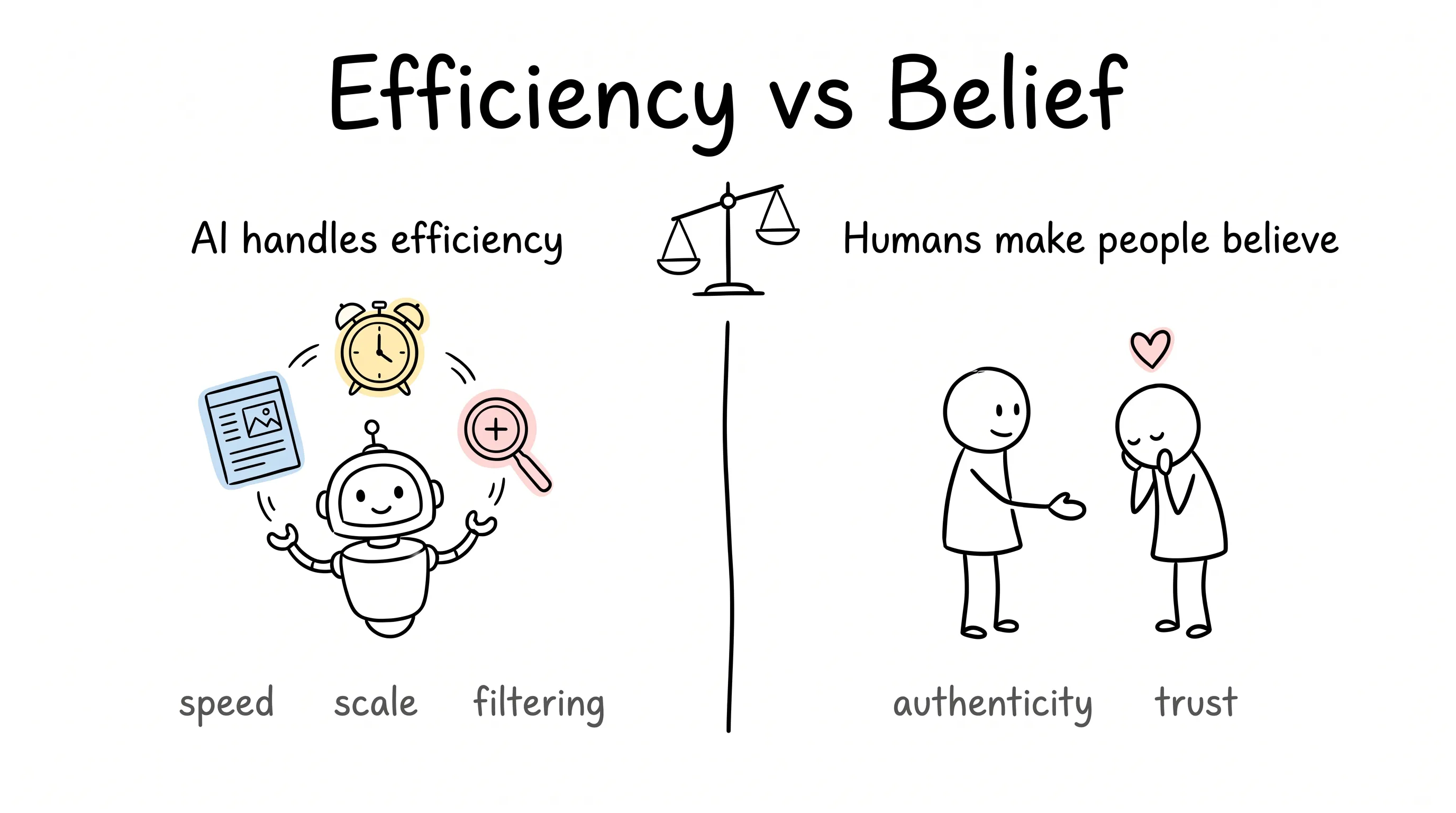
Scarcity is what makes things valuable. When everyone can generate a thousand pieces of content overnight, the value of any single piece falls. At that point, what's scarce is no longer "content" — it's authenticity, it's trust, it's the person willing to make one piece of content solid for you.
AI handles efficiency. Humans make people believe.
Back to the number at the beginning
Five years. Fivefold.
I can't tell you who will finally win at this table. But one thing I'm fairly sure of: what gets eliminated won't be "humans" — only humans who don't know how to use AI.
My wish for you: in this fivefold wave, be the one AI amplifies, not the one swapped out for a cheaper substitute.
Continue reading
Related articles

What Is AI Marketing Automation? It Starts With a 40-Point Gap
A learn article explaining what AI marketing automation is: how learning-based systems differ from rule-based automation, how AI decisioning optimizes message, channel, and timing choices, what data it depends on, and where it applies across the customer lifecycle.

It's 2026: Stop "Buying" AI Tools for Your Marketing Team — Start "Hiring" AI Agents
This learn article explains how AI agents differ from standalone AI tools in marketing, outlines three agent categories — build-your-own platforms, CRM-native agents, and vertical tools — and covers use cases across SEO, social media, advertising, and reporting, plus criteria for choosing one.

What Is an AI Marketing Agent? From "Using AI" to "Delegating to AI"
A learn article explaining what an AI marketing agent is, how it differs from rule-based automation, and which repetitive tasks such as lead qualification, reporting, and campaign monitoring can be delegated while humans keep key decisions.