
Everyone's Asking AI Now — Is Your Content Keeping Up? Let's Talk GEO
A learn article on how AI-driven search shifts content goals from rankings to citations. It distinguishes LLM SEO, GEO, and AI SEO, and suggests question-style headlines, topic clusters, Reddit and Quora participation, trust building, tracking AI citations, and new KPIs such as citation share, visibility, and brand.
A couple of days ago, a friend who has been doing SEO for eight years invited me out for tea. His first words as he sat down: "Run, have I been wasting my time?"
I asked what happened.
He told me: his site had climbed into the top three of the search results, yet traffic was slipping. Nothing in the analytics looked wrong. Then he tried searching in ChatGPT and Perplexity — a user asks a question, and the AI just answers, full stop. No clicks at all.
He looked lost: "Everyone's gone off to ask AI. Who am I optimizing for?"
He's hardly the only one asking. Lately I've heard this question over and over. As it happens, I once had a long, deep conversation with a peer at Hostinger who works on organic traffic, and their own team has studied this whole shift in real depth. Today I'm going to break down everything worth taking away from that conversation.
Three New Terms — Don't Mix Them Up
So what is AI SEO?
Put simply: it's optimizing your website, your content, and your brand so that AI is willing to pick you.
SEO used to mean fighting your way onto page one of Google's search results. Now users open ChatGPT, Google's AI Overviews, or Google AI Mode, ask their question directly, and the AI hands back an answer it has synthesized on its own. Your goal has shifted from "rank high" to "get cited by AI, get mentioned by AI."
From fighting for rankings to begging for citations.
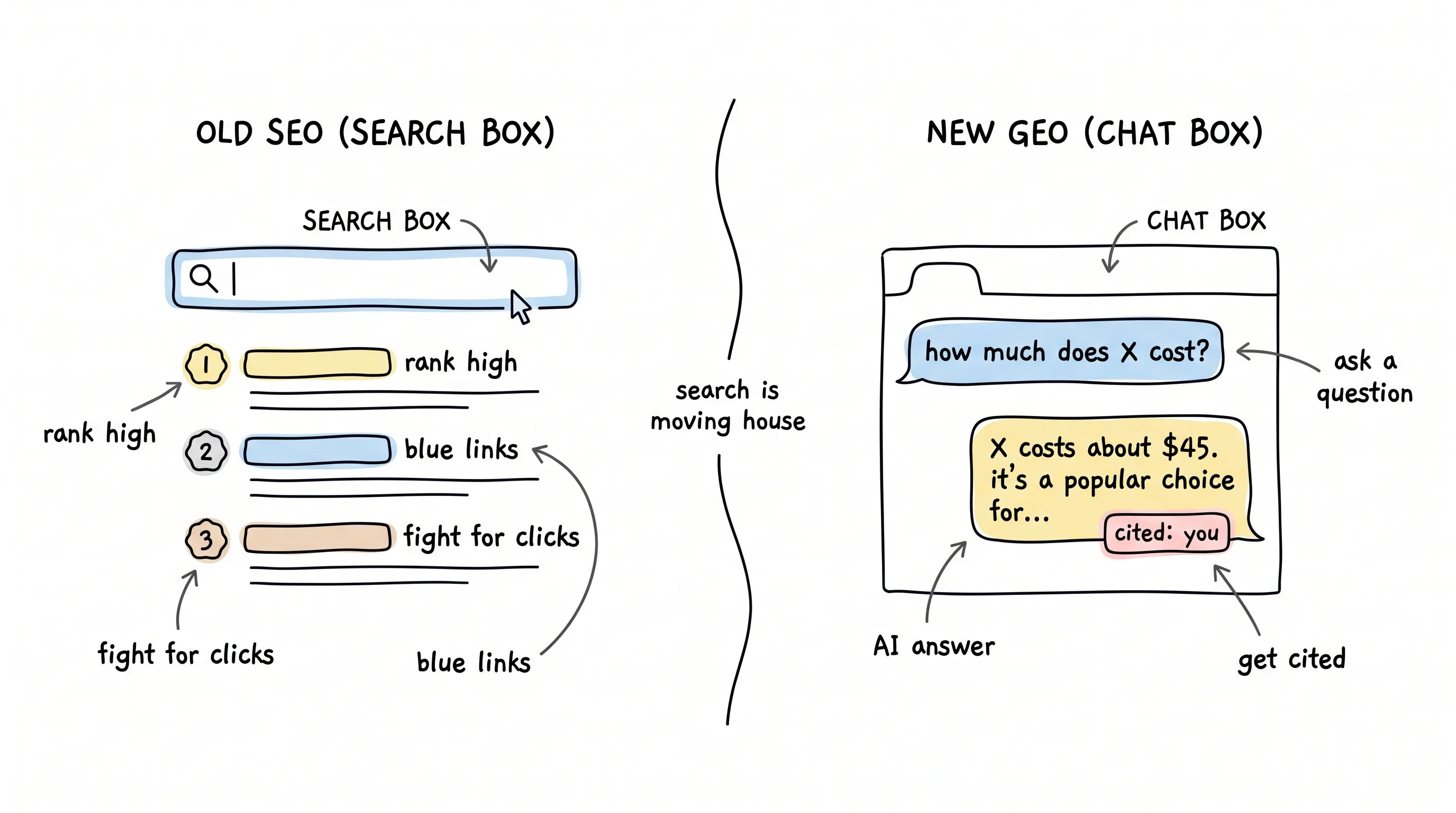
The industry is throwing around new jargon at a dizzying rate, and it's easy to get tangled. Let me straighten it out for you.
LLM SEO targets large language models themselves — how to structure your content so models like GPT can read it, trust it, and want to cite it.
GEO, Generative Engine Optimization, is aimed squarely at tools that generate answers directly, like ChatGPT and Google's AI Overviews. The term was formally introduced in a research paper in 2024, and it's only gotten hotter since.
AI SEO, the way I see it, is better treated as one big umbrella. All of the above sit under it. The core of it comes down to one thing: AI is reshaping search, and your content has to change with it.
So What Do You Change? Start With the Headlines
Where do you actually start? Honestly, the whole playbook is still evolving, but some patterns are already emerging.
First one: rewrite your headlines from "keywords" into "sentences."
Think about how you talk to AI yourself. You wouldn't type in the single word "pricing," would you? You'd type: "How much does this tool cost per month?"
Users ask complete questions. Your content should look like the questions they ask.
A landing page that just says "Pricing" leaves the AI guessing what you mean. Change it to "How much does X actually cost?" and follow it immediately with a crisp answer. Blogs are the same: swap the tired "N ways to solve problem X" for "How a beginner can fix X without hiring an expert."
Question goes in, answer comes out. AI loves that structure — because it can use it as-is.
Second one: stop counting keywords, start covering topics.
Google and the major models alike favor sites that treat a subject in depth over sites that chase trending keywords in scattered, hit-or-miss fashion.
Take an example. Say you want to own the topic "online courses." One overview article is nowhere near enough. You need a full content cluster: "What Exactly Is an Online Course," "How to Build and Sell Your First Course," "How Much Does a Course Cost to Make." One article per angle, until the topic is covered from every direction and there's no gap left.
Then the AI looks at your site and sees: this place is thorough, this place is deep. So it cites you in its answers.
Why Isn't AI Citing Me Yet, Even After I've Changed Everything?
My friend asked me this too: he'd done it all, so why was he still absent from AI answers?
A few common reasons.
Your domain hasn't built up authority on the topic yet. AI trusts established brands and long-standing sources; a new site needs time to simmer.
Your content is too generic — nothing original to say. Why would AI cite you?
Your updates haven't been recrawled yet. Models don't read your site in real time. Wait.
You lack third-party validation. If no reputable site has ever mentioned you, the AI has no idea whether you're worth trusting.
The Biggest Overlooked Steal: Reddit
Of everything from that conversation, the single most valuable piece of advice was this: go do Reddit.
SEO people never used to look at Reddit at all. But the situation has changed. In 2024, Google and then OpenAI signed data licensing deals with Reddit. Which means the discussion threads on Reddit — even a user casually mentioning a brand in passing — are being fed straight into the answers of ChatGPT, Perplexity, and platforms like them.
Wow — there's a lot packed into that one fact.
The training data behind AI models is stuffed with this kind of real-user conversation. Whether your brand gets discussed on Reddit, and whether the talk is good or bad, directly shapes how AI "introduces" you.
If your brand has no footprint on Reddit yet, now is exactly the right time to fix that. The goal is not to run ads. It's to slip into the real discussions and answer questions earnestly, help people, share.
By the way, the same logic applies to Quora, LinkedIn, and other communities. AI scavenges for material everywhere — so you have to leave material everywhere.
So How Do You Build Trust?
What counts as trust, though? In the old SEO days, authority was roughly equivalent to backlink counts plus content coverage. The standard has changed now.
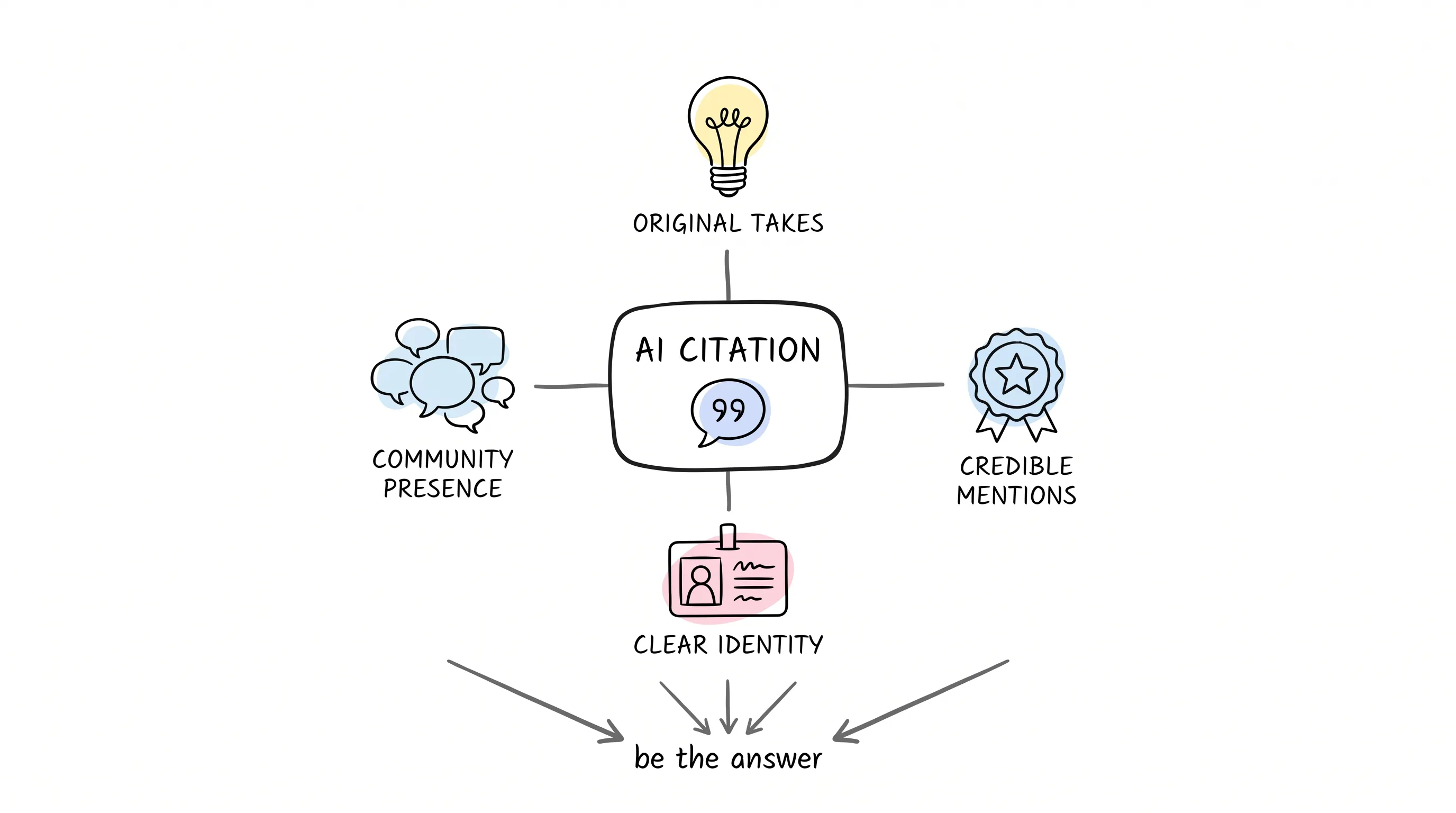
Authority is being the source that both AI and real users are willing to treat as the answer.
How do you build it concretely? Four things.
First: only publish what you have an original take on. Industry analysis, first-hand experience, hard-won lessons from your own mistakes — even written loosely, that's fine. Take content that already exists online, give it a cosmetic rewrite, and ship it — AI can spot rehashed material better than anyone.
Second: get the credible places to mention you. Being cited or interviewed by industry sites, weighty blogs, and serious creators is your credit history as far as the AI is concerned.
Third: show your identity clearly. About pages, author bios, structured data (schema) — spell out "who you are and why you're worth trusting."
Fourth: hang out where the people are. Reddit and Quora as mentioned above — go answer questions, go help. When people trust you, AI trusts you.
How Do I Even Know If AI Is Citing Me?
Tracking is a headache. The traditional SEO toolkit doesn't quite cut it here. A few low-tech methods, plus some new ones.
The manual method: periodically open ChatGPT and friends, ask questions related to your business, and see whether you show up in the answers. Crude, but it works.
The tool method: a batch of new tools has already sprung up specifically to monitor "how often your brand appears in AI answers." The veteran SEO tools are following suit — Ahrefs, for instance, has launched a feature called Brand Radar that tracks brand mentions across AI platforms.
The data method: watch two kinds of traffic. One is referral — some AI platforms pass along source information, so check whether unfamiliar referrers are showing up. The other is direct — some AI platforms don't pass source data, and their clicks get lumped into "direct visits." If your direct traffic jumps for no obvious reason, AI might be the one sending people your way.
And the KPIs? The old standbys (organic traffic, keyword rankings) still matter, but they're no longer enough. The new scoreboard has a few new line items:
Citation share: how many times your links get cited in AI answers.
Visibility score: how often your brand gets mentioned across the various AI platforms' answers.
Brand sentiment: when AI talks about you, is it saying good things or bad things? Any factual errors? This one is especially worth watching. If AI gets you wrong, you need to find a way to correct the record.
AI Overview appearances: how many Google AI Overviews your website has shown up in.
Should You Do This? Don't Hesitate
Some will ask: this whole thing is still evolving — shouldn't I wait until it settles down before jumping in?
My answer is blunt: start now.
AI search is, at bottom, insurance on your brand's visibility. When users want a quick answer, want to compare prices, want to do their homework, more and more of them reach for AI first, not the search box. If your content isn't optimized the way AI reads, then even with traditional SEO maxed out at its ceiling, you simply don't exist in the new answers.
Search is moving house. Your brand has to move with it.
What Happens Next?
Two things are worth preparing for in advance.
One: AI agents. Google, ChatGPT, and their peers are evolving from "answering questions" into "doing things for you" — booking tickets, placing orders on your behalf. When that day comes, your website won't just need to be readable by humans; it will need to be operable by AI. Your booking flow and checkout flow have to be walkable by a machine.
Two: multimodal answers. AI will no longer spit out text alone. Images, video, charts, and code will get mixed into answers automatically. Your visual content and interactive content need to start being optimized in ways AI can understand, too.
So will Google be replaced outright?
Hard to say. But my read: no — not anytime soon.
Traditional search remains strong for navigational queries, broad exploration, and discovering diverse content. And Google itself is frantically rebuilding, stuffing AI in at every turn. Most likely, the future is a hybrid: AI handles the answers, traditional search handles the exploration, and the two complement each other.
The Ending
That day, by the time the tea was finished, the friend picked up the bill. As we left, he said: "Got it. SEO isn't dead — search just changed the way it lives."
Yeah.
Where the users go, optimization goes. Users used to live in the search box; now they live in the chat box.
Someday, your customer will turn to AI and say: find me a reliable X service. And the AI will say a name.
I hope that name is yours.
Continue reading
Related articles

It's 2026: Stop "Buying" AI Tools for Your Marketing Team — Start "Hiring" AI Agents
This learn article explains how AI agents differ from standalone AI tools in marketing, outlines three agent categories — build-your-own platforms, CRM-native agents, and vertical tools — and covers use cases across SEO, social media, advertising, and reporting, plus criteria for choosing one.

What Is GEO? How Your Brand Gets "Mentioned" in the Age of AI Search
An explainer on GEO (Generative Engine Optimization) for e-commerce and DTC brands: how it differs from SEO and AEO, why AI answers shape brand visibility, and eight practices covering question-focused content, consistent brand messaging, structured pages, external evidence, comparisons, and AI mention tracking.

AI Is Already Making Decisions for Your Customers. Are You on the List?
A learn article explains GEO (Generative Engine Optimization): why AI-generated answers now shape which brands customers see, and how SEO fundamentals, entity clarity, citable evidence, and monthly measurement affect visibility in AI answers.