
Even the Smartest AI Needs the Business Know-How in Your Head
A recap of a BoxWorks conversation between NVIDIA's Jensen Huang and Box CEO Aaron Levie. The article argues current models already do useful work, and covers supplying your own business knowledge, context engines, agent processes, permissions, and how saved time is spent, with four starting steps for marketers.
A few days ago, I watched a conversation. Jensen Huang of NVIDIA and Aaron Levie, CEO of Box, talked about AI at BoxWorks.
After it ended, one image kept playing in my head:
A Ferrari parked in your driveway. And there you are, standing in the garage, agonizing over whether to upgrade to a better engine next year.
The car is right there. You're not driving it.
That's what AI looks like to a lot of businesses today. The models are already good enough — good enough to do real work. And yet you're still waiting, waiting for the next big breakthrough.
Huang put it plainly: today's models can already do useful work. He compared this stage of AI to the early personal computer, to the first iPhone. People found uses for those technologies long before they became as powerful as they are today.
Why did they get adopted? Because the people using them brought something the machine didn't know.
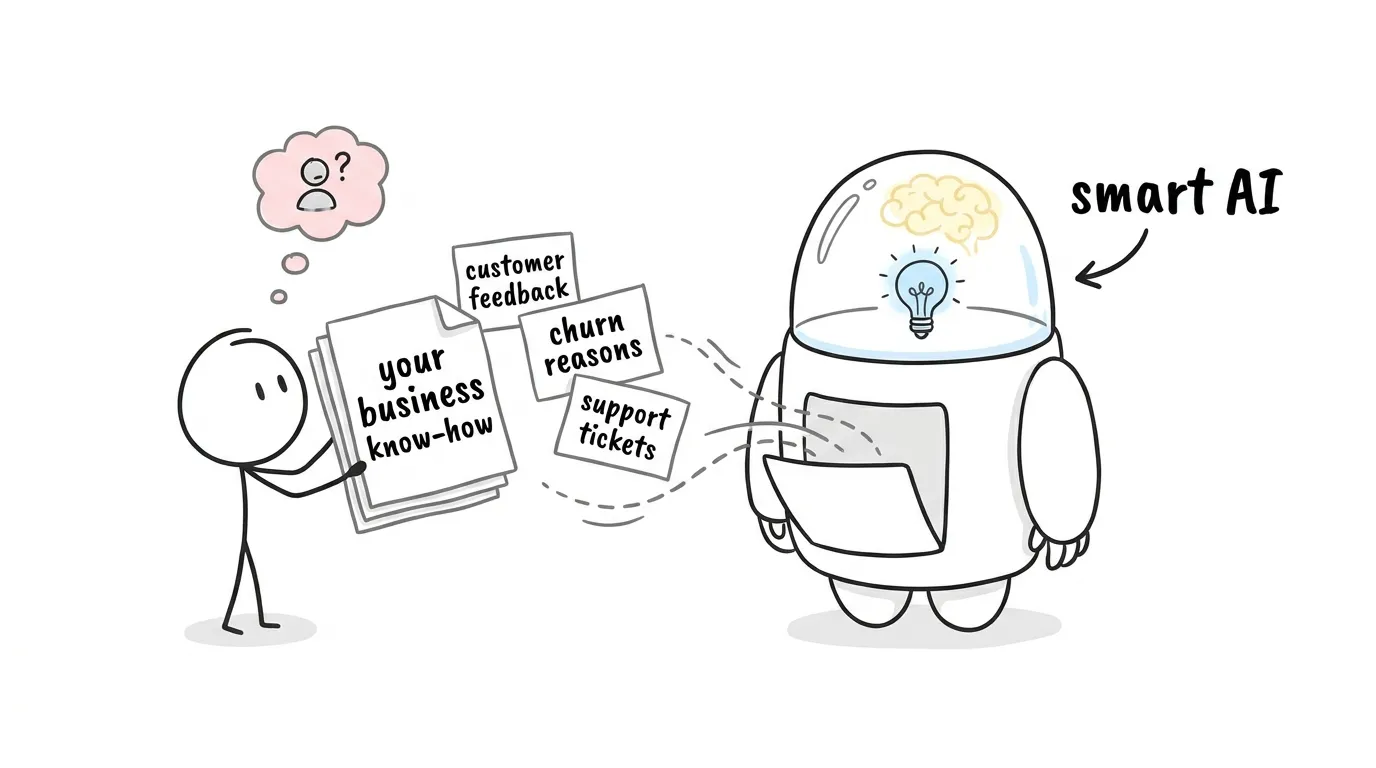
For a business, what is that thing? It's the business know-how in your head.
Your Most Valuable Knowledge Is Asleep in a Pile of Files
Let's do some math first.
Over the years, how much have companies spent on customer research, feedback collection, analysis reports? Hundreds of thousands, even millions of dollars — not unusual.
And then? Those files sit on servers, unopened.
When a decision needs to be made, who goes digging for a customer survey from three years ago? Nobody. Everyone decides by gut feel.
I've seen too many companies pay for insights and then fail to use them at the moment of decision. Painful? Yes. But that's reality.
It's even more true for AI. Feed it nothing, and all it can give you is generic talk. It doesn't understand why your customers leave, or why your loyal ones stay. Because it has never seen any of it.
AI isn't short on intelligence. It's short on being told who your customers are.
Take customer retention. Ask AI "how do I improve retention," and you get an answer that could apply to any business on earth. But change the question — feed it a year of customer feedback, support tickets, and churn reasons, and ask it to find the recurring problems.
The difference shows up immediately. The first answer is copied from the internet. The second is computed from your own ledger.
Where's the difficulty? In finding the material. Most of it is unstructured data — not in spreadsheets, not in databases, scattered across folders, emails, and assorted reports. Assembling one useful package can take half a day of digging.
What Is a "Context Engine"? The Librarian for AI
So how do you get AI to find the few useful documents in a pile of files?
In that conversation, what stuck with me most was a concept: the context engine.
What is a context engine?
When you go to a library, do you want the librarian to pull out the few relevant books, or do you want to haul the entire library home?
The former, obviously.
A context engine is the librarian for AI. It helps an agent find the relevant information, instead of stuffing every document into it to read.
The numbers are striking. Huang mentioned that Box's context engine can cut an agent's token consumption by as much as 90%.
Ninety percent.
But let me pour half a bucket of cold water on that: don't treat the number as a promise. It depends on the task, the configuration, the material you're working with. Your number will most likely not be 90%.
But the direction is clear: the less irrelevant material an agent reads, the faster the task, the lower the cost. That's arithmetic, not mysticism.
Huang also noted that advances in NVIDIA's compute will keep driving processing costs down. For the rest of us, there's only one question: when you run the numbers for your specific use case, does it pay off?
Don't Let AI Improvise. Give It a Job Description.
Next, I want to talk about something easy to overlook.
Huang compared the model to a brain, and the supporting systems to a "harness" — the body. However smart the brain, without a body, without access to company knowledge, without tool permissions, it can't get anything done.
I couldn't agree more.
Take an agent that handles order issues. It can look up a customer's history, check shipping status, and then resolve the problem for you. If things get complicated and a human needs to take over, the agent can organize the background material so the customer doesn't have to explain everything from scratch.
Good. That's what agents should do.
But I don't want an agent inventing a new process on the fly every time it gets a request.
Take customer onboarding. Collecting information, creating accounts, scheduling calls, updating records. These steps should be defined clearly by the business itself — which actions require human approval, spelled out in black and white.
Or take a company that designs kitchens and bathrooms. It could use an agent to gather client preferences before a consultation, organize project details, and prepare routine follow-ups for human review.
And the designer? The design is still done by the designer. The decisions? Still made by the boss and the team.
What the agent takes over is everything that eats their day: scheduling, hunting for files, sending follow-ups.
The brain you can buy. The process has to be homegrown.
The Day the Veteran Leaves, the Answers Walk Out With Them
One more thing Huang raised that I think deserves its own section: institutional memory.
What is institutional memory?
A team solves a customer problem once and records the solution. Six months later, another agent runs into a similar problem and pulls it up to use.
Sounds simple. But have you thought about what it actually saves you from?
It saves you from the day the veteran leaves — and the answers walk out the door with them.
It's too common. One person leaves, and the whole company knows "he definitely knows how to handle this" — but nobody knows where to find it.
So: write down the problems you've solved. You're leaving a lifeline for your future self.
That said, writing it down isn't the end of the story. Someone has to check: is this still accurate? Still current? An outdated policy doesn't automatically become useful just because an agent can retrieve it at lightning speed.
A document retrieved faster is still an old document.
What AI Can See and What It Can't Touch: Decide First
Here's my advice to every business:
Do not connect an agent to your company files before you've thought through what it's allowed to see and do.
In the conversation, Huang and Levie talked about how Box protects business information, and about NVIDIA's OpenShell — a more secure environment for running agents. Huang emphasized one term in particular: zero trust.
What is zero trust? Here's an analogy.
When you hire an accountant, do you hand over every employee file in the company? Confidential contracts? No. You grant access based on the job they do.
Agents are the same. They're the new hire. What makes them all-knowing?
So: scope permissions by role, keep an eye on activity, and keep a brake you can slam at any moment. And be explicit about which actions require human approval.
Trust is designed. It is not default.
Buy the Oven. Guard the Family Recipe.
So for a business adopting AI: buy off the shelf, or build your own?
Huang's advice: use general-purpose models, then specialize around your own expertise.
I strongly agree, and I have an even simpler way to put it —
The restaurant analogy. Buy the oven. Guard the recipe.
Any oven will do — just buy one. But the family recipe is everything that makes you different from the shop across the street. That, you keep in your own hands.
A business doesn't need to build every tool it uses. But it must know: which part of its knowledge makes it different from competitors.
The conversation also mentioned open-source models as one option for customization. But a word of caution: that doesn't mean every small company needs to hire engineers or train its own models. Don't be intimidated.
You only need to answer one question: What does our team know that a general-purpose model will never know?
Answer that, then figure out where it can help you do the work better. That's enough.
The Time You Save: What Will You Do With It?
At this point, I want to ask you an uncomfortable question.
If AI really saves you time, what will you do with it?
Huang made a point I like: productivity gains shouldn't be measured only in time saved or money saved. They can also free up room for the team to do things it couldn't afford to do before.
What does that mean?
A marketing team used to have time to deep-dive only three campaign ideas a week. With AI helping, maybe five, maybe eight.
But what I care about isn't the extra few. It's whether the extra ones made the decisions better. If all you produced was more discarded drafts, the time saved was time wasted.
Huang gave the example of radiology: time saved can go to serving more patients. Note — this doesn't happen automatically. The tests that must be run, the monitoring that must be watched, none of it can be skipped.
So for marketing teams, I ask three questions:
Where did the saved time go? Into talking with more customers? Into testing an idea you never had the nerve to try? Into fixing that old problem your customers have complained about eight hundred times?
The value of AI isn't how much time you save. It's where the saved time goes.
Learning to Use AI Is Now Part of the Job
Finally, something practical.
Huang is optimistic about people who use AI well. But he didn't dodge the other side: work will change, and some people will lose their jobs.
I don't want to gloss over that.
The change is real. So what do you do? People need training and support, not a cold "you'll have to adapt." Helping less technical colleagues adopt AI and use it well is itself part of the job — and it's the part I care about most.
And you — how do you start?
You don't need to become a programmer. Just pick one task you know well enough to judge right from wrong.
Run it once with a tool, check its work, and see whether it's actually useful. That's it.
If You're a Marketer, Start With These Four Steps
I've distilled that conversation into four moves to get you started:
First, pick one customer question you've never answered well. A recurring complaint in feedback, the reasons customers churn. Purpose first, tools second. Don't reverse the order.
Second, find the information that can answer it. Pull together the relevant research and support records, check the dates, sort out permissions. A small handful of useful, fresh sources beats a folder stuffed with everything.
Third, run one task, then inspect the output yourself. Have it summarize recurring problems, or draft a follow-up email. Check it against the source material, fix what needs fixing, and only then let anyone act on it.
Fourth, decide how the saved time will be spent. I'd spend it meeting more customers, or testing an idea I never had time for. Mass-producing more content? Not on my default list.
A Final Word
For years, I've been helping businesses understand their customers. The deepest lesson:
The hard part isn't collecting information. It's getting people to actually use it at the moment they make the call.
That's why this conversation stayed with me. I wanted to see whether AI can really help a team find that research, read that complaint, and put what it learned into practice.
I no longer need the next dazzling demo.
I just want to see what's different about the customers.
Data doesn't turn into decisions on its own. Decisions are always made by people — AI just gives the people making them an open ledger at hand.
Continue reading
Related articles

What Is an AI Marketing Agent? From "Using AI" to "Delegating to AI"
A learn article explaining what an AI marketing agent is, how it differs from rule-based automation, and which repetitive tasks such as lead qualification, reporting, and campaign monitoring can be delegated while humans keep key decisions.

Marketing Automation Is Shifting from "You Do It" to "You Say It"
This article explains how marketing automation is shifting from rule-based platforms that merely execute toward AI agents that plan, create, publish, and review campaigns, covering delegable tasks, underlying technologies, tool categories, adoption steps, and risks such as privacy and automating without strategy.

When AI Does the Creative, Mistakes Come in Batches Too
A learn article on the risks of using generative AI for marketing creative across brand, legal, compliance, and operational layers, with case examples and seven practices for review, rights clearance, documentation, and vendor governance.