
Doing More Work Won't Make You a More Valuable Marketer
An opinion piece arguing that AI has made marketing execution cheap, shifting value toward judgment, accountability, and problem selection over hours worked. It also discusses changes to compensation, hiring, and management layers.
The other day, I handed a task over to AI.
Old me would have needed most of a day—a senior marketer's worth of hours. AI gave me a first draft in a few minutes. Sometimes it was scarily good. Sometimes it was wrong with total confidence.
Either way, the starting line just moved.
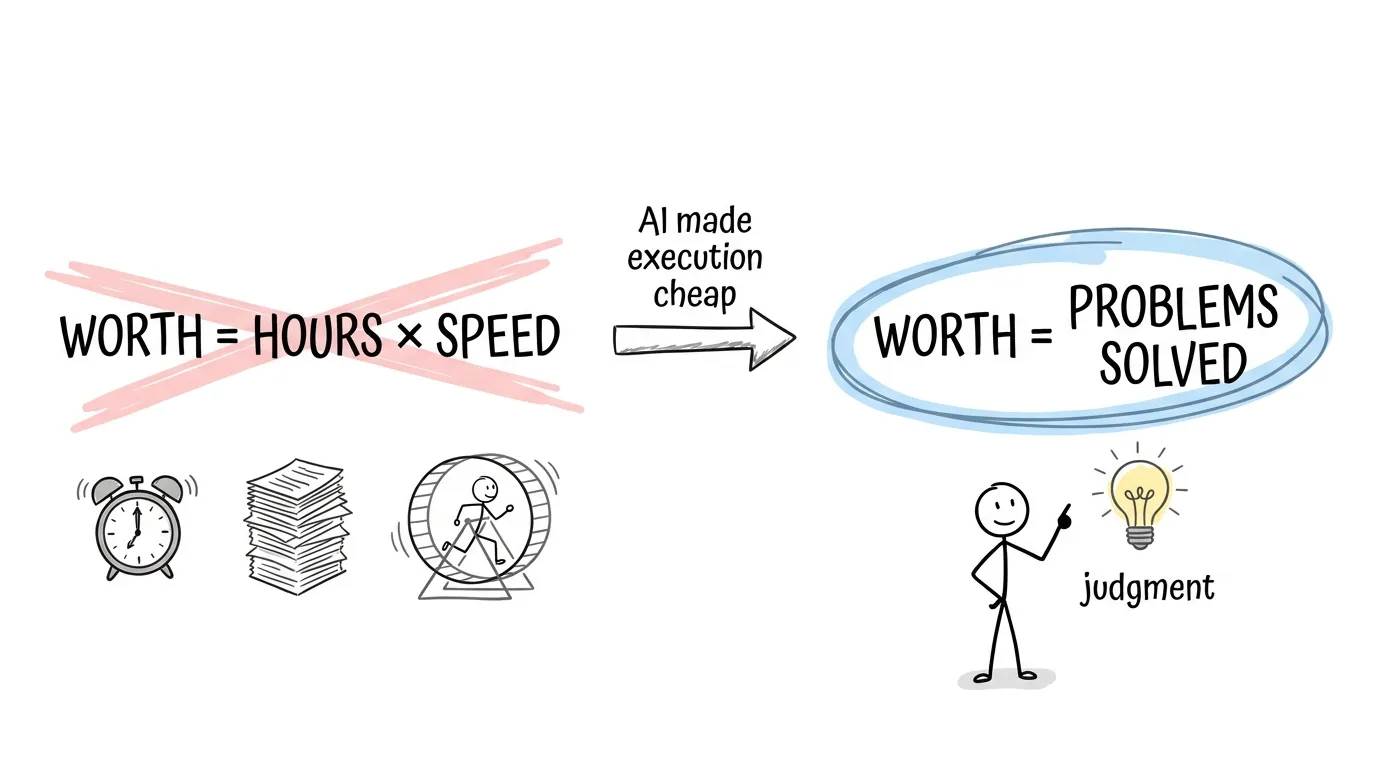
I run marketing at Devart and TMetric. Twenty years in, I believed in one equation: the more you know and the faster you work, the more you're worth.
AI just crossed that equation out.
Why? Because AI made execution cheap. And cheap things don't command a price.
Experience Is No Longer What You Sell
What counts as execution? Writing plans, building reports, setting up campaigns—the "roll up your sleeves and do it" work.
That used to be hard currency. A person with 15 years of ad experience? You never questioned their skill. You just trusted them, no questions asked.
Now? Anyone willing to spend a bit of effort learning the tools can access knowledge that used to take years to accumulate.
There was a study that ran an experiment with Boston Consulting Group (BCG) consultants. The results were interesting: on tasks AI handles well, the people using AI performed noticeably better.
But the second half of the finding gets far less airtime: on tasks AI is bad at, the people relying on AI did worse than those who didn't use it at all.
What does that tell us? However fast the tool, it can't decide for you which problem to solve.
Here's an example. The company says: we need more leads. With AI, the team spins up campaigns, churns out content, and iterates landing pages at blistering speed. But AI won't stop and ask: does this company actually have a leads problem? And it can't come up with the one idea that actually moves the numbers.
That's the gap between "busy" and "results." AI can only help you shorten the first half.
The World Economic Forum expects that by 2030, 39% of workers' core skills will have changed or become outdated. Tools will keep changing. But "judging which problem is worth solving" ages much more slowly.
Clients Buy Outcomes, Not Your 40 Hours
Let's do the math.
Two consultants, same problem. The first one digs through research, runs the data, writes recommendations—40 hours. The second one hands most of the research to AI, spends 8 hours verifying, and delivers an equally good plan.
Should the second consultant get paid a fifth of the fee?
I don't think so. The client is buying "the problem got solved," not 40 hours of your life.
But look at how compensation actually works: monthly salaries, hourly rates, utilization, the 40-hour week. Why? Because time is easy to count and value is not. And the moment AI arrived, the absurdity of measuring contribution in hours was exposed for everyone to see.
What worries me is the opposite kind of company: work that used to take a week now takes a day, so let's have people do five times as much.
That's taking a great tool and turning it into a shackle.
Here's an ironic one: I sell a time-tracking product (TMetric), and I don't believe hours should measure anyone's worth. But I'd still urge you to start logging your time now—not to catch anyone slacking, but to note how long your routine work takes today. Six months from now, that's how you'll be able to say exactly how much AI has eaten.
Another example. A monthly-retainer agency: a client report that used to take a full day now gets done in an hour with AI's help. The client notices nothing—only that the report looks a bit nicer. Without time records, even the agency itself doesn't know: the margin moved. By how much? Nobody can say.
Time data tells you cost. Results tell you value. You need both.
But what I'd rather see you do with those two numbers is cut the meaningless work—not confirm that everyone is busy every single minute.
Being busy is not a business model.
Every Role Is Becoming a Business Partner
If you get paid on results, the shape of your work changes too.
In Microsoft's 2025 Work Trend Index, 83% of leaders said AI will have employees taking on more complex strategic work earlier in their careers. The 2026 report puts it even more bluntly: as agents take over more execution, critical thinking and quality control matter more.
What do I mean by business partner? Someone who isn't responsible for a task list, but for a business problem.
Their brief isn't "write 12 blog posts this month." It's "this quarter, drive 30% more qualified pipeline for this product, with cost per unit under $500." Which plays to run, where to use AI, where to bring in experts—they decide. If the numbers don't move, they own it.
For this kind of person, the more you know, the better. A marketer who understands positioning, and media buying, and analytics, and pricing, and unit economics can use AI to do what used to take several specialists. Not mastery of everything—the ability to connect the dots is what's valuable now.
Hiring is changing too. A fast-growing B2B company might need a head of marketing, but not for 40 hours a week. Maybe 10 to 15 hours, plus a small execution team, plus AI. That's enough. So that head of marketing can serve two or three companies at once.
Upwork's 2026 Future Workforce Index found that 38% of high-skilled knowledge workers surveyed in the US are freelancing. A year ago, that number was 28%.
What does that mean? A full-time seat is no longer the only option for smart people.
My guess is pay will follow: consulting fees, project fees, bonuses tied to numbers that actually move—replacing the monthly salary that assumes you're selling hours by default.
Messy? Very. A head of marketing can't save a bad product or a dead market, and fights over who carries that blame will be epic. But I'd rather have that mess than pretend every important role requires someone sitting at a desk all day.
Oh, and here's the uncomfortable part: if you're still waiting for your manager to slice work into small tasks, then executing a badly written brief word for word without ever asking why—I have bad news. Nobody will need that person.
Learning AI is the same. Waiting for your company to train you? The person next to you is already using it, and nobody's going to pause and wait. Raise your hand first. Push AI into everything currently on your desk. The more you practice, the further ahead you get.
We Don't Need That Many Managers Anymore
Those of us in management weren't exactly eager to say this out loud.
A big chunk of traditional management is, at its core, "coordinating execution": breaking down tasks, assigning work, chasing progress, passing messages up and down. Once AI does the execution and people answer directly for results, that coordination becomes unnecessary.
The signals have been there for a while.
In 2024, Gartner predicted that by 2026, one in five companies would use AI to flatten their organizations, cutting more than half of middle-management positions. Revelio Labs, a hiring-data company (cited by Korn Ferry), shows recruiting for middle-management roles down more than 40% since 2022. And the managers who remain are managing more people: per Gallup, in 2025 the average manager has 12.1 direct reports, up from 10.9 a year earlier.
The big companies moved first. Amazon is requiring the ratio of individual contributors to managers to rise by at least 15%. Google cut 35% of its managers who had fewer than three reports, many of them moving back to hands-on roles. And it's not just tech giants: in a Korn Ferry survey of 15,000 workers, 41% said their company had cut management layers in the past year.
This May, Cloudflare laid off 20% of its employees. CEO Matthew Prince wrote a line that stuck with me:
"The majority of those we let go last week were 'measurers.'"
The people who build things and the people who sell things, kept. The people who measure people, gone.
Management won't disappear, though. Setting direction, making trade-offs, developing people, standing in front when things go wrong—someone has to do that. But the managers who stay will look more and more like a "playing coach": carrying a business result themselves, leading a few partners who can each hold their own.
What will disappear is the layer that mainly forwards the status report.
But there's a dangerous question hiding in here: if AI swallows the entry-level work, and companies cut the very managers who were supposed to develop newcomers—where does the next generation of senior people come from?
I don't have an answer to that yet.
So What Do We Actually Get Paid For?
If AI changes who's valuable, then hiring and evaluation have to change too.
How would I change interviews? No more "how many years of experience," "how many tools." I'd give a candidate a real business problem and ask: what data do you need? Which assumptions would you challenge? How would you get to the answer? And I'd encourage them to use AI—then follow up with: why should anyone trust what AI gave you?
That reveals far more than "how many years have you been on this platform."
Evaluation is the same. Picture someone who automates a process that eats 20 hours a week. What happens to those 20 hours? Do you hand them a bigger problem to chew on, or quietly pile on five times the workload? Whichever a company picks tells you whether it actually cares about results—or just about the office looking busy.
Full-time jobs won't vanish next year, and experience won't suddenly be worthless. But the scale is tipping: execution keeps getting cheaper, while judgment, accountability, building systems that run without you, staying clear-eyed about AI's output, and real creativity keep getting more expensive. And by creativity I don't mean drawing pictures—I mean new ideas, new ways of cracking a problem.
Think about it: isn't work splitting into two halves? Either you work with your hands, like a plumber, doing the physical things AI can't touch; or you work with your head, producing not mechanical repetition but real business results. The middle stretch is disappearing. And if most of your work is low-barrier execution, I have to say something painful.
I'm not worried about AI replacing people who think. It replaces the jobs that never required thinking in the first place.
The abilities that got you here may not keep you valuable five years from now. Stop asking how much work a person can stuff into 40 hours a week. Ask instead: what problems can they solve? Is the business genuinely better off with them?
That's where the money will be.
Here's to always standing on the side of the problem, not the side of the task.
Continue reading
Related articles

What Is an AI Marketing Agent? From "Using AI" to "Delegating to AI"
A learn article explaining what an AI marketing agent is, how it differs from rule-based automation, and which repetitive tasks such as lead qualification, reporting, and campaign monitoring can be delegated while humans keep key decisions.

Marketing Automation Is Shifting from "You Do It" to "You Say It"
This article explains how marketing automation is shifting from rule-based platforms that merely execute toward AI agents that plan, create, publish, and review campaigns, covering delegable tasks, underlying technologies, tool categories, adoption steps, and risks such as privacy and automating without strategy.

When AI Does the Creative, Mistakes Come in Batches Too
A learn article on the risks of using generative AI for marketing creative across brand, legal, compliance, and operational layers, with case examples and seven practices for review, rights clearance, documentation, and vendor governance.