
Does Your Website Still Recognize Your Guests?
An educational article on AI website personalization for DTC sites, explaining real-time behavioral data, built-in platform AI such as Shopify Magic and Adobe Sensei, and a three-step starting approach.
Let me start with a small story.
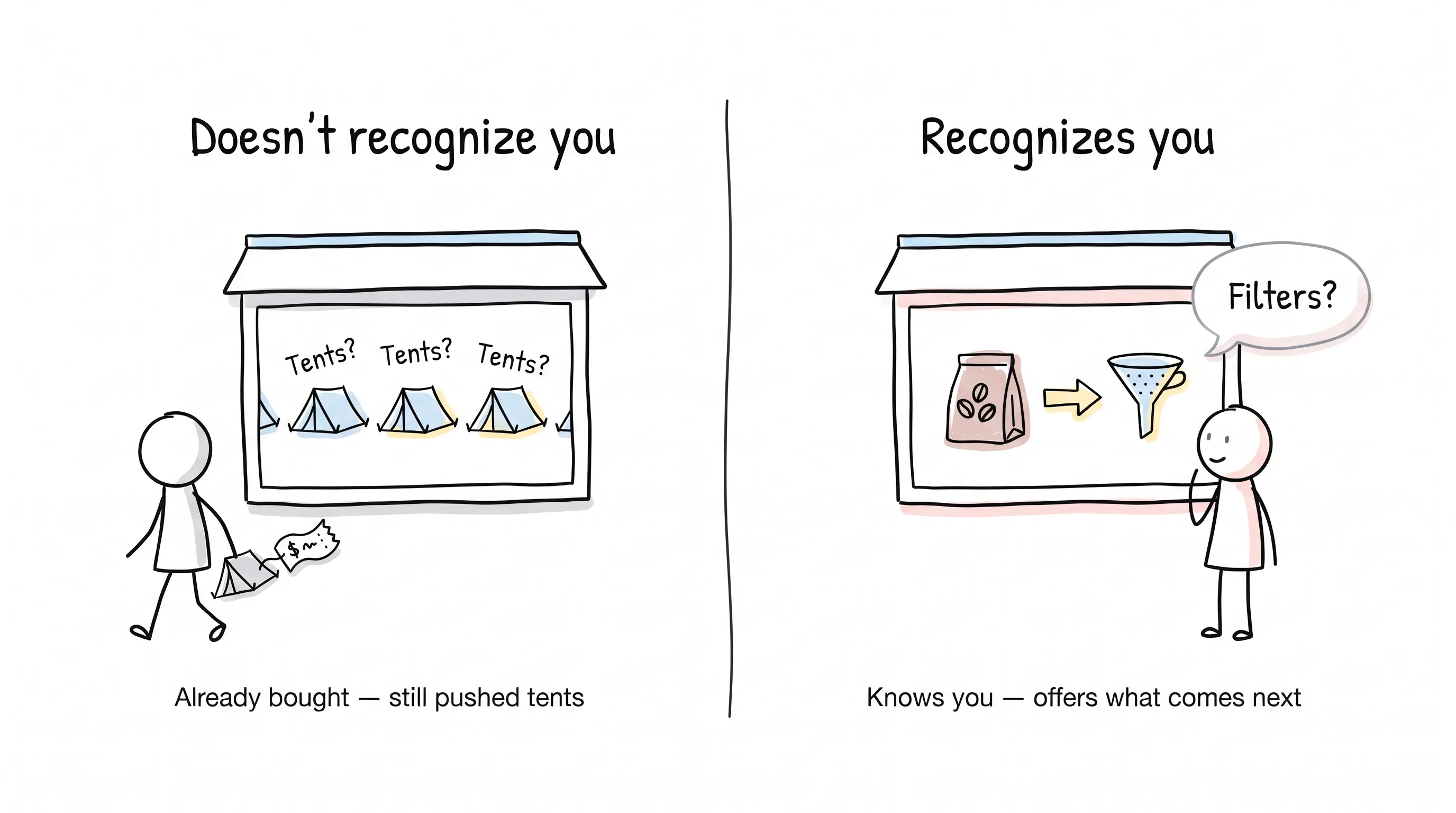
Last month, I looked at a tent on an e-commerce site. I spent a long while on it — comparing prices, reading reviews, doing the math on dimensions — and finally placed the order.
Then, for the next week, the site kept recommending tents to me.
Tents of every kind. Tents everywhere.
But I had already bought one. It didn't know that.
You've been there too. Get a new phone, and the app keeps pushing the old model; pay your rent, and your bank is still pitching you a "rent installment plan."
This is the real state of many websites today: a greeter standing at the door, bowing to every visitor with the exact same welcome line.
What Is AI Personalization?
Let's get the concept straight first. What is AI personalization?
Put simply: you make your website recognize people.
When you show up, it knows what you've looked at, what you've bought, and which pages held your attention longest — and it adjusts on the spot: the products it recommends, the search results it serves you, the offers it extends — all of it belongs to you alone.
For a decade or more, companies have been shouting about "a different experience for every visitor." AI is what makes it actually doable for the first time.
Three things fit together to make this work.
First, real-time behavioral data. Every click, every swipe, every hesitation is a clue.
Second, machine learning. The model finds patterns in the clues: people who buy coffee beans will most likely buy paper filters next month.
Third, the AI capabilities already built into your platforms. This is the part many people don't know. Quite a few of the site-building and marketing tools you use today come with AI inside. Adobe Sensei, Shopify Magic, Optimizely's Opal, and search specialist Algolia all do this. You don't have to train a model from scratch — just as you don't have to grow your own rice to cook dinner.
The Math Works
The concept sounds lovely. What matters is the ledger.
There's a company called OneMagnify — a firm that specializes in digital marketing for brands — and it has spent years building exactly these kinds of systems for clients. Its numbers: visitors who receive AI recommendations convert at rates 10% to 30% higher; brands running dynamic recommendations and personalized promotions see revenue 35% higher; AI service bots can deflect as much as 47% of service requests.
These are a vendor's own numbers, so you don't have to take them all on faith.
But there's a plainer piece of math you can do yourself.
Say your site gets 10,000 visitors a day with a 2% conversion rate — 200 orders a day. Personalization nudges conversion to 2.5%: 50 extra orders a day. Over a year? More than 18,000 extra orders. You barely spend anything more — you've simply changed "show tents to everyone" into "show people what they might actually buy."
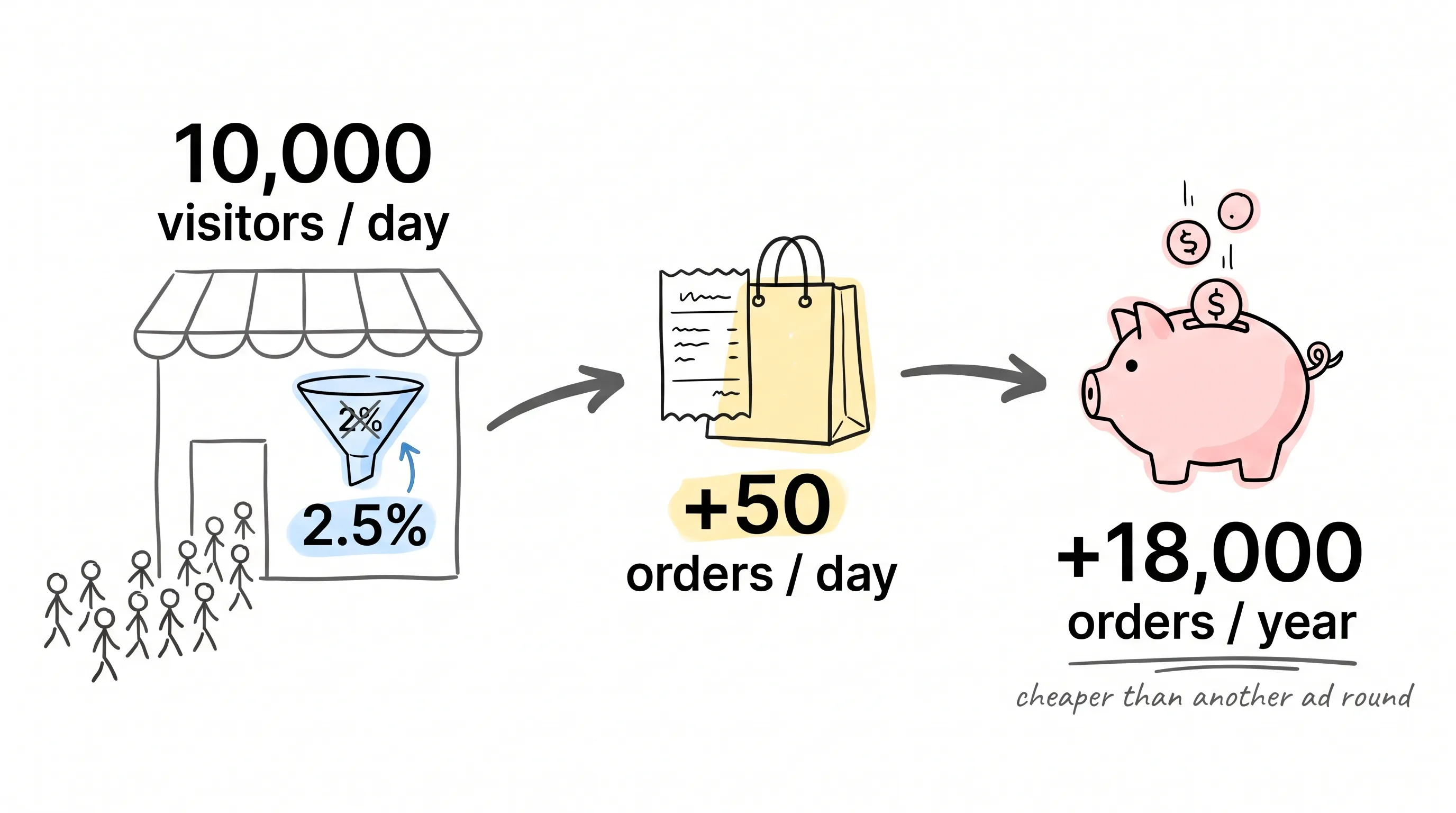
Good grief — that's far cheaper than running another round of ads.
One Engine, Different Vehicles
Retailers know personalization best: product recommendations, add-on suggestions, search suggestions — that's all personalization at work.
But it goes far beyond retail.
Hospitals and pharmaceutical companies use it to straighten out their processes, so supply chains and partners can see clearly and keep up.
Banks use it to figure out what you might need right now, and hand it over gently at the right moment. Trust gets built exactly that way — a little at a time.
B2B manufacturers and software companies use it to qualify leads. Which white paper did a visitor read on your site, what materials did they download — AI can gauge how far that prospect is from signing, and which account sales should chase first.
The same technology: retail uses it to sell more, finance uses it to earn trust, B2B uses it to save salespeople's time.
Where Do You Start?
Don't rush out to buy tools first.
Step one: find where your visitors struggle. Every website has spots that make people frown — things they can't find, forms they can't finish, pages they can't understand. Hunt them down one by one — that's your opportunity list.
Step two: put the AI already in your platform to work. Forget in-house development for now; use the capabilities growing out of the tools in your hand, and get recommendations, search, and content working end to end.
Step three — the easiest step to fumble: tend it like a plant, not paint it like a wall. Painting a wall is a one-time job; a plant needs attention every day. Visitors' tastes change, and the model has to keep adjusting with them.
Going live is just the beginning. Optimization is the daily routine.
Back to That Tent
Finally, back to the tent from the beginning.
To this day, that website doesn't know I've already bought. It's still passionately selling to someone who has already walked away.
And the site next door? After I bought coffee beans, it quietly suggested paper filters. I clicked. One small move — one more order from me.
The technology gap between those two websites comes down, in the end, to the gap between those two moves.
Whoever recognizes their guests keeps their guests.
May your website soon learn to recognize every guest who walks in.
Continue reading
Related articles

What Is AI Marketing Automation? It Starts With a 40-Point Gap
A learn article explaining what AI marketing automation is: how learning-based systems differ from rule-based automation, how AI decisioning optimizes message, channel, and timing choices, what data it depends on, and where it applies across the customer lifecycle.

Marketing Automation Is Shifting from "You Do It" to "You Say It"
This article explains how marketing automation is shifting from rule-based platforms that merely execute toward AI agents that plan, create, publish, and review campaigns, covering delegable tasks, underlying technologies, tool categories, adoption steps, and risks such as privacy and automating without strategy.

Rankings Are Taking a Dive, Customers Are Sprinting Ahead: This November, I Re-Ran the Numbers on AI Search
A learn article on how AI search reshapes marketing measurement, covering reported mismatches between rank-tracking tools and live Google results, ChatGPT's business profile test, single-page visitors as high-intent leads, and CRO plus GA4 tracking verification practices.