
Does AI Actually Make Money? I Opened the Books of a Dozen Companies to Show You
A learn article reviewing public results from roughly a dozen companies applying AI in customer service, sales, lending, retail, healthcare, and fraud prevention, then distilling five recurring rules for choosing first projects, measuring outcomes, and budgeting.
A while back, a friend of mine who runs a traditional business asked me: this whole AI thing — is it real money, or the emperor's new clothes? Don't talk to me about concepts. Talk to me about money.
Fine. Today I'm opening the books.
Over the past six months, I went through the public report cards of about a dozen companies. A Nordic fintech, an American bank, healthcare providers, and a little restaurant on a street in Thailand. Here's the conclusion up front: AI really is making money. But the way it makes money isn't quite what most people think.
How is it different? Hold on — let me tell you a few stories first.
One Robot Did the Work of 700 People
Sweden has a "buy now, pay later" company called Klarna. With 150 million users worldwide, you can imagine the pressure on its customer service.
They built an AI support agent on top of OpenAI's models. When the report card went up, plenty of people didn't believe it:
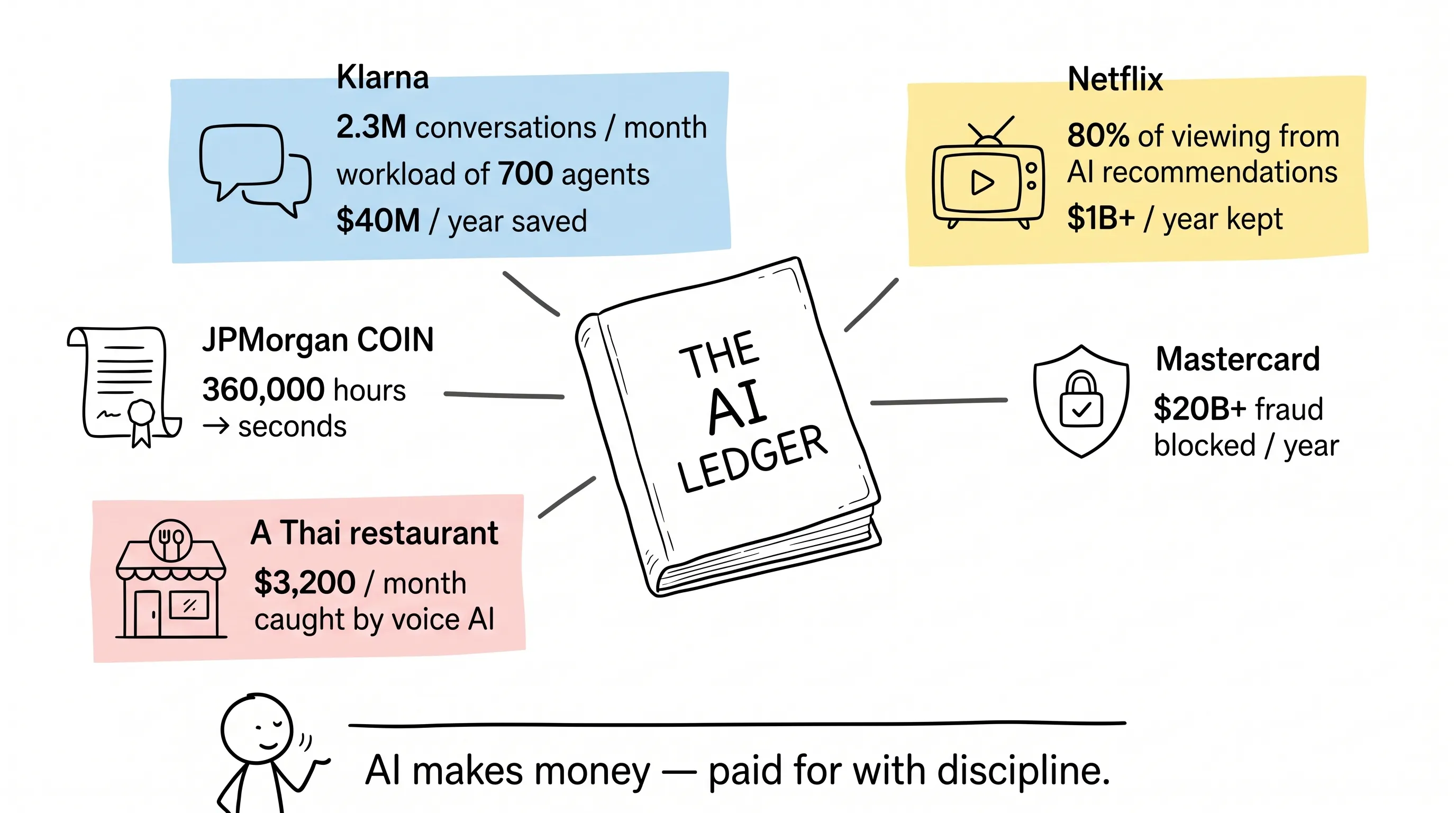
In a single month it handled 2.3 million conversations — the workload of 700 full-time agents. A question that used to take 11 minutes on average now takes 2. Customer satisfaction didn't drop; it actually ticked up slightly. Estimated savings: $40 million a year.
700 people.
Think about that: the workload of 700 customer-service jobs, taken over by a single model.
Now, don't rush to panic. What caught my eye was their playbook. It didn't start by gnawing on the hardest bones — dispute arbitration, compensation negotiations, the toughest work of all, it never touched those. It picked the high-frequency questions instead, the ones asked ten thousand times a day: Where's my order? Has my refund landed? How do I check my credit limit?
The most repetitive work goes to the machine first. Whatever it can't handle gets passed to a human.
Not an isolated case. Bank of America has a virtual assistant called Erica. Since launch, it has handled 2 billion interactions, with 98% satisfaction on completed requests, and more than 20% of the calls that would have gone to a call center get absorbed right inside the app. And it added features one year at a time — it never tried to swallow everything in one bite.
So the pattern here: AI wins at customer service through patience, not cleverness. Do the repetitive stuff first; leave the hard stuff to people.
Netflix's Snowball Has Been Rolling for Twenty Years
Now let's look at the money-making side.
Spotify's ad sales team uses Salesforce's Einstein to score leads: lead-conversion accuracy improved 40%, sales efficiency rose 25%, and time wasted on bad leads dropped 30%.
Pretty numbers. But you have to see the prerequisite standing in front of those pretty numbers: they cleaned up their customer data first.
AI amplifies a good process. It can't save a broken one. If your salespeople can't even be bothered to log customer information, even the best cook in the world can't bake bread without flour.
Netflix is a story on another level. 80% of viewing comes from AI recommendations rather than users searching on their own. Because the recommendations land and users stay longer, the subscription revenue not lost to churn each year comes to conservatively over $1 billion.
What is compounding? The better the recommendations, the more people watch; the more they watch, the thicker the data; the thicker the data, the better the recommendations. That snowball has been rolling for twenty years, growing bigger the whole way.
360,000 Hours, Compressed Into Seconds
JPMorgan has a system called COIN, built to review commercial loan contracts. Lawyers used to spend 360,000 hours a year doing this. Now: seconds.
Why so fast? Because loan contracts are highly standardized, high in volume, and clear in their rules. Document work that is standardized, high-volume, and rule-bound is a gold mine for AI.
On the retail front, Walmart uses predictive models to manage inventory: inventory costs down 10% to 15%, fewer stockouts, less waste. But note — holidays, big promotions, the events with no regular pattern, still need a human hand on the wheel. AI is great at predicting patterns; it's bad at predicting surprises.
On the factory floor, Siemens packs equipment with sensors for predictive maintenance: unplanned downtime cut in half, equipment lifespan extended 10% to 20%, maintenance costs down 20% to 30%. Tesla is more direct: cameras on the production line, machine vision watching for defects, detection accuracy above 90%.
It's like a medical checkup. Spending small money on regular screening beats a machine breaking down at midnight and the whole plant scrambling to fix it. The catch with checkups, though, is that you have to be willing to buy the checkup card first. The sensors are that card.
The Doctor's Good Helper, and a $20 Billion Gatekeeper
Mayo Clinic built an ECG AI that spots cardiac red flags like low ejection fraction, with 93.2% sensitivity, flagging issues on average 7 years before clinical diagnosis.
Notice how it positions itself: it doesn't make the diagnosis for the doctor. It just nudges the doctor — this patient, please take another look.
The right posture for medical AI is the copilot, not grabbing the wheel.
Kaiser Permanente hands the administrative work to systems: prior-authorization approval times cut in half, paperwork reduced, and clinicians finally get back to the bedside.
Finance is even livelier. Mastercard's models block more than 2 billion fraud attempts a year, preventing over $20 billion in losses — while false declines of legitimate transactions also dropped by half. But there's no once-and-done here: scammers change tactics every day, so the model has to learn every day. It's a chess game that's always in progress and never ends.
The most interesting one is Ant. Using alternative data like consumption and payments, it does credit scoring for people with no traditional credit history: 80% of these users had never borrowed from a bank before, approval results come back within 3 minutes, and the bad-debt rate is on par with traditional scoring methods.
The most moving thing about technology isn't making rich people's lives more convenient. It's letting people who could never borrow money finally borrow it.
A Thai Restaurant That Lost $3,200 in One Month
Enough about the giants. Here's something closer to you.
Restaurants have an old, stubborn problem: too many phone calls at peak hours. A Thai restaurant in Portland ran the numbers and found that missed takeout calls alone were costing it $3,200 every month.
Once it installed a voice AI to answer the phone, those orders got caught, and the front-desk staff got freed up. Don't underestimate the small-shop business. Loman AI's research puts the numbers like this: missed orders during peak hours down 30%, food waste down 20% to 40%, AI-driven scheduling saving 15% to 20% in labor costs, and voice ordering accuracy at 91%.
The most crucial line: projects like this typically pay for themselves in 4 to 8 weeks.
The small shop's rule for using AI comes down to one word: don't get greedy. Solve the most painful problem, one at a time. Once the pain stops, solve the next one.
Five Rules
After going through a dozen or so ledgers, you start to notice things that keep recurring.
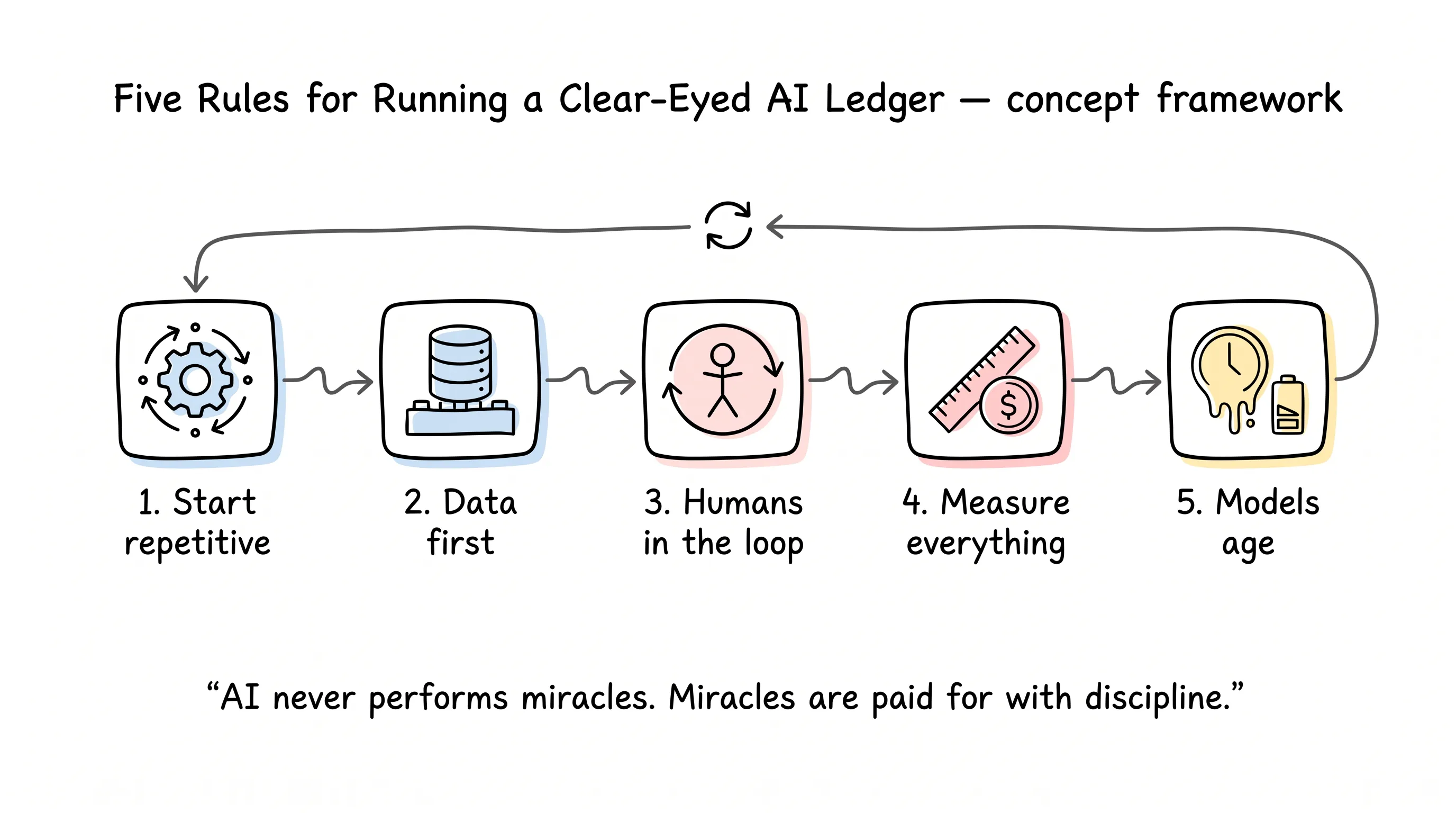
First, start with work that is high-volume and repetitive. Klarna picked high-frequency questions; JPMorgan picked standardized contracts. Nobody started by gnawing on the hardest bone.
Second, data is the foundation. Netflix's recommendations rest on years of accumulated viewing data; Mastercard's anti-fraud runs on oceans of real-time transactions. AI without data is a beautiful empty shell.
Third, keep humans in the loop. Mayo's AI reminds the doctor; it doesn't make the call. Behind Erica, a human agent always stands ready.
Fourth, run the numbers all the way down. Resolution time, accuracy, dollars saved — measure all of it. A fuzzy "digital transformation" story won't survive one round of questions from the board.
Fifth, models age. Fraud evolves, products rotate, users change. AI is a continuous investment, not a one-time renovation.
Now It's Your Turn to Run the Numbers
How do you turn someone else's ledger into your budget?
Find the case that looks most like your own business, then take the numbers they published and discount them to 60 or 70 cents on the dollar. Check the prerequisites: is the data clean, can the systems be connected, is the team willing to change how it works. Then roll out in stages: win small first, then expand, and lock down your metrics before you start.
Here's a time anchor: most successful cases see positive returns in 12 to 24 months. Automating high-frequency processes pays back fastest, at 6 to 12 months. On budget: a mid-size company's first round typically lands between $500,000 and $2 million, and small-scope projects can get going at $100,000 to $300,000. Which industries pay back fastest? Finance and manufacturing — high volume, complete data, hard metrics. Healthcare shows dazzling clinical results, but the regulatory gate is slow.
And take a look at what failed projects look like: fuzzy goals, dirty data, nobody willing to change the process. Of those five rules above, they checked none of them.
Back to That Friend
I ran into that friend again later. He said: actually, what I wanted to ask was, where do I start?
The answer is sitting in those five rules: find a step so repetitive it numbs your employees, a step where the books can be counted clearly — and start there.
Your first case won't be as dramatic as 700 people. But the books, you count one entry at a time.
AI never performs miracles. Miracles are paid for with discipline.
Here's to running your first clear-eyed AI ledger — soon.
Continue reading
Related articles
Does AI Know Your Brand? A Look at GEO, the New Craft
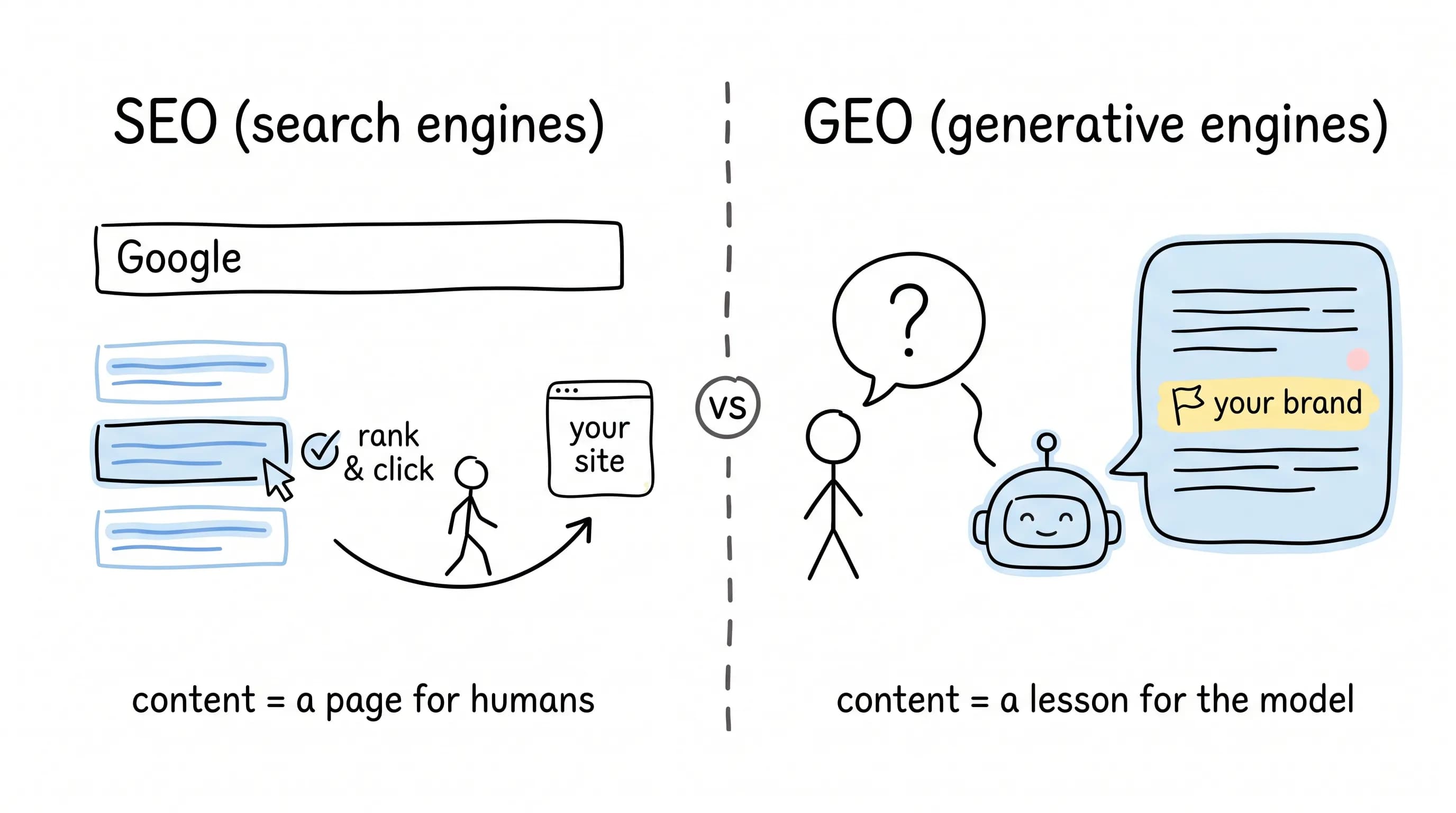
An explainer on GEO (Generative Engine Optimization): how AI engines like ChatGPT, Perplexity, and Gemini differ, how GEO goals and metrics diverge from SEO, and which SEO skills still carry over.
89% of Retailers Are Already Using AI. The Playbook for E-Commerce Has Changed
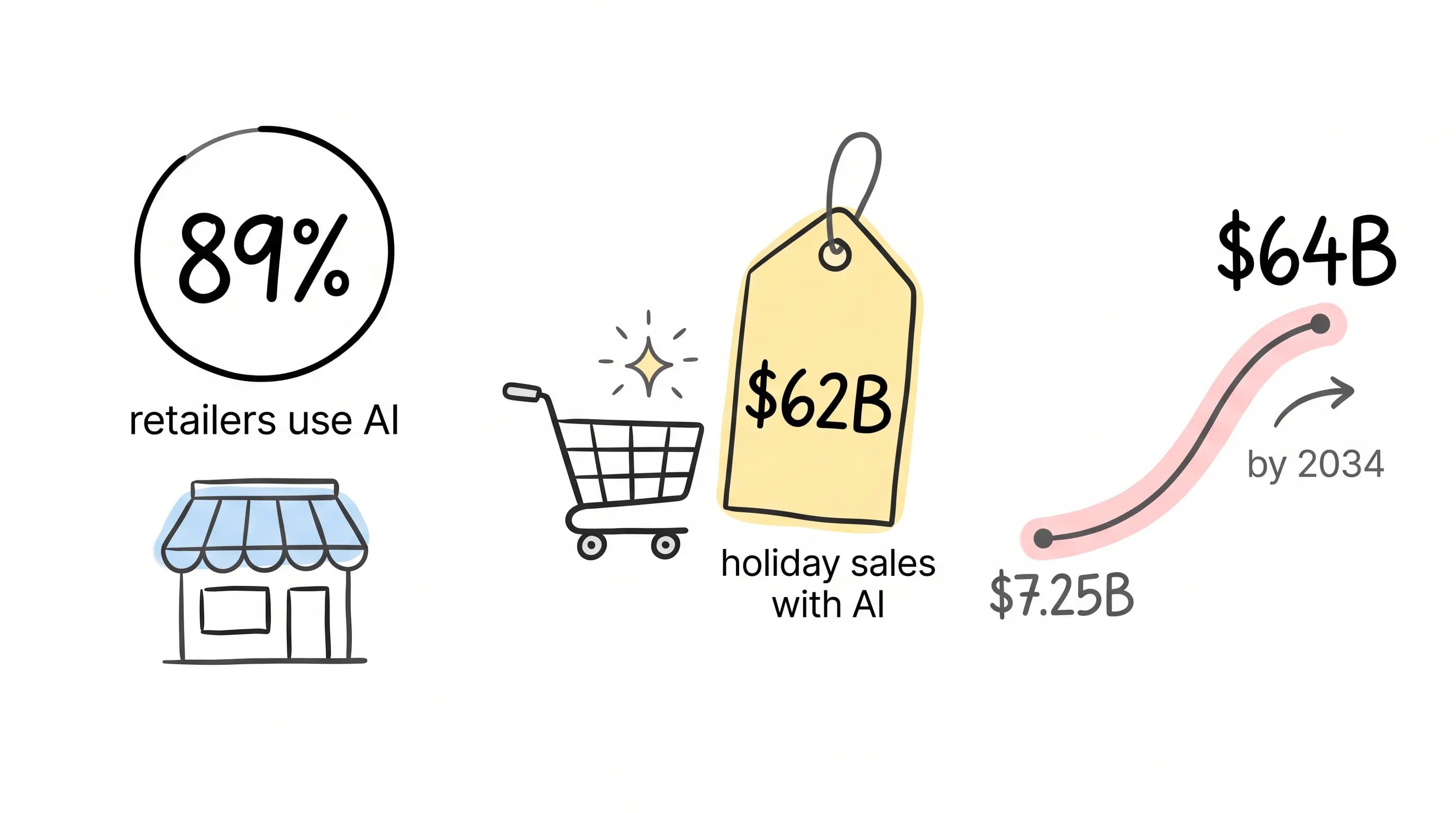
A learn article on AI in e-commerce: adoption context, use cases from recommendations, search, dynamic pricing, customer service, inventory, and fraud control, plus B2B applications, generative AI content, tool examples, pitfalls, and a six-step adoption path.
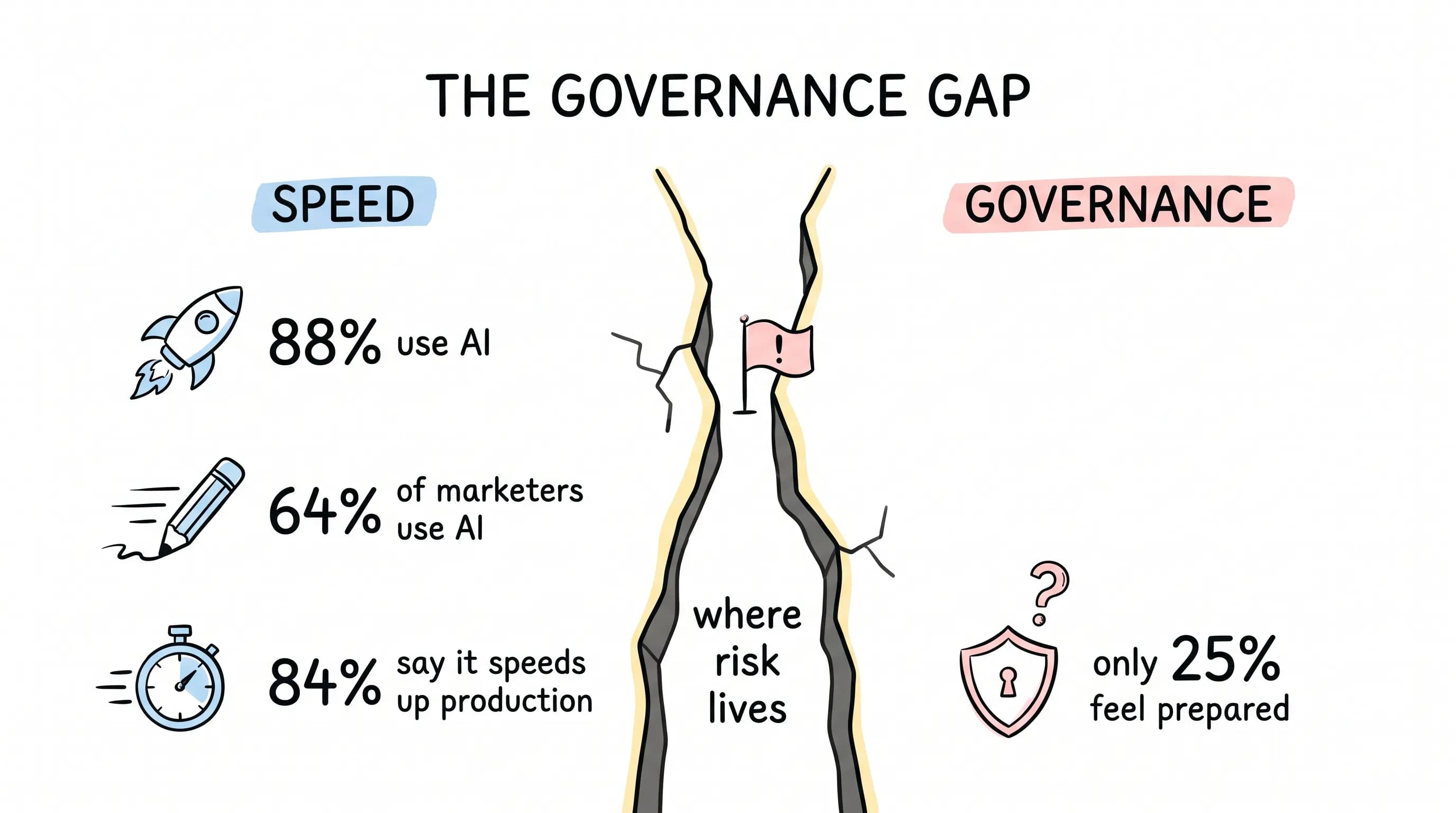
AI Makes Content at Lightning Speed — But Can You Answer "Who Approved This?"
This article looks at the gap between AI content speed and governance readiness in marketing teams, and outlines nine control points — prompt validation, brand guardrails, permissions, approval workflows, human review, versioning, IP checks, audit trails, and asset reuse — for brand-safe AI content.