
Customers Are Starting to Ask, Not Search
A learn article on the shift from keyword search to asking AI chatbots, arguing that AIO (AI Optimization) should complement SEO and paid search. It advises testing AI tools firsthand, auditing existing spend, and strengthening site content and reviews to stay visible in AI answers.
The other day, I came across a set of numbers that stopped me in my tracks.
A Pew Research Center survey shows that roughly half of Americans are already using AI chatbots. In just two years, that figure has climbed by nearly fifty percent.
But here's the number worth chewing on: four out of every ten chatbot users turn to them to look things up and find information.
What does "finding information" mean? It's the thing you used to do — open a search engine and type in keywords.
Now, they just ask AI.
Picture this scene. In the past, when your air conditioner broke down, you'd open the search box, type in "AC repair," and then pick the one that looked most reliable from a string of blue links. What about now? You might just ask AI directly: my AC isn't cooling — recommend a technician for me.
AI will chat with you. How long have you had it? What brand? What's your budget? When the conversation is done, it hands you a few local recommendations.
Like consulting a friend who knows their stuff.
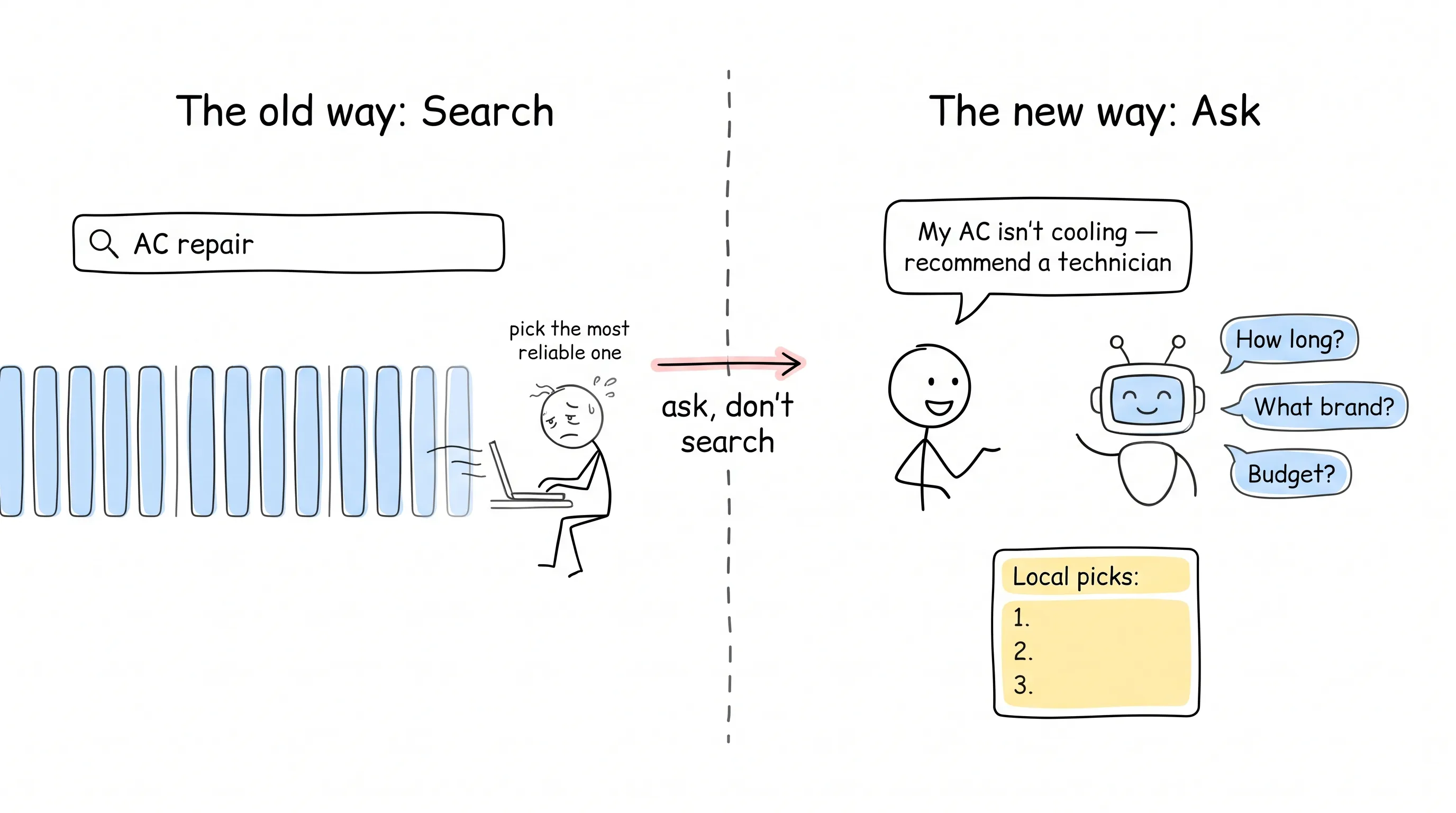
And that brings up a new question: when customers go from "searching" to "asking," can your business still be found?
Jenny Sutton, who leads digital marketing solutions at Audacy, recently wrote an article devoted to exactly this. Her point is clear: marketers should add AIO to their digital strategy.
So what is AIO? AI Optimization. Simply put, it's making sure that when AI answers a user's question, it thinks of you, mentions you, and recommends you.
Go Play With It First
Sutton's first piece of advice is refreshingly plain: try it yourself.
Go into an AI tool and search "new tires." It won't rush to throw a row of links at you. First it asks: what type of tires do you want? What kind of shop do you prefer? Only after you answer does it give you local recommendations.
The experience is consultative. It asks its way down, and recommends the same way.
And it's still going deeper. Google is experimenting with building actions like purchasing and booking directly into the AI experience. Which means that in the future, users may never visit your website at all — they'll place the order and book the service right inside the AI.
Wow. For local businesses, this is huge. The front door to a sale is moving.
Don't Rush to Move the Budget
So should you sweep your entire budget over to AIO in one go?
Not so fast.
Do the math: half of people using AI means the other half is still on traditional search. Keep investing in paid search — it's genuinely driving traffic and leads. Keep doing SEO — it decides where you rank in the search results.
That's why Sutton keeps stressing that AIO works alongside them, not instead of them. Neither replaces the other.
Before you act, she offers two concrete moves: first, take inventory of your existing digital spending and see what's still working — don't throw away what works just to chase the new. Second, grill your service providers — the ones doing SEO, the ones running your marketing for you — and make them explain how far they've gotten testing AI tools and how they're building them into strategy. If they can't answer, you'll know exactly where you stand.
In the AI Era, the Unglamorous Work Matters More
Two things that sound like tired old advice are actually worth more in the AI era: content and word of mouth.
When search engines and AI platforms decide whom to put in front of users, they both rely on trustworthy information. So the information on your website needs to be fresh, and authoritative enough. Have you organized an FAQ? Do you have genuinely useful expert content? Are the photos recent? Is the site easy to browse? Details like these all build your credibility.
Then there are reviews. Ask your happy customers to leave them. For the positive ones, thank people; for the negative ones, respond seriously and fix things seriously. Real customer experiences will speak for you across the entire digital ecosystem.
What AI draws on to find answers is still this honest, down-to-earth content. Shortcuts, quite simply, don't exist.
Zoom Out for a Second
The path users take to find a business has indeed changed. But the essence of business hasn't: turning attention into action.
Mature channels like audio, social media, and CTV (connected TV) build awareness and trust in the early stretch of the journey; SEO, paid search, and AIO catch people steadily near the point of sale. The first stretch plants the seed, the later stretch brings in the harvest — each does its own job.
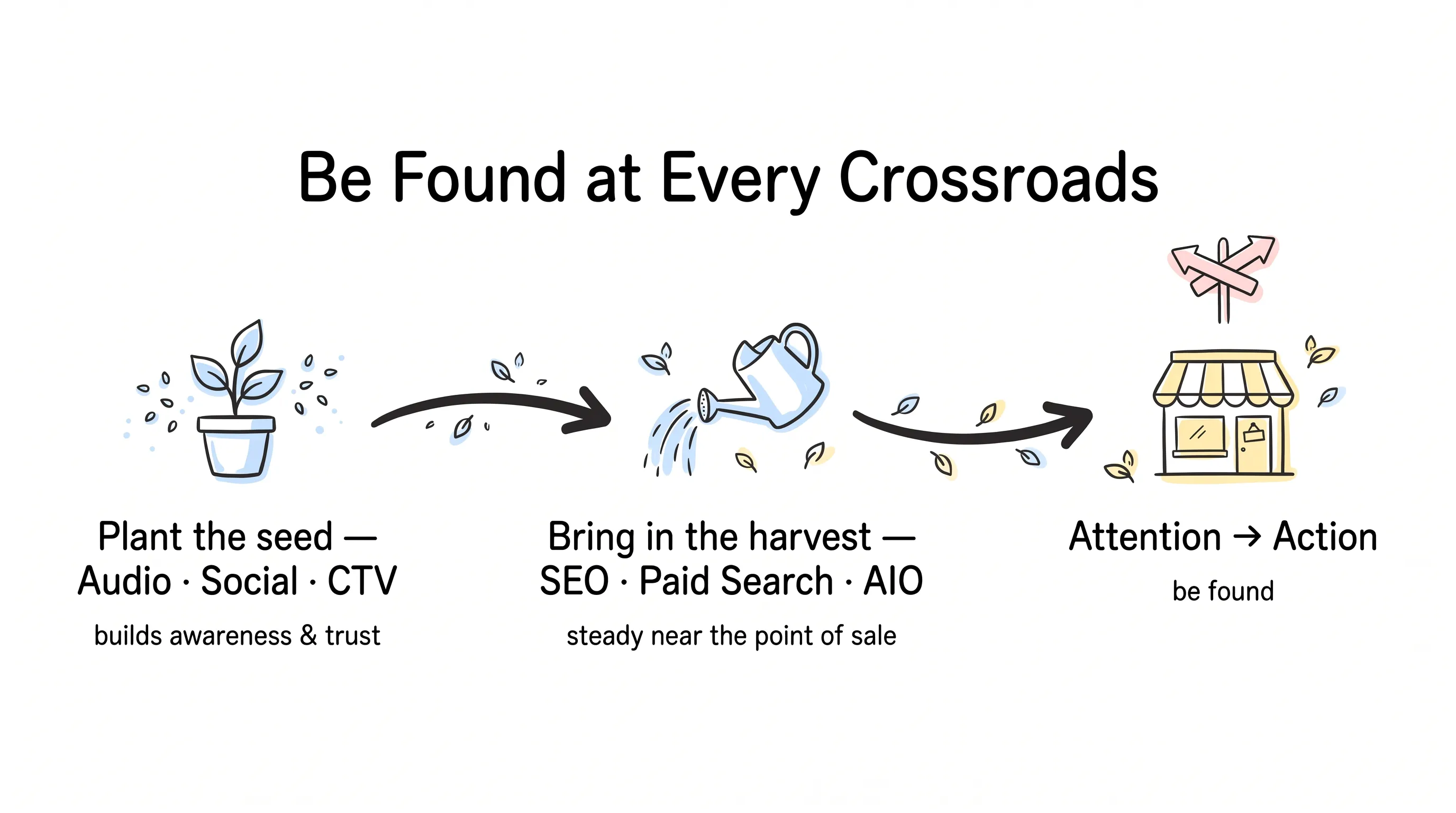
What AI has changed is how people find things. What it hasn't changed is that you must be found.
Make sure customers can see you at every crossroads where they show up.
Here's to always being found.
Continue reading
Related articles

It's 2026: Stop "Buying" AI Tools for Your Marketing Team — Start "Hiring" AI Agents
This learn article explains how AI agents differ from standalone AI tools in marketing, outlines three agent categories — build-your-own platforms, CRM-native agents, and vertical tools — and covers use cases across SEO, social media, advertising, and reporting, plus criteria for choosing one.

What Is GEO? How Your Brand Gets "Mentioned" in the Age of AI Search
An explainer on GEO (Generative Engine Optimization) for e-commerce and DTC brands: how it differs from SEO and AEO, why AI answers shape brand visibility, and eight practices covering question-focused content, consistent brand messaging, structured pages, external evidence, comparisons, and AI mention tracking.

AI Is Already Making Decisions for Your Customers. Are You on the List?
A learn article explains GEO (Generative Engine Optimization): why AI-generated answers now shape which brands customers see, and how SEO fundamentals, entity clarity, citable evidence, and monthly measurement affect visibility in AI answers.