
Cross-Border E-Commerce: What Can AI Actually Do for This Business?
A learn article explaining what AI can do for cross-border e-commerce: merging data silos into customer profiles, then applying recommendations, AI customer service, inventory planning, and fraud detection, with a Zhejiang straw-hat factory case and notes on trust and tools.
A while back, an old friend of mine who's been in foreign trade for years invited me to dinner. He's been at it for over a decade, selling goods to more than twenty countries. Halfway through the meal, he suddenly sighed: customer acquisition keeps getting harder, spending keeps climbing, and the margin on every order keeps shrinking.
I asked him: have you tried using AI?
He waved his hand. Sounded like smoke and mirrors to him.
I said, it's not smoke and mirrors at all. Let me walk you through it today.
First, Look at How Big the Opportunity Is
What is cross-border e-commerce, exactly?
Simple: the buyer is in country A, the seller is in country B, and the transaction happens online.
Why is this worth talking about? Because it's still growing. One forecast puts further growth in global cross-border e-commerce at 37.6 percent. What does that mean? For every $100 in that market, it becomes $137.
Now look at Southeast Asia. Back in 2019, a report estimated that by 2025, the region's internet economy would reach $240 billion. And what happened since? People there didn't just keep buying more — they got increasingly comfortable buying from abroad. On Amazon, Shopee, Lazada, Tokopedia, cross-border orders visibly multiplied.
The opportunity is real. But opportunity has never been evenly distributed.
Why Some Sellers Feast While Others Go Hungry
Think about it: with everyone listing products online, why do some sellers thrive while others get nothing?
Because consumers in every country have completely different habits.
Buyers in Japan, South Korea, and China, for instance, trust their local e-commerce platforms deeply. As an outsider, forcing your way in is hard. Or take this: in Asia, shopping happens on the phone in a couple of taps — while quite a few Western countries still do most of their ordering in front of a computer screen.
The playbook that works like a charm on mobile back home might not even get you through the door over there.
There's one number that stuck with me. At the height of the pandemic, 85 percent of Southeast Asia's digital consumers tried a new mobile app. Eighty-five percent! The whole population effectively moved house: from offline to online, from desktop to mobile.
If you don't understand local habits, all that traffic will slip right through your fingers.
So What Can AI Actually Help With?
Alright, back to my friend's question.
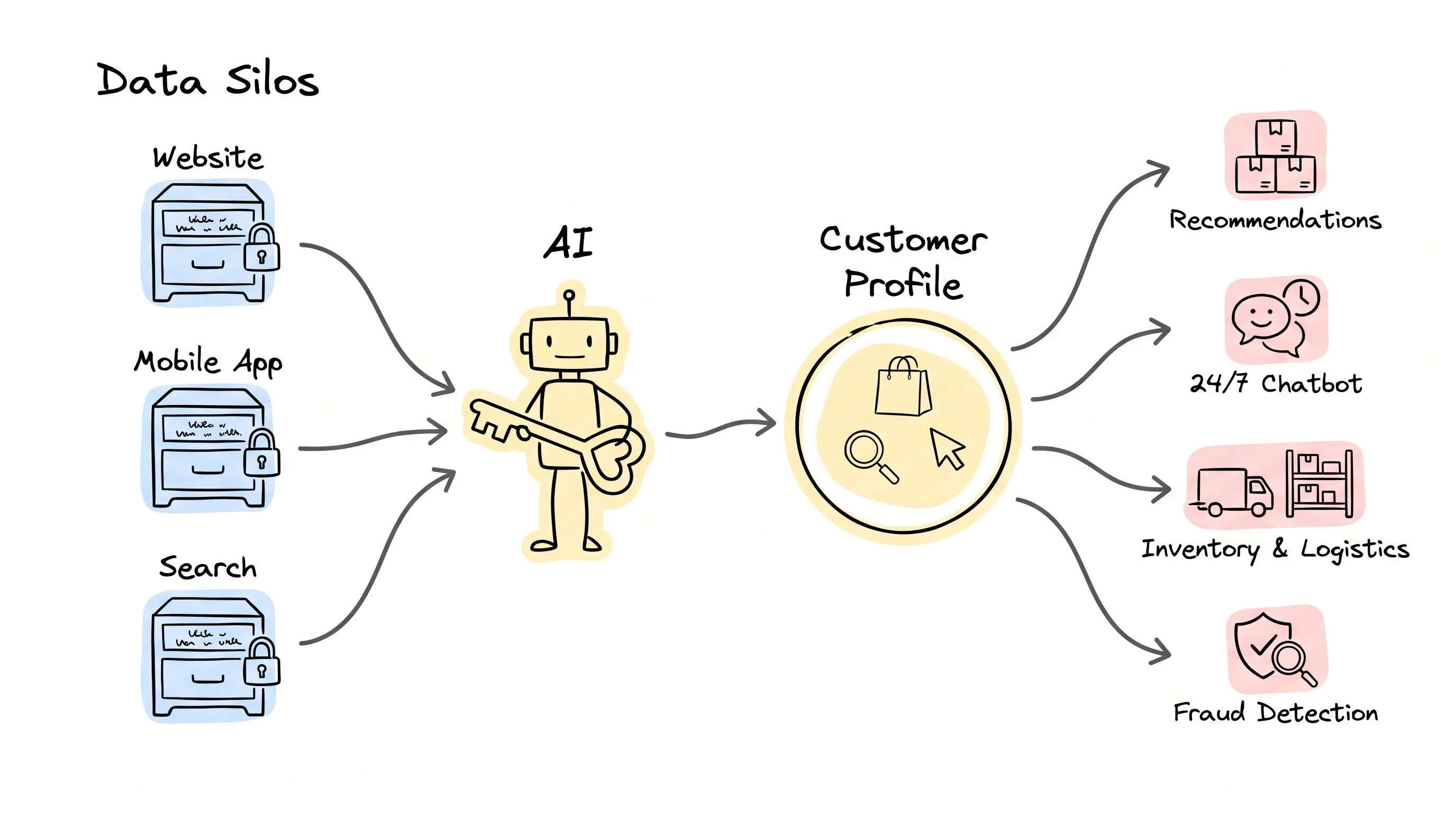
People in cross-border commerce are actually sitting on mountains of data: customers' languages, local customs, shifting seasons, what devices people order on, how many time zones lie in between. Is this data useful? Hugely. But there's one killer problem: it's scattered everywhere. The website keeps its data, the app keeps its own, the search engine keeps another — everyone guards their own patch.
The industry jargon for this is "data silos" (data isolated in separate systems that can't talk to each other). Let me put it in plain terms: you have a room full of gold, but it's locked in five different cabinets, and each key is held by a different person.
The most basic thing AI does is open those cabinets and bring the data together in one place. Merge the website, app, and search engine data, and a complete customer profile emerges: what they've bought, how they browse, what they've searched — all at a glance.
Once the profile is clear, everything downstream gets easier. The recommendation engine knows what products to show them. AI-powered customer service takes over the questions repeated ten thousand times — "where's my package?", "which size should I pick?" — freeing human agents to handle what's genuinely complex. AI can help schedule inventory and logistics. And fraud detection, too.
Yes, AI in cross-border e-commerce is far from mature yet. But the early stage is precisely the window to get in.
The Straw Hats of Zhejiang Tell a Great Story
Let me give you a concrete case.
A cluster of small straw-hat factories in Zhejiang — sounds unremarkable, right? Yet they did something remarkably forward-looking: they used machine learning to analyze e-commerce data and read market demand and consumer trends; then they brought generative AI into design and production, dramatically shortening the cycle from idea to product. The moment the market twitched, they adjusted.
And the result? AI and big data significantly improved these factories' market responsiveness and sales performance. The researchers behind the study made a special point of noting: this playbook works just as well for small and micro businesses that want to sell globally.
Of course, this is one industry's case — you can't stretch it over every industry. But it proves at least one thing:
When small factories use AI, the contest isn't about who has more money. It's about who can pivot faster.
And One Thing Worth More Than the Technology
By now you might be thinking: so I should just rush out and adopt AI, right?
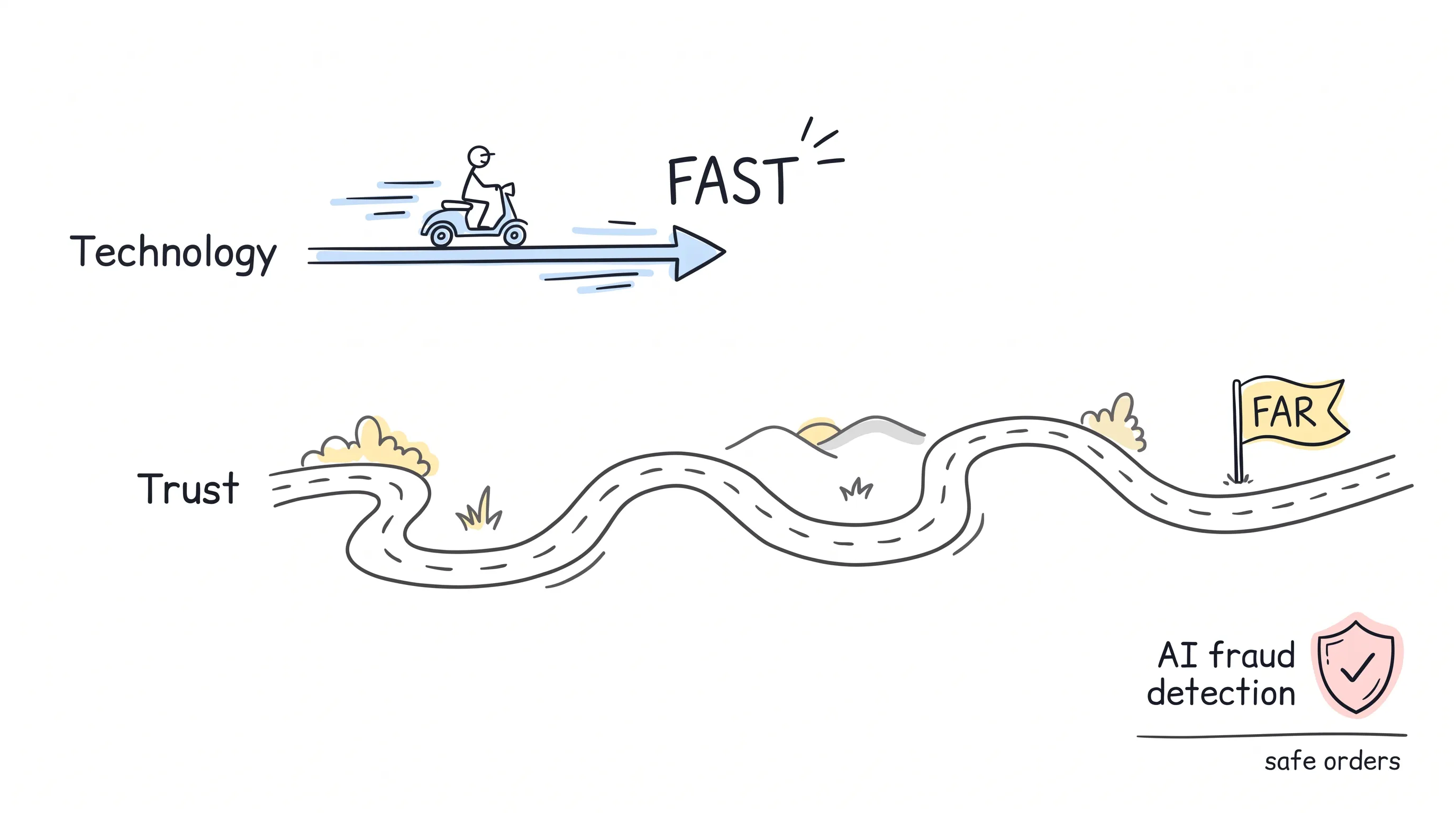
Not so fast. There's one thing that's an even tighter bottleneck than the technology itself: trust.
These past few years, there's been no shortage of AI gone wrong in the news. Every failure thickens the public's doubt another layer. And all the uncertainty built into the technology itself piles on more. Whether a customer dares hand over their card number, dares place an order with you — that decides whether they use you at all.
The good news: trust can be earned with tools too. AI-powered cloud services can spot fraud in the conversion funnel and keep every order safe. Trust is built up exactly one "ordered, nothing went wrong" at a time.
Technology decides how fast you can go. Trust decides how far you can go.
One Last Thing
Oh, and if you're serious about getting started — there are already plenty of tools out there: Shopify Magic, Helium 10, Klaviyo AI… no shortage at all. What really matters is being clear about which problem you're trying to solve.
When we parted that evening, I told my friend: don't treat AI as mysticism — treat it as an assistant that never sleeps. He nodded with a smile and said he'd go back and give it a try.
And I wish you the same: may you find the key that opens the cabinet.
Continue reading
Related articles

What Is an AI Marketing Agent? From "Using AI" to "Delegating to AI"
A learn article explaining what an AI marketing agent is, how it differs from rule-based automation, and which repetitive tasks such as lead qualification, reporting, and campaign monitoring can be delegated while humans keep key decisions.

Marketing Automation Is Shifting from "You Do It" to "You Say It"
This article explains how marketing automation is shifting from rule-based platforms that merely execute toward AI agents that plan, create, publish, and review campaigns, covering delegable tasks, underlying technologies, tool categories, adoption steps, and risks such as privacy and automating without strategy.

When AI Does the Creative, Mistakes Come in Batches Too
A learn article on the risks of using generative AI for marketing creative across brand, legal, compliance, and operational layers, with case examples and seven practices for review, rights clearance, documentation, and vendor governance.