
Clients Stopped Searching. Now They Ask AI: What Is GEO?
An explainer article on GEO (Generative Engine Optimization), covering how AI-generated answers change brand visibility, how GEO differs from SEO and AEO, and a six-step workflow for getting cited by AI assistants.
A while back, a friend of mine who runs an enterprise-services business invited me to dinner. Halfway through the meal, he told me about something that had sent a chill down his spine.
Last quarter, his sales team followed up with a batch of new clients and asked how they had originally found the company.
He expected to hear "I found you on Google" or "I checked out your website."
Instead, several clients gave the exact same answer: I asked AI.
So he went and asked a few AI chatbots himself. It got worse: his own company didn't appear in the answers at all.
His clients didn't fail to find him. They never even got the chance to see him.
Behind this story hides a term more and more people have started to study: GEO. Today, let's unpack it.
What Is GEO?
GEO stands for Generative Engine Optimization.
What is a generative engine? ChatGPT, Gemini, Perplexity, Grok, plus Google's AI Overviews. What they have in common: instead of handing you a pile of links, they hand you an answer.
Search used to be like a stack of business cards. You type in keywords, it flings ten links at you, and you sort through them yourself.
Search now is increasingly like a restaurant host. You ask, "Which enterprise-services firm is actually any good?" and it answers: these few — take a close look at them.
Here's the catch.
If the host never says your name, the guest never finds your door.
That is exactly what GEO exists to fix: getting AI to mention you and quote you when it answers questions — to treat you as part of the answer.
How Much Is This Business Worth? Let's Run the Numbers
Concepts on their own don't get us anywhere — let's do the math.
Traffic from traditional search converts at about 2.1% on average. Traffic from AI search, according to a 2025 analysis by Backlinko, averages as high as 27%.
A gap of more than ten times.
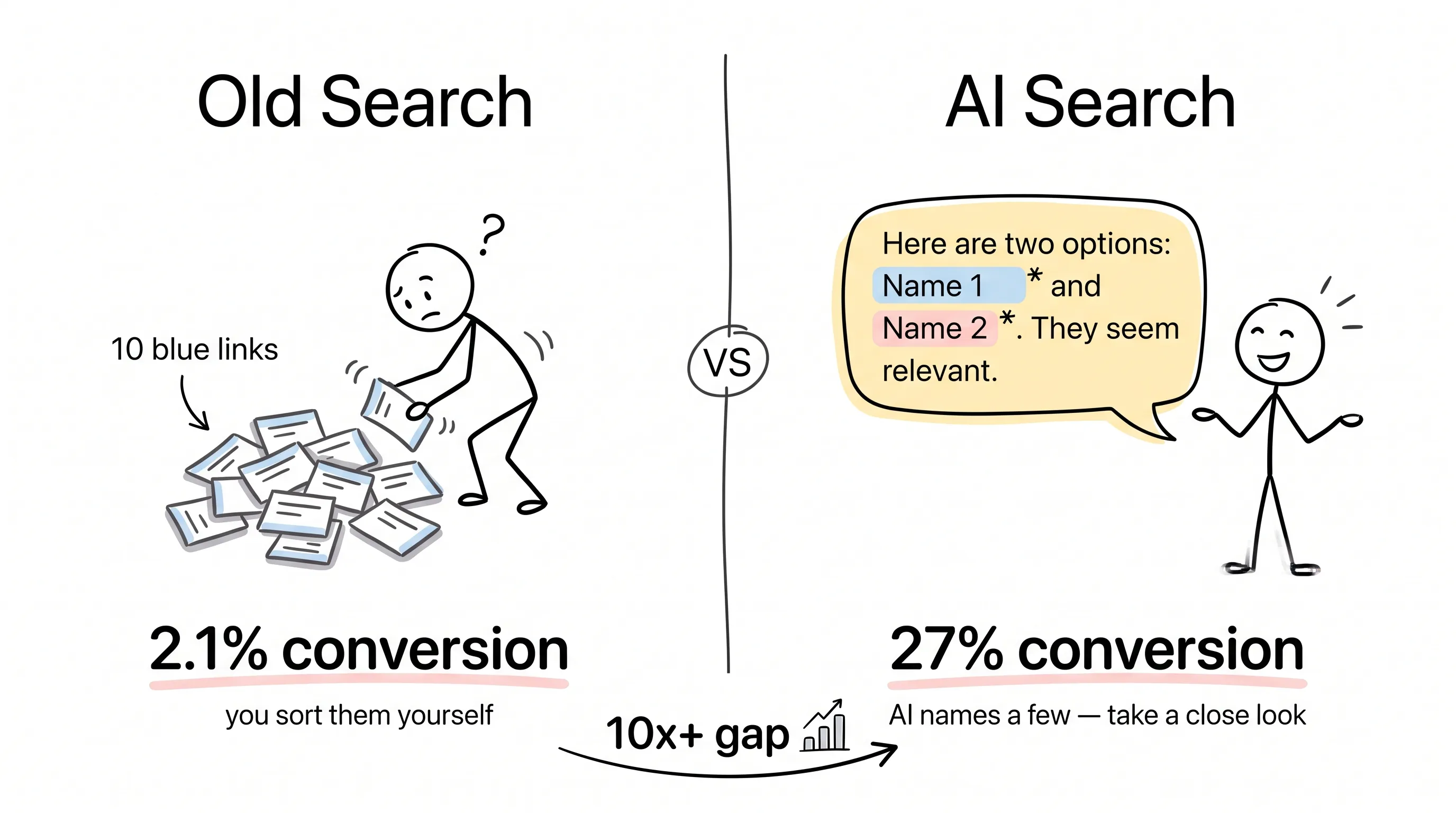
Why? Think about it. A person Googling "CRM recommendation" might just be browsing on a whim. A person asking ChatGPT "which CRM should our 50-person team use?" shows up with a budget and a decision to make.
The caliber of the visitor has changed. That's why the ones who feel the pain first are often B2B companies selling complex products with long decision chains: the deeper a client researches, the more AI shapes the decision.
Now, two more numbers.
One: after one company finished its GEO optimization, its website traffic from large language models grew 800% year over year.
The other: results Percepture has shown off. This company has done enterprise-grade SEO for over a decade and now does GEO for clients. One tech-industry client, after building up its AI search presence, saw sales-qualified leads (prospects vetted and passed to sales) grow 212%, with traffic from AI sources converting at 12.8 times the rate of traditional search. A telecom client did three months of structured-data optimization and grew its mentions in Google AI Overviews by 3,000%.
Three months. 3,000%.
These aren't vanity metrics. This is revenue.
By the time the client walks through your door, they already trust you. Once they're inside, the rest is just process.
GEO, SEO, AEO — Which Is Which?
The three acronyms look alike, and plenty of people can't tell them apart. Let me take them one at a time.
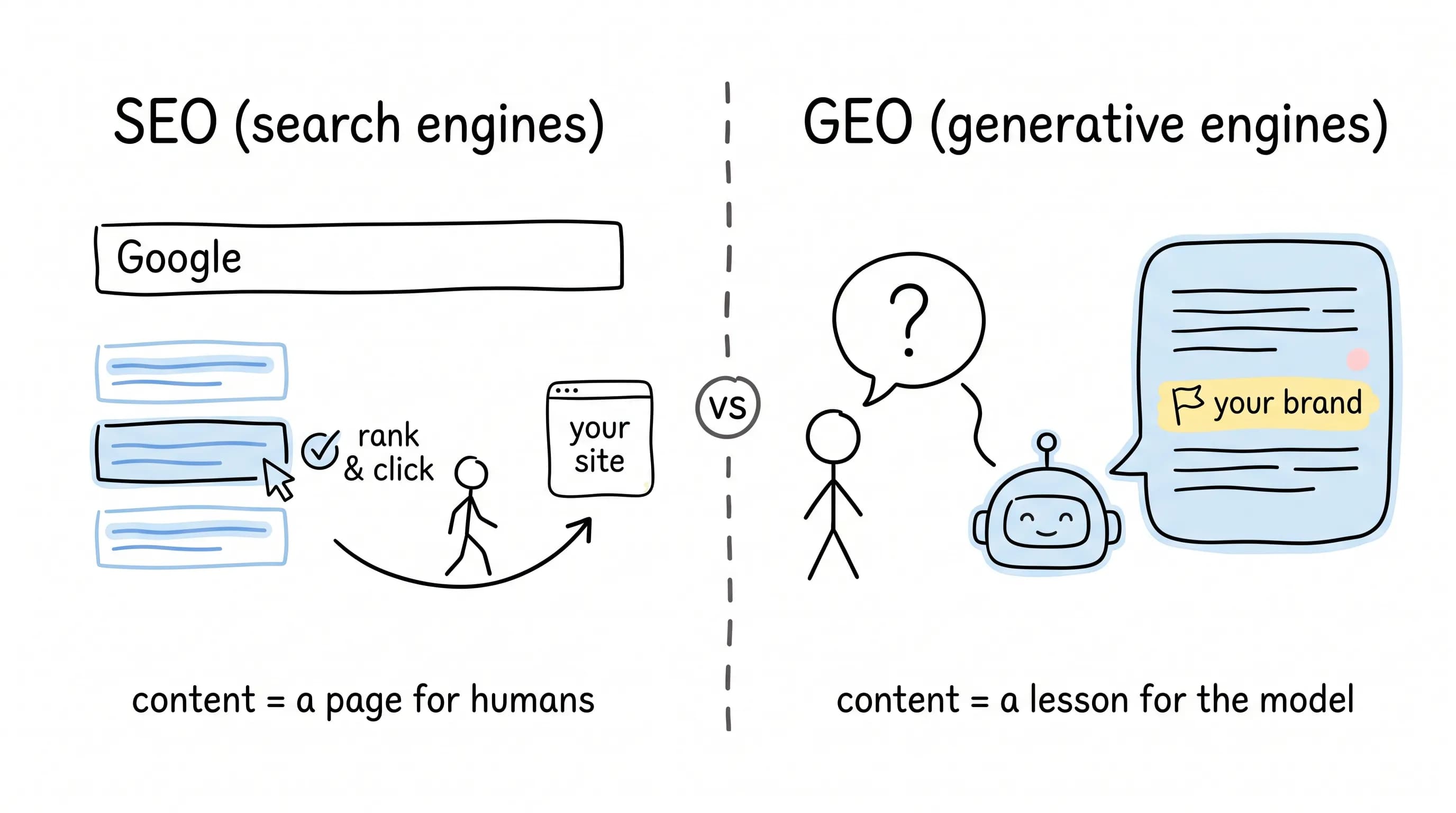
SEO — search engine optimization — is the old friend. The goal is getting your web page onto the first page of Google's results. You compete on keywords, on backlinks.
AEO — Answer Engine Optimization — pushes the goal one step further: make your content the featured snippet (the boxed answer at the top of Google's results), the standard answer a voice assistant reads out loud.
GEO pushes one step further still: get your brand cited by AI when it generates answers.
Notice something? These three are really three stages of one and the same thing. First we fought for rankings, then for snippets, now for citations.
So is SEO still useful?
Immensely useful. Percepture has a view I strongly agree with: AI search has not replaced SEO — it just picks up where SEO leaves off. The answers AI gives are still built, in large part, on search results and authoritative content. If the foundation is shaky, GEO can't rise either.
But there is one distinction you must be clear about.
SEO succeeds when a person gets delivered to your doorstep. GEO succeeds when, before the person has even set out, you are already an option in their mind.
In the eyes of AI, there is no page one. There are the cited, and the nonexistent.
So How Do You Actually Do It? Six Things
Percepture has publicly shared the workflow they use. Here it is, in my own plain-language version.
Step one: look in the mirror first. Go see how you look today inside ChatGPT, Perplexity, and Google AI Overviews. Where are the mentions, where are the blanks, and when AI talks about you, is it praise or criticism. You need the negative before you can develop the photo.
Step two: draw the map. Which topics and which entities (people, brands, organizations, concepts that machines recognize as distinct things) should you claim? Which hills have your competitors already occupied? It's still keyword research and competitive analysis — only the target has changed from search terms to questions and entities.
Step three: fix the structure. When AI reads your content, it reads the structured data first. FAQ schema, HowTo schema, Organization schema — these markers let a machine understand at a glance who you are and what you're good at. Same dish — but if the menu is written so the machine can read it, it's far more likely to get ordered.
Step four: build your identity record. AI recognizes entities: people, brands, institutions, concepts. Places like Wikipedia and Wikidata are the ID system of the AI world. Who you are, what you do, why you're trustworthy — get it written crystal clear in the registry first.
Step five: pile up evidence. AI doesn't accept ads; it accepts evidence. Coverage in authoritative media, high-quality backlinks — they all testify on your behalf. Percepture keeps a dedicated digital PR team precisely to win these citations, because they know the frequency and sentiment of mentions are built slowly, over time.
Step six: review monthly. Mentions, referral traffic, the tone AI uses when it talks about you — track them month by month with SEMrush, Google Search Console, or monitoring tools like BrandLight and Profound. What works, double down on. What doesn't, replace.
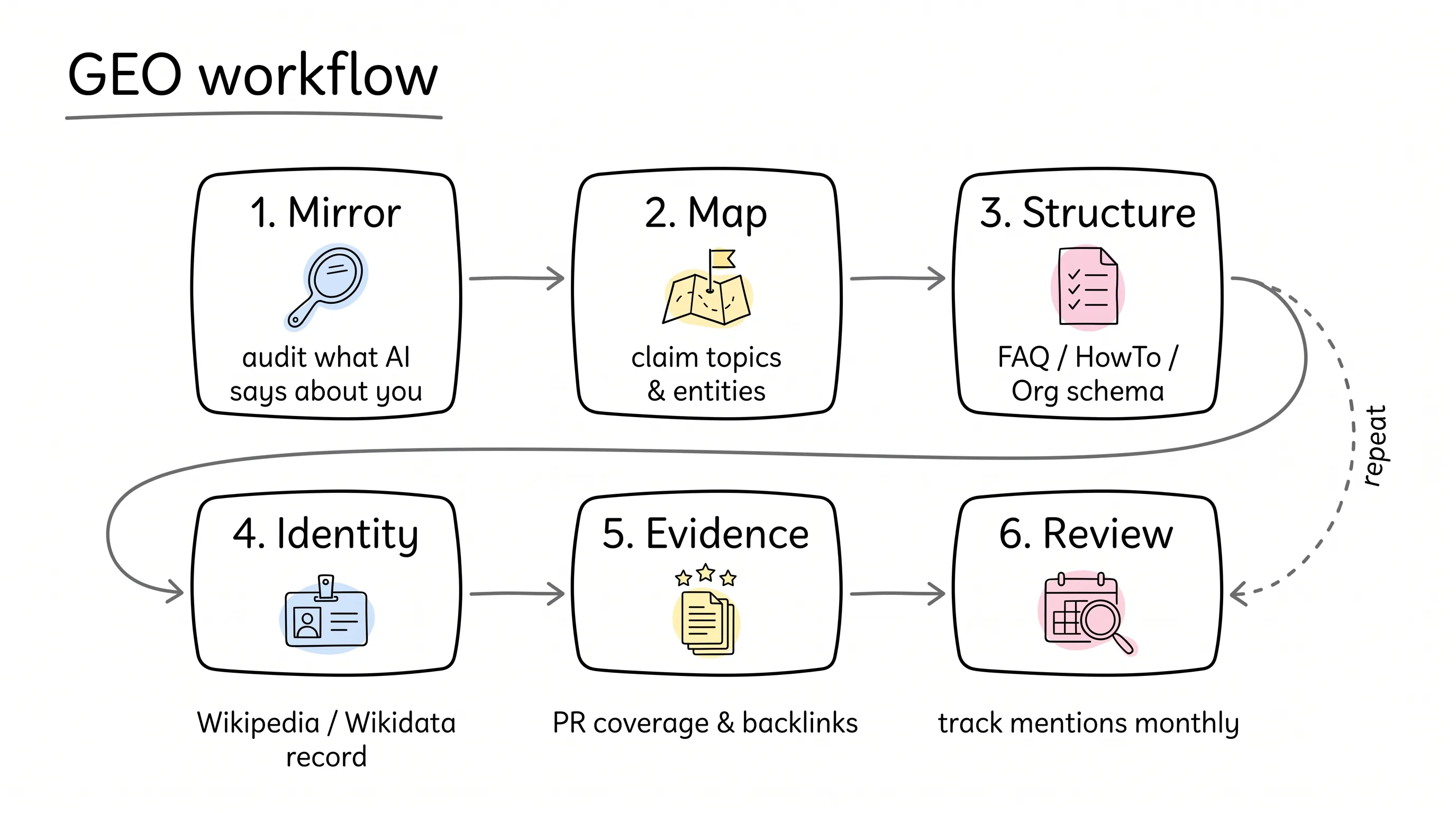
You see? Six things, and not one of them is magic. All of them are grunt work, careful work.
How Long Until It Works? Do Small Companies Stand a Chance?
The two most frequently asked questions, answered together.
On timing, the common rhythm is: early signals appear around six weeks — for instance, brand terms start showing up in AI Overviews; a fuller picture of visibility generally takes three to six months. And this thing compounds: the longer you keep at it, the deeper AI's trust in you grows.
On scale, small companies may actually be the ones with the advantage.
Why? Think about it. Big companies fight over big words like CRM and cloud services, and you can't outshout them there. But inside your own niche — say, cold-storage asset management in South China — the hilltop may still be empty. Whoever first accumulates enough entities and citations on a narrow topic becomes the standard answer to that narrow question.
The key is: don't grab for the big words; grab the narrow topics you genuinely understand.
Finally, Back to That Dinner
At the end of that dinner, I told my friend: no need to be anxious about this, but you do need to start moving.
Some people predict that by 2027, four in ten searches will bypass the traditional results page and stop directly on the answer an AI gives. Whether that number lands exactly, nobody can promise. But the direction is very likely right: people's habits are sliding from searching to asking.
Where habits migrate, business follows.
You used to fight your rivals for rankings. Now you fight to be remembered by AI.
Here's to the next time a client mentions you — inside an AI's answer.
Continue reading
Related articles
Does AI Know Your Brand? A Look at GEO, the New Craft
An explainer on GEO (Generative Engine Optimization): how AI engines like ChatGPT, Perplexity, and Gemini differ, how GEO goals and metrics diverge from SEO, and which SEO skills still carry over.
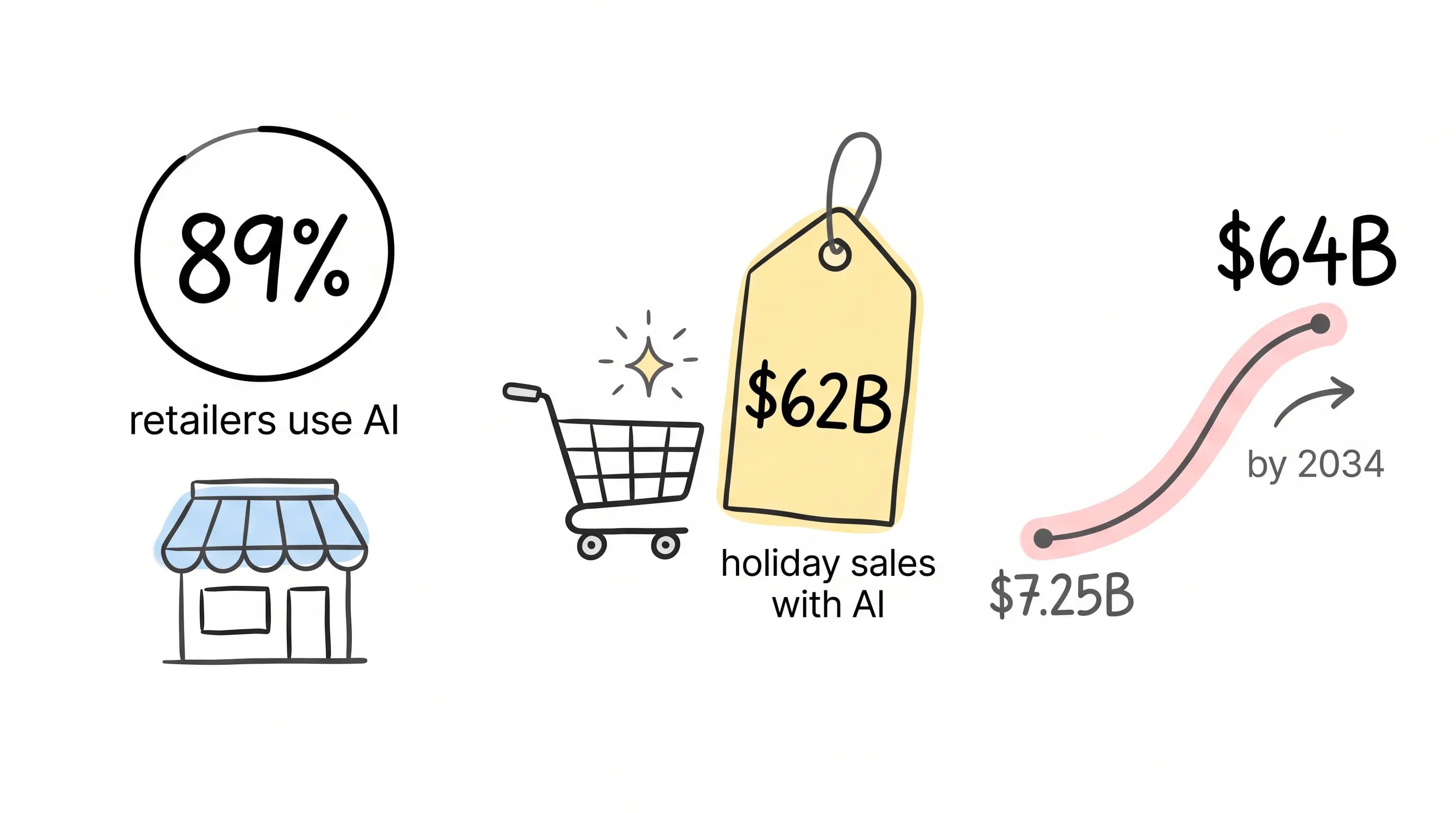
89% of Retailers Are Already Using AI. The Playbook for E-Commerce Has Changed
A learn article on AI in e-commerce: adoption context, use cases from recommendations, search, dynamic pricing, customer service, inventory, and fraud control, plus B2B applications, generative AI content, tool examples, pitfalls, and a six-step adoption path.
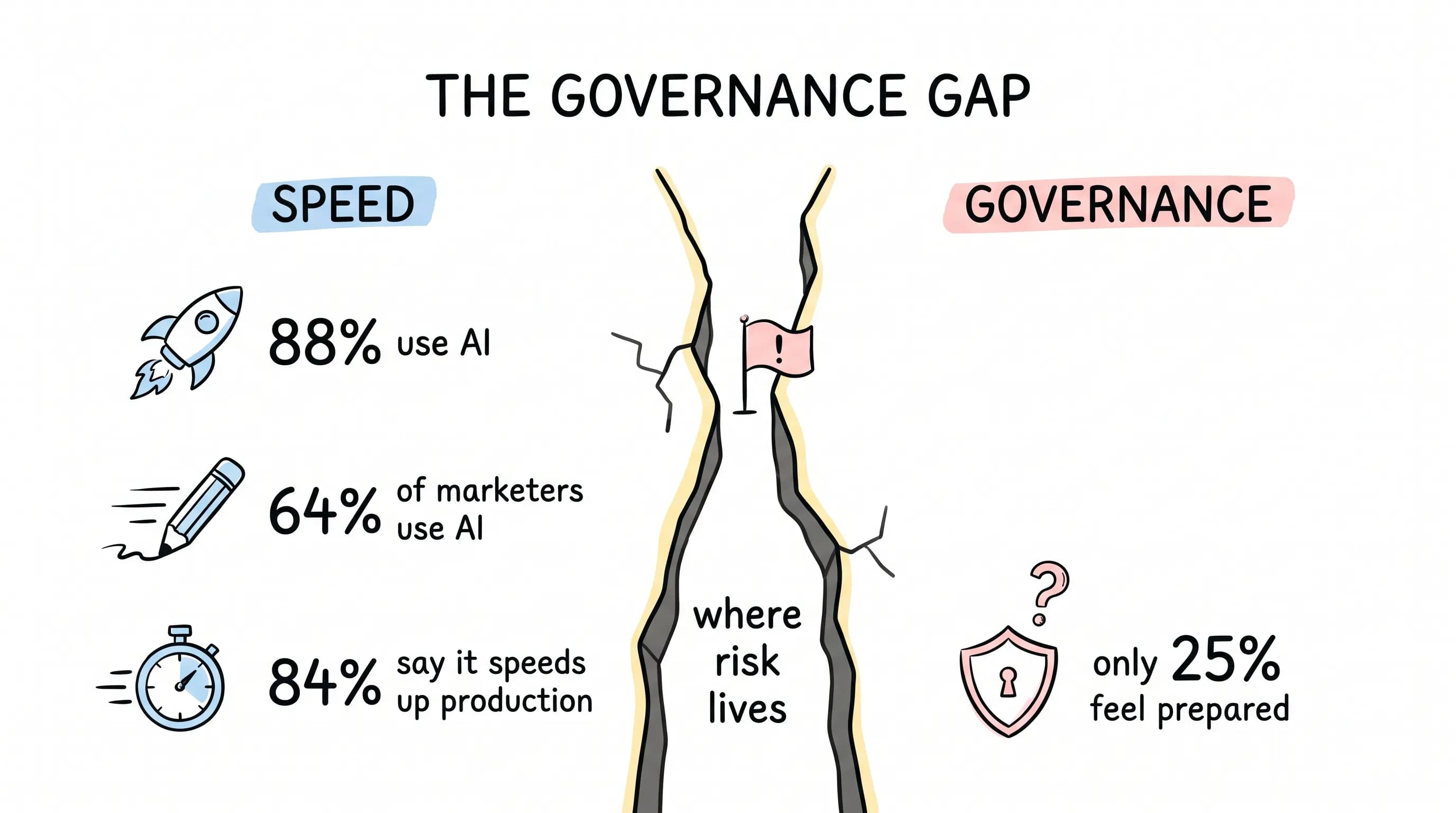
AI Makes Content at Lightning Speed — But Can You Answer "Who Approved This?"
This article looks at the gap between AI content speed and governance readiness in marketing teams, and outlines nine control points — prompt validation, brand guardrails, permissions, approval workflows, human review, versioning, IP checks, audit trails, and asset reuse — for brand-safe AI content.