
ChatGPT Ads Are Worth Buying. But Only With Pocket Change.
Argues that ChatGPT Ads is a tactical test rather than a platform bet: Gemini holds the distribution advantage and OpenAI's focus points to enterprise, so keep the main budget on Google and Meta while spending a small share to bank early know-how.
A few days ago I had dinner with a friend who runs a brand. Halfway through the meal, he pulled out his phone and showed me: ChatGPT has launched ad placements. Should we move early and grab first-mover advantage? he asked. He had already worked out the budget — it would be shifted over from Google.
I put down my chopsticks. I didn't answer directly; first I told him a story from 18 years ago.
In 2008, the browser market was still IE's territory. That September, Google released Chrome. Over the following 18 years, Statcounter's market-share curve told the whole story: IE collapsed, Firefox shrank into a small, loyal but marginal territory, and Chrome became a slow staircase that never came back down.
Swap the logos on that curve, and you get today's AI assistant market.
SensorTower's monthly active user (MAU) data came off almost the same mold: ChatGPT surged the hardest, but from September 2025, its curve went flat; Gemini drew a clean diagonal, straight upward; Claude is growing for real too, only its scale is an order of magnitude below the top two.
Now, let's seat them.
ChatGPT sits in IE's seat: it defined the category, and now it has to fight for the next one.
Claude sits in Firefox's seat: loved by die-hard users, but the pond is structurally small.
Gemini sits in Chrome's seat. And note — not because the product is better, but because it was born into a distribution network that never has to ask for your permission.
What do I mean by distribution? It's what decides this whole game.
That's exactly how Chrome won back then: born in 2008, fed big by Google's own channels, then bundled by Android into every phone. Today's Gemini inherits the same compounding curve — and starts even further ahead. It lives inside Google Search, inside Android, inside Workspace and YouTube. It doesn't need to acquire users from zero.
ChatGPT has no such net. Every user it has, it had to earn the hard way: one download, one habit, one retention loop at a time.
And how did that earning go? On SensorTower's curve, it has been essentially flat since September 2025. SimilarWeb twists the knife: the user overlap between ChatGPT and Google runs as high as 95%. The users who truly belong to ChatGPT alone — the genuine incremental audience — amount to just 5%.
Some still reach for the Safari analogy: at least ChatGPT is an independent entry point, they say. These numbers drive a nail through that kind of fantasy — it commands no exclusive user base, and it isn't really nibbling away at search behavior.
Here's an even more honest yardstick. TikTok has about 2 billion MAU worldwide, roughly twice ChatGPT's. Suppose you have $100 of media budget — how much would go to TikTok? Call it $5. Then the strategic position ChatGPT Ads deserves today is about $2.50, and not a dollar more.
The share you'd give TikTok is exactly the yardstick for the weight ChatGPT deserves today.
So OpenAI itself — surely it treats ads as its lifeline? It's already collecting money for them, after all.
Quite the opposite.
In October 2024, at a conversation at Harvard, Altman called advertising a "last resort" business model, and added: "The combination of ads and AI makes me especially uneasy."
Fourteen months later, OpenAI launched ads.
Going back on its word? No. Just short of money. The reversal shows the company needs revenue; it does not show that ads have become its strategic center of gravity.
The personnel signal is even clearer. COO Brad Lightcap — a finance background — is out. The incoming CRO, Denise Dresser, previously ran Slack. And then came Dali Rajic, an enterprise-security veteran. Did you notice? Not one of these names comes from ad sales or media — every one of them is enterprise B2B. OpenAI's product muscle is being pointed at B2B.
Why? Do the math and it's obvious.
OpenAI itself projects $280 billion in revenue by 2030. How much from ads? "Only" $100 billion. The remaining $180 billion comes from B2B.
Last month, OpenAI released ChatGPT Work, plugging agents into email, Slack, Notion and Figma to handle multi-step knowledge work for white-collar teams. According to The Information, they are also testing outcome-based enterprise pricing: the work gets done, then they collect.
Do you see what's happening? Layer by layer, they're taking over white-collar work in a way that's easier to buy. A plan sold this way moves far more tokens than a single ChatGPT Pro subscription.
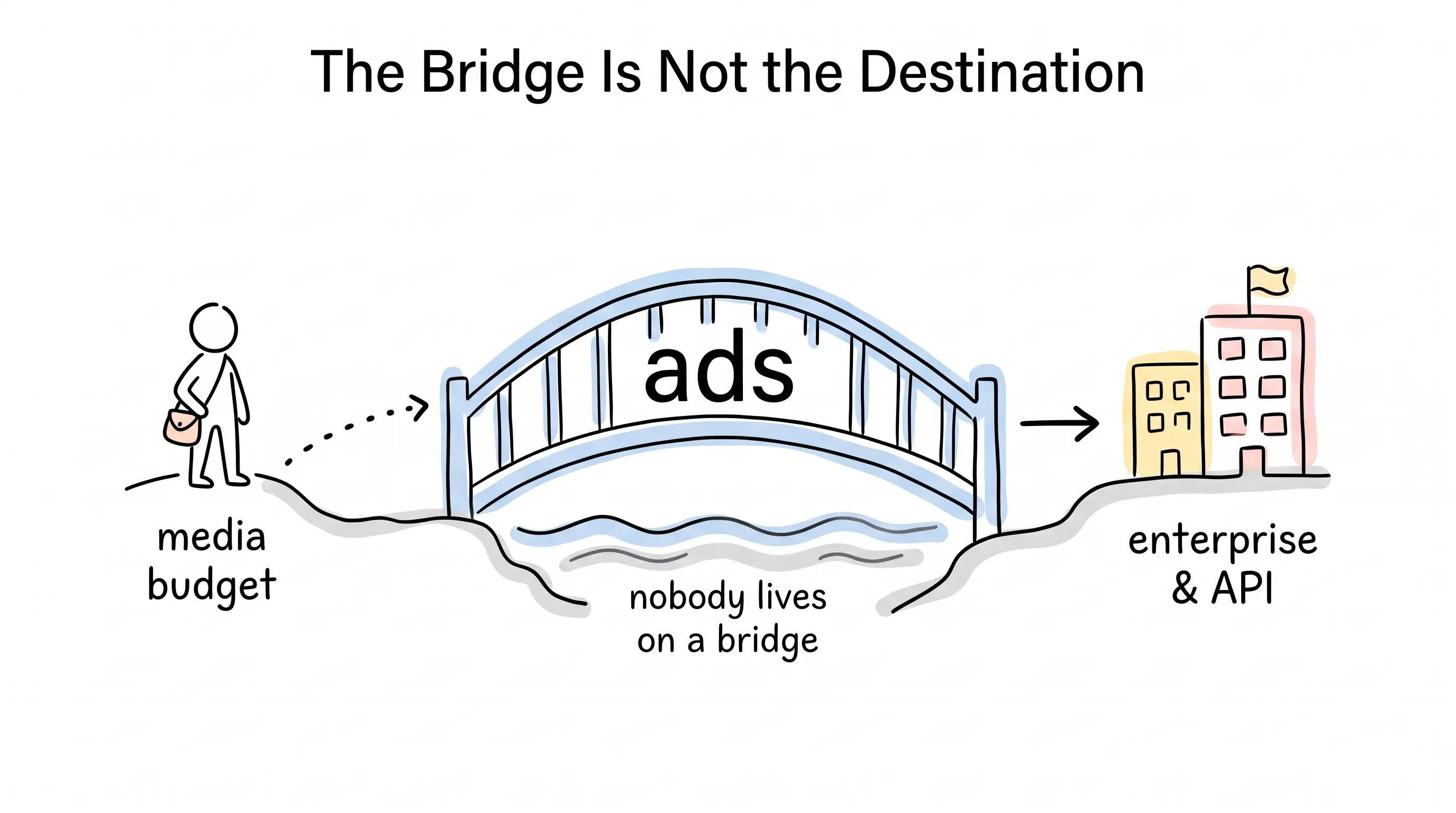
Ads are the bridge. Enterprise and API are the destination. Bridges matter, but nobody lives on one. When a company's hiring and products are both exerting force elsewhere, don't expect ads to get any share of the company's core attention.
By now you might be thinking: fine, then I simply won't invest at all — one less thing to worry about.
Not so fast. Losing the long-term platform war, and whether it's worth stepping onto the field now, are two different questions. Confusing them is the most expensive mistake of all.
First, this platform will hold. Bloomberg's analysis has a number: in Microsoft's most recent fiscal year, it recognized $24 billion in revenue from OpenAI, about 70% of its entire AI business. In any industry, single-customer concentration to that degree is a danger signal. Here, the logic runs the other way: Microsoft would not put a sum of that magnitude behind a company that can't live past two years. For friends still muttering "the platform is too new to trust," this number has already answered whether ChatGPT Ads will still exist two years from now.
Second, for a historical reference point, the more accurate analogy is not IE — it's early TikTok Ads. In TikTok's first few years, a big crowd of advertisers stood on the shore watching, and the reasons usually leaned political, with little to do with marketing logic. Yet the signals were laid out in plain sight: a real user base, genuinely incremental reach. The ad-buying know-how accumulated by the ones who got in the water first took rivals years to match.
Third, timing and crowding. This August, OpenAI expanded ChatGPT Ads to 31 European countries — its largest market expansion to date, landing right in front of Q4. That's no coincidence. OpenAI needs peak-season data to support its 2027 budget negotiations; early movers get to lock up ad inventory and audience insights while CPM and CPC are still cheap. For OpenAI, this is positioning. For you, this is a discount window.
How crowded is it? SE Ranking ran the numbers: a single advertiser called BestMoney accounted for 13.56% of all ChatGPT ads. What does that mean? 13.56% of the storefronts on one street belong to the same family. Add that ChatGPT shows at most one ad per query, while Google's results page can stack four. Scarce supply, thin competition.
Test while it's cheap. Learn while it's empty.
OK — back to that dinner.
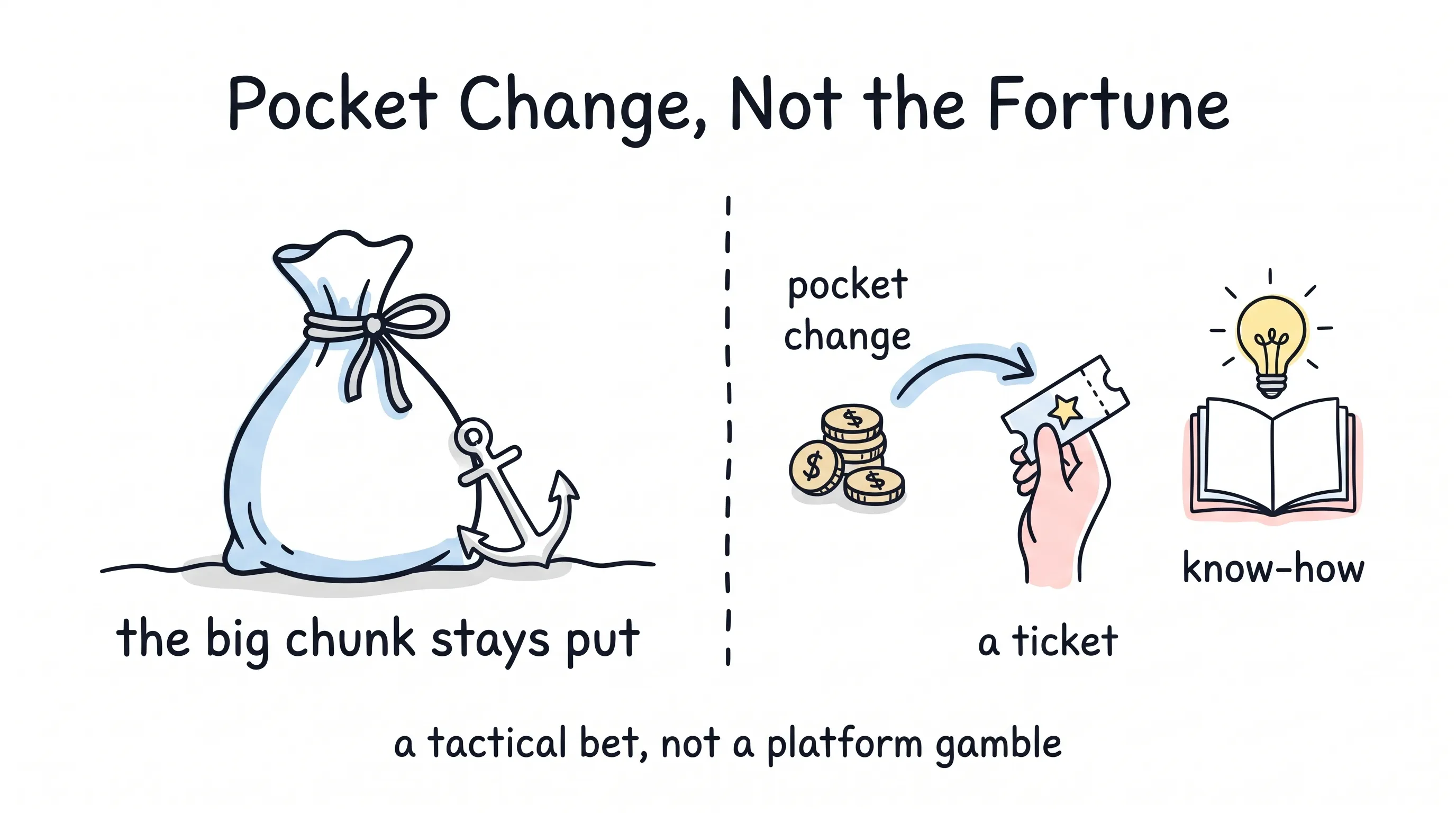
My advice to him: split the budget in two. The big chunk doesn't move by a cent — it stays with Google and Meta. The long-term distribution war was always Google's game, and there's no sign yet of it losing: ChatGPT's MAU is flat, the product moat is closing around it, and every executive appointment points to enterprise rather than advertising. All of these signals say the same thing.
The pocket change goes to ChatGPT Ads — to buy a ticket. Run a few rounds of creatives, get a feel for the audiences, and bank first-hand data of your own. By the time this channel becomes as crowded and as expensive as every other platform, what you'll have over everyone else is exactly the know-how you banked today.
Spend pocket change to buy know-how. Never bet your whole fortune on faith.
ChatGPT ads are a tactical bet, not a platform gamble. Don't chase the shadow and drop the prey in hand.
Here's to looking back two years from now and calling this the best-spent pocket change of your year.
Continue reading
Related articles
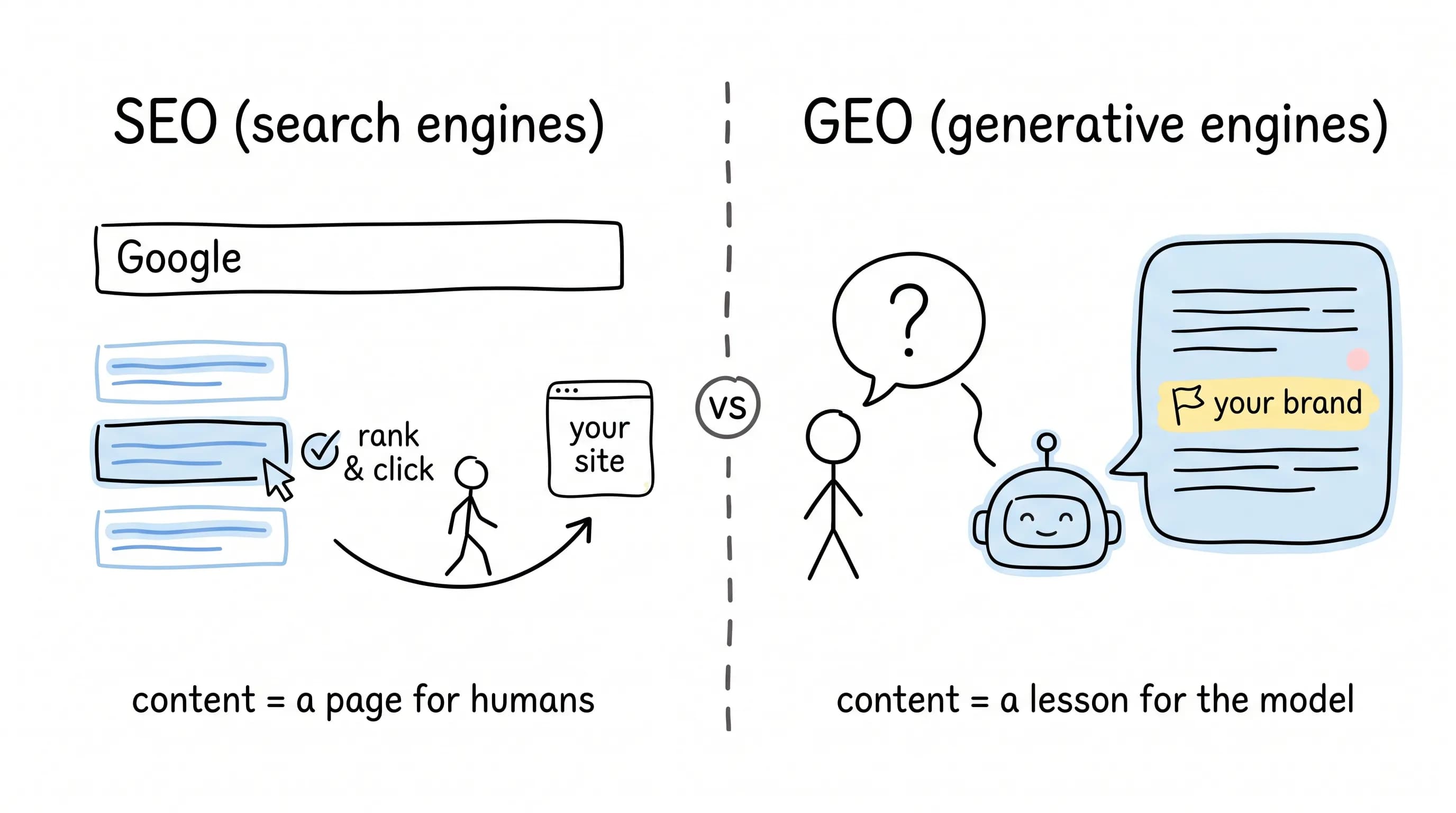
Does AI Know Your Brand? A Look at GEO, the New Craft
An explainer on GEO (Generative Engine Optimization): how AI engines like ChatGPT, Perplexity, and Gemini differ, how GEO goals and metrics diverge from SEO, and which SEO skills still carry over.
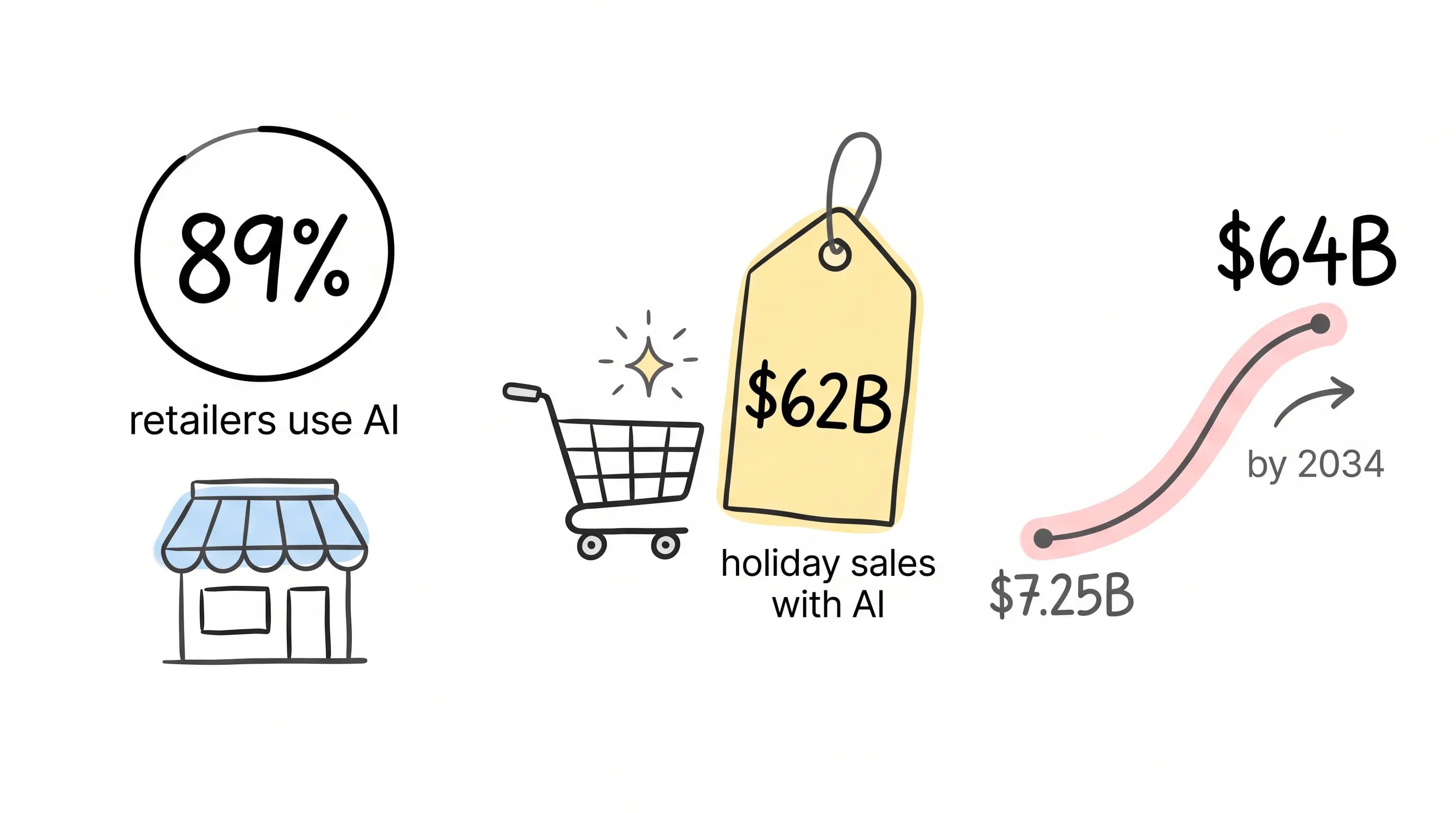
89% of Retailers Are Already Using AI. The Playbook for E-Commerce Has Changed
A learn article on AI in e-commerce: adoption context, use cases from recommendations, search, dynamic pricing, customer service, inventory, and fraud control, plus B2B applications, generative AI content, tool examples, pitfalls, and a six-step adoption path.
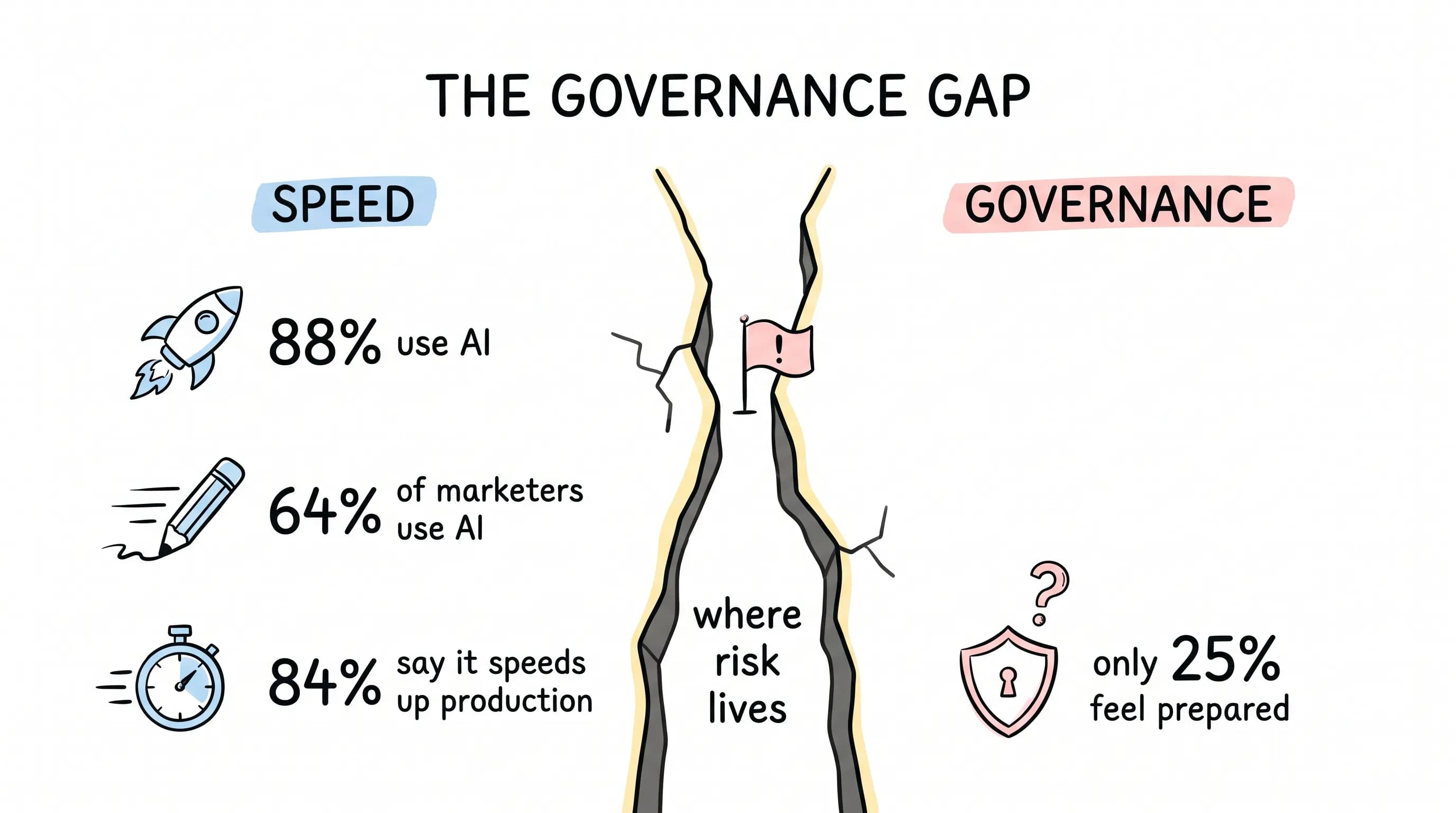
AI Makes Content at Lightning Speed — But Can You Answer "Who Approved This?"
This article looks at the gap between AI content speed and governance readiness in marketing teams, and outlines nine control points — prompt validation, brand guardrails, permissions, approval workflows, human review, versioning, IP checks, audit trails, and asset reuse — for brand-safe AI content.