
Buyers Are Now Letting AI Draft the Shortlist. Is Your Name on It?
This learn article explains how buyers now ask AI assistants for vendor shortlists and why missing from AI answers costs visibility. It covers finding AEO keyword gaps from search data, customer language, and direct AI prompts, then prioritizing gaps and writing answer-ready content with ongoing tracking.
A few days ago, a friend who works in enterprise software took me out to dinner. Halfway through the meal, the venting started: his company ranks well on Google, and nearly all of his core keywords sit on page one. But lately his sales team keeps hearing the same thing from customers: AI recommended a few of your competitors — we never saw you.
I told him that didn't surprise me.
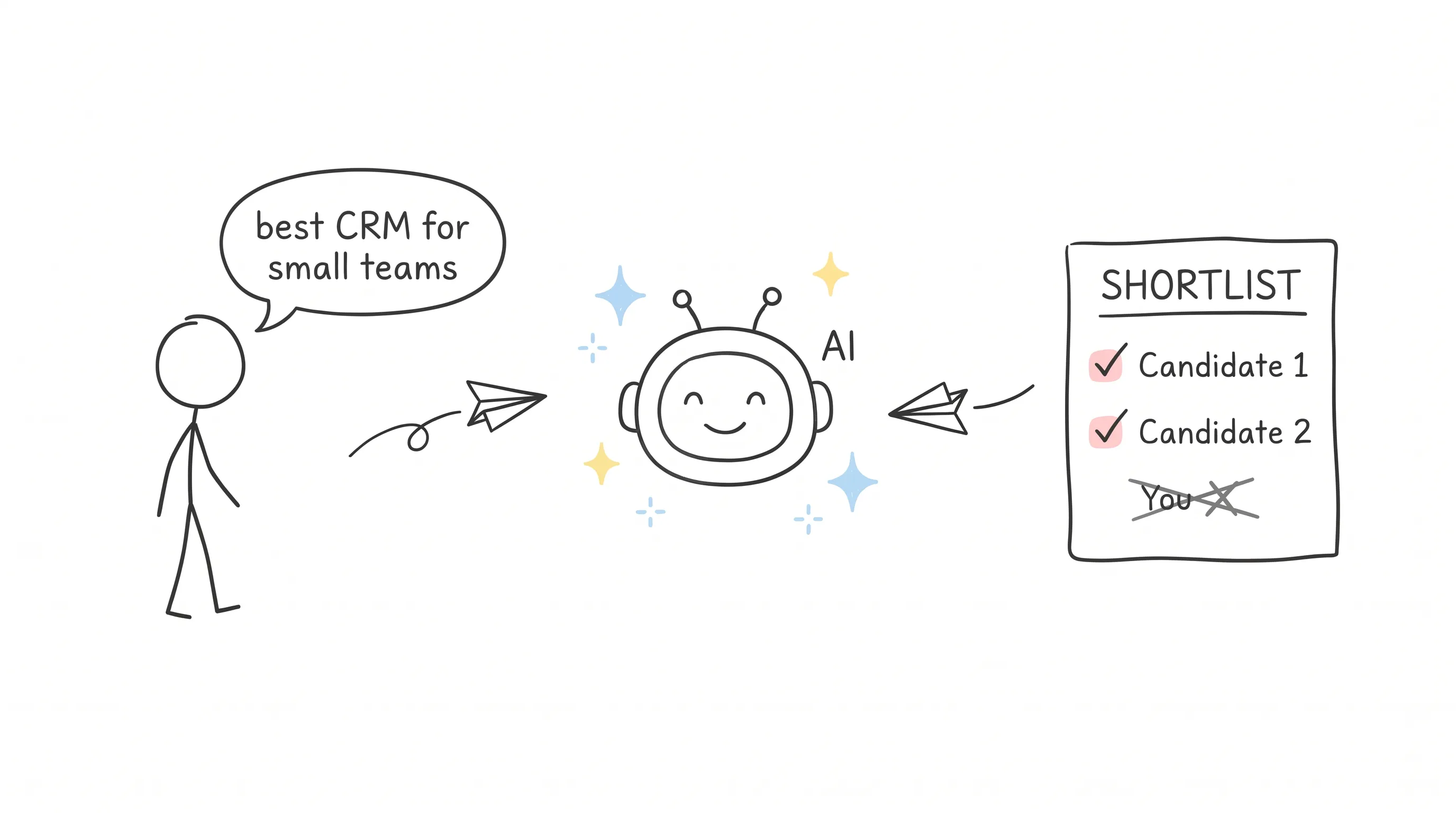
Buyers have moved. They used to search, dig through links, and compare for themselves. Now they go straight to ChatGPT, Gemini, or Perplexity and ask: recommend a few CRMs that work for small teams. Instead of tossing them a pile of blue links, AI hands over a shortlist.
If you're not on that list, you're out. And you can be eliminated without ever knowing it.
What Is an AEO (Answer Engine Optimization) Keyword Gap?
It's the questions buyers ask, AI answers, and your name never appears in the answer.
Traditional SEO has a concept called the "keyword gap": the terms your competitors rank for and you don't. The AEO gap follows the same logic, but its scope is much wider: it doesn't measure rankings — it measures citations. Which questions, which prompts, get other people cited by AI while you're left out?
These two gaps are not the same thing. Filling one doesn't mean you've filled the other.
You might think: I rank first on Google, AI surely has to copy me?
Not necessarily.
BrightEdge analyzed Google's AI Overviews (AIO): among the sources cited by AIO, only about 17% also rank in the top ten organic results. In other words, out of every six citations, roughly five come from content outside the first page.
A 2025 survey makes it even clearer. HubSpot asked 3,063 CRM software purchase decision-makers: 42% are already using AI search to assist vendor selection — and among all the metrics HubSpot tracks, this one predicts purchase intent best.
Traffic is following the buyers. According to search industry outlet Search Engine Land, referral traffic from tools like ChatGPT and Gemini roughly tripled over the past year, climbing month by month through 2025 — December ended up nearly three times January.
Triple. That's not a forecast — it's already happened.
So here is the situation today: buyers let AI draft the shortlist, and AI picks its citations from sources it trusts. If your brand isn't cited, buyers cross you off before they ever open your website.
Being absent from AI is deadlier than being absent from Google's front page.
Where Are the Gaps? Three Cases, Plus One Inventory
So how do you find out where your gaps are? Three real cases and one self-audit — enough to draw a complete map.
Case One: Go Through Your Own Search Data
Google Search Console holds every query that ever won you an impression or a click. Export it, drop it into a spreadsheet, and start with two categories: long-tail queries — the ones that run on and on — and question-style queries, the "how do I," "why," "which is better" kind.
Why these two? Because the way people talk to AI search increasingly sounds like the way they type into a search box: one full sentence, the whole question stated.
Here's a dumb-but-effective trick: count the words in each query and sort in descending order. The formula is:
=IF(TRIM(B1)="",0,LEN(TRIM(B1))-LEN(SUBSTITUTE(TRIM(B1)," ",""))+1)
I exported 1,000 queries from my own site and ran the formula. The ones at the top were all the same agony: B2B software companies struggling to tie pipeline to won deals. That's a real pain point I can solve. So that's a piece of content — an entry point.
Data alone isn't enough. Go look at the search results page too: under this question, is there an AI Overview? Which pages, which domains does the AI cite? See that clearly first; then decide what to model your own writing on.
Case Two: Go Through the Customer's Own Words
Sales call recordings, support tickets, Reddit threads, G2 reviews, your own community. These places hold customers' most native phrasing. And the way a customer asks a colleague is almost identical to the way they ask AI.
One example. Someone in the HubSpot community asked: compared to HubSpot, how much slower is WordPress on page speed? HubSpot's own site happened to have a WordPress vs. HubSpot comparison article, fairly thorough — except it never answered the speed question head-on.
That's what half-qualified looks like: you claimed the question but never delivered the answer. When the AI wants to cite you, it can't find a single self-contained passage to lift.
Case Three: Go Ask the AI Directly
There's something counterintuitive here: the competitors you run into inside AI answers may not be the same crowd you compete with on Google at all.
Run a batch of prompts buyers would actually type — say, "what is the best CRM for a small sales team" — once each in ChatGPT, Perplexity, and Google's AI Overviews. Log every answer, every cited domain, every cited page type into a spreadsheet.
When that CRM example was run, what got cited the most? Third-party comparison articles, with pricing tables, pros and cons, hands-on reviews. Not a single one was a vendor's own site.
What does that tell you? You can't break into this battlefield through your own website. You need third-party content and PR — getting other people's pages to mention you.
Finally, Inventory the Content You Already Have
Take the findings from the first three steps and ask one question of every page: does this page directly give an answer the AI could lift whole?
Plenty of pages cover everything except an actual answer. To AI, those pages might as well not exist.
Run all four steps and you'll have a map in hand: where the answer is clear, where it's going in circles, and where citations are being taken by competitors. By the way — take this map to ask the boss for budget, and it'll beat any slide deck.
A Pile of Gaps — Which One to Fill First?
There will never be just one gap. Fix them all? You can't.
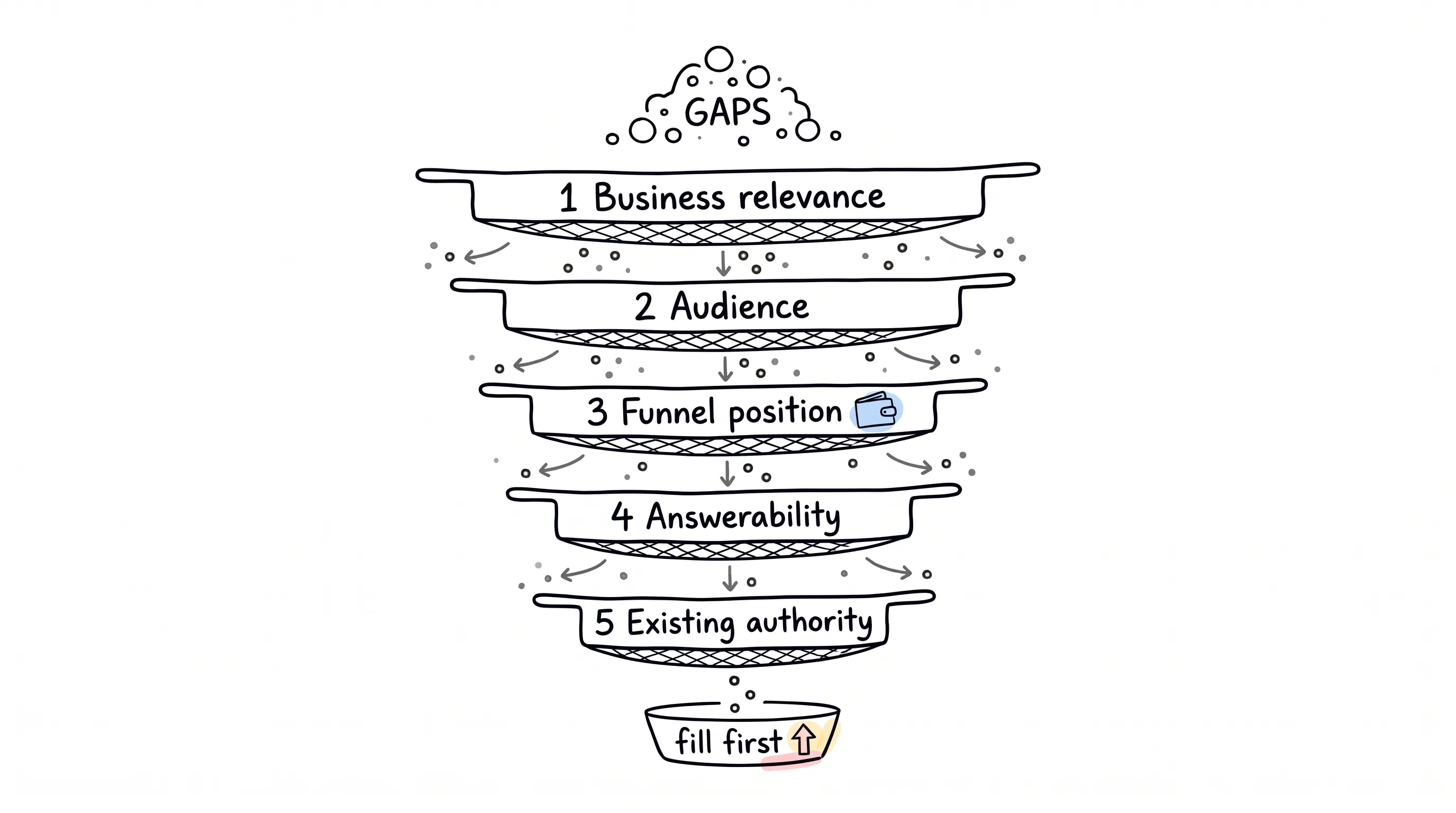
Filter. Run every gap through five sieves, in order:
- Business relevance. Does this question connect to what you sell? If not, it waits — no matter how big the search volume.
- Audience. Are the people asking it your ideal customers? Do they hold sign-off power?
- Funnel position. Questions like "A or B, which is better" sit far closer to the wallet than "what is XX." Fill the ones near the decision first.
- Answerability. Can your experts give a direct, complete, well-founded answer? If you can't answer it, don't touch it yet.
- Existing authority. Topics that already rank and already get impressions need only a nudge to enter the citation zone; building from zero is much slower. Pick the quick wins first.
One example. In my search data I saw a flood of queries from e-commerce sites with over a thousand SKUs. Content like that would absolutely grow exposure, but I don't serve e-commerce clients — they're not my ideal customers. The biggest gap by volume is not necessarily the gap you should fill.
When it comes to filling gaps, choosing the right few matters more than filling more of them.
For a quick baseline, you can use HubSpot's free tool, AI Search Grader: it looks at how ChatGPT, Gemini, and Perplexity describe your brand, scores you on five dimensions — sentiment, presence quality, brand recognition, share of voice, market position — and hands you a free optimization report. Use it as your baseline, and every move afterward has a number attached.
How Do Gaps Become Content That Gets Cited?
Gaps found. Next: turn them into content AI actually wants to cite.
What does answer-ready mean? Every question on the page is immediately followed by one complete, direct, well-founded answer — a passage AI can lift whole.
Four moves.
One, choose the right format. Comparison questions become comparison pages with tables — not essays; operational questions that recur in tickets become step-by-step guides; attribution and methodology questions suit blog posts or use-case pages.
Two, lead with the answer. If a question sits under a subheading, the first or second sentence after the heading must deliver the full answer, in wording that mirrors the question itself. Details, exceptions, and caveats come later. Many pages that "were clearly written but never got cited" die of the same disease: the answer is buried in paragraph six.
Three, cover the follow-ups. After buyers ask the main question, there's always a next question. Give each follow-up its own subheading and one direct answer, and a single page now covers a whole string of related prompts.
Four, link with intent. Outward, link to case studies, product specs, and data pages — put evidence behind your claims. Inward, let content on the same topic knit into one connected whole.
Tracking by Hand Won't Scale
Can all of this be done by hand? Yes. But let me be honest: doing it manually is slow and sloppy, and each pass captures only a snapshot. AI answers change every day. Look once every three months, and what you're seeing is the world of three months ago.
That's why dedicated AEO tools have emerged. Take HubSpot AEO as an example — it does four things:
- Every day, it sends the prompts you're tracking to ChatGPT, Gemini, and Perplexity, then rolls the results into one brand visibility score: what share of answers mention you. Visibility turns from a one-time check into a curve you can watch week over week.
- It compares competitors continuously: which names appear in the answers, how consistently, how their share shifts — giving you a share of voice.
- It analyzes citations: which domains, what types of pages, are deciding the answers in your category.
- It gives recommendations: which gaps are answerable, relevant, and sit at a funnel position worth the effort.
The tool doesn't understand your ideal customers; judgment stays human. But it can compress a hundred gaps down to the ten worth acting on. When it's time to actually write, Marketing Hub's SEO features pick up where it leaves off: use CRM data to recommend which prompts to target, turn recommendations into published content, then connect Search Console to watch impressions and clicks on the new pages.
The tool doesn't think for you. It buys back the time you'd spend watching.
Four Numbers — It Only Counts If You Keep Counting
One last thing, and the easiest one to slack on: keep measuring.
Watch four numbers.
Visibility. If it climbs, your content is right. If it keeps falling even after new content ships, something has to change — the prompts, the format, or the sources being cited. At least one of the three.
Citations. More honest than visibility. Visibility up while citations stay flat means AI mentions you but doesn't treat you as a source. That's an awareness problem, not a content gap — and the cure is completely different.
Prompt coverage. Buyer phrasing drifts; new competitors enter. Your prompt list needs regular refreshing, or you'll be measuring last year's buyers.
Revenue. The first three numbers must eventually land in leads, opportunities, and dollars you can count. Visibility and citations are leading indicators; pipeline and revenue are the ace you play when reporting to management.
One more trap: if your score hasn't moved in two months, either your own numbers are stuck, or an engine redesign rippled through the whole industry's citation habits. Misread that, and you'll start changing strategy at random. There's a free beta dashboard called AI Search Sensor that tracks citation volatility across the three engines, with industry-level benchmarks. Put your curve next to the industry's, and you can tell whether you're the one ailing — or the whole industry is just changing seasons.
Back to That Dinner
Back to the friend from the beginning. His product hadn't changed. His rankings hadn't changed. What changed was the buyer's first stop.
Buyers aren't flipping through ten pages of blue links anymore — they let AI draft the shortlist. If you're not on it, everything after that is effort spent on your competitors' behalf.
Buyers are asking. AI is answering. Your job is to make sure the answer includes you.
Start by exporting your search data once. Start by running ten prompts. Start by rewriting one meandering article into a single direct answer.
I've seen what doing this right pays: one client's deal began as a single question asked in Gemini and closed as a six-figure contract.
Here's wishing you a permanent place on the list.
Continue reading
Related articles

It's 2026: Stop "Buying" AI Tools for Your Marketing Team — Start "Hiring" AI Agents
This learn article explains how AI agents differ from standalone AI tools in marketing, outlines three agent categories — build-your-own platforms, CRM-native agents, and vertical tools — and covers use cases across SEO, social media, advertising, and reporting, plus criteria for choosing one.

What Is GEO? How Your Brand Gets "Mentioned" in the Age of AI Search
An explainer on GEO (Generative Engine Optimization) for e-commerce and DTC brands: how it differs from SEO and AEO, why AI answers shape brand visibility, and eight practices covering question-focused content, consistent brand messaging, structured pages, external evidence, comparisons, and AI mention tracking.

AI Is Already Making Decisions for Your Customers. Are You on the List?
A learn article explains GEO (Generative Engine Optimization): why AI-generated answers now shape which brands customers see, and how SEO fundamentals, entity clarity, citable evidence, and monthly measurement affect visibility in AI answers.