
Before You Do AI Content Marketing, Get One Thing Straight: Who's the Head Chef?
A learn article explaining the difference between AI-assisted and AI-generated content marketing for small teams, comparing writing, SEO, social, image, and email tools, and outlining a five-step content pipeline with human review.
A while back, a friend of mine who runs a bakery studio invited me out for tea. Her team is three people, and half their time goes into making cakes — the other half into taking photos, writing posts, running social media, and answering DMs.
She said: what scares me most these days isn't making cakes — it's "we still haven't posted anything today."
I said, then have you heard about using AI to make content?
She said, sure I've heard of it — isn't that just letting a robot write articles? Whatever it writes has that burnt taste, and customers can tell it's fake at a glance.
I said, I think you've got the wrong idea about this. Today, let's take the whole thing apart and set it straight.
So What Is AI Content?
What is AI content marketing, exactly?
To put it plainly: you put AI's hands into every stage of content production — picking topics, writing, making images, publishing, reviewing results. Under the hood, three things do the heavy lifting: machine learning, natural language processing, and data analytics. Those terms sound intimidating, but you don't need to understand them. You only need to know the outcome: work that used to take hiring a whole team can now be mostly handled by a single toolbox.
But there's a fork in this road that a lot of people never think through.
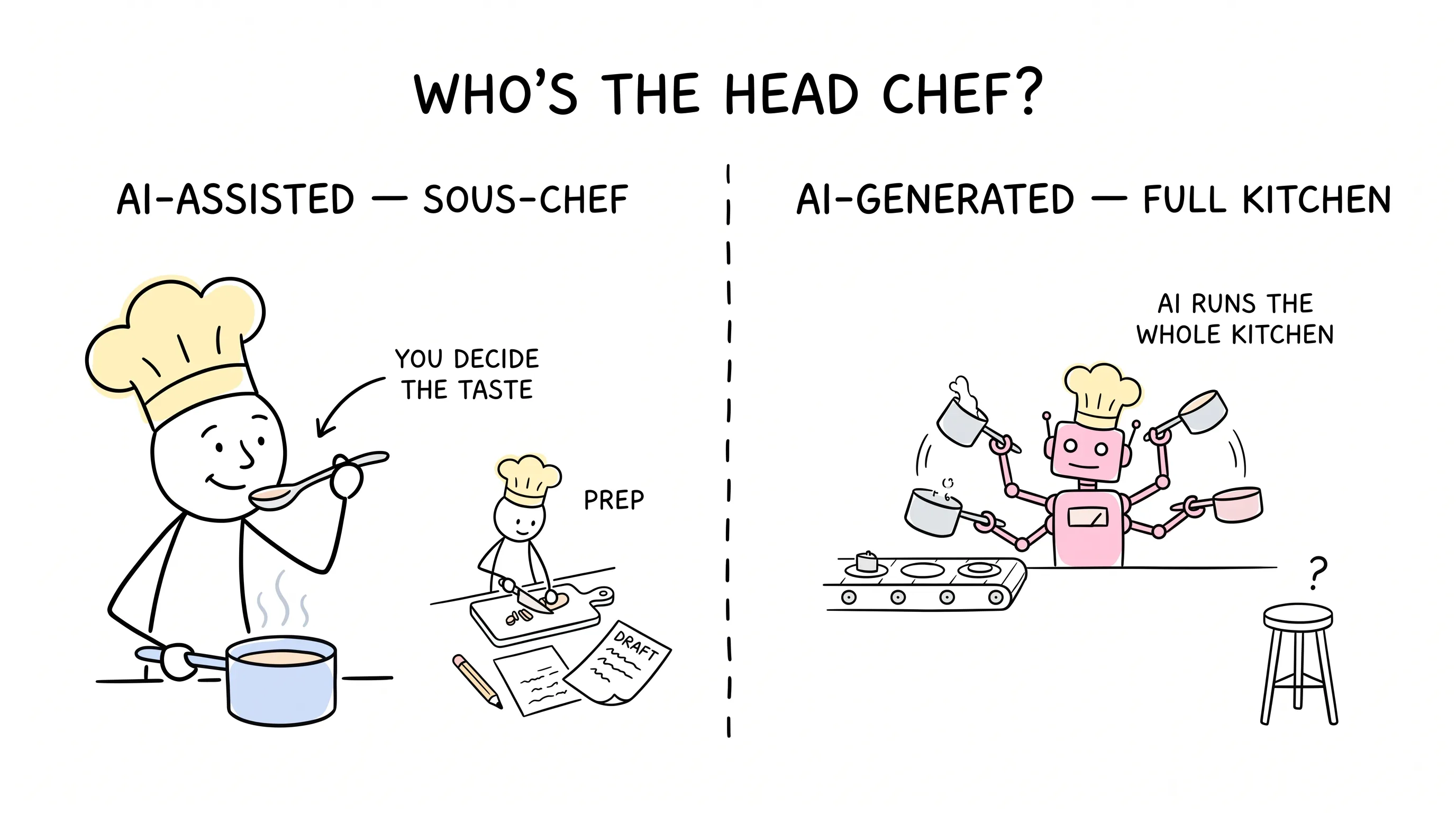
The first way of using it is called AI-assisted. AI helps you brainstorm ideas, fix grammar, pick keywords, and read the data — but the one holding the pen is still you.
The second is called AI-generated. You give it a prompt, and it hands you a finished piece. Type a sentence into ChatGPT or Jasper, and a full piece of product copy comes out.
What's the difference between the two?
Here's an analogy. In the first, AI is the sous-chef: washing vegetables, doing the prep, and watching the heat are all its job — but how the dish tastes is the head chef's call. In the second, AI runs the whole kitchen.
Today, AI has left its mark on nearly every stage of content production, in both of these ways:
Writing blogs — it finds keywords and optimizes while keeping an eye on your rankings. Posting on social — it turns out twenty versions a day and runs A/B tests in real time. Sending email — it follows each recipient's behavior data and finds a hundred different human ways to say the same thing. Images and short video — generative tools produce the graphics and clips outright.
Where Are Small Teams Actually Using AI?
You might say all of this sounds like big-company business.
Quite the opposite. For big teams, AI is a nice bonus. For small teams, it's a lifeline.
Let me break down the five most common uses.
First, writing blogs. What small teams lack usually isn't ideas — it's the time it takes to turn an idea into an article that can rank. Tools like Jasper, Surfer, and Scalenut first build the article skeleton for you and suggest which keywords to weave in, then score your writing as you go. AI produces the first draft, humans revise; the speed more than doubles, and the rankings don't drop.
Second, posting on social media. Lately and Copy.ai are best at one thing: taking your long article or podcast episode and slicing it into dozens of short pieces, hashtags thought up for you as well. One piece of content feeds the whole week.
Third, sending email. Seventh Sense and HubSpot solve the mystical question of "what time to send." They watch when your users habitually open email and deliver the message right to the doorstep of their inbox — and they can even test two subject lines to see which one wins.
Fourth, customer service. Manychat — or a bot you wire up yourself on the ChatGPT API — answers the common questions automatically and can slip in a product recommendation while it's at it.
Fifth, the most easily overlooked: a consistent voice. On a team of three to five people, it's easiest to end up with five different tones. Tools like Grammarly and Writer let you encode your brand voice rules, so no matter who does the writing, it all comes out tasting the same.
Think about it: not one of these five jobs is "thinking for you." Every one of them is "doing the grunt work for you."
What Tools Are Out There, Exactly? Let's Run the Numbers
There are enough tools to make your eyes blur. I've grouped them by purpose, picked the representative ones, and I'll run the numbers with you.
First, the writing ones.
Jasper — the old master of the marketing world. It digests your brand guidelines, and every article it produces carries your flavor. For long content and brand content, it's the one to see. Starts at $39 a month.
Copy.ai — fast, and broad. Social copy, ad headlines, handled in one go. There's a free version; paid starts at $36 a month. If your budget is tight, start here.
Writesonic leans toward e-commerce. Product descriptions and landing-page copy, produced in bulk. From $16 a month — the lowest bar to entry.
ChatGPT — everyone knows it. What's really valuable is custom GPTs: feed it your website copy and FAQs, and you train an assistant that understands only your business. Plus is $20 a month.
HubSpot's AI lives inside its CRM system. Writing emails, writing blogs, segmenting audiences, handling follow-ups — start to finish. It suits people who are already using HubSpot. But it isn't cheap: the Professional tier starts at $800 a month.
Now, the ones that push your content up the search results.
Surfer watches the articles currently ranked ahead of you and tells you which keywords you're missing and where your structure falls short, scoring as you write. From $79 a month.
Clearscope, same school of method, cleaner interface, and it installs directly in Google Docs. $189 a month — not cheap, but for make-or-break content like product pages, it's worth it.
Scalenut covers everything from keyword research to drafting to optimization in one tool. From $20 a month — a freelancer's cup of tea.
MarketMuse is good at finding content gaps: what you've written, what competitors have written, and what's missing in between. There's a free version.
Semrush, the veteran all-in-one SEO suite, has grown an AI assistant inside it too, feeding you keyword data as you write.
Then, social and images.
Lately turns long pieces into short posts. From $199 a month — not cheap, but what it replaces is several days of one person's work each week. Whether it pays off, do your own math.
Predis.ai — give it a prompt, and the copy comes out together with the images. There's a free version; paid starts at $27 a month. If you're in e-commerce, give it a try.
Canva — everyone who does design knows it. The Magic Write inside writes while you lay out the page; the free version gives you 50 uses a month, and Pro is $120 a year. It generates images too, so it basically covers the whole brand-assets job.
Midjourney produces the most artistic images of the bunch. Blog covers, ad backgrounds — from $8 a month.
Adobe Firefly is the generative-image tool for the pros, wired into the Adobe suite. From $9.99 a month.
Last, email and conversations.
Mailchimp — the classic starting point for small teams sending email. Free up to 500 contacts; paid from $13 a month.
Kit, originally called ConvertKit, is the creators' favorite. Free up to ten thousand subscribers, and AI can even help you test your email subject lines. That free tier is genuinely generous.
Seventh Sense specializes in curing "what time to send email." It hangs off HubSpot and starts at $80 a month.
Manychat builds auto-reply bots on Messenger, Instagram, and SMS. There's a free version; Pro starts at $15 a month.
One more thing: these prices are reference points as of when I wrote this piece. Every company adjusts them whenever it likes — go take another look at each official site before you buy.
How Do You Assemble the Pipeline?
You have the tools — how do you string them together?
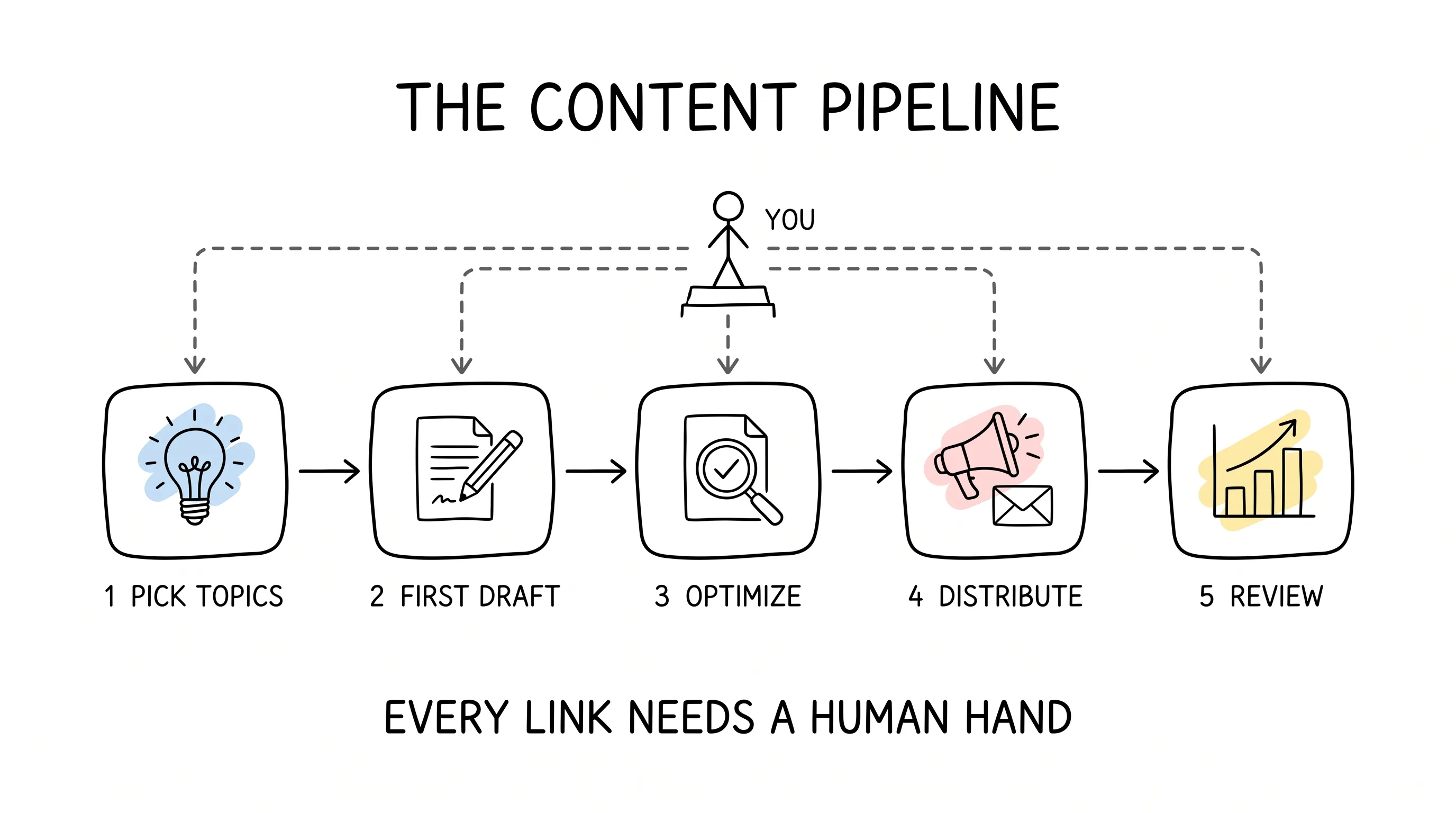
Picture content production as a restaurant: front of house and back kitchen, ingredients coming in, dishes going out, everyone with their own station.
Step one, choosing topics. Have ChatGPT and Jasper work from trending search terms and the questions customers ask most, and hand you a pile of topic candidates. Remember: you do the picking, not it.
Step two, writing the first draft. Jasper writes the long pieces, Copy.ai and Writesonic write the short copy, and Grammarly tidies up tone and typos.
Step three, optimizing. Surfer and Clearscope score the article and offer suggestions, and MarketMuse helps you fill in the pieces your competitors have written and you haven't.
Step four, distribution. Canva makes the images, Kit sends the emails, Lately splits the long piece into post after post.
Step five, the review. Semrush watches the rankings; HubSpot sees the whole picture.
What does it taste like, all strung together? Here's a real chain:
Jasper produces the blog first draft, Surfer straightens out the keywords and structure, Canva adds the images and social posts, Kit sends it out through email, and Semrush tracks the data and rankings behind the scenes.
A team of two or three, running on this chain, can match the output of what used to take a five-person team.
But remember this: every link on the chain needs a human hand passing over it.
But Everything Always Has a Flip Side
At this point, you may already be rolling up your sleeves.
Don't rush — let me pour half a bucket of cold water on that enthusiasm first.
AI's writing has two chronic bad habits.
First, it makes things up with a completely straight face. It isn't understanding the world — it's guessing the next word. Data, years, people's names: it dares to say it, you might dare to believe it, and believing it is where things go wrong. So before anything is published, a pair of human eyes must go over it word by word.
Second, no soul. AI can put up a beautiful structure, but it doesn't understand why you revised the recipe in the middle of the night, or why your customers favor that one cake. What small teams compete on is exactly that little bit of human touch — cut it, and you've thrown away everything that's truly yours.
By the way, you may have worried about this: will search engines penalize AI-generated content?
Google stated its position long ago: it cares about whether the content is good, not how the content was produced. To translate that: as long as your content is useful and trustworthy to readers, it doesn't care whether it was handwritten or drafted by AI. But that phrase — "useful to readers" — is precisely the part that needs a human standing guard.
So my judgment has always been clear:
AI is the sous-chef. The head chef is always you.
After You Hit Publish, What Do You Watch?
Getting the content out is only the beginning.
Watch four numbers: the rankings of your target keywords, the blog's bounce rate and time on page, the email open rate and click rate, and the likes, shares, and comments on your social posts.
Semrush and Surfer cover the search side, Mailchimp and Kit the email side, Lately and Predis the social side.
This is where AI's real value begins: it doesn't just tell you which number looks good and which looks bad — it also reminds you which topic is rising and which old article is due for a refresh. Before, you guessed by feel; now you make decisions off the ledger.
Back to That Cup of Tea
Halfway through the tea, my friend asked me: so should I go buy a pile of tools?
I said, no. First get three things straight: what your customers love to read, how many people you have in total, and how much you're willing to spend in a month.
Then start with one small entry point. Take her: hand the weekly product story to ChatGPT for a first draft, revise it herself for ten minutes, then send. Twenty dollars a month takes care of that nagging worry of "we still haven't posted anything today" first. Once it's running smoothly, add the next tool.
Tools won't build a brand for you. The person who builds the brand is still you.
Let AI do the grunt work; your job is to make sure the content has you in it.
Here's wishing that little shop of yours cakes that sell better and better, and content that gets easier and easier to write.
Continue reading
Related articles
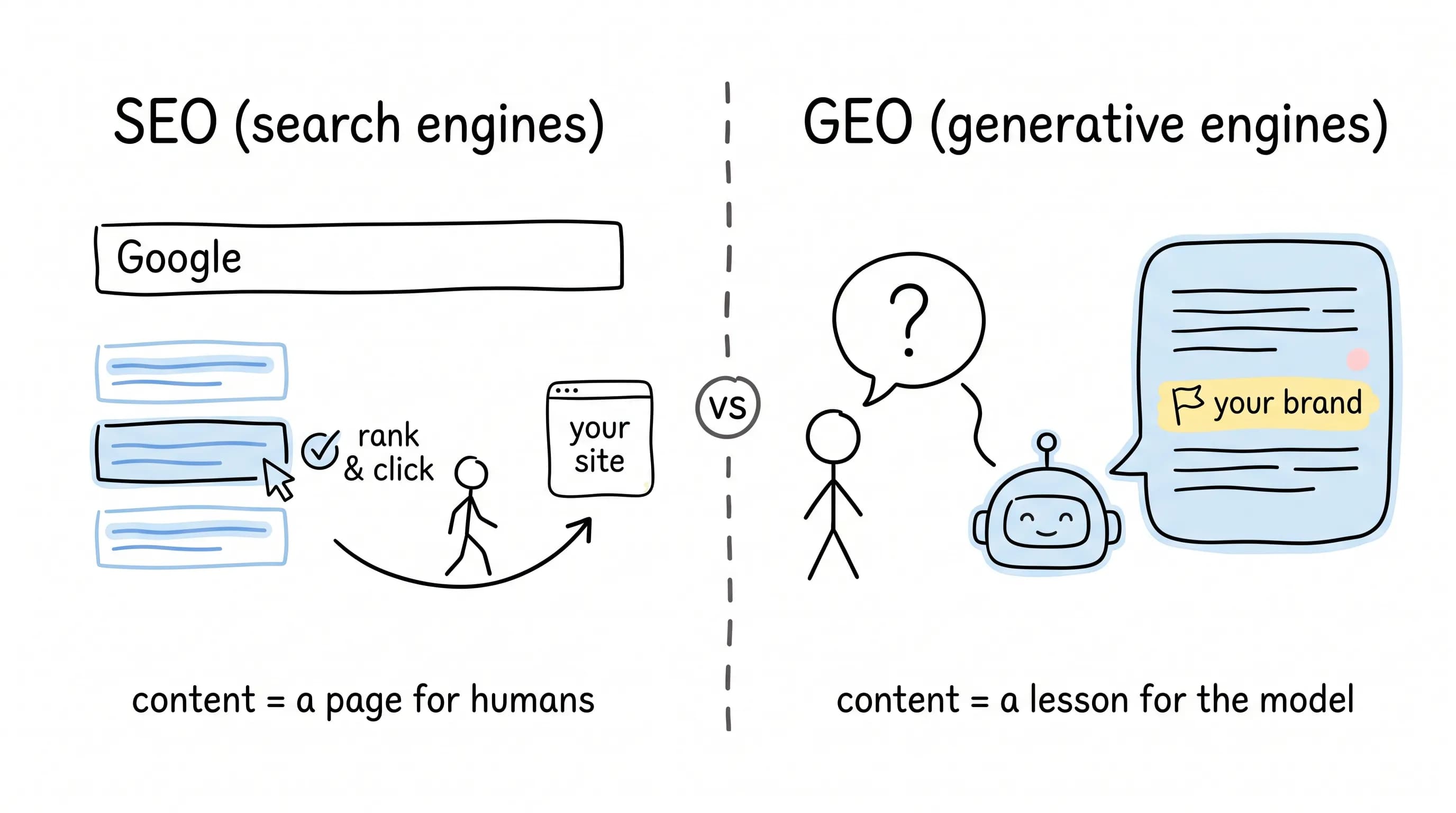
Does AI Know Your Brand? A Look at GEO, the New Craft
An explainer on GEO (Generative Engine Optimization): how AI engines like ChatGPT, Perplexity, and Gemini differ, how GEO goals and metrics diverge from SEO, and which SEO skills still carry over.
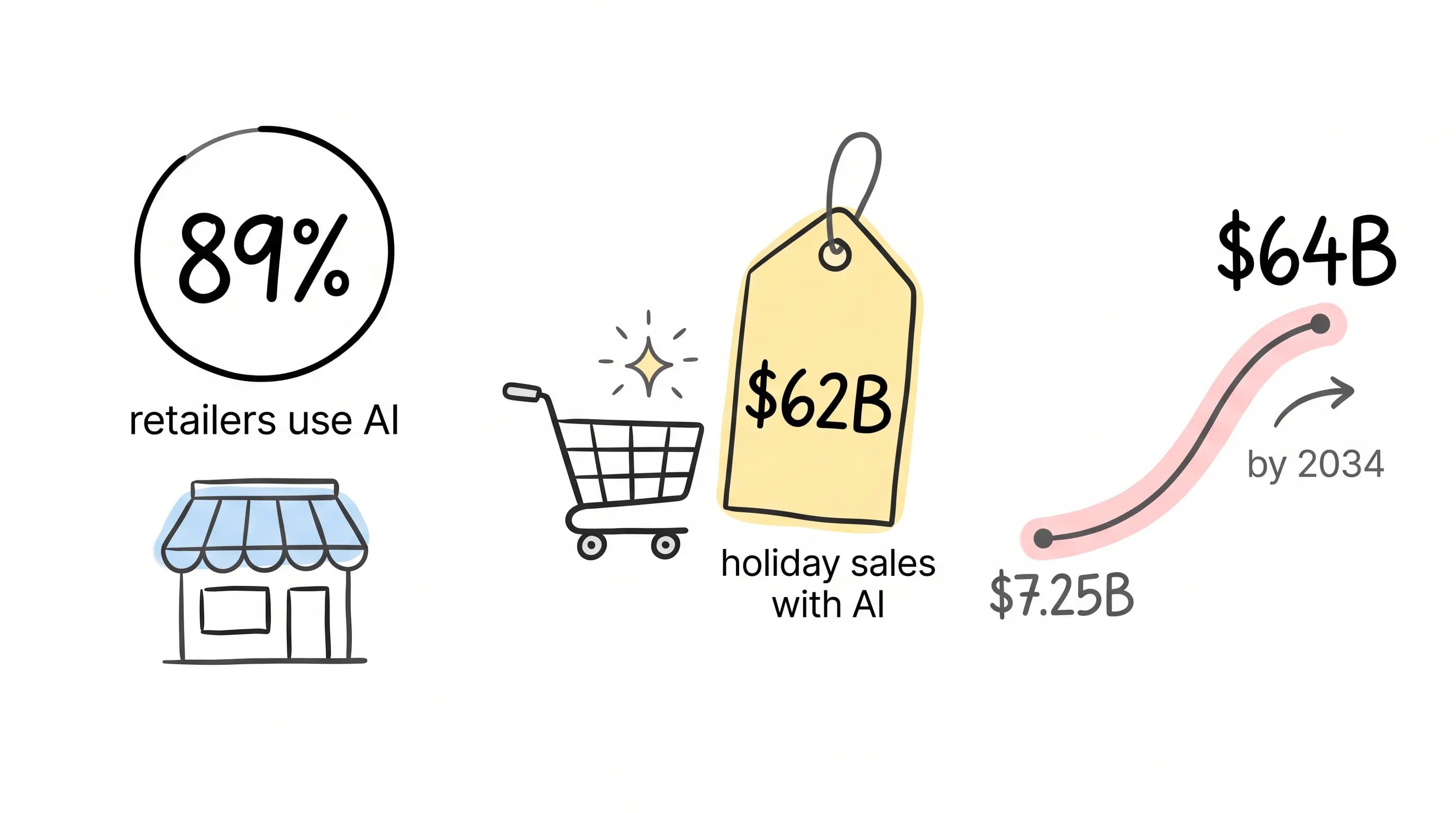
89% of Retailers Are Already Using AI. The Playbook for E-Commerce Has Changed
A learn article on AI in e-commerce: adoption context, use cases from recommendations, search, dynamic pricing, customer service, inventory, and fraud control, plus B2B applications, generative AI content, tool examples, pitfalls, and a six-step adoption path.
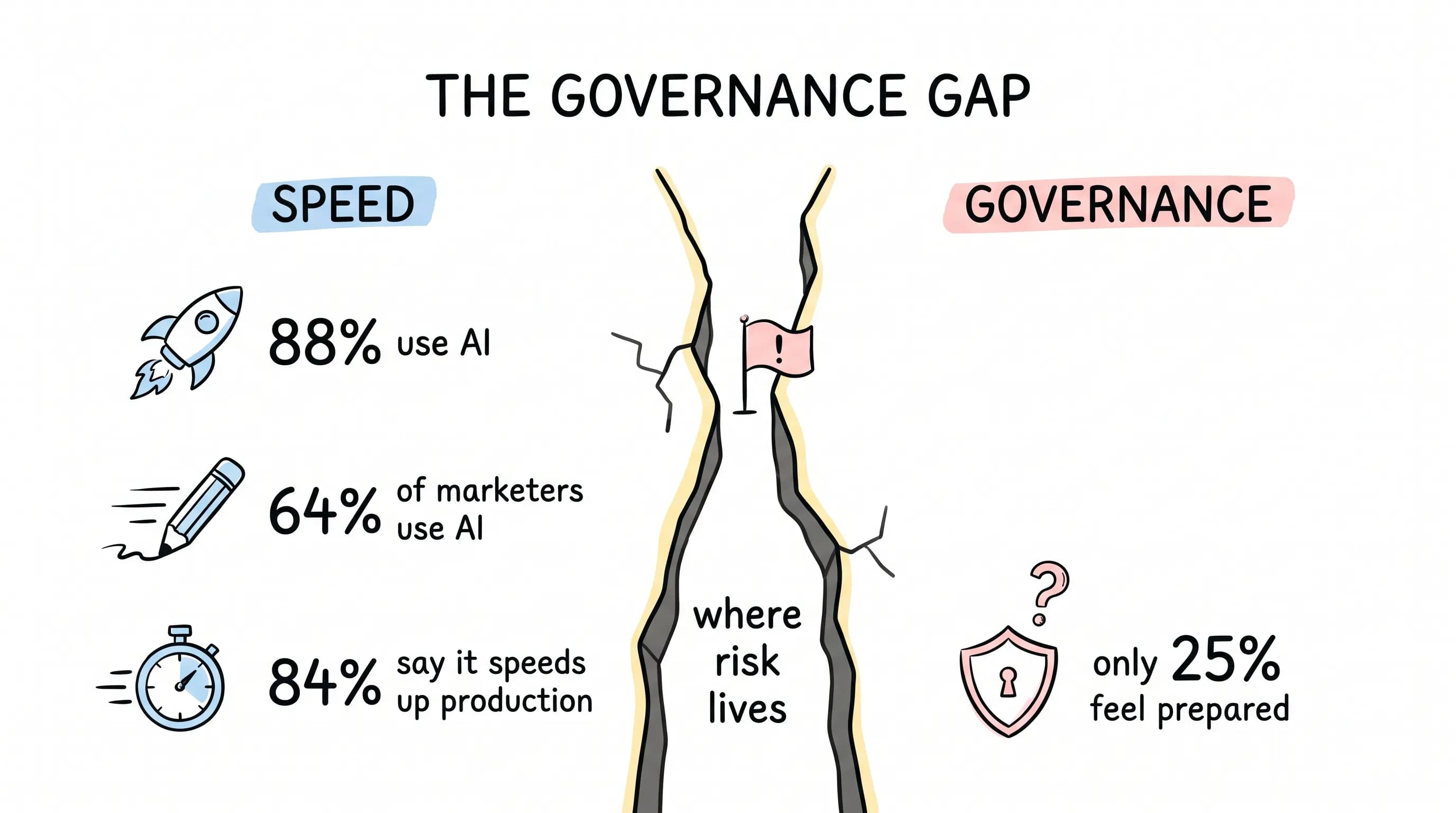
AI Makes Content at Lightning Speed — But Can You Answer "Who Approved This?"
This article looks at the gap between AI content speed and governance readiness in marketing teams, and outlines nine control points — prompt validation, brand guardrails, permissions, approval workflows, human review, versioning, IP checks, audit trails, and asset reuse — for brand-safe AI content.