
Before You Buy GEO Services, Get Clear on What You're Actually Buying
Explains what GEO services actually cover, separating LLM mentions, AI Overview citations (AIO), and post-click optimization (SXO), and outlines how ChatGPT, Claude, Perplexity, Gemini, and Google AI Overviews differ in what they cite. Recommends an AI visibility audit before purchasing.
A few days ago, a friend of mine who runs a cross-border e-commerce business came to see me. A service provider had pitched him a GEO package — Generative Engine Optimization (GEO) — and the quote wasn't cheap. He asked me: how is this any different from SEO? Am I about to get fleeced all over again?
I said he was asking the right question. But the answer probably wasn't what he expected.
Whether GEO is worth buying, let's set that aside for now. First he had to figure out one thing: when you pay for GEO services, what exactly are you buying?
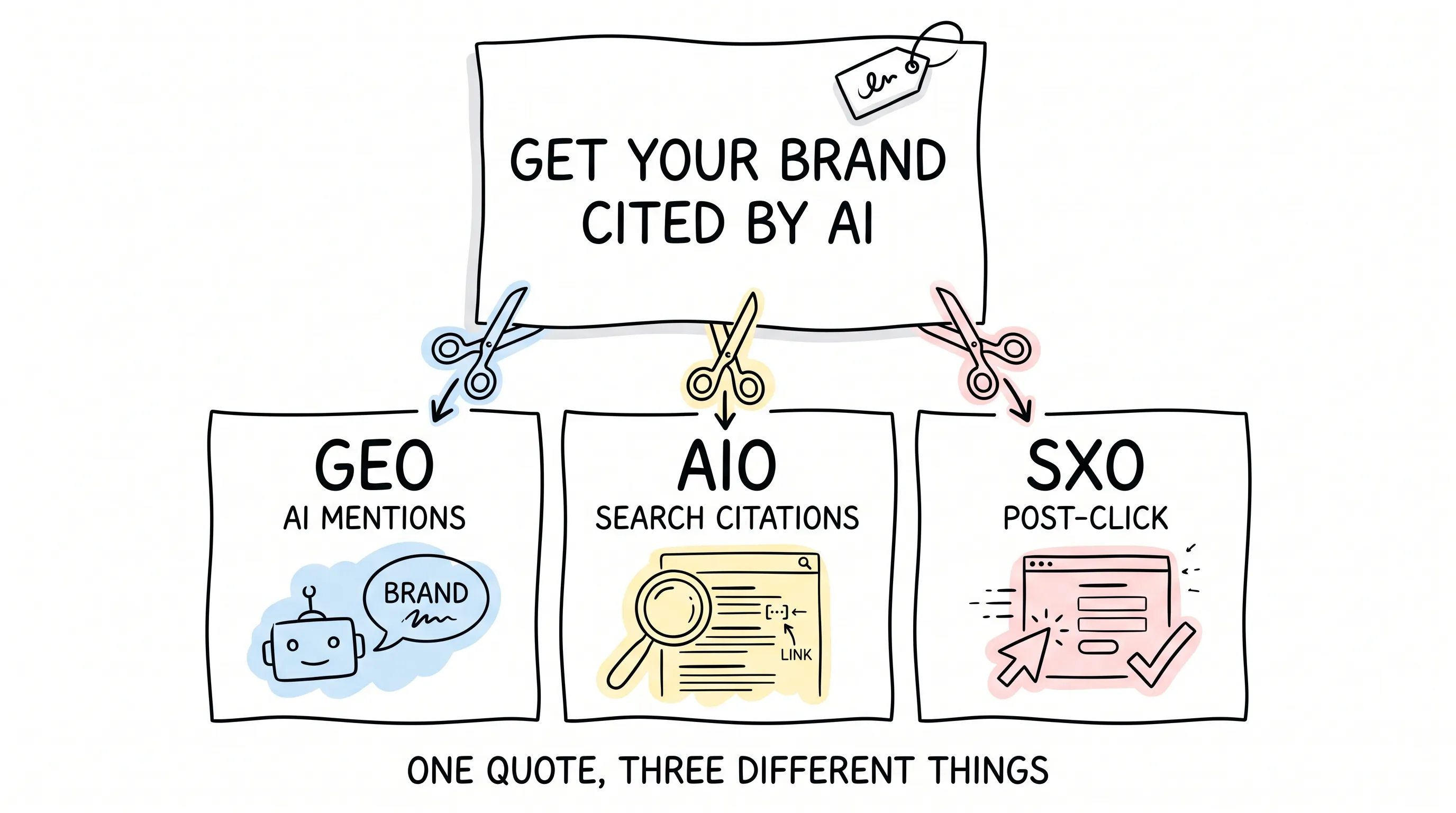
A Quote Sheet Hides Three Different Things
What is GEO? Put simply, it's getting AI systems like ChatGPT and Gemini to willingly mention and cite you when they answer questions.
Why is that worth paying for? Because when an AI answers a question, it only names a small handful of brands. A user asks "which one is best?", the AI gives one answer, and the answer contains only those few names. If you're not in the list of names, you may as well not exist.
I took a look at the proposal he'd brought. On the surface it was a single line — "get your brand cited by AI" — but broken apart, it's three different things.
The first: getting large models like ChatGPT, Claude, and Perplexity to mention you in their answers.
The second: getting Google's AI Overviews and Copilot inside Bing to cite you in the AI summary on the search results page. That's called AIO.
The third is called SXO, and it governs what happens after the user clicks your result: is the page fast, is the form simple, do the inquiries come in.
Three things, three methods, three sets of metrics. If a provider mashes them into one lump and just thumps its chest promising "you'll be cited by AI," be a little more wary.
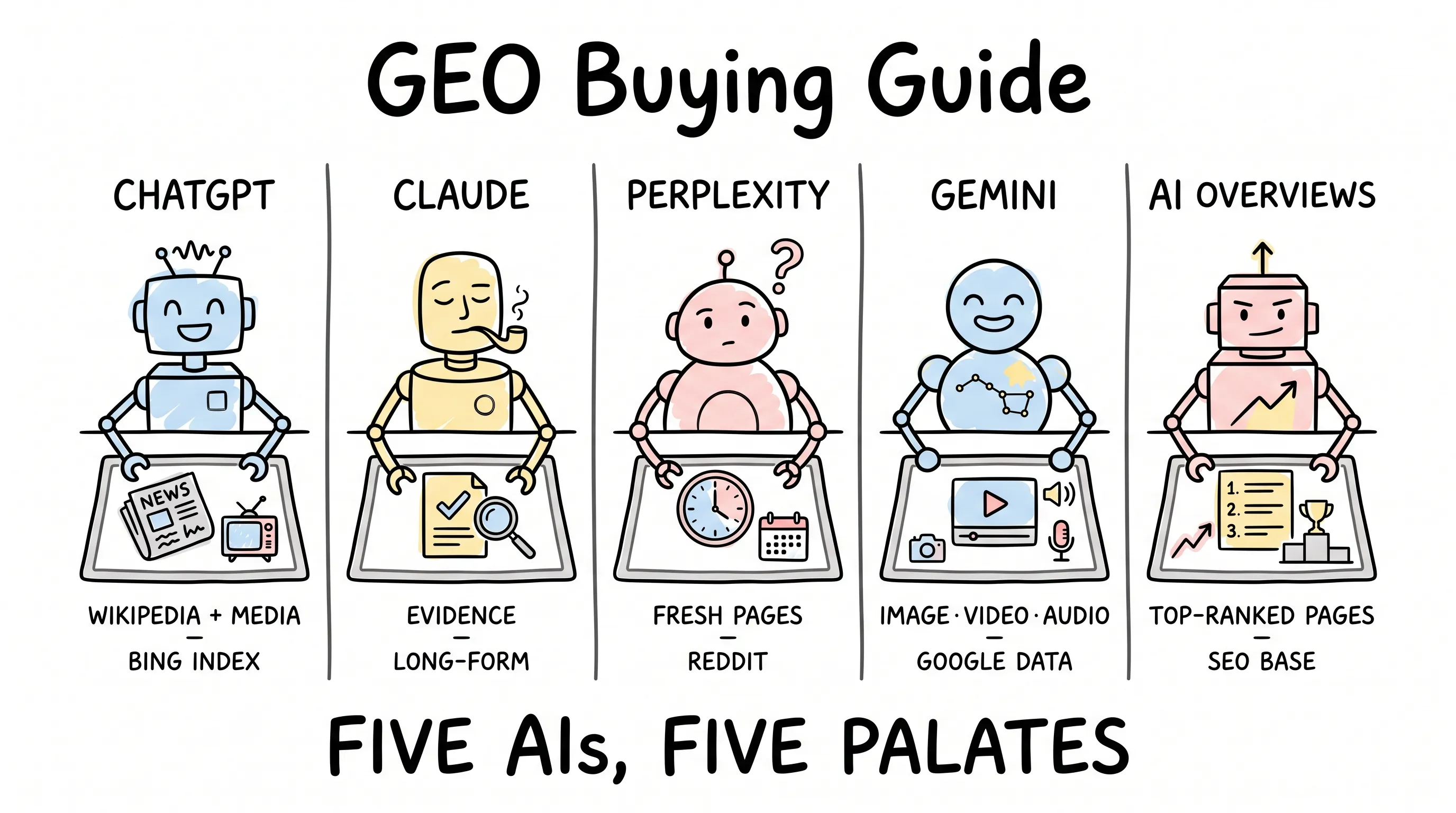
Five AIs, Five Palates
The most interesting part of this is: there's no one move that works everywhere in GEO.
Think about it: how does ChatGPT pick brands? The names it recommends are usually ones that Wikipedia and mainstream media have already mentioned. Why? Because it was trained to give balanced answers that "most sources agree on." So to get into a ChatGPT answer, you first have to accumulate consensus across the open internet: third-party mentions, genuine reviews, getting your Bing indexing in order (when ChatGPT retrieves web pages, it mainly goes through Bing's index).
And Claude? Anthropic trained it with a constitutional approach — it insists on claims backed by evidence. It favors long-form, well-structured pages; when it sees promotional talk with no evidence behind it, it doesn't trust it. To get cited by Claude, that flashy product page of yours may have to be rewritten into a long-form article with real substance and logic.
Perplexity is the most search-engine-like; it attaches a citation to almost every sentence. It favors two things: recently updated pages, and active communities like Reddit.
Gemini is pickier. It doesn't just read text — it also takes in images, video, and audio, plus Google's own local data and shopping data. A plain-text website is at an inherent disadvantage with Gemini.
Google AI Overviews is the most direct: what it cites is, mostly, pages that already rank highly in organic search. So an SEO foundation is still your ticket here.
See the difference? Five engines, five palates, five approaches. When a provider says "there is no universal solution," that's the truth, not a price-raising script. Whoever figures out each AI's palate first gets named first.
The Touchstone: Make Them Run an Audit First
So how do you tell whether a GEO provider is a real expert or a snake-oil salesman? There's a method — I call it the touchstone: have them run an AI visibility audit for you first.
A proper audit looks like this: first find the 20 to 30 questions your customers would actually go ask an AI, throw each of those questions one by one at ChatGPT, Claude, Perplexity, Gemini, and Google AI Overviews, then write down which websites each one cited. Where your competitors appear, where you're absent — one table makes it crystal clear.
The audit itself is worth part of the ticket price. Because what it hands you is a share-of-voice map for the AI era.
If a provider won't even do the audit, and opens with a guarantee like "on ChatGPT in 60 days," you can act as if the conversation never happened. By the way, there really are providers claiming that on average, within two months, they can get a brand cited on 7 or more questions. Numbers like that — take them with a grain of salt. A promise that can't be written into the contract equals zero.
Two More Hidden Bills
Toward the end, my friend asked: so is this money actually worth spending?
I said, you still have two bills left uncounted.
One is the reputation bill. AI is repeating the whole internet's verdict on you. Your ratings and reviews on every platform all become the flavor on the AI's palate. Review management used to be a chore for the marketing department; now it directly decides how the AI introduces you to your customers.
The other is the language bill. One detail is really interesting: providers in Dubai discovered that hardly anyone is seriously producing quality content in Arabic, so the AI can only cite whoever writes it seriously. That logic holds in any smaller-language market. A content vacuum is a citation goldmine.
The Early Movers Are Already Under Way
Last, a word about timing.
Fifteen years ago, companies that couldn't be bothered with SEO later spent ten times the money and still couldn't buy back a front-row position. GEO is right now at that "still in time" stage: most companies haven't moved, and the field isn't crowded.
But I'm not urging you to be impulsive. Run that audit first, see how big the gap between you and your competitors really is, then decide how much to buy and which piece to buy first.
Buying GEO services is, in essence, not buying the result of "being mentioned by AI." It's getting a map first, then — article by article, review by genuine review — bending the AI's palate toward you, bit by bit.
Every day, the AI is making the multiple-choice choices for your customers. If you're not among the options, your competitor is.
Good luck.
Continue reading
Related articles

What Is AI Marketing Automation? It Starts With a 40-Point Gap
A learn article explaining what AI marketing automation is: how learning-based systems differ from rule-based automation, how AI decisioning optimizes message, channel, and timing choices, what data it depends on, and where it applies across the customer lifecycle.

It's 2026: Stop "Buying" AI Tools for Your Marketing Team — Start "Hiring" AI Agents
This learn article explains how AI agents differ from standalone AI tools in marketing, outlines three agent categories — build-your-own platforms, CRM-native agents, and vertical tools — and covers use cases across SEO, social media, advertising, and reporting, plus criteria for choosing one.

What Is an AI Marketing Agent? From "Using AI" to "Delegating to AI"
A learn article explaining what an AI marketing agent is, how it differs from rule-based automation, and which repetitive tasks such as lead qualification, reporting, and campaign monitoring can be delegated while humans keep key decisions.