
Before You Buy a Marketing AI Platform with "Context," Do the One Job Nobody Will Do for You
A guide to preparing brand rules, customer facts, and approval authority before buying a marketing AI platform with context features.
Let me paint you a scenario. See if it sounds familiar.
Monday morning, one of your marketing ops colleagues types four sentences into the company's newly launched marketing AI. By lunchtime, it has produced five nurture emails, two landing pages, and a set of feed ads. On Wednesday, the whole campaign goes live.
On Friday, the brand lead finds the problem: the third email promises a 60-day refund guarantee, in writing.
The company retired that offer earlier this spring.
Why did the AI say something wrong? It didn't. It simply didn't know. That information was sitting in the legal review inbox, and in the heads of two people who sat in on a meeting two quarters ago. The AI never saw the updated language, and nobody was assigned to check the emails before launch.
So now every marketing AI vendor is selling the same word: context. Before you pay, you'd better think one thing through first. The hardest part of it? Your team already owns the decision.
What Is Context?
Scott Brinker, who has been tracking the martech industry since 2008, calls context the martech world's word of the year for 2026. His definition: the instructions you feed your AI agents, the organized data you give them, and the tools you authorize them to use.
In plain terms, for a marketing department, context is three things you could finish writing on a whiteboard.
Which claims, offers, and wording the company has approved, and which are explicitly off-limits. Those are your brand rules.
Who this person is, what they've bought, and what they've agreed to receive from you. Those are your customer facts.
Who signs off on which types of work, and how quickly they must sign. That's your approval authority.
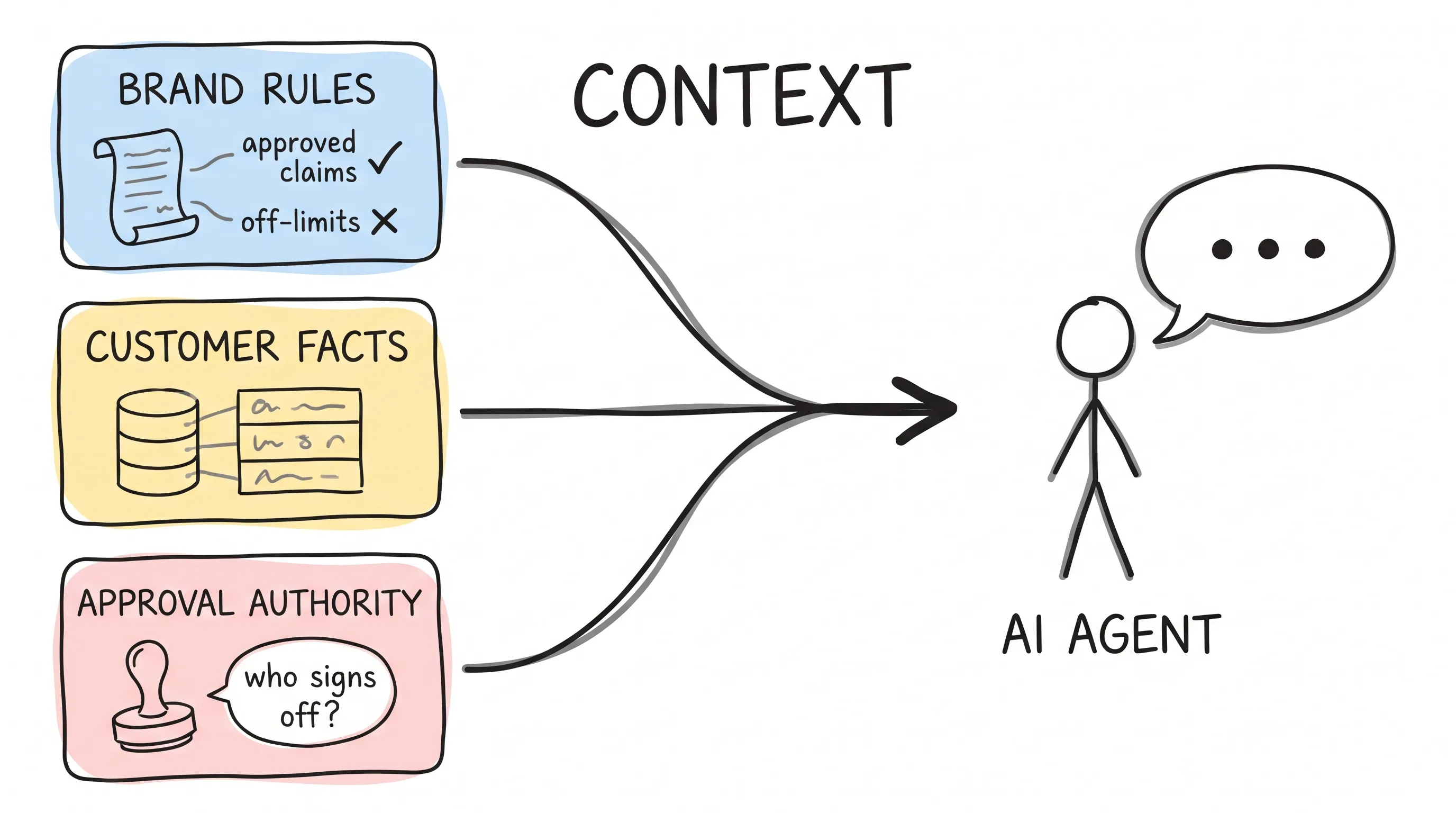
Customer facts are easy — they're sitting in a database. The other two are the trouble. Brand rules and approval authority are scattered across brand-guide PDFs, email threads from a few years back, and the heads of your company's most tenured people.
This arrangement used to work, because every campaign had to pass through those people, and they had time to stop whatever was wrong.
Then AI took the brakes off.
That slow, plodding production-and-approval process had quietly been playing the role of brakes all along. Now a single marketer can launch an entire campaign before lunch. With the brakes gone, you notice for the first time: the car never had a steering wheel.
What a Platform Can Store Is What You Have to Build Yourself
Two industry reports from 2026 put this in sharp relief. Bynder's digital asset management report shows 97% of respondents saying AI has already changed how they produce content, and 42% of teams already putting AI directly into content creation and processing. In another report, from Pantheon, 79% of marketing leaders admit that manually reviewing AI output is a major obstacle to expanding their use of AI.
Put simply: content output keeps climbing, and review can't keep up.
So vendors started selling context. Part of that value is real.
A platform really can centralize the language you've approved, feed it to every AI agent, and automatically intercept drafts that cross the line. That beats the brand PDF nobody ever opens.
But what qualifies as context in the first place? That decision, no vendor can make for you.
Which product claims legal has signed off on, which audiences you should never touch at all, which offers ended last quarter. These are calls management has to make. However professional the vendor's implementation team, all they can do is store the decisions you've already made.
What happens when the order is reversed? You buy the platform first, then go hunting for things to feed it. The result: you pay to store a pile of desk clutter — the 2022 edition of the brand guide, a few prompts a colleague dashed off in a hurry, a list of claims nobody ever reviewed.
And then the AI will faithfully enforce those rules.
Including the outdated ones.
Approval Authority Is the Decision Everyone Misses
Brand guides are written for humans. When a person hits a place the guide doesn't cover, they fill the gap with their own judgment. AI never fills the gap; it executes exactly what's written. So the deeper AI goes into campaigns, the more "who approves what" has to be put in writing.
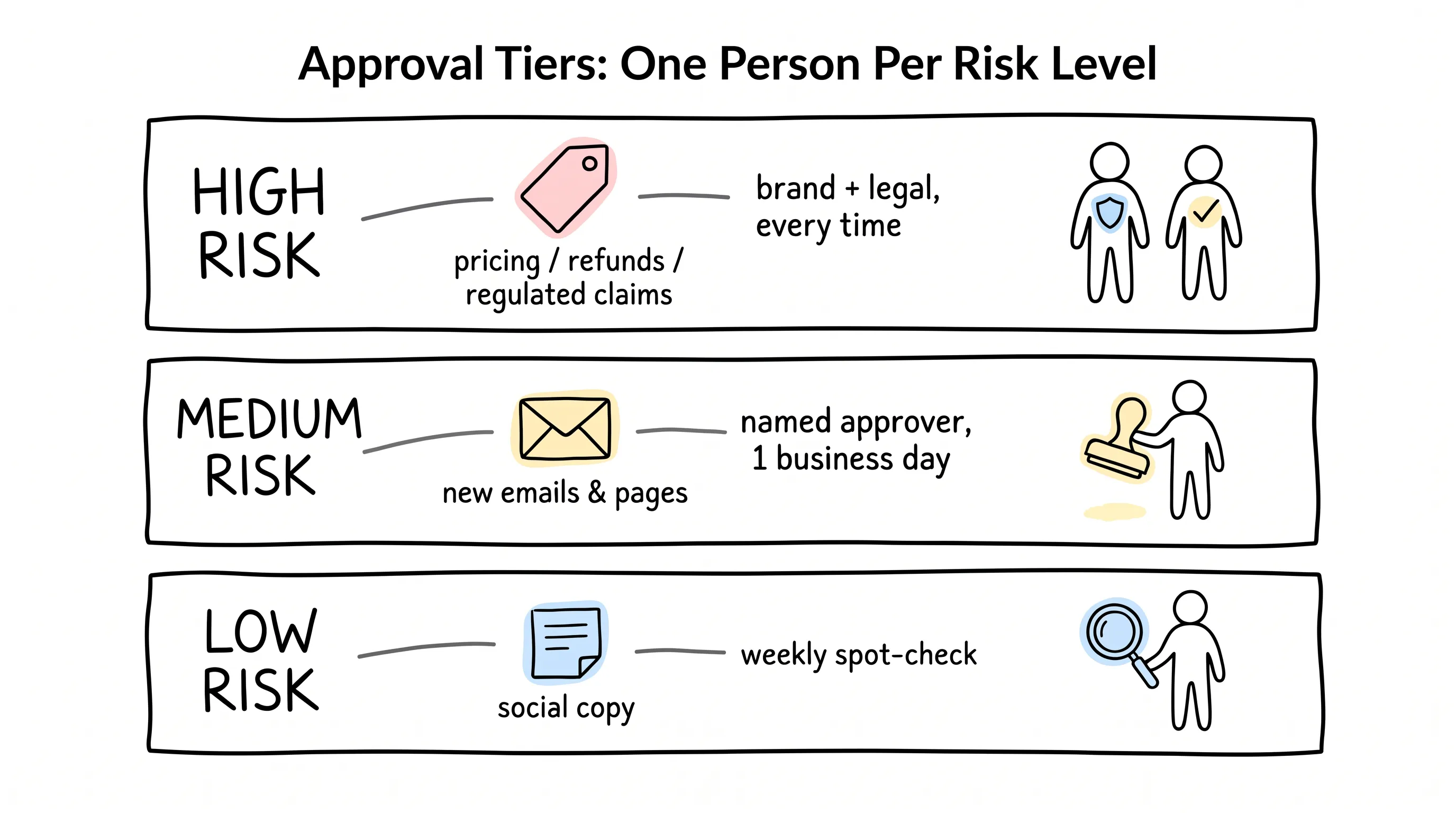
My advice is simple: sort the work AI produces into three tiers by the cost of getting it wrong, and assign one person to each tier.
Social copy, written in fresh variations from approved claims only — the content lead spot-checks once a week. That's low risk.
New email sequences and new landing pages need a named approver to sign within one business day. That's medium risk.
Pricing, refund guarantees, regulated claims, new audiences — these cannot go live without sign-off from both brand and legal, every single time. That's high risk.
Yes, the trade looks bad. Confirming approved claims and writing clear approval rules will eat several weeks of your most experienced people. The high-risk tier will also deliberately slow some campaigns, so they launch later than the vendor demo promised.
But I'd still make this trade. A campaign that's a week late costs you time. A dead promise sent to forty thousand inboxes costs you money, reputation, and a meeting with legal.
Before You Buy, Check Whether Your Team Has This Person
There's one more trap, worse than choosing the platform: the skills gap.
The person who approves high-risk campaigns has to know your product claims and target audiences cold. If your team doesn't have such a person, then the problem you need to solve isn't a tooling problem after all — it's a people problem. Adding AI won't fix it, and adding headcount may not either. Because what you need isn't a pair of hands; it's the brain that carries all that boundary awareness.
So before you sign for any product with "context" capabilities, make one sheet of paper first.
Write down the product claims you've approved. Write down the audiences you will never market to. Write down the name of the approver for each of the low, medium, and high tiers.
Can you produce that within a week? Good — you can go buy the platform, and it'll be a powerful ally.
Can't? Then congratulations, you've just found that one job no platform will ever do for you.
Do it first.
Back to that email that blew up on Friday. The problem was never the AI. It's that from start to finish, nobody ever told it that the 60-day refund guarantee was dead.
May your AI only ever say the right things.
And better still: may someone have already told it, before it ever speaks, what the right thing is.
Continue reading
Related articles

What Is AI Marketing Automation? It Starts With a 40-Point Gap
A learn article explaining what AI marketing automation is: how learning-based systems differ from rule-based automation, how AI decisioning optimizes message, channel, and timing choices, what data it depends on, and where it applies across the customer lifecycle.

Marketing Automation Is Shifting from "You Do It" to "You Say It"
This article explains how marketing automation is shifting from rule-based platforms that merely execute toward AI agents that plan, create, publish, and review campaigns, covering delegable tasks, underlying technologies, tool categories, adoption steps, and risks such as privacy and automating without strategy.

Rankings Are Taking a Dive, Customers Are Sprinting Ahead: This November, I Re-Ran the Numbers on AI Search
A learn article on how AI search reshapes marketing measurement, covering reported mismatches between rank-tracking tools and live Google results, ChatGPT's business profile test, single-page visitors as high-intent leads, and CRO plus GA4 tracking verification practices.