
Automation Platforms Are Becoming AI's Hands and Feet
An analysis of how automation platforms such as Zapier, Make, and n8n are adding AI agent capabilities, how the MCP protocol became a shared standard, and what production deployments suggest about starting with narrow, human-backed workflows.
Let me start with something I came across recently.
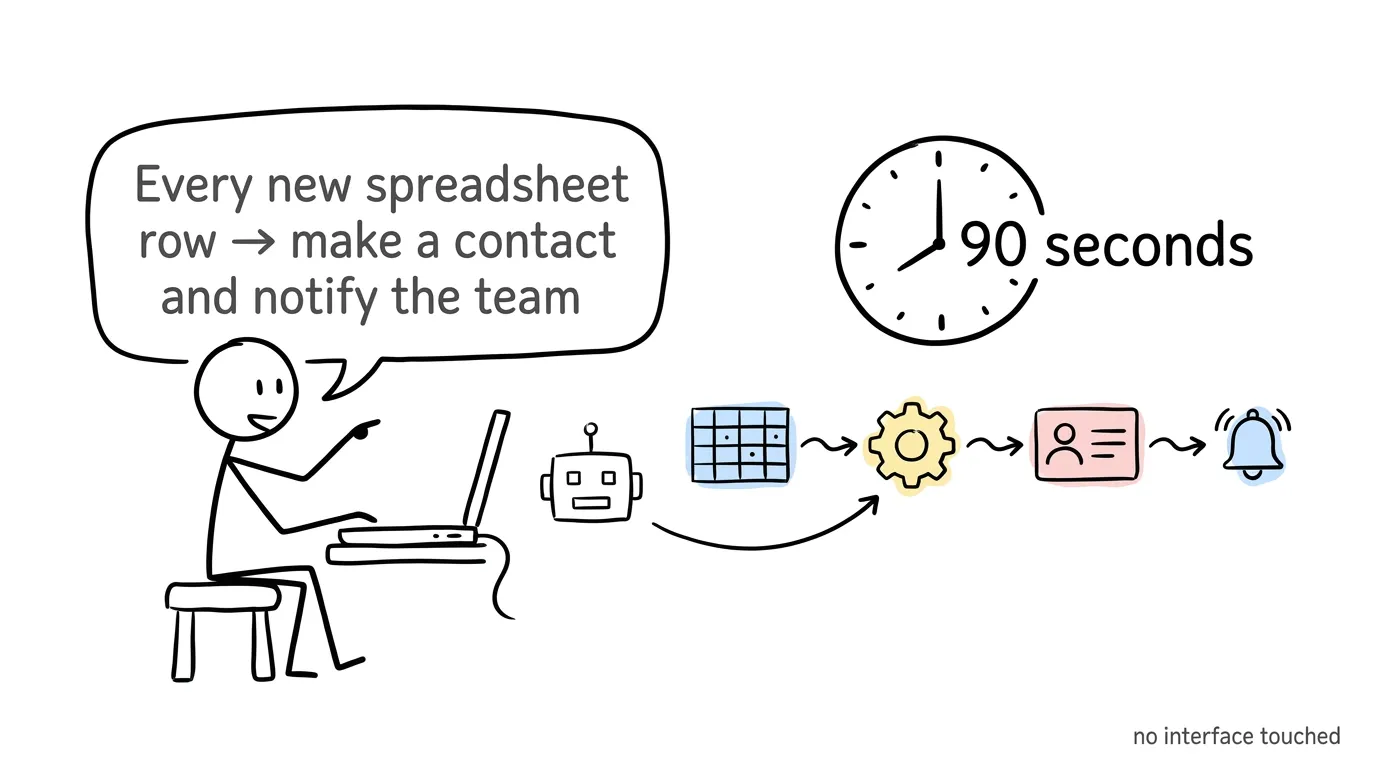
Someone ran a test: they connected Claude's desktop app to a Zapier account using a protocol called MCP, then told Claude, "Every time this Google Sheet gets a new row, create a HubSpot contact and send a Slack notification."
90 seconds.
Claude discovered the available Zap on its own, built the automation itself, and confirmed it was running — all without ever touching the Zapier interface.
My first reaction was: wow, so this is what software can be.
But hold on — behind this little story hides a much bigger shift. Let me walk you through it from the beginning.
Everyone Says "Agent," But...
For the past decade, automation platforms like Zapier, Make, and n8n have been doing one thing: triggers plus actions, drag-and-drop workflows. You fill in a form, it sends you an email. Reliable, but dumb.
From late 2024 into early 2026, these companies collectively rebranded themselves as "AI Agent platforms."
Is it just a fresh coat of paint?
At first, honestly, it looked like it. Through the first half of 2025, most of the so-called "agent features" on the market, once you peeled them back, were just a layer of large-model API with a new name slapped on. But by December 2025, a few players had shipped something genuinely new. And the money followed: the AI agent market is projected to grow from $7.84 billion in 2025 to $52.62 billion by 2030, a compound annual growth rate of 46.3%. Gartner predicts that by the end of 2026, 40% of enterprise applications will embed task-focused AI agents — up from less than 5% in 2025. Inquiries about multi-agent systems jumped 1,445% in a single year.
1,445%. What does that number mean? Simple: everyone is asking the same question — how do I actually use this?
The problem is, every company gives a different answer. And the differences between three of those answers are worth a very close look.
One Dream, Three Paths
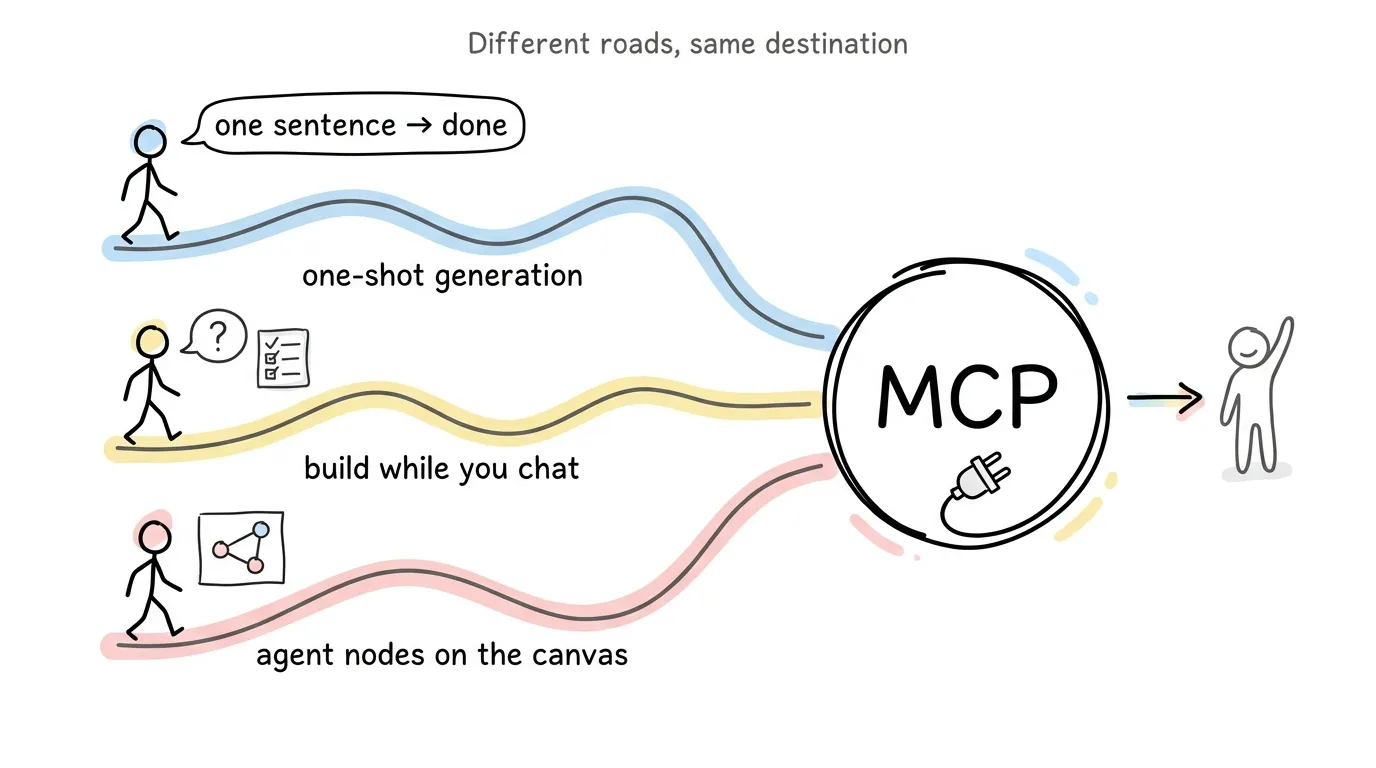
Start with Zapier. In May 2025 it changed course, and at its September developer conference it showed off three things: Copilot, where you describe what you want in plain language and it generates an entire Zap — field mapping and error handling included; Canvas, a single visual map of how the dozens or hundreds of automations in your organization interlock; and MCP support, letting external AI agents discover and call Zaps directly.
We put Copilot to the test on three real workflows. The first: pushing form submissions into a CRM. One sentence, one pass — solid. The second: lead scoring with branching logic plus conditional alerts. Two rounds of back-and-forth fixes, done in 5 minutes; building it by hand would have taken 15. The third: pulling data from three APIs and transforming it. It botched the nested JSON field mapping, and a human had to finish the job.
The conclusion is clear: for simple and medium-complexity work, Copilot delivers a real speedup. Once you're dealing with nested data or conditional logic more than two levels deep, treat it as a starting point, not a finished product.
Now Make. Its Maia takes a different road: instead of generating everything in one shot from a single prompt, it builds while you chat. You give a rough idea, Maia proposes a plan, and it asks questions back: "Should missing email addresses be handled?" "For this step, would you prefer a branch or a filter?" Every step sits on the canvas, visible and tangible.
Where's the difference? Copilot is: you name the destination, it hands you the result. Maia walks the road with you. For beginners who've been scared off by a canvas full of nodes, Maia is an excellent onboarding coach. For veterans, it saves the scaffolding time — while control stays in your hands.
Then there's n8n, the most "developer" of the three. Instead of building a separate AI product, it added agent nodes directly onto its own canvas, letting large models judge conditions, pick tools, and execute multi-step tasks themselves. LangChain works, vector databases work, self-hosted models work too.
That last point looks unremarkable, but it's actually the ticket into the game. We deployed a support-email pipeline for a client: the model classifies messages by intent and urgency, urgent ones go straight to the on-call channel, routine ones get drafted as template replies. The whole thing ran on the client's own servers — not a single byte of data left the network. Do the same job on Zapier or Make, and the email content has to travel to a third-party AI endpoint. For industries like finance and healthcare, that's not a nice-to-have; it's a disqualifier.
In October 2025, n8n raised a $180 million Series C at a $2.5 billion valuation, with the use of proceeds stated plainly: double down on AI.
The old-guard RPA camp is pivoting too. UiPath outright renamed its platform the "Agentic Automation platform," and in February 2026 released healthcare-specific agents for tasks like medical record summarization and denial-of-claim prevention, while joining the Agentic AI Foundation to help set the standards. Automation Anywhere went the acquisition route, buying Aisera in November 2025 to pick up ready-made agents for IT service and customer support, and by January 2026 was reported to be in merger talks with C3.ai. Workato went even more direct, betting on MCP: in February 2026 it launched 8 production-grade MCP servers in one go, with plans to exceed 100 within the year.
See the pattern? The routes are wildly different, but everyone is converging on the same place.
That place is called MCP.
What Exactly Is MCP?
Back to those 90 seconds.
MCP — Model Context Protocol — was released by Anthropic in November 2024. The problem it solves is remarkably plain: how does an AI "discover" outside tools, call them, and get results back?
Before, every platform built its own interface, and an AI wanting to connect to 100 tools would need 100 separate integrations. MCP unified the interface. It's like a universal socket: every tool ships a plug to the same spec, and every AI ships a socket to the same spec.
That socket later became the industry's shared standard. OpenAI followed with support in March 2025; by mid-2025 the ecosystem had more than 5,800 servers and 300-plus clients, with SDK downloads hitting 97 million per month; and in December 2025, Anthropic donated MCP to the Agentic AI Foundation under the Linux Foundation, with OpenAI and Block as founding members and AWS, Google, Microsoft, and Cloudflare on the supporter list.
A protocol in one company's hands became the industry's public infrastructure.
What does that mean? The identity of automation platforms changed. They're no longer just "tools for humans" — they've become infrastructure for AI systems. Any MCP-compatible agent can treat the automations inside Zapier, Make, and Workato as its own hands, calling them whenever it wants.
That's exactly where the opening 90 seconds came from.
But Hold Your Horses
Demos are electric; production is sober.
As of mid-2025, only 14% of organizations had actually run agentic solutions in production.
14%. The remaining 86% are still stuck somewhere between demo and pilot.
The agents that did make it into production, I found, almost all look the same.
First, narrow. They do one thing with clear boundaries: email triage, invoice processing, lead qualification. No production system dares let an agent take on the whole world.
Second, humans as the backstop. Uncertain cases get routed to human review — never let the agent act on low-confidence decisions. One product, Relay.app, built its entire company on this model, and did it rather well. Sadly, it announced its shutdown in July 2026, deleting all accounts and workflows on September 14. The model was right; the company didn't survive. That tells you how brutal this market is.
Third, legacy automation up front. The agent only handles the "thinking"; the actual "doing" is still done by the original Zapier, Make, and n8n workflows. Decisions belong to AI; execution belongs to the process.
Our own tuition payments confirm this. Over the past six months, we deployed four AI-enhanced automation systems for clients. The two that ran steady were both narrow: one triaging support requests, one drafting RFP Q&A from a company knowledge base. The two that failed were too ambitious: one trying to fully automate sales qualification end to end, the other trying to orchestrate cross-department approval flows. Exception handling and fallback rules kept piling up until maintenance costs nearly matched doing it manually — and what's the point of that?
The lesson in one sentence: Go narrow first, get it working, then widen.
The production results the industry has reported were all carved out of narrow scenarios too: logistics delays down as much as 40%, customer service call duration down about 25%, transfer rates down as much as 60%. The numbers aren't small — but notice, not a single one came from a "general-purpose agent."
AI Also Took a Red Pen to the Price List
This wave has a side effect few people talk about: pricing.
Zapier bundles AI steps directly into its plans at no extra charge. Airtable removed its per-seat AI fees in June 2025. Make switched from per-operation billing to a credit system in August 2025, and in November opened bring-your-own-API-key to all paid plans. The logic is obvious: AI is no longer a selling point, it's standard equipment — charging separately for it no longer makes sense.
On the other side, the pressure of free never lets up. n8n's community edition, MIT-licensed Activepieces, and Windmill can all be self-hosted at zero cost. When commercial platforms set their prices, this sword hangs over their heads at all times.
The Last Month or So of 2026: What to Watch
As I write this, it's November 2026. Looking back on the year, a few threads are worth keeping an eye on.
Multi-agent collaboration is starting to emerge — the era of lone agents is ending, and Airtable's Superagent and UiPath's swarm orchestration are early specimens. Governance has become a hard requirement: if agents act autonomously, audit logs, approval gates, and one-click rollback must follow, and "governance as code" is becoming standard practice. With MCP now in the Linux Foundation's hands, standardization will most likely accelerate — watch when tools that haven't supported it yet close the gap. And consolidation: once the C3.ai merger talks play out, the boundary between the RPA market and the AI platform market will effectively be gone.
If 2025 was the year every vendor put "AI" into its keynote slides, then 2026 is the year the market started doing something else: telling apart whose agents are doing real work in production, and whose agents are only dancing on stage.
Finally, Back to Those 90 Seconds
Remember the test at the start? One sentence of plain human language, 90 seconds, one automation live, no interface ever touched.
Hold onto that moment. A few years from now, looking back, that may well be the first time we "commanded software with our words."
Automation platforms didn't disappear. They simply went from being your hands to being AI's hands.
Whose hands they become doesn't matter much. What matters is figuring out, first, what you want those hands to do.
Here's to the day you command software with your words — sooner rather than later.
Continue reading
Related articles

What Is an AI Marketing Agent? From "Using AI" to "Delegating to AI"
A learn article explaining what an AI marketing agent is, how it differs from rule-based automation, and which repetitive tasks such as lead qualification, reporting, and campaign monitoring can be delegated while humans keep key decisions.

Marketing Automation Is Shifting from "You Do It" to "You Say It"
This article explains how marketing automation is shifting from rule-based platforms that merely execute toward AI agents that plan, create, publish, and review campaigns, covering delegable tasks, underlying technologies, tool categories, adoption steps, and risks such as privacy and automating without strategy.

When AI Does the Creative, Mistakes Come in Batches Too
A learn article on the risks of using generative AI for marketing creative across brand, legal, compliance, and operational layers, with case examples and seven practices for review, rights clearance, documentation, and vendor governance.