
At the End of AI Search, There Are People
An essay arguing that AI search finally lets users express their full, complex needs beyond keywords, and that meaning lies in the person behind the prompt. It cautions against over-relying on standardized prompt tracking and urges marketers to build deeper user understanding and niche-scenario content.
A few days ago, I was helping a friend plan a family vacation. Speaking to an AI assistant, I poured out a whole string of requests: two adults, two kids, one big room—but the kids' sleeping area had to be separate and enclosed; no settling for mediocre food; a rental car for driving ourselves once we arrived; a hotel with a pool, and the children's pool had to be heated.
Then I paused.
Ten years ago, a request like this would have meant sitting down at a travel agency counter and explaining all of it to an agent for half the day.
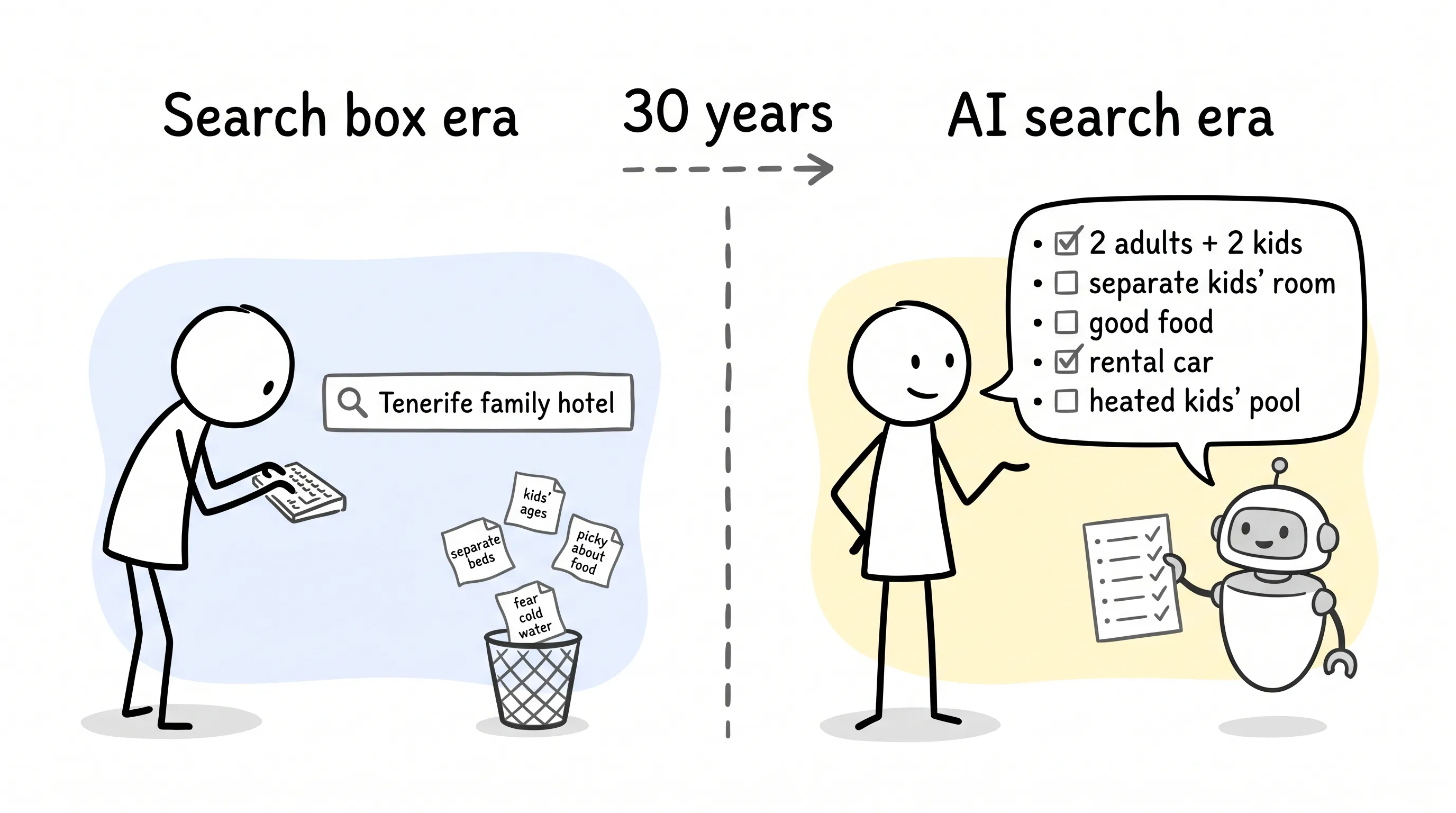
And how would I have found a hotel back then? Typed into the search box: Tenerife family hotel recommendation.
Four words.
How much got lost in those four words? How old the kids are, why I insisted their beds be separate from ours, how picky we'd be about food, whether the kids fear cold water. All of it, lost.
But there was no way around it. The search engines of that era could only understand those four words. It took us years to learn to compress ourselves into a string of keywords.
At bottom, that wasn't search getting better. That was thirty years of the search box formatting us.
The Complexity Was Always There—It Just Had Nowhere to Go
Some say AI search has made user needs more complicated.
No. People were never simple.
So where did all that complex demand go in the past? To the travel agency counter, to friends' dinner tables, to the mouths of people in the know. A seasoned travel advisor could piece together what you really wanted from your scattered remarks. Once search arrived, that road was closed off, and all we had left was one small input box.
So what AI search does is finally allow us to say out loud the complexity that was there all along.
What does this mean for marketers?
For years, everyone has talked about personalization, about one-to-one marketing, all trying to figure out what the specific person in front of them actually wants. Genuinely wanting to do it, mostly failing—settling for slicing users into a handful of personas. Now it's different: users volunteer what they want, why they want it, what they're worried about, where they can compromise.
There's an essential distinction here: a keyword can only tell you the "intent"; a full conversation tells you the motivations and concerns behind that intent.
Say a user searches "CRM recommendations"—all you know is that they plan to buy a CRM. But if they ask: "The team is twenty people, the sales reps hate filling out forms, and the boss insists on seeing customer follow-up records—which CRM should we pick so it doesn't sit idle the moment we buy it?" Now you're seeing more than purchase intent. You're seeing this person's situation.
Behavioral science said it long ago: intent is only the part above the waterline; motives and obstacles sink beneath the surface. In the past, these things often didn't surface until the sales meeting. Now, they're laid on the table in the very first question.
This is also a wake-up call for content: when users ask in this much detail, can your content catch it? Covering the big categories is nowhere near enough. The specific situations underneath those categories—someone has to write about them.
The Same Question, Two Answers
One layer deeper, things get more interesting.
A person's question is no longer the complete expression of their intent.
When someone uses one or two AI tools day after day, those tools start to remember them. Habits, preferences, old deliberations, things discussed—slowly, all of it becomes background knowledge.
An example.
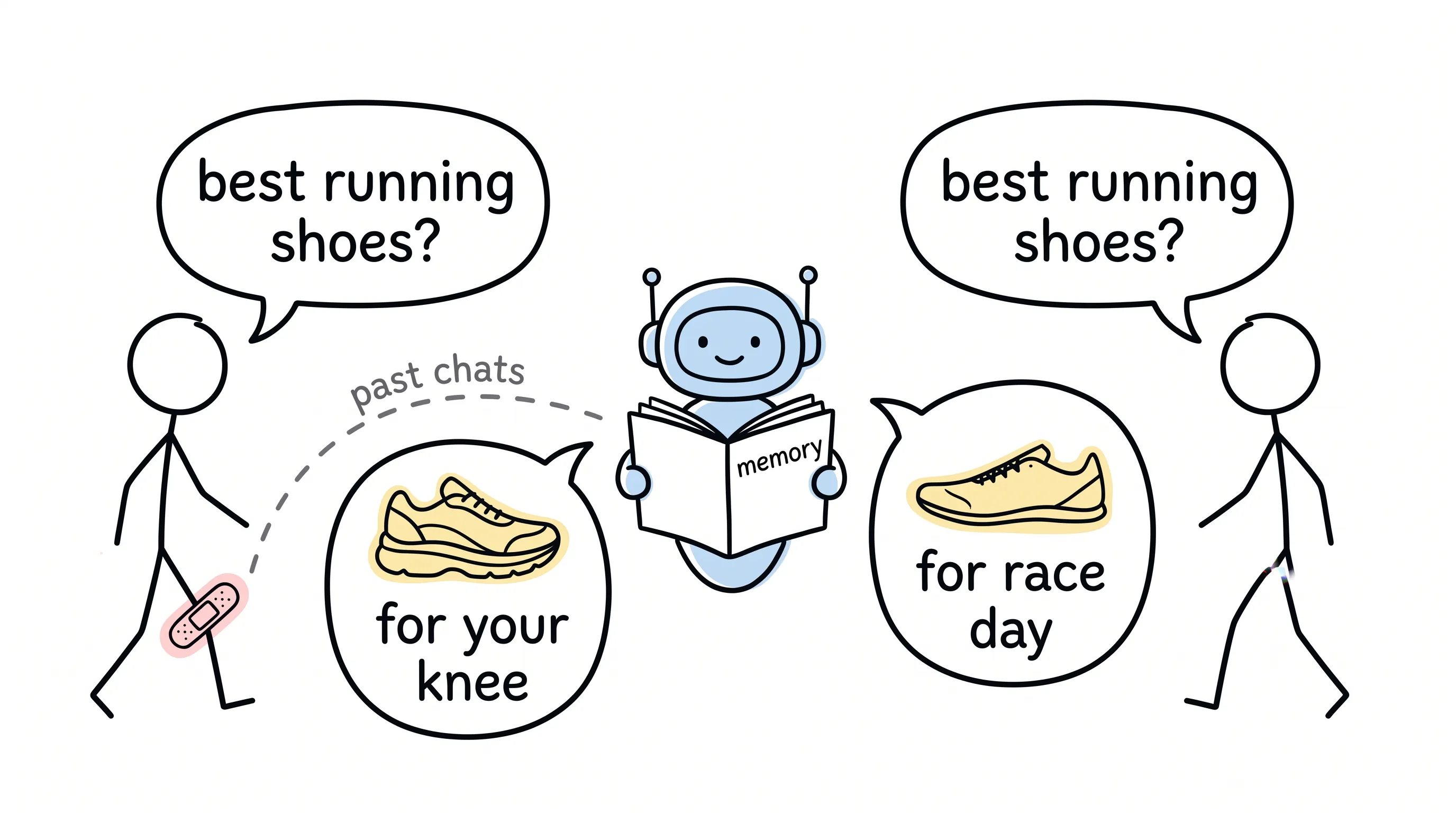
Two people ask the same AI assistant the exact same question about running shoes.
One of them had spent months chatting with this assistant about a knee injury; the other never had.
Their questions are word-for-word identical. But the recommendations they get will very likely differ. Because that knee injury, though absent from this question, genuinely shaped the answer.
The meaning isn't in the prompt. It's in the living person behind the prompt.
That's why I've always felt "assistant" is the right word for it. An assistant understands you; a search engine doesn't. Think of a good assistant who has been with you for five years—do you still introduce yourself every time you speak? No. You say "book that place from last time," and they know exactly what you mean.
Memory and personalization capabilities vary widely across platforms, and they also depend on each user's own permission settings—so not every AI search experience works this way. But the direction is unmistakably clear.
Followed to its conclusion, "that hotel I loved staying at in Mexico—find me the Tenerife version" is no longer crazy talk. To traditional SEO, that sentence is worthless: what on earth is a "Tenerife version"? The keywords contain nothing. But to an AI that knows you, it knows where you've stayed, what you loved, roughly what your budget is, who you usually travel with. The meaning lives outside the prompt.
And this poses a new question for marketers.
Prompt Tracking: Don't Put Too Much Faith in It
These past two years, prompt tracking has been all the rage. The logic is easy to grasp: keyword tracking ran for so many years—rank reports climbing from the SEO team all the way to the boardroom—that switching to a new thing to track now is pure instinct.
The questions are always the same: when this prompt goes out, how does ChatGPT answer? Does my brand show up? Which competitors get named? How often are we recommended?
Should you do it? Yes—this data has value.
But there's a premise you need to think through first.
If the same person asking the same question can get different answers depending on their background, then your standardized prompt measures only one cross-section. One questionnaire, applied to a thousand different lives—what can it possibly measure?
Prompt tracking doesn't measure the truth. It measures one possibility among many.
So you have to look at both ends: what the AI says, and what goes unsaid. Your own website's data is an excellent clue: which pages are visitors arriving from AI platforms? Is the traffic they bring concentrating in a few highly specific scenarios? Working backward from this, you can guess what users are asking, and in which situations your brand comes to mind.
Prompt tracking isn't dead. What's dead is the blind faith in it.
The Word "Best" Has Changed
Back to those running shoes.
When someone searches "best running shoes," the contest is among a crowd of shoe sellers. But what if the AI knows: they're training for their first marathon, they've injured a knee, comfort matters more than speed, they like a certain locked-in feel, and the budget caps at $150?
The meaning of "best" changes on the spot.
Going forward, many questions will no longer have one globally unified best answer—only an answer that is "right for this person, in this situation."
And this is precisely the opportunity for brands that truly understand their users. Going deep into niche scenarios with content cuts deeper than chasing high-volume keywords. It holds beyond your own website, too: niche creators, specialist publications, vertical communities—all are places to build the "I get you" evidence in specific contexts.
What you have to do is give the AI enough reasons and evidence to think of you first, at the right moment.
This Isn't a Search Question. It's a Strategy Question.
By now, the question you're itching to ask is probably: how do I get AI to recommend my brand more?
Stop for a second. You're asking too small a question.
The questions truly worth answering are these:
What kind of person is our product especially good for?
In which situations are we the only right choice?
Among the reasons users choose us, are there some even we ourselves haven't recognized?
Can we produce evidence for those reasons? And are there needs we can see—needs no one else has met—big enough to justify changing the product itself?
Think these through, and you'll find AI search was never a search-optimization question at all. Search marketers have always held a treasure in their hands: the questions users ask in their own words. Those questions used to be short, dry, and hard. Now they're long, detailed, and human—and the insights have grown richer along with them. Which means you've earned the right to carry those insights back upstream in the company, to influence what the product should become and where the positioning should stand.
You might discover that a group you never considered is a strikingly good fit for your product; that something users deeply care about is buried on the third level of your own website; that some combination of needs goes unaddressed across the entire category.
None of these are SEO questions.
These are the business itself.
The End of Search
From keywords to prompts, this industry has spent years in upheaval. But prompts probably aren't the destination either.
The destination, in the end, is a simple one: in search, the thing that matters most has always been people.
What are they trying to accomplish? What are they afraid of? Where are they willing to compromise, and where will they never budge?
One more point, and many people overlook it. The deepest insights don't necessarily come from ever more sophisticated tools. They may come from your company's salespeople, who hear the reasons customers say no every day; from customer service, fielding the strange questions the website has no answers for; from the store associate, who watches firsthand why a customer picks something up—and then puts it back down.
Wire those people's ears back into your search and your marketing.
Because on the day AI understands every individual better and better, whoever understands people best will have their answers rise to the top.
Thirty years ago, we learned to squeeze ourselves into the search box. Now it's our turn to set people free from it.
Here's to hearing, sooner rather than later, the truths people can finally say out loud.
Continue reading
Related articles

It's 2026: Stop "Buying" AI Tools for Your Marketing Team — Start "Hiring" AI Agents
This learn article explains how AI agents differ from standalone AI tools in marketing, outlines three agent categories — build-your-own platforms, CRM-native agents, and vertical tools — and covers use cases across SEO, social media, advertising, and reporting, plus criteria for choosing one.

What Is GEO? How Your Brand Gets "Mentioned" in the Age of AI Search
An explainer on GEO (Generative Engine Optimization) for e-commerce and DTC brands: how it differs from SEO and AEO, why AI answers shape brand visibility, and eight practices covering question-focused content, consistent brand messaging, structured pages, external evidence, comparisons, and AI mention tracking.

AI Is Already Making Decisions for Your Customers. Are You on the List?
A learn article explains GEO (Generative Engine Optimization): why AI-generated answers now shape which brands customers see, and how SEO fundamentals, entity clarity, citable evidence, and monthly measurement affect visibility in AI answers.