
AI-Written Content: Does Google Actually Accept It?
This article explains how Google evaluates AI-written content, debunking AI-detection myths and covering E-E-A-T, helpful-content guidance, and the trust risks of AI-generated reviews. It closes with five practices for pairing AI drafts with human editing across SEO and content workflows.
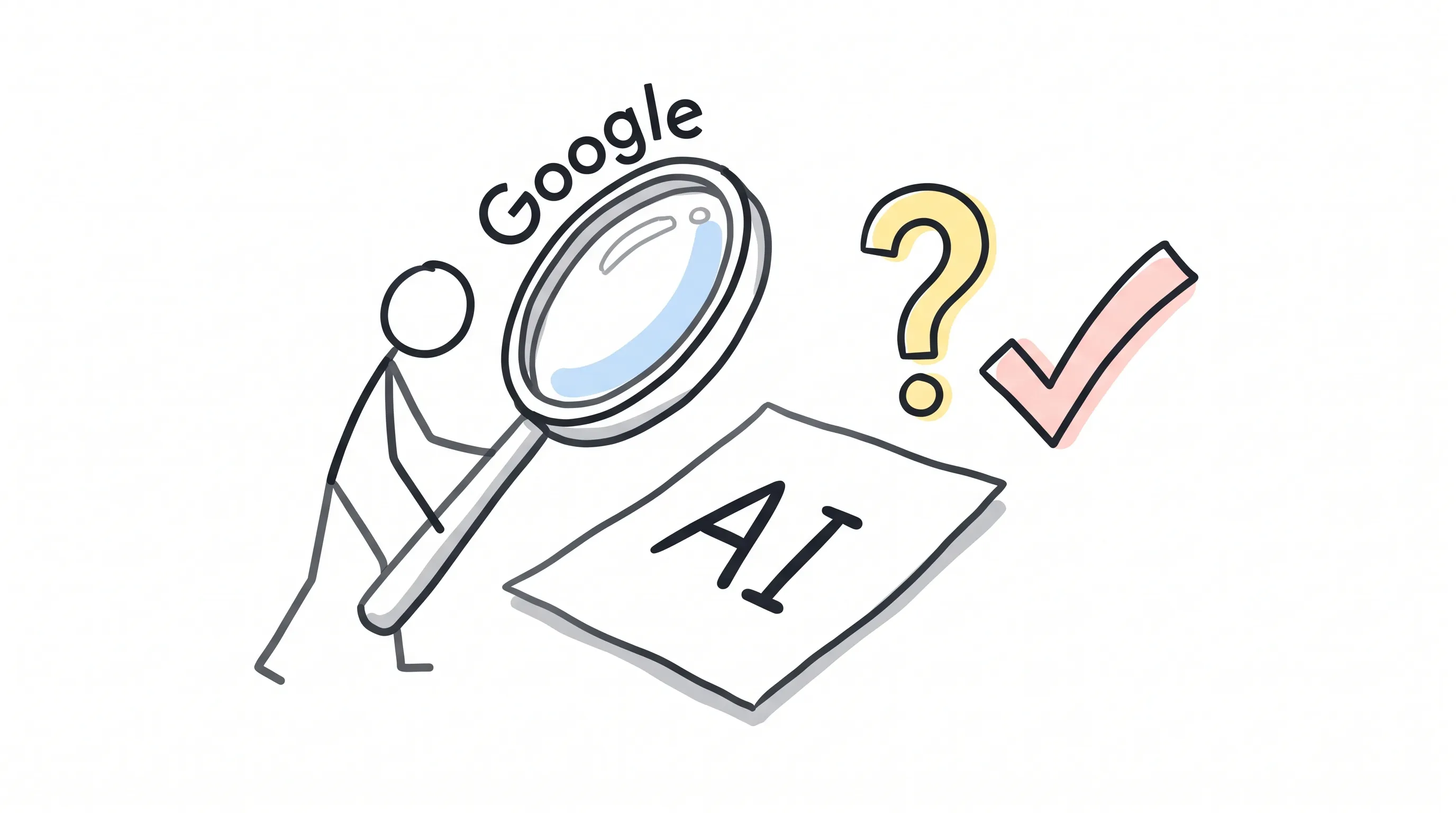
A few days ago, I had dinner with two friends who work in content.
One of them looked miserable. He kept worrying: will Google penalize AI-written stuff? He didn't dare use a single AI-written piece — everything done by hand, and it was wearing him down.
The other one was glowing. His team had gone all-in on AI, one person doing the work of three, with articles pouring out nonstop.
Halfway through the meal, it suddenly hit me: both of them might be wrong.
Wrong how? Let's untangle it from the beginning.
First, Do the Math
What is AI content? It's having AI write articles for you, come up with topic ideas, and handle SEO.
How common is this now? One survey found that over 80% of marketers are already using AI somewhere in their workflow.
That's right — eight out of ten.
Why do so many people use it? The math makes it obvious.
Some companies report that using AI for content cuts production time by nearly half. Hiring writers is expensive; AI tools require an upfront investment, but spread over the long run, content costs drop by around 30%. AI never has moods, never takes a day off, and everything it writes sounds consistent. It can also scan oceans of data in one go and tell you what topics are hot right now and which keywords are worth pursuing.
Powerful stuff!
But there's always a flip side.
AI writes fast, but it hasn't lived through what you've lived through. What it produces is safe and bland — like a glass of plain water. Readers skim it once and scroll away. Worse, when it makes things up with a perfectly straight face, you might not even notice. One survey says six in ten marketers using generative AI worry about the same thing: that one day this stuff could blow up over bias, plagiarism, or a values misstep, and wreck the brand's reputation.
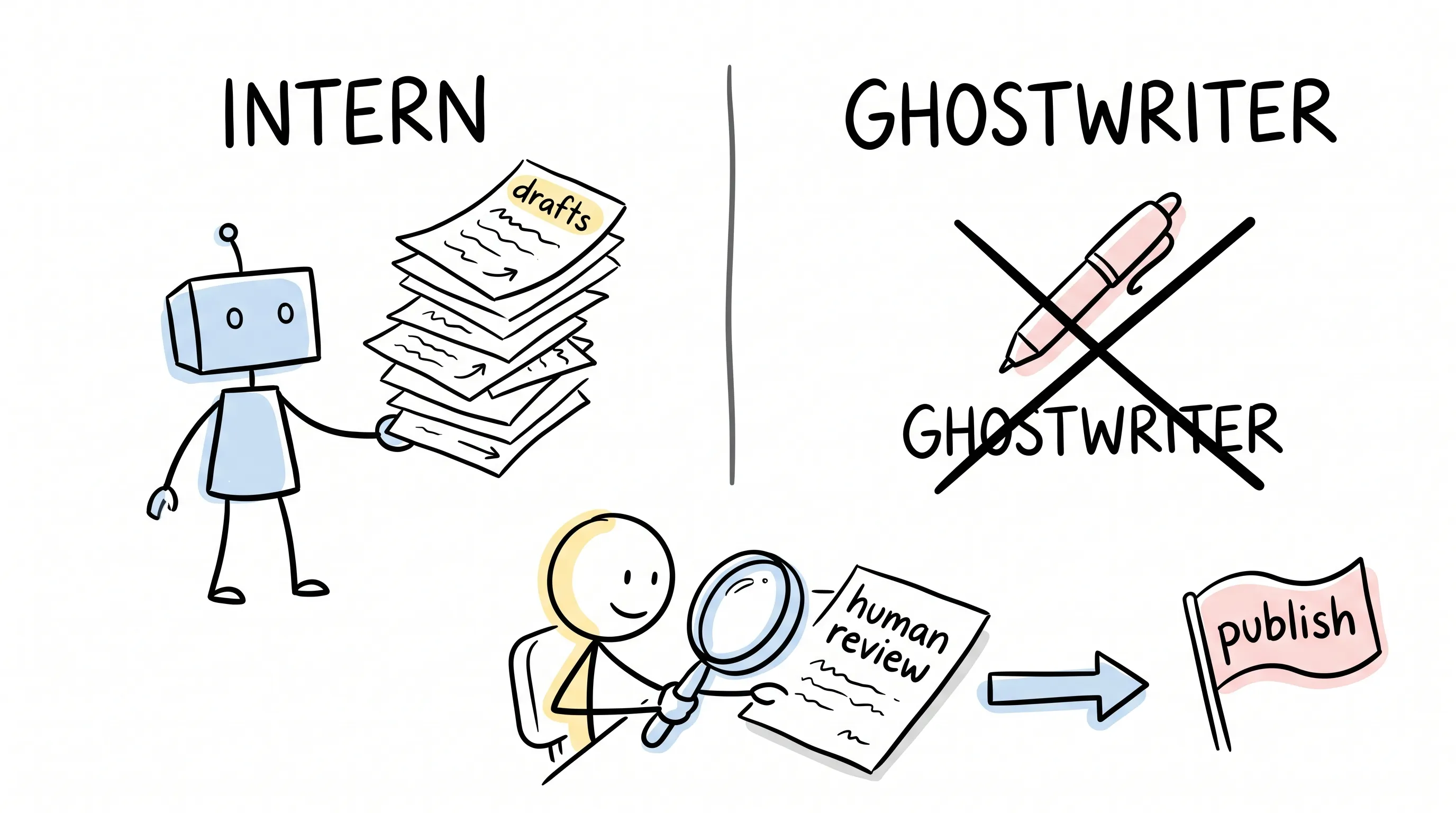
So here's my view: AI is an intern, not a ghostwriter.
An intern can knock out a ton of groundwork. But before anything gets published under your name, a master craftsman has to review it.
The Legends of "AI Detection"
A lot of people are afraid to use AI because they fear being "detected." There are several prevailing myths about AI detection. Let's take them apart one by one.
Myth one: detection tools are always right.
Nope. Studies have tested this: the best AI detection tools today are only about 80% accurate. The remaining 20% — that's where the collateral damage lands, and it may hit people who painstakingly wrote everything themselves.
Myth two: AI-written content gets caught every time.
Also no. Tools recognize patterns, and patterns can be grown into the text. It's estimated that nearly 40% of AI content can't be detected at all. Betting everything on detection tools is itself a gamble.
Myth three: detection exists to catch plagiarism.
Detection tools look at far more than plagiarism: sentence structure, word-choice habits, the rhythm of the writing. Like a veteran music fan who can tell the original from a cover by the intro alone. Of course, even veteran music fans get it wrong sometimes.
Myth four — the most important one: Google ranks you based on detection tools.
This one deserves a serious answer.
What Google Actually Thinks
Google's search algorithm processes 3.5 billion searches a day. What does it really care about?
A Googler named John Mueller once said something I love: "What matters is not which tool you used, but what you made."
That's the answer.
Google doesn't check your papers. It asks exactly one question: is this article useful to the people reading it?
What is E-E-A-T (Experience, Expertise, Authoritativeness, Trust)? Human-written or AI-written, those four boxes all have to be checked. If you write about diving, you'd better have actually been underwater. If you write about investing, you'd better have actually lost money — or made some. AI can help you build the framework, but first-hand experience is something it can't substitute for.
Google has also specifically updated its content guidelines — the "Helpful Content Update." The core is one sentence: content is written for people, not for search engines. After that update rolled out, sites that genuinely served their users saw traffic rise by about 20% on average. The ones stuffing keywords and gaming the algorithm got pushed down.
You see, Google's position is clear: tools don't matter, quality does. AI-written content is not an original sin — badly written content is.
By the way, Google also encourages honesty. If AI was involved, say so when it matters. Getting caught hiding it — that's when real trouble starts.
The Trust Crisis Sparked by a Single Review
There's another corner of this story that cuts deeper than articles: reviews.
When you shop online, don't you check the reviews first? Everyone does. Reviews are the bedrock of trust in e-commerce.
But that bedrock is being hollowed out by AI.
There's a service called Fakespot that specializes in analyzing the authenticity of Amazon reviews. It estimates that more than 30% of product reviews on the platform may be fake, or batch-generated by AI. AI can churn out thousands of reviews a day, changing just a few words in each — they look plausible, but none of those people ever touched the product.
What's the difference between a real review and a fake one? Let me show you two.
A real user's review of a smartwatch: "Wore it for three months — the battery genuinely lasts two days. Heart-rate data syncs to my fitness app, never had a hiccup. Once the sync glitched, and customer service fixed it for me in ten minutes."
An AI-written one: "This smartwatch has been used for several months with good battery life, lasting over a day. The heart-rate monitoring is accurate and integrates seamlessly with fitness apps. The design is stylish and comfortable to wear. Customer service is responsive. Recommended for users who need a reliable smartwatch."
Spot the difference?
The second one has no grammar problems — it's as tidy as a product manual. But there's no "three months," no "ten minutes," no trace of a living human being who actually spent time with this product.
The charm of a real review lies precisely in its rough edges. A bit wordy, a bit off-topic, maybe even a few typos. But you know the person on the other side of the screen really used the thing.
Trust takes ten years to build — and one fake review to smash.
So What Should You Actually Do?
Okay, enough theory. Here's the playbook. I'll boil it down to five things.
First, use AI to mass-produce first drafts, and let humans supply the soul. HubSpot does exactly this — using AI to expand content output while keeping the quality gate firmly in human hands. As for topic gaps and keyword opportunities, tools like MarketMuse and Clearscope can help you find them.
Second, use AI for personalization. Why can't you stop scrolling through Netflix's recommendations? Why do Amazon's products always seem "exactly what you wanted"? Behind it all is AI reading your behavior. Your content can work the same way — tools like Dynamic Yield and Optimizely can do it.
Third, use AI for SEO intelligence. Platforms like Moz, SEMrush, and Ahrefs are already using AI to forecast keyword trends and analyze competitors. What used to be guesswork can now be calculated.
Fourth, hand repetitive work to the machine. Writing metadata, tagging images, hunting for backlinks — none of this is creative, but all of it takes time. Salesforce uses AI to automate tasks like these; BrightEdge and Conductor are built for it too.
Fifth, use AI to see the future. Google Analytics' predictive features can tell you in advance where traffic is heading. While everyone else is still chasing trends, you're already waiting on the road the trend must pass through.
One-line summary: Let AI do what machines are good at, and give human time back to the things only humans can do.
Finally, Back to That Dinner
As the evening wound down, I found myself thinking about those two friends again.
The worried one didn't need to worry. Google doesn't care whether you used AI to write — only whether it's well written. The key isn't "whether to use it," it's "how to use it."
The excited one is the one who should be careful. Fully automated, mass-produced content with no human gatekeeping — readers aren't fools, and Google is less of one. What you save is time; what you lose might be the brand.
AI isn't here to take your job. It's here to hand out tools. And once the tools are in everyone's hands, the competition comes back to that old question:
Do you really understand your readers?
Here's hoping you find your own master craftsman soon, too.
Continue reading
Related articles

What Is AI Marketing Automation? It Starts With a 40-Point Gap
A learn article explaining what AI marketing automation is: how learning-based systems differ from rule-based automation, how AI decisioning optimizes message, channel, and timing choices, what data it depends on, and where it applies across the customer lifecycle.

It's 2026: Stop "Buying" AI Tools for Your Marketing Team — Start "Hiring" AI Agents
This learn article explains how AI agents differ from standalone AI tools in marketing, outlines three agent categories — build-your-own platforms, CRM-native agents, and vertical tools — and covers use cases across SEO, social media, advertising, and reporting, plus criteria for choosing one.

What Is an AI Marketing Agent? From "Using AI" to "Delegating to AI"
A learn article explaining what an AI marketing agent is, how it differs from rule-based automation, and which repetitive tasks such as lead qualification, reporting, and campaign monitoring can be delegated while humans keep key decisions.