
AI Writes Articles Now. How Do You Get Seen at All?
An overview of how AI-generated content is reshaping content marketing, covering GEO and AEO practices for getting cited in AI answers, human-AI co-creation workflows, and risks such as hallucination, bias, and copyright.
A while back, I had dinner with a friend who works in content marketing. He sighed and told me his company cut its writing staff in half this year — and the one new role they hired for was called "AI Content Operations."
So I asked: how many pieces do you write a day now?
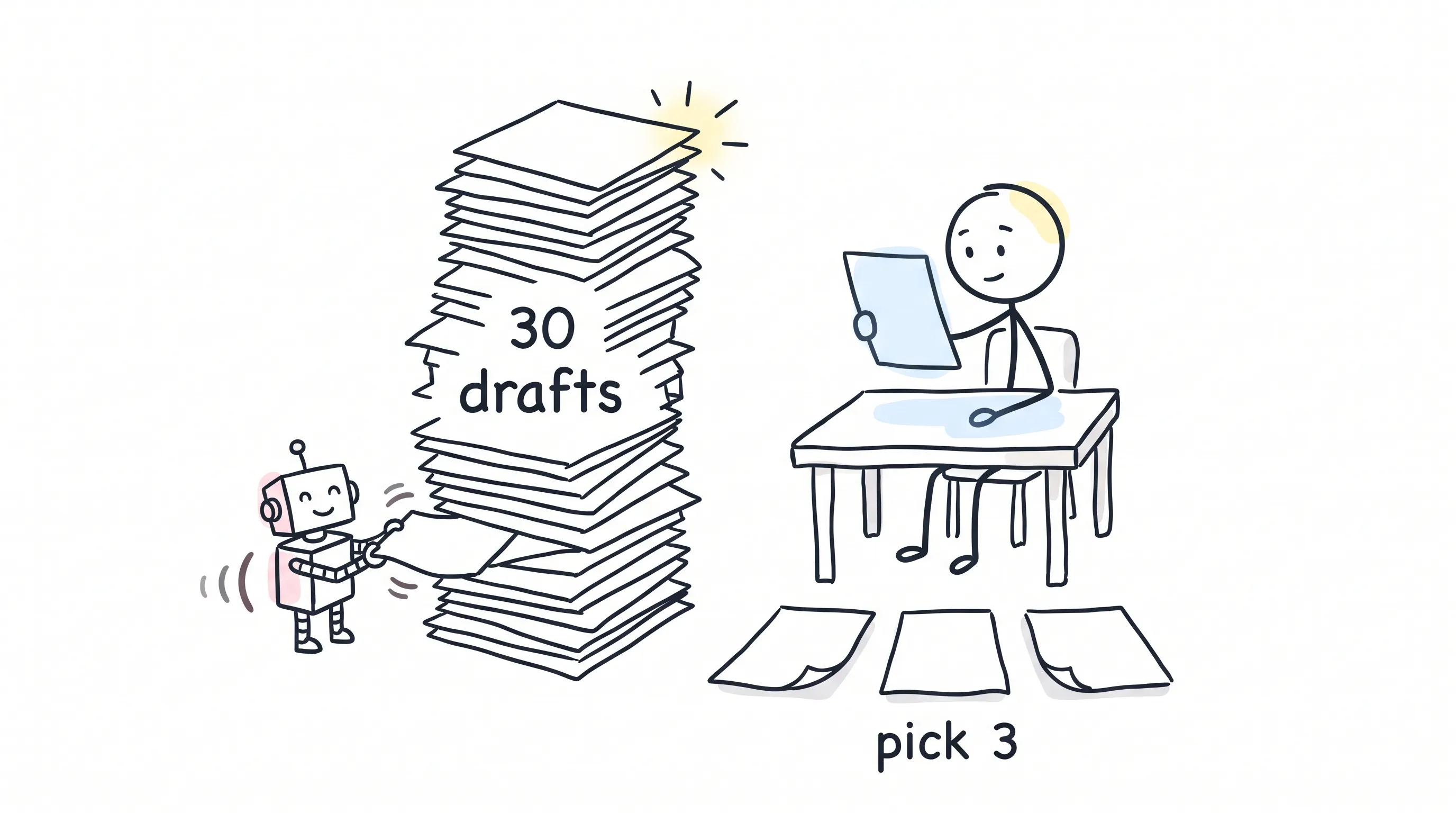
He said, I don't write. I review. AI turns out 30 first drafts a day; my job is to pick the three that are fit to show anyone.
Wow. This change is moving far faster than I anticipated.
Geoffrey Hinton — the grand old man they call the "godfather of AI" — once said something I love: we are standing at the beginning of something very, very exciting. When it comes to content marketing, I believe him.
First, a number. CoSchedule's 2025 State of AI Marketing report says 85% of marketers are already using AI tools to produce content. Eighty-five percent.
What does consensus look like? That's what it looks like. When 85% of people are doing something, it's no longer an advantage — it becomes the air everyone breathes. Back in 2022, when ChatGPT first launched, people were still arguing about whether AI could "really write." Today, nobody debates that question anymore. The question now is: everyone has AI — so what?
Then, the battlefield moved.
What battlefield, exactly?
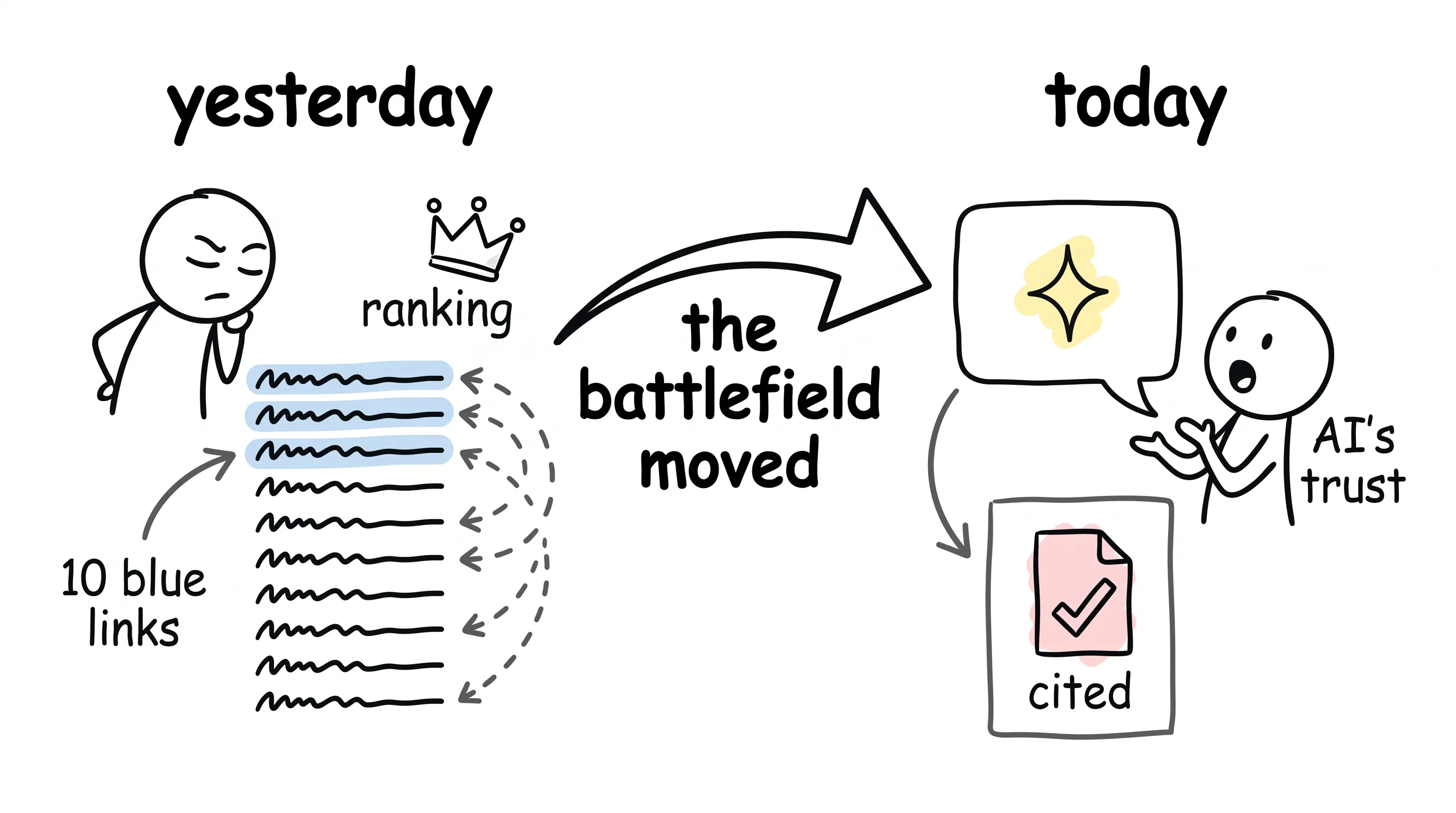
Content used to be a fight for search rankings: rank in the top three, and the traffic was yours.
Today, your users go straight to AI with their questions. They ask ChatGPT, ask Perplexity, ask any search engine with an AI summary bolted on. The AI answers, and the user never even opens your website. This is called "zero-click."
Think about what that means.
The rules of the game have changed — from "ranking" to "being cited." The question is whether your content is something AI can read, can trust, and will ultimately cite in its answers.
You used to compete for the user's attention. Now you have to win the AI's trust first.
The industry has two terms for this.
One is GEO — Generative Engine Optimization. Making sure generative engines can accurately understand and evaluate your content, and fold it into their own answers.
The other is AEO — Answer Engine Optimization. It goes a step further: getting the AI to treat you as the source of the standard answer when it responds.
How do you pull it off? Honestly, it's no mystery. Write articles with clear structure and accurate facts, and keep them updated; build plenty of pillar pages, FAQs, and other content blocks AI can parse and cite at a glance; keep the information consistent across your whole site — don't let AI read two contradictory answers on two different pages of yours.
Doesn't sound hard, right? But plenty of companies I've seen live like this: piles of content, structure a total mess, nothing updated for a year. Of course AI won't cite them. No matter how high the pile gets, it's wasted output.
The right way to use AI: co-creation, not delegation
Back to basics: using AI to write content.
Another 2025 report, the State of Marketing AI, says more than 70% of marketing teams are already using AI to produce content at scale. But with the same tools, the gap in output is staggering. Some people use it to create hits; others use it to mass-produce garbage. What makes the difference?
AI is the copilot, not the autopilot. Plenty of people treated it as an autopilot — and they crashed.
Here's what I've learned about co-creating with AI:
Do your homework first. Your understanding of your users, your competitors, your industry — AI doesn't have any of that. Feed it in first, and only then will it write anything meaningful. Open with "write me an article" and what you'll get is perfectly smooth, perfectly useless filler.
Give it plenty of material. Feed it your old drafts, your examples, your explicit requirements. "Write something for me" is a gamble; "write it like this" is an instruction.
The last pass must be a human one. Your brand's voice, the nuance of your strategy, the verification of facts — the things you hold most dear are exactly what AI doesn't understand. It's faster than you, but it has no idea where it should be running.
And one very practical point: wire AI into your workflow. Content calendar, CRM, publishing platform — connect them all. Use it in scattered fragments, and the output scatters too.
Going deeper: AI isn't just writing for you — it's starting to think for you
If "AI writes the first draft" was phase one of this wave, a few things are already further along.
The first: hyper-personalization.
McKinsey has a number: 71% of consumers now expect personalized interactions, and companies that do it well pull in 40% more revenue as a result. Forty percent. That's not optimization — that's the pie being cut up all over again.
You open Netflix, and the next show you want to watch is already sitting on the homepage. You didn't search. You didn't scroll. It guessed. That's hyper-personalization: using predictive analytics (AI that forecasts what you'll want next) to anticipate your next move and put the thing in front of you before you ask.
The second: multimodal.
Text, images, video, audio — one AI system handles them all. Brands can generate an entire coordinated asset suite in one go and push it across every platform at once. Airbnb lets users tour properties through AI-generated virtual walkthroughs — and before long, they're sticking around.
The third: agentic AI.
Agentic AI — the thing the entire industry was talking about in 2025. This kind of AI doesn't wait for your instructions. It researches on its own, analyzes on its own, writes on its own, schedules and publishes on its own, reviews its own performance. Like a marketing team that never clocks out. One forecast puts this market's compound annual growth rate above 43% between 2025 and 2032. Accenture's Chief Marketing Officer Jill Kramer put it bluntly: agents dramatically simplify workflows, accelerate execution, and cut through the content chaos.
But let me offer one warning: the more autonomous your agents, the tighter your grip needs to be. The faster they run, the more expensive it is when they're headed the wrong way.
The fourth: conversation and advertising.
On the chatbot side, Rep AI's research says AI conversations drive 4× the conversion rate. Walmart's 2025 retail report says 54% of shoppers feel digital assistants save them time. And I love the Sephora example: they trained an AI beauty advisor on their cosmetics data and hooked it into Messenger, their website, and their app. It ended up shouldering 75% of routine inquiries on its own, and user wait times dropped from minutes to under ten seconds.
On the ad side, global spend on programmatic advertising (ads bought and placed by algorithms in real time) topped $650 billion in 2024. AI adjusts placement in real time: who sees it, what they see, when they see it — all computed for you. Even Burger King got playful with it: in February 2024, they let users design their dream burger in the app with up to eight ingredients, for a $1 million prize. AI instantly generated photorealistic images of each burger, then automatically set them to custom music and turned them into video ads. The result: more than 3 million one-of-a-kind burgers and 1.3 million videos. That's what putting AI to work where it counts looks like.
But. Here come the risks.
All that said — everything has a flip side.
2025 had its share of incidents. xAI's Grok leaked hundreds of thousands of users' private conversations. ChatGPT took plenty of heat for bias and hallucinations. MidJourney is still stuck in a copyright whirlpool it can't escape.
These incidents make one thing clear: used carelessly, AI can become a brand crisis overnight.
Let me count off the deadliest traps:
Data privacy. You can feed AI tools almost anything — but once customer data or internal documents go in, one leak and the trust shatters beyond repair. Control what data AI is allowed to touch.
Bias. AI doesn't invent bias; it absorbs it from its training data. Have a human review before anything ships — check the tone, the representation, the fairness.
Brand safety. AI has no filter. When it says something outrageous, nobody blames the algorithm — they blame you. Anything public-facing gets a human pass before it goes out.
Hallucination. When AI is wrong, it sounds just as confident. Every factual claim gets human verification before publication. Never let your brand name vouch for false information.
AI slop. I love this term — it's exactly what it sounds like: AI garbage. When a team gets lazy, AI mass-produces cookie-cutter content, and eventually every brand sounds identical. If users can't tell you apart from everyone else, you're in danger. Be deliberate with your inputs, ruthless with your editing.
Copyright. Some AI-generated images and text hew so closely to their training data that they may infringe someone's copyright. Use tools with commercial licenses, and scan before you publish.
Compliance. AI regulation is shifting fast in every country. What's a legal play today may be a violation tomorrow. Make sure your team documents exactly how AI is being used.
Don't gamble on a single one of them.
Finally — back to my friend
At the end of that dinner, I asked him: are you scared?
He said, I was. When they first cut the writing staff, everyone in the company was wondering whether AI was about to replace us. Then it clicked. It was never AI that left you behind. It's the companies that used AI to build systems — with strategy, with governance — leaving behind everyone still flying solo.
HubSpot's Chief Marketing Officer Kipp Bodnar said it well: the future of AI isn't humans versus AI — it's humans alongside AI.
More and more, I believe the real dividing line in content marketing in 2026 is right here: the same tools sit in front of everyone. Some use them to produce three times the garbage; others use them to build systems nobody can catch up with. Everyone has the tools. What actually separates the winners is the person wielding them — and the method behind it.
The next competitive advantage isn't producing more content. It's being recognized by AI, cited by AI, trusted by AI.
Here's to becoming the one that gets cited.
Continue reading
Related articles

What Is AI Marketing Automation? It Starts With a 40-Point Gap
A learn article explaining what AI marketing automation is: how learning-based systems differ from rule-based automation, how AI decisioning optimizes message, channel, and timing choices, what data it depends on, and where it applies across the customer lifecycle.

It's 2026: Stop "Buying" AI Tools for Your Marketing Team — Start "Hiring" AI Agents
This learn article explains how AI agents differ from standalone AI tools in marketing, outlines three agent categories — build-your-own platforms, CRM-native agents, and vertical tools — and covers use cases across SEO, social media, advertising, and reporting, plus criteria for choosing one.

What Is an AI Marketing Agent? From "Using AI" to "Delegating to AI"
A learn article explaining what an AI marketing agent is, how it differs from rule-based automation, and which repetitive tasks such as lead qualification, reporting, and campaign monitoring can be delegated while humans keep key decisions.