
AI Recommended Your Store — So Why Is the Customer Still Reading Reviews First?
An analysis of how consumers verify AI recommendations for local businesses through reviews, social media, and search before deciding. Based on SOCi's Local Discovery Index survey data on AI usage growth and trust gaps.
A few days ago I had dinner with a friend who runs a chain of restaurants.
He told me he was torn over one decision: whether to invest in AI search. I told him to answer one question first. A customer asks an AI which nearby places are worth visiting, and the AI recommends you. Then what?
Then — does the customer walk straight through your door?
Probably not. They open a review app and scroll through the reviews one by one; they take a quick look at your social accounts; they may even circle back and run another search.
That single action is everything I want to talk about today.
Start with the data. Local marketing technology company SOCi has run an annual survey for three years straight called the Local Discovery Index. The 2026 edition asked over a thousand US consumers: how do you actually find local businesses? The sample was weighted to match the US population — median age 39, median household income around $81,600.
The finding: the path to finding a business has completely changed.
What Is the Verification Loop?
We used to describe the consumer journey as a straight line: search, compare, buy. Done.
Not anymore. Consumers now move in circles: they discover a business on one channel, go verify it on another, and make the final call on a third. And all of this can happen within the same small window of time. Faster than you can react.
What is the verification loop? It's this: once you've discovered a business, you cross-check it against information from other channels — and only when it holds up do you feel comfortable deciding.
The data is right here. 83% of people use search engines to discover local businesses. 55% use social. 52% use AI.
You might meet a customer for the first time on any channel — and be cross-checked on any of them.
Why does the loop exist? Because no channel is fast, complete, and trustworthy all at once. AI is fast, but sometimes states falsehoods with total confidence. Reviews are trustworthy, but they usually won't tell you the opening hours. Search has everything, but you have to sift through all of it yourself.
So users end up doing their own triangulation: three imperfect sources, stitched into an answer that's just barely trustworthy.
How Fast Is AI Growing?
The survey has been running for three years, and the trendline is remarkably clear.
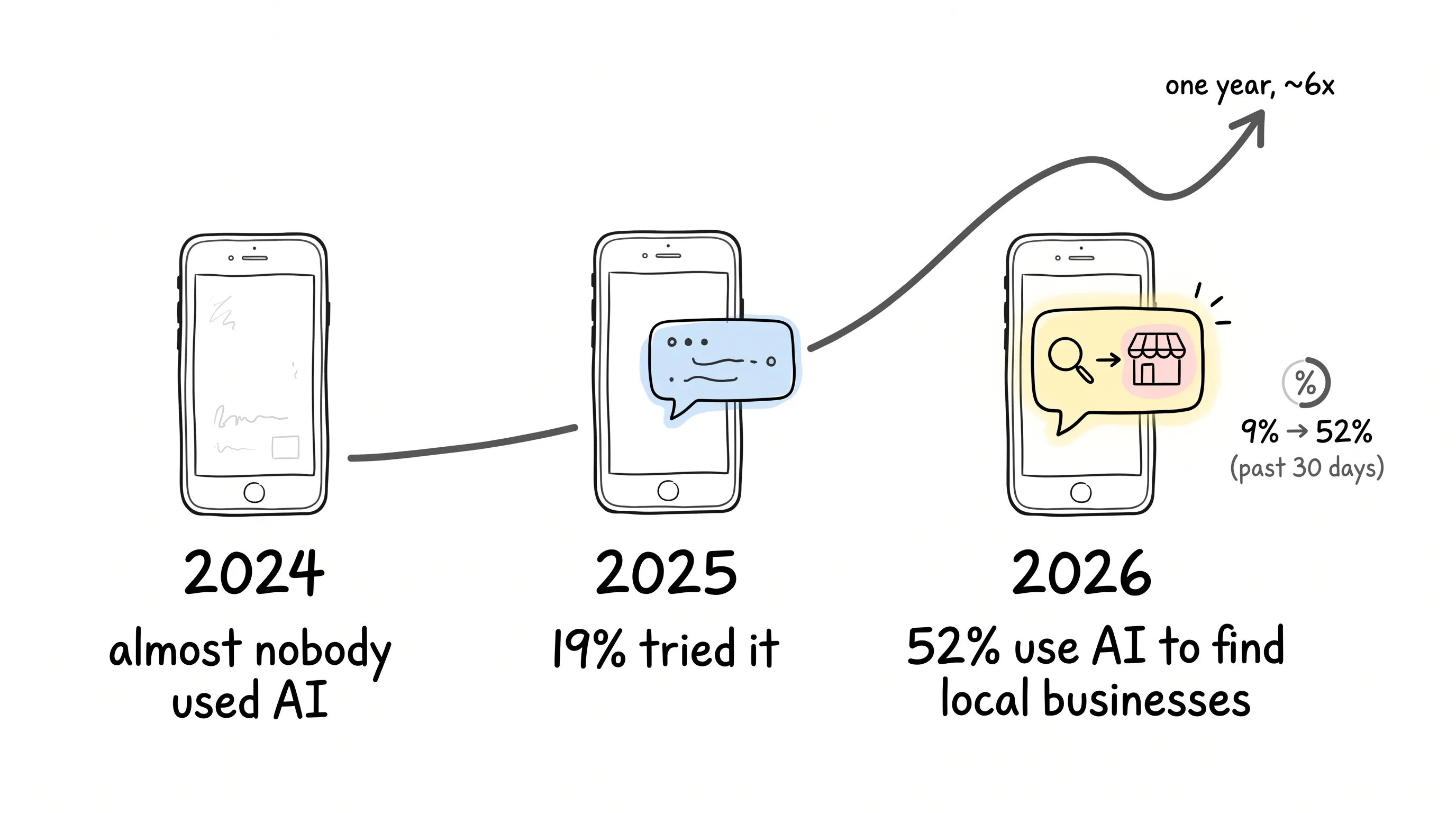
In 2024, almost nobody used AI to find local businesses. In early 2025, about 19% had tried it. By 2026, 60% now treat AI as a regular discovery channel, and 52% use it specifically to research local businesses.
And here's an even starker number: of the people who had used AI to find a local business in the past 30 days, only 9% said so in the 2025 survey. In 2026, it's 52%.
One year. Nearly sixfold.
Wow.
That said, the penetration is extremely uneven. Slice the audience any way you like and this section is loaded with insight.
By income: among people earning under $50,000 a year, 47% regularly use AI; above $100,000, it's 76%. By age: Millennials lead at 63%; Gen Z sits at 49% and Gen X at 48%, basically neck and neck; Baby Boomers, just 11%.
One sentence: the people most likely to research your business on AI are Millennials with money and the willingness to spend it.
How do they use it? Half of them go looking on their own: 57% use ChatGPT, 51% use Gemini. The other half arrive passively: 51% have seen AI-generated answers at the top of Google results, 35% have clicked into Google's AI Mode, and roughly a third have bumped into AI content on Meta's platforms and in map apps.
Which means: whether or not you invest in AI optimization, AI is already standing between your customer and your store.
The More People Use It, the Less They Trust It
Here's the interesting part.
Usage is exploding. Trust isn't keeping up.
Among the people using AI, 67% say AI has burned them at least once — they asked about a local business and got wrong information. 30% say that bad information caused real trouble: the wasted-trip kind.
So what about trust? Over the past year, only 27% said they trust AI more. The remaining 73% were unchanged or drifting downward — and 23% explicitly said their trust had fallen.
Heavy use, low trust. And this contradiction has spawned a behavior: verification.
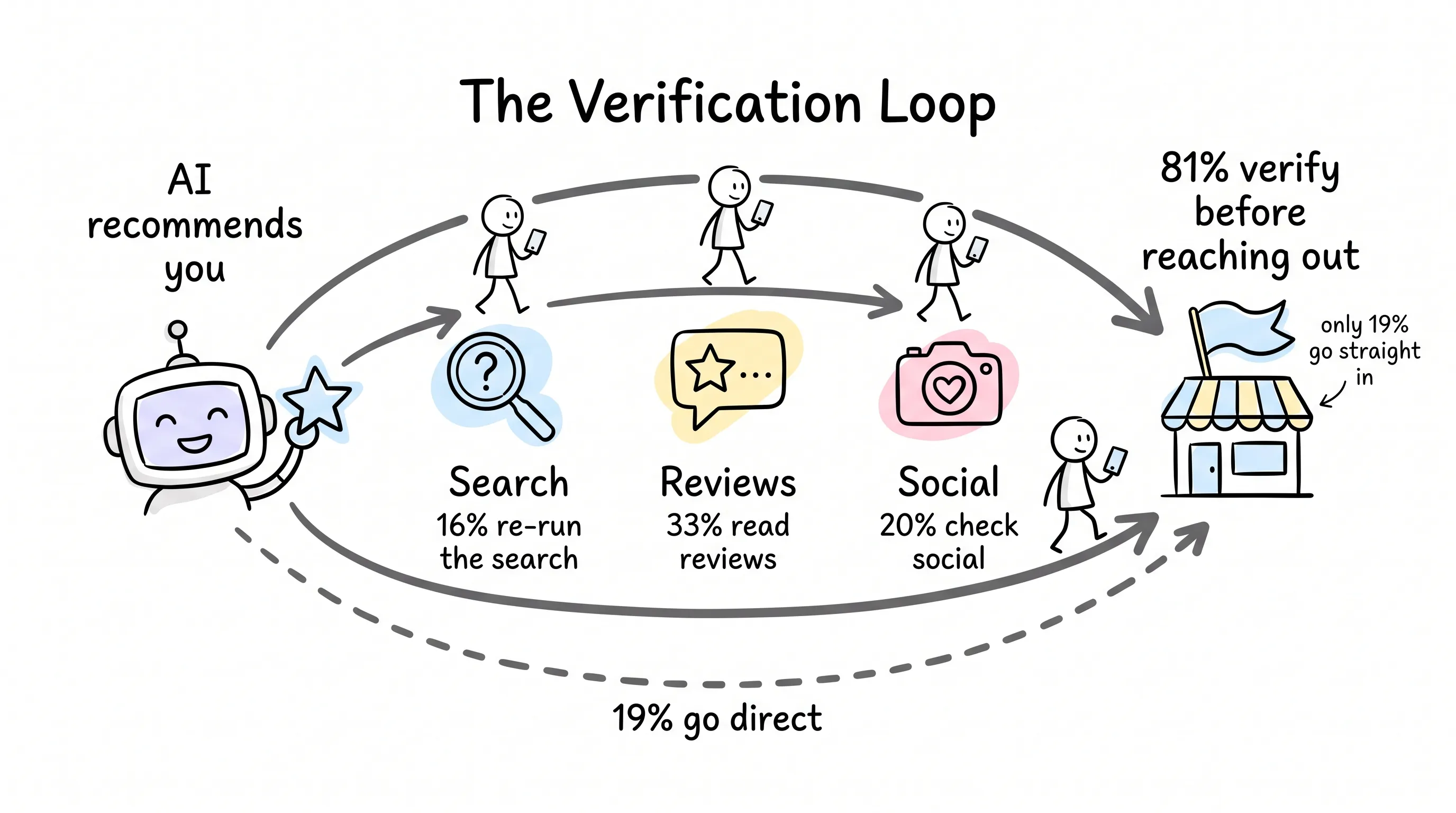
When AI recommends a business, 81% of people do something before reaching out. 33% go read reviews, 20% check the business's social media, 16% run the search again, and 12% simply work through several sources one by one. Only 19% go straight from AI recommendation to contacting the business.
Do you see what's happening?
Winning that AI recommendation slot only delivers the customer to the fork in the road outside your door. Which way they turn depends on the condition of your reviews and the liveliness of your social accounts.
AI exposure and reputation management have always been two halves of the same job. If you do the first half and leave the second half empty, you might as well not have started.
Social Platforms Are Becoming Search Engines
The rise of social deserves its own discussion.
The share of people discovering local businesses through social was only 17% in 2024; by 2026 it hit 55%. And 43% will use social to "pre-check" what a place feels like before they go.
Which platforms are doing the searching? Facebook 73%, YouTube 69%, Instagram 67%, TikTok 50%.
The first time I saw that ranking, I paused. The platform leading the pack is the oldest, largest one — not the newest.
YouTube in second place tells you one thing: people genuinely want to watch. To see the vibe of the place, to see the person serving them show off their craft. TikTok can reach half of all social searchers, but it skews young — it's the only platform Gen Z favors over Facebook.
Social doesn't just help people discover; it closes the sale: 59% say a single post or video turned them into a customer of a local business. Among Millennials, that number is 70%.
So stop treating your local accounts as parrots for headquarters content. Customers want information about "this store, this street" — not a nationwide script.
Reviews Are Still the Gate
AI and social have expanded the territory of discovery, but what actually decides who makes the shortlist is still reviews.
99% of people read reviews before a first visit at least some of the time; 68% always or mostly do. The role of reviews in local business, plainly put: the biggest, always-browsable library of neighborhood opinion.
What's changed is that customers don't just look at the star ratings anymore — they watch how you respond.
72% would rather choose a business that replies to reviews; in 2025 that number was 65%. 65% say that if a business responds thoughtfully to a negative review, they're more likely to come back. And 87% even say they might change a negative review to a positive one because of it.
Do the math on what a single reply is worth in ad spend.
One more detail, and anyone holding a budget should write it down: the higher the income, the sharper the sensitivity to reputation. The share who always read reviews climbs from 63% in the low-income group to 76% in the high-income group; the share who prefer businesses that reply climbs from 62% to 80%. The customers with the highest spending power are exactly the ones watching your reputation most closely.
Every Industry Runs a Different Playbook
The loop runs differently in every industry.
Search is the number-one entry point in every category, but the runner-up keeps changing. In healthcare (21%) and groceries (19%), AI-started journeys are the most common; in financial services, 20% enter through social; for gas and auto, 25% come in through map apps. Which makes sense — finding a gas station is need-driven and location-first by nature.
The deciding factor differs too. In five of eight categories, reviews and reputation call the shots, from restaurants (41%) to healthcare (38%). When choosing an apartment, visual content matters most, 43%. For groceries and gas, it's practical information like opening hours and location, 37% and 36%. For financial services, brand credentials, 34%.
So the "one asset for every channel, every category" approach doesn't work in 2026. You have to match the playbook to the industry.
A Few Words for Marketers
The data is on the table. Back to action. My read comes down to four points.
First, stop hunting for "the one channel that matters most." Your customer moves in circles, so you need to show up at every point along the loop.
Second, treat the AI trust gap as your own job to fix. Every claim in an AI answer should check out across search, social, and reviews. Consistency is what makes the AI's answer credible.
Third, run social as a local channel. Publish what local people care about, engage sincerely, and quit the nationwide parroting.
Fourth, build reputation store by store. Local reviews shape both the customer's choice and how AI describes you — and a reply is itself a conversion action.
Finally, back to the scene we opened with.
The customer asks the AI, the AI recommends you. That step, you can win with technology and luck.
But the handful of reviews scrolled and the videos watched right before they put the phone down — those are earned one day at a time.
AI's job is getting you seen. Reputation's job is getting you believed. Getting seen is a traffic problem. Being trusted is a business problem.
This survey isn't perfect — a sample of just over a thousand carries bias no matter how you weight it. But the direction is clear enough, and it's worth acting on now.
May you be not just seen by AI, but believed by your customers.
Continue reading
Related articles
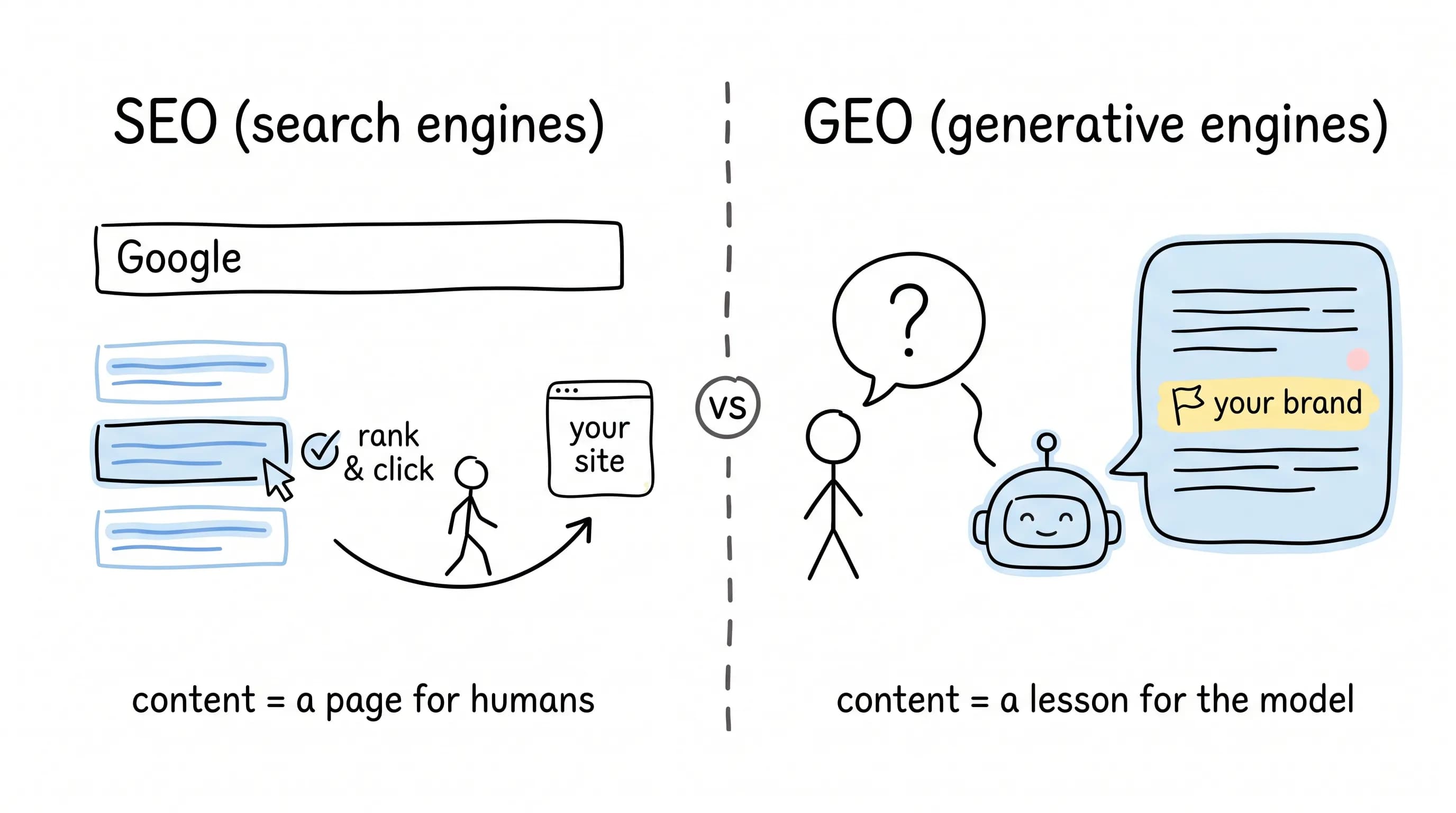
Does AI Know Your Brand? A Look at GEO, the New Craft
An explainer on GEO (Generative Engine Optimization): how AI engines like ChatGPT, Perplexity, and Gemini differ, how GEO goals and metrics diverge from SEO, and which SEO skills still carry over.
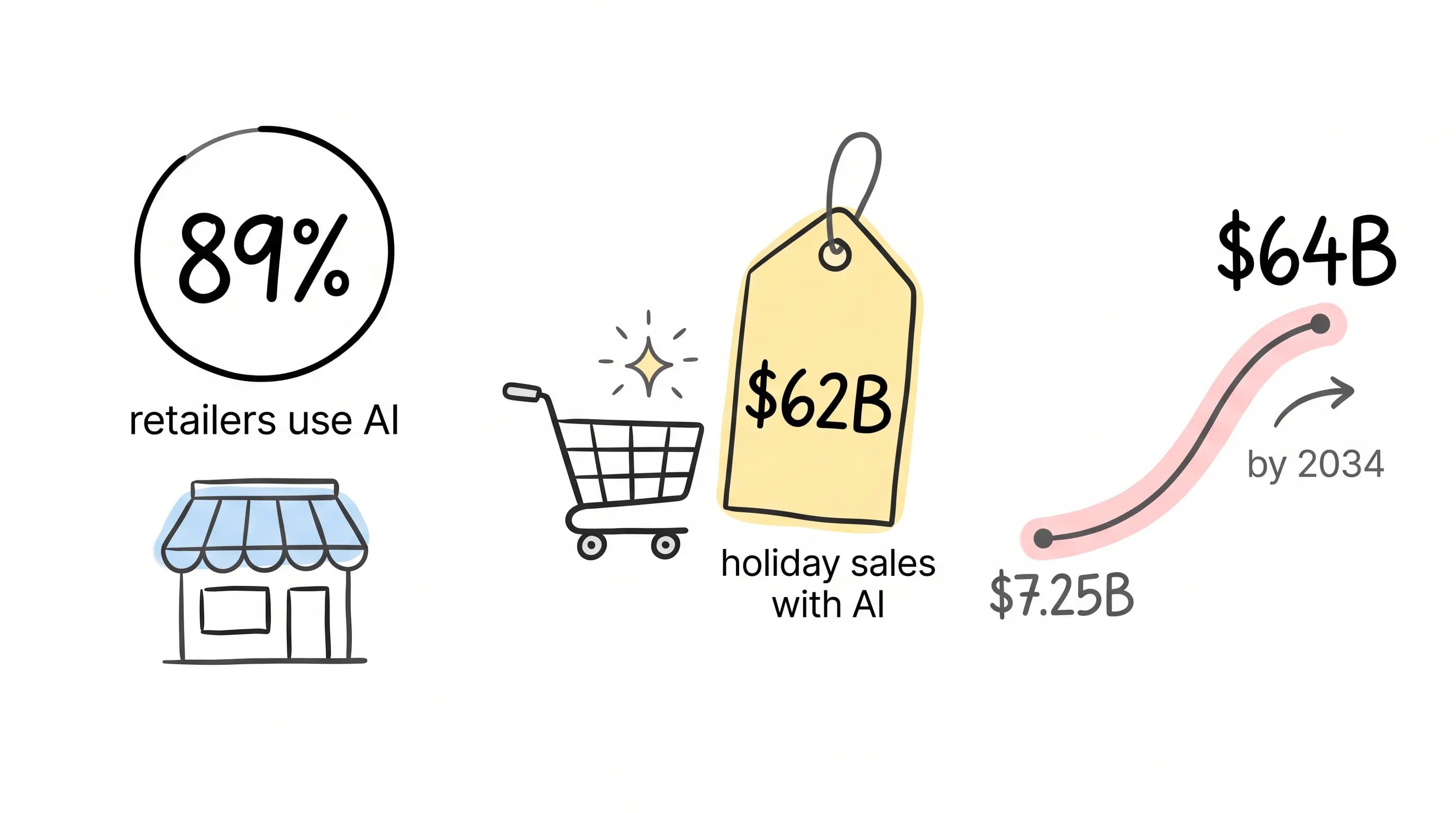
89% of Retailers Are Already Using AI. The Playbook for E-Commerce Has Changed
A learn article on AI in e-commerce: adoption context, use cases from recommendations, search, dynamic pricing, customer service, inventory, and fraud control, plus B2B applications, generative AI content, tool examples, pitfalls, and a six-step adoption path.
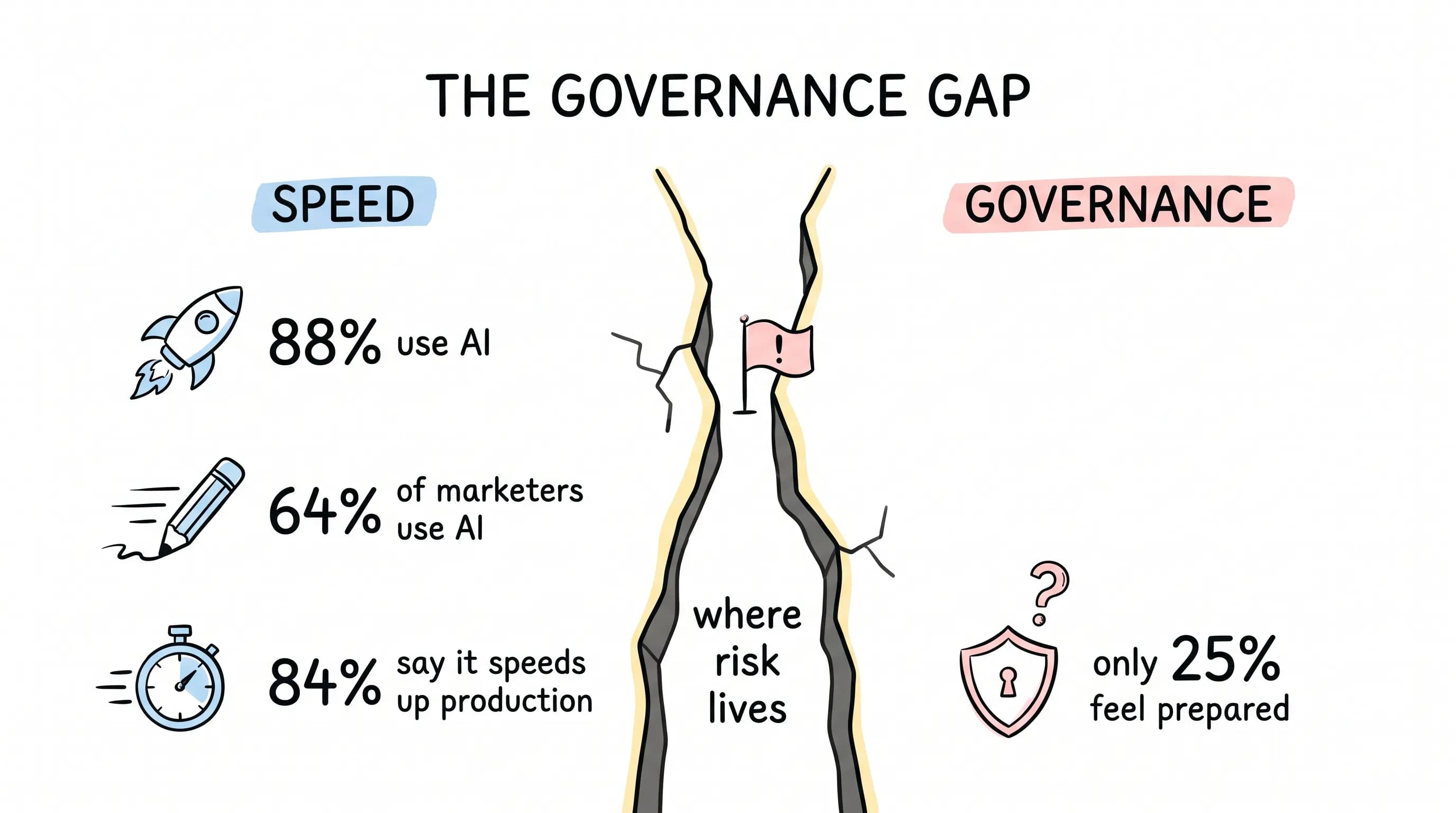
AI Makes Content at Lightning Speed — But Can You Answer "Who Approved This?"
This article looks at the gap between AI content speed and governance readiness in marketing teams, and outlines nine control points — prompt validation, brand guardrails, permissions, approval workflows, human review, versioning, IP checks, audit trails, and asset reuse — for brand-safe AI content.