
AI Marketing: In the End, It All Comes Down to Data
A learn article walking through how generative, predictive, and monitoring AI are applied in marketing — from ad copy iteration and lead scoring to anomaly alerts — and arguing that data quality sets the ceiling for AI performance.
A few days ago, a friend who runs ad campaigns invited me to dinner.
We'd barely sat down, menus still in hand, when he opened with this: our marketing weekly reports — no longer written by humans.
So what do your people do now? I asked.
The AI is watching, he said. When costs spike, it flags it. When budgets should move, it speaks up. It even knows which ads are about to die before I do.
Then what do you do?
Well, I'm having dinner with you, aren't I?
Respect.
After that meal, I went home and untangled the whole AI-marketing thing from start to finish. Here it is.
First, What Exactly Is an AI Agent?
What is an AI agent?
It's AI that doesn't just "talk" — it "does."
The old AI was like a chatty intern: you ask, it answers. An AI agent is different. It looks at the data on its own, forms recommendations on its own, and acts on its own. At 3 a.m., if your cost per click (CPC) suddenly spikes, there's no waiting for the analyst to clock in the next morning — the alarm is already sounding.
That's why marketing and sales have become the fastest AI adopters in any company. While other departments are still holding roadmap meetings, marketing has already plugged AI into its daily routine: analyzing data, optimizing campaigns, watching for anomalies, personalizing, cutting out repetitive work.
How fast? One survey found that among marketers using AI, 90% say decision-making has sped up.
But there's a catch — a prerequisite most people haven't fully grasped.
Hold that thought. We'll come back to it.
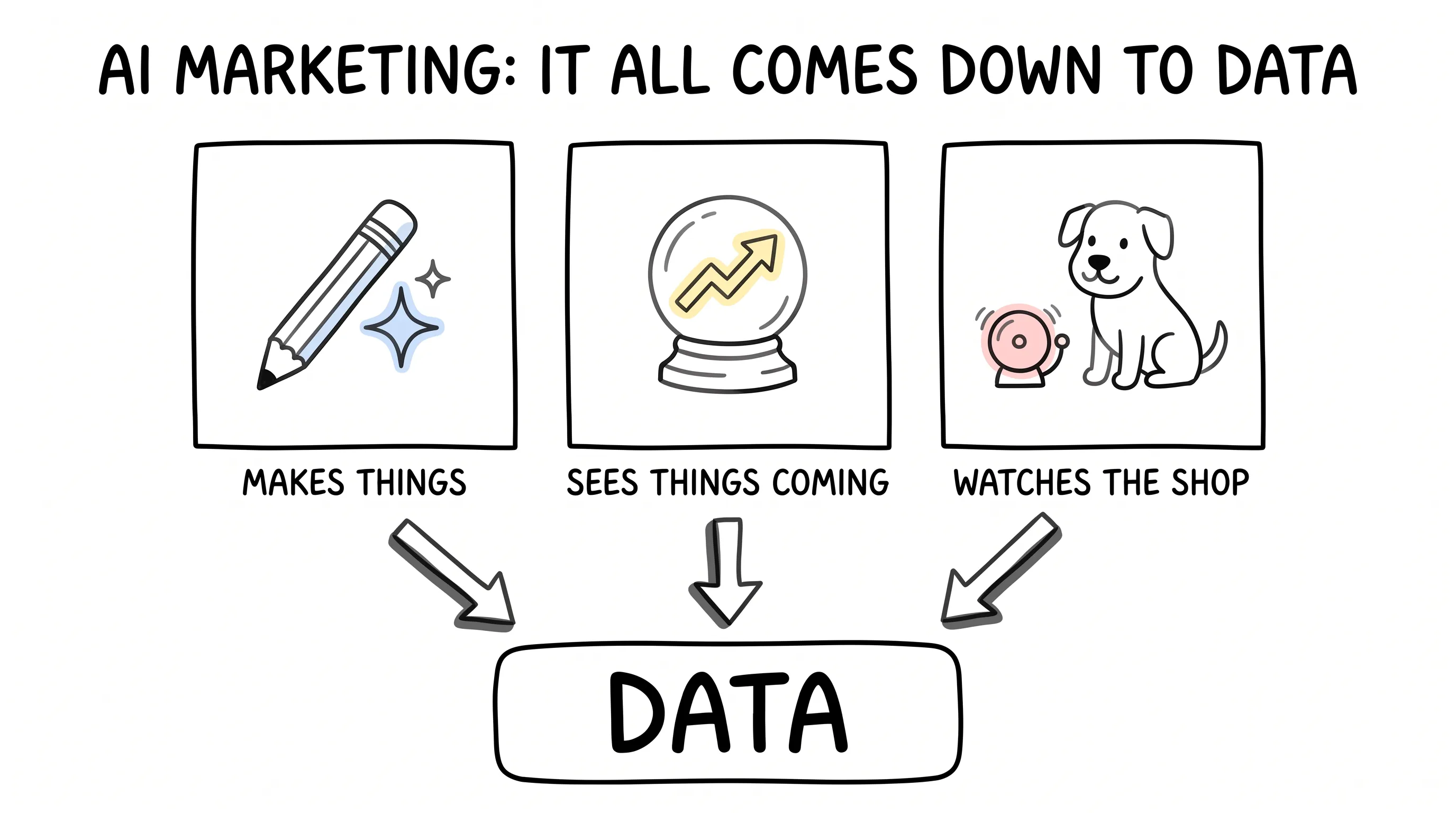
The First Kind of AI: One That "Makes Things"
The most familiar kind: Generative AI. It writes copy, creates images, produces video.
Take ad writing. A good headline used to take a team half a day of brainstorming. Now you tell ChatGPT what you want, and seconds later you have dozens of versions on the table. Pick one, tweak the tone, swap the keywords, ship it. Plenty of teams report cutting content-production time by 30–50%. Writers are finally free to move from grinding out copy to thinking about strategy and telling stories.
Here's an example that genuinely stunned me. Nutella — yes, the chocolate spread — used AI to generate 7 million unique jar labels, every single one different. The result? Every last jar sold out.
Seven million. Each one unique.
And it gets wilder. JPMorgan tested AI-written ad copy, and the best-performing AI version drove a click-through rate up to 450% higher than the human-written one.
What does 450% mean? The headline you stayed up all night polishing delivers less than a quarter of the AI's results.
Of course, the real power of Generative AI isn't in "generating" — it's in "iterating." Make dozens of versions, test them on small traffic, let the data speak, run whatever wins, then feed the winner back in and generate the next batch. Generate, test, optimize, repeat. Once that loop spins up, every dollar you spend goes toward creative that's already been validated.
The Second Kind of AI: One That "Sees Things Coming"
If Generative AI helps you "create," Predictive AI helps you "anticipate."
What does anticipating mean? Knowing roughly what tomorrow holds before it happens — instead of running a post-mortem after things break.
Take churn. AI combs through a user's behavioral history — how often they log in, what they've bought, whether they're still active — and flags them before they walk out the door: this one's about to leave. Send a tailored offer, a heartfelt email, and you keep them. Research shows companies using churn prediction cut churn by 13%–31% and lifted conversion by 9%–20%.
Or take figuring out which customers are worth the most. Amplitude has a predictive LTV (lifetime value) feature that tells you straight up: this user will be worth roughly this much in the future. The valuable ones get the VIP treatment.
The seam between marketing and sales is where this gets even more visible. Grammarly's sales team uses Salesforce's Einstein AI for lead scoring. The system picks up on some remarkably clever signals: several people at the same company all using the free version at once? That's a purchase in the making. Sales follows up immediately.
The result: paid conversions rose 80%.
How was lead scoring done before? A few points for job title, a few for company size. Crude. AI watches thousands of signals at once and finds the patterns: customers in this industry who downloaded the whitepaper and then visited the pricing page twice close at far higher rates. Put your people on the prospects who matter; stop wasting them on dead ends.
The Third Kind of AI: One That "Watches the Shop"
The third kind, I call the "digital supervisor."
What's a digital supervisor? AI that has learned your business's "normal water level" — and squawks the moment things drift off it.
Your customer acquisition cost suddenly spiking? It doesn't just report the number — it helps you diagnose: did an ad channel change its rules, or is a competitor bidding up the same traffic? Adobe Analytics' anomaly detection runs an attribution analysis automatically when data looks off, and tells you what's driving the change. SuperAGI's system is smarter still — it recognizes normal fluctuations: a traffic surge during a major sale, low conversions on Mondays. It won't bother you with those, only the real problems. And Anodot can monitor millions of metrics simultaneously. What no human team could watch, it watches.
Soon, nobody will be hand-writing reports either. Microsoft Power BI's Copilot: say "show me conversion by channel," and the chart appears on its own. Tableau Agent goes further — you ask in plain language to change a calculation or switch up a chart type, and it understands. Coupler.io's dashboards have AI Insights built right in, automatically translating trends and anomalies in your data into plain-English takeaways.
And now you can simply "ask" your data. Pipe your business data into Claude or ChatGPT and interrogate it like a conversation: I'm worried AI search is eating our organic traffic — what's the trend? It digs through the data and hands you an evidence-based answer.
And paid campaigns? Goes without saying. Google and Meta's ad systems have long used machine learning to auto-pause underperforming ads, shift budgets, and adjust bids. Mailchimp can test multiple subject lines — a small sample goes out first, and whichever wins gets automatically sent to everyone else. Some customers report that "AI-picked best send time" alone lifted open rates by 20%. E-commerce retailers using AI targeting routinely see return on ad spend (ROAS) improve by 10%–25%.
Search is changing too. Semrush released keyword prediction, so you can lie in wait for topics about to take off. Google's own search results are going AI-native, which spawned a new acronym: AEO — Answer Engine Optimization — structuring your content so AI answers cite you. One survey says 68% of companies are already reworking their SEO strategy.
You read that right. Even "how search works" needs a full rebuild.
But Here's the Most Important Part
I've made all of this sound exciting, but my friend also said something sobering: when his team first adopted AI, the results were a disaster.
Why?
Because the data was scattered.
Conversion data in one spreadsheet, ad spend in another, CRM records sitting in somebody's inbox. What the AI saw were three incomplete worlds. Its recommendations looked smart — but they were guesses.
Ivan Burban, head of marketing at Coupler.io, put it in a way I couldn't agree with more: AI can do a lot, but it isn't magic. The quality of the insights depends on the data you feed it.
That's exactly the problem his company solves: pulling 400+ data sources into one place, into a single clean foundation. Once the foundation is solid, you can actually trust what the AI tells you.
So many companies are anxious about "whether to adopt AI," and they've got the order completely backwards. AI's ceiling is set by your data's floor.
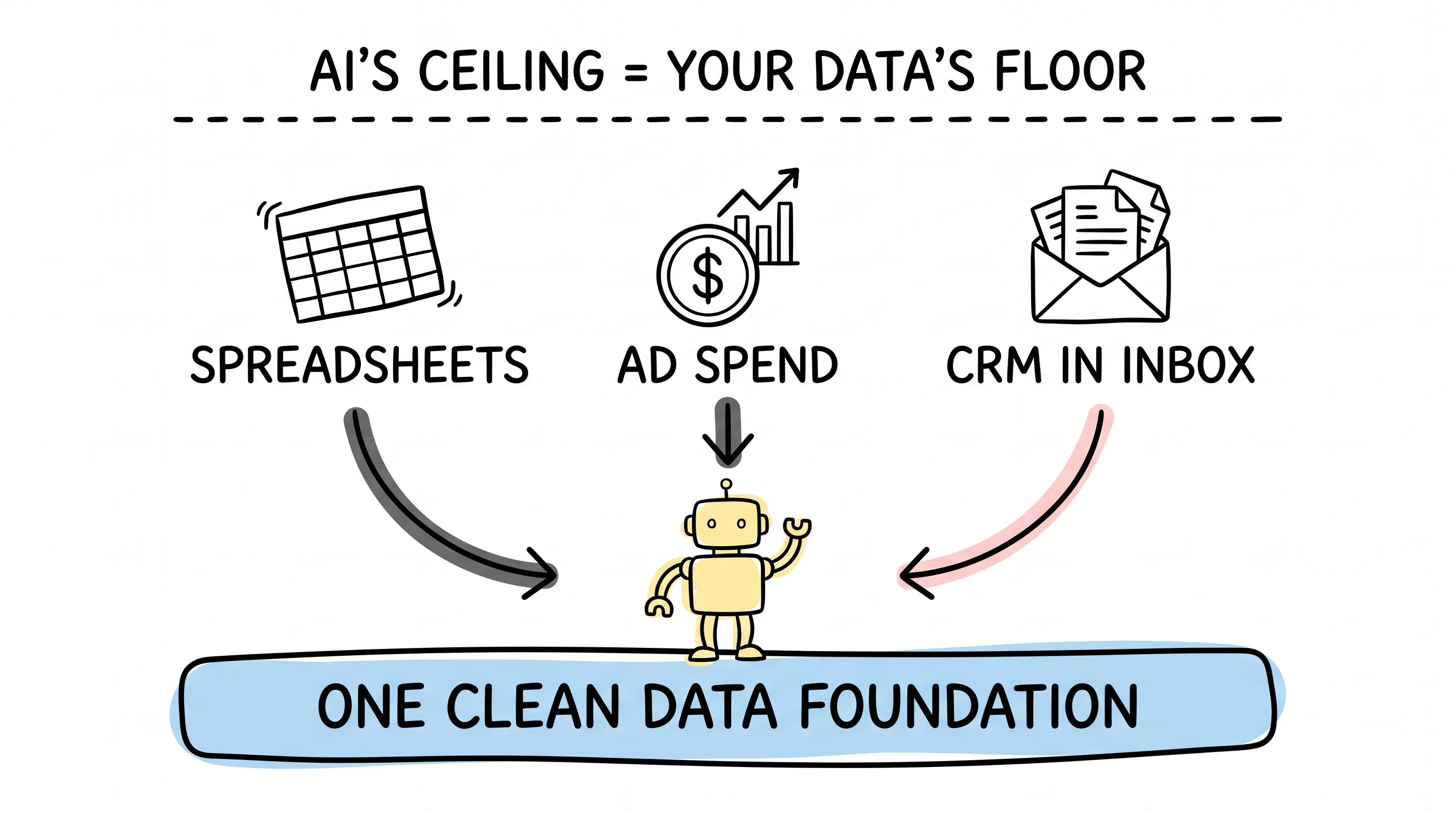
If your data is a mess, the harder your AI works, the faster it gets things wrong.
Two Last Things
Of course — don't hand over the whole operation. AI misreads noisy data, cries wolf, overreacts to short-term blips. The steering wheel stays in your hands.
My advice: start small. Automate one report. Set up a batch of anomaly alerts. Test a batch of AI-written copy. Once that's running smoothly, move on to prediction and intelligent orchestration.
Gartner predicts that in the coming years, most CMOs will use AI to manage cross-channel customer journeys in real time. At that point, AI won't just do the work — it will decide when to speak, what to say, and what to do next.
Oh — and at that dinner, halfway through the meal, my friend's phone buzzed. The AI flagged an ad whose costs had climbed. He glanced at it, tapped confirm, and kept eating.
That's what the new normal looks like.
Here's hoping you, too, get to enjoy a quiet dinner like that soon.
Continue reading
Related articles

What Is AI Marketing Automation? It Starts With a 40-Point Gap
A learn article explaining what AI marketing automation is: how learning-based systems differ from rule-based automation, how AI decisioning optimizes message, channel, and timing choices, what data it depends on, and where it applies across the customer lifecycle.

It's 2026: Stop "Buying" AI Tools for Your Marketing Team — Start "Hiring" AI Agents
This learn article explains how AI agents differ from standalone AI tools in marketing, outlines three agent categories — build-your-own platforms, CRM-native agents, and vertical tools — and covers use cases across SEO, social media, advertising, and reporting, plus criteria for choosing one.

What Is an AI Marketing Agent? From "Using AI" to "Delegating to AI"
A learn article explaining what an AI marketing agent is, how it differs from rule-based automation, and which repetitive tasks such as lead qualification, reporting, and campaign monitoring can be delegated while humans keep key decisions.