
AI Marketing in APAC: What's the Actual Playbook? Let Me Tell You 3 Stories
A learn article on AI marketing in APAC, told through three case stories covering template-driven e-commerce visual production, scaled localization of campaign banners, and real-time market intelligence for creative planning.
A few days ago, an old friend of mine who runs a cross-border e-commerce business took me out to dinner.
He looked exhausted. He barely touched his chopsticks.
He said peak season was here. Platforms ship new products every day, and every product needs images: hero images, detail-page images, size charts — even the image file names have to be renamed one by one to match each platform's rules. His designers worked overtime every day, and the backlog still wouldn't clear.
He asked me whether he should hire another batch of designers.
I said, what you're short of probably isn't people.
What you're short of is an assembly line.
He froze.
A few days after that dinner, I came across an APAC market analysis published this past May. Several cases in it made exactly the point I hadn't fully explained — crystal clear.
Today, I'll tell you 3 of those stories.
What Is AI Marketing, Really?
First, let me fix a misconception.
Many people think AI marketing means having AI write a few lines of copy, or draw a few images.
Not even close.
That's just "using an AI tool." The real dividing line is whether AI runs through the entire content production chain: research, production, management, localization, publishing — no stage left out. Content runs at industrial efficiency, without burning money in proportion to headcount or agency bills.
One line from that analysis stuck with me: content production cycles that used to take six weeks are now compressed to days. And the teams that outpace their peers stand on four pillars: AI creative production, real-time market intelligence, localization at scale, and brand governance.
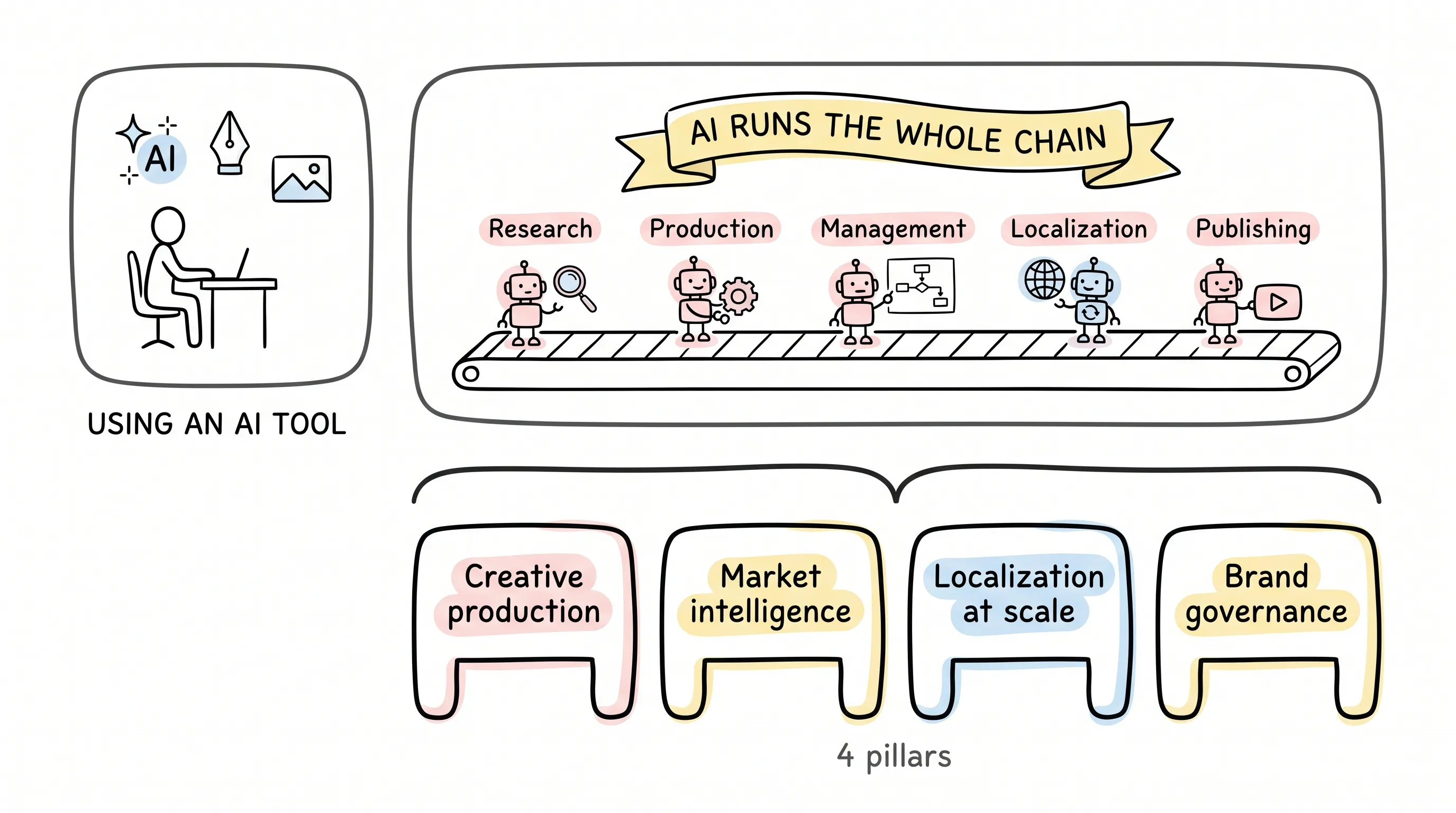
Think about it: all four pillars are "content operations" work.
Why APAC, of all places?
Because APAC isn't one market. It's a whole pile of markets. Ten-plus languages, dozens of platform ecosystems, and completely different cultures. A line that lands in Seoul can fall flat in Jakarta — push on to Mumbai, and it might actually offend someone.
So the same AI that's an efficiency tool elsewhere is, in APAC, the price of admission.
How do you get in?
Read on. 3 stories, from apparel, tech hardware, and beauty.
Story 1: From 50 to 1,000
Timberland — yes, the yellow-boot brand — runs e-commerce in Southeast Asia.
Their situation probably sounds familiar: more and more products, a creative team that stays the same size, and every year all the new launches crammed into a four-month peak season. One peak-season cycle means handling 1,200+ product launches, each one needing platform-specific visuals, size charts, plus SEO-compliant file naming.
All by hand.
Were the designers suffering? Yes. But what was holding them back was never their craft.
It was the process.
Then they rebuilt the whole production chain around assembly-line thinking: recurring design patterns distilled into templates; product data went into a spreadsheet, and images generated in batches — no more copy-pasting into Photoshop one by one; cutouts and color correction went to automation under global brand rules; even file naming, which used to be a full-time daily job, became automatic.
And the result?
Weekly new-listing capacity went from 50 to over 1,000.
20x. Without adding a single person.
On the size-chart workflow alone, costs dropped 90%.
Repeatable creative work is, at its core, infrastructure — not creativity.
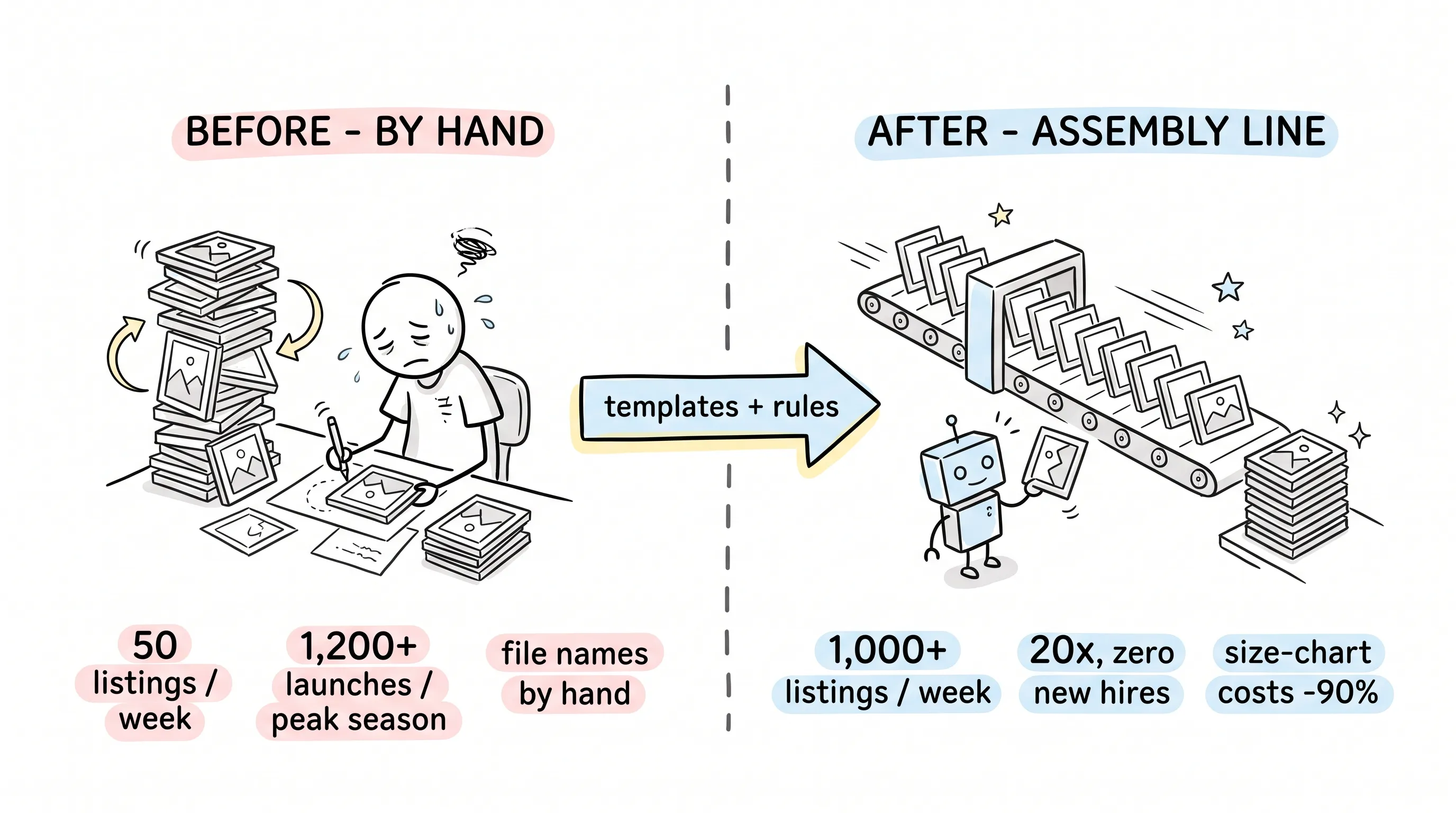
Treat e-commerce visual production like manufacturing — with templates, rules, an assembly line — and capacity becomes elastic. Whoever treats it as "handwork for the design department" will be hiring forever.
Story 2: 13×9 — How Do You Do This Multiplication?
Story 2 comes from a global tech hardware brand.
It had to run ads simultaneously across a wide swath of markets — Southeast Asia, Europe, and more. Every campaign meant 13 banner sizes, multiplied by 9 languages, multiplied by different promotional messages per region.
Do the math: 13 × 9 × N regions. One campaign — hundreds of images.
How did they do it before? Designers copied the master file and edited image by image. One round took weeks.
What did they change? One word: beautiful.
The idea is movable-type printing. The plate is fixed; the type is what moves.
Four steps. First, group banners by aspect ratio, so similar sizes share one composition. Second, prepare the logo, copy blocks, and hero visual in both horizontal and vertical versions up front. Third, put each region's headlines and prices into one spreadsheet, injected into every size and every language in a single click. Fourth, file names auto-generated from that same sheet.
Afterwards, campaign production speed tripled. Visuals across markets actually became more consistent — with fewer errors.
The lesson here deserves to be written down by every cross-border brand:
Localization at scale is an architecture problem, not a headcount problem.
What changes: language, price, market. What doesn't: layout, brand elements, proportions. Store the changing and the unchanging separately, and the multiplication of hundreds of images becomes a table lookup.
For brands still running global campaigns by copying a master file and editing image by image — this model, at APAC's scale, was never going to hold up.
Story 3: The Rearview Mirror, or the GPS
Story 3 is the most interesting one.
A beauty and personal-care brand, spanning five APAC markets. It doesn't lack capacity — agencies handle production. What it lacks sits further upstream: intelligence.
What do I mean?
Their campaign briefs were built on quarterly consumer research. By the time the creative was done and live, the market had long since moved. A competitor would make a big move — and by the time they saw it, it was already a market event.
It's like driving.
Quarterly research is driving with your eyes on the rearview mirror. The picture is clear, but what you're looking at is always the road you just passed.
Later, they added a layer of AI intelligence in front of the creative process, running 24/7: monitoring social media and search sentiment across every market in real time; knowing instantly when a competitor launches a campaign or changes its messaging; building a set of "synthetic consumers" from real behavioral data and stress-testing creative against them before launch; and looking 3 to 6 months ahead at trends, so planning stays a step ahead of competitors.
The brief went from "quarterly snapshot" to "live broadcast."
Post-launch rework dropped noticeably. And the team made decisions with a different kind of confidence.
Speed without intelligence is just producing noise faster.
I don't need to tell you how cutthroat beauty is in APAC, or how fragmented its cultures are. Brands that invest only in production speed and not in intelligence are headed in the wrong direction.
Three Stories, One Lesson
Apparel, hardware, beauty — three unrelated industries, the same logic underneath. Let me fold it into three sentences:
First, build the infrastructure before talking about output. Templates, brand rules, data pipelines — these are infrastructure, not project overhead. The first image is expensive. The 500th is nearly free.
Second, research and production must be joined into one pipe. In old-style operations, research is research's job, production is production's, two teams sitting in separate rows; in new operations, the input to creative decisions shifts from last quarter's report to real-time data.
Third, brand governance must grow inside the production process, not rely on after-the-fact human review. At volume, human review always collapses: it either drags the speed back down, or gets quietly bypassed when deadlines press. Build the rules upstream, and every image leaves the factory compliant.
If you're choosing a "content operations platform" for your company, there are really just four questions: Does it cover the entire chain? Can it digest APAC's diversity of languages and cultures? Does it get smarter the more you use it? Are brand rules built into the generation step, or policed downstream by humans?
Platforms that pack these things into one architecture already exist. Take MUSE AI: it uses a Market Research Agent powered by atypicaAI for real-time intelligence and audience simulation, and museDAM (digital asset management) to bake brand compliance into the production stage; after content ships, it keeps adapting to market signals. Is the architecture any good? Measure it against those four questions and you'll know.
Back to That Dinner
That night, I told my friend these three stories.
He said nothing for a long time. Then he put down his chopsticks and said:
"Let me go back first and take stock of how much of our work is mindless repetition."
I said: that's exactly it.
Give the repeatable to the assembly line. The non-repeatable — that's the creative's real battlefield.
And here's wishing you never spend your most expensive creative talent on the places that need creativity least.
Continue reading
Related articles
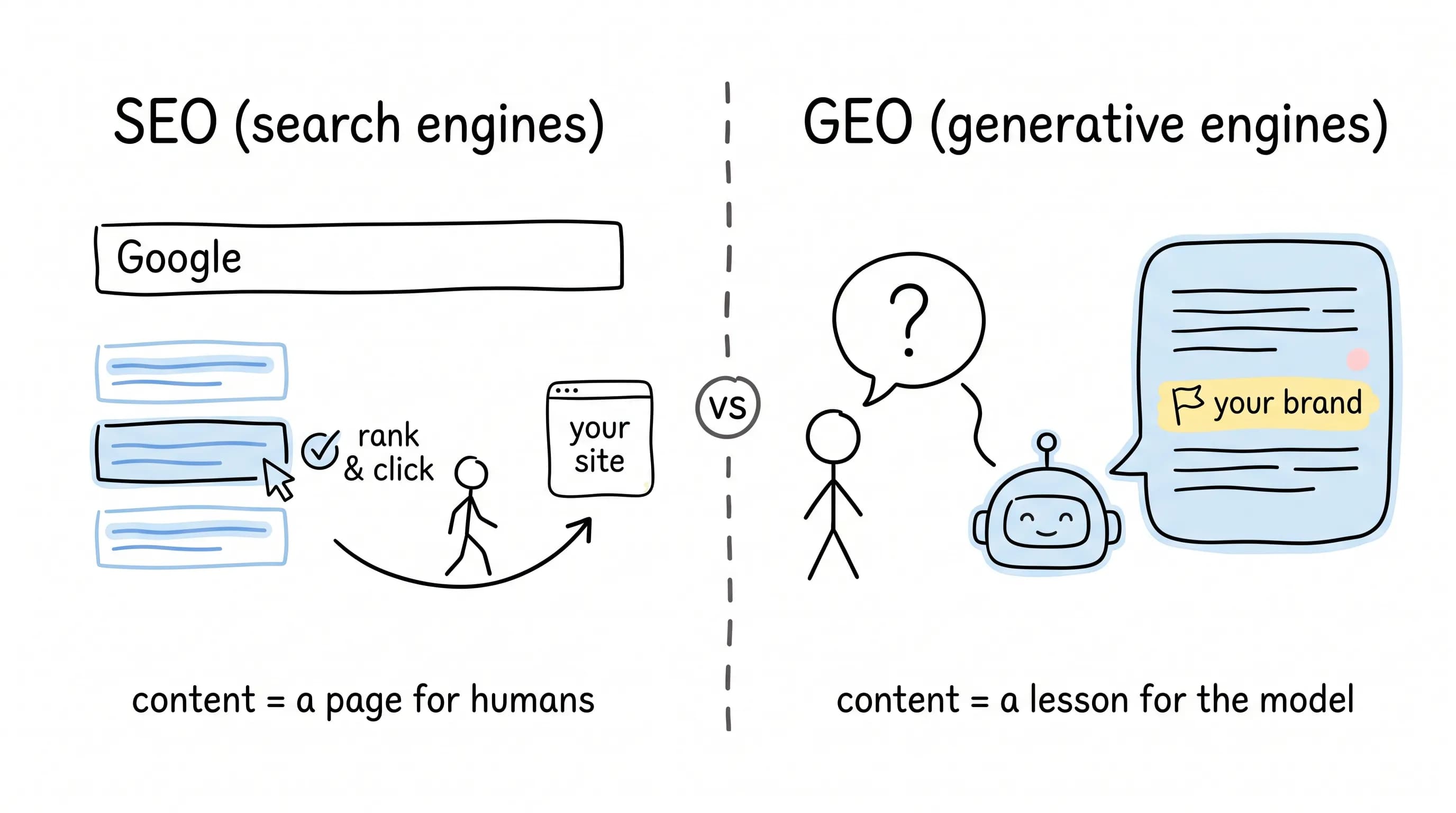
Does AI Know Your Brand? A Look at GEO, the New Craft
An explainer on GEO (Generative Engine Optimization): how AI engines like ChatGPT, Perplexity, and Gemini differ, how GEO goals and metrics diverge from SEO, and which SEO skills still carry over.
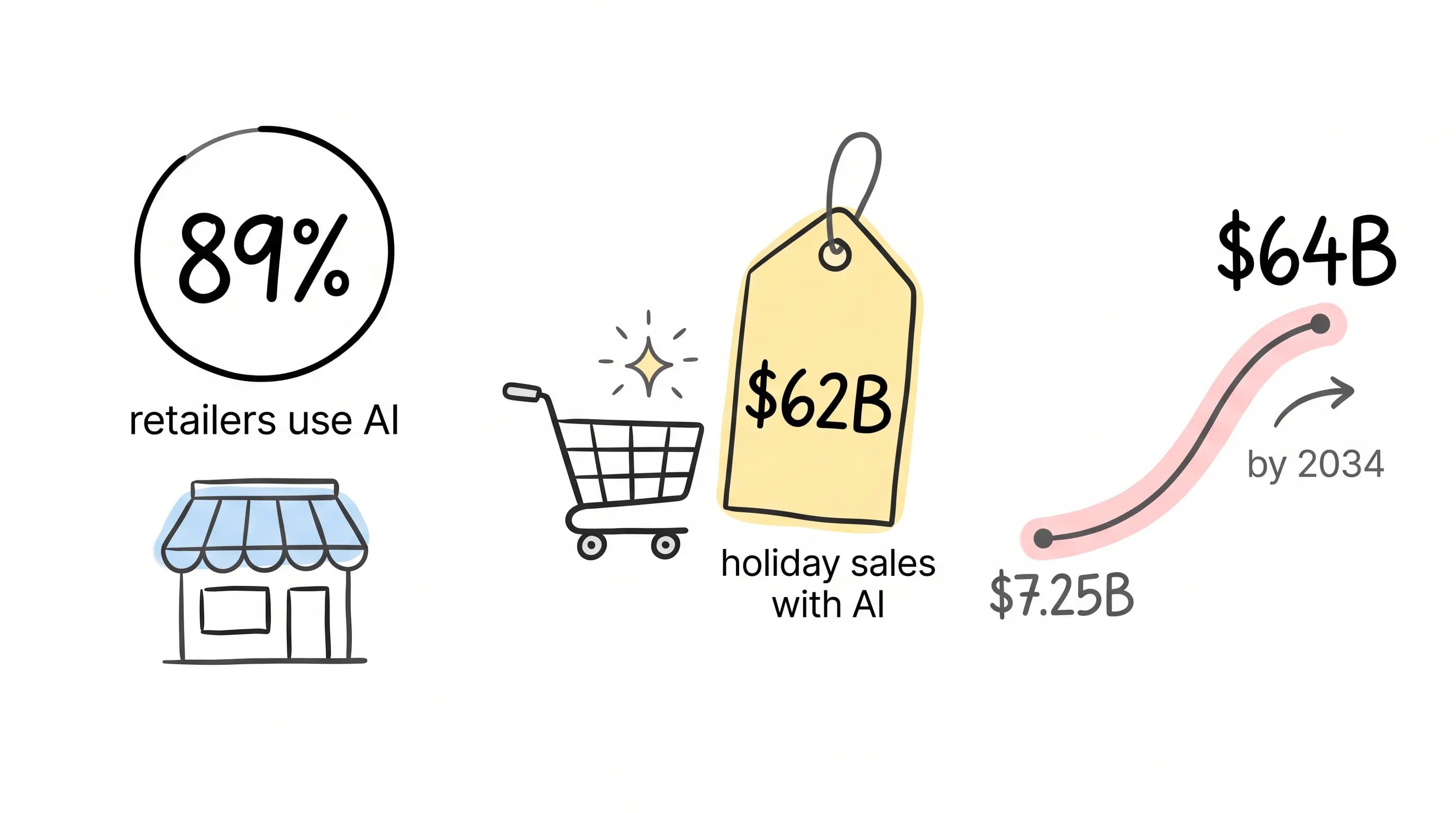
89% of Retailers Are Already Using AI. The Playbook for E-Commerce Has Changed
A learn article on AI in e-commerce: adoption context, use cases from recommendations, search, dynamic pricing, customer service, inventory, and fraud control, plus B2B applications, generative AI content, tool examples, pitfalls, and a six-step adoption path.
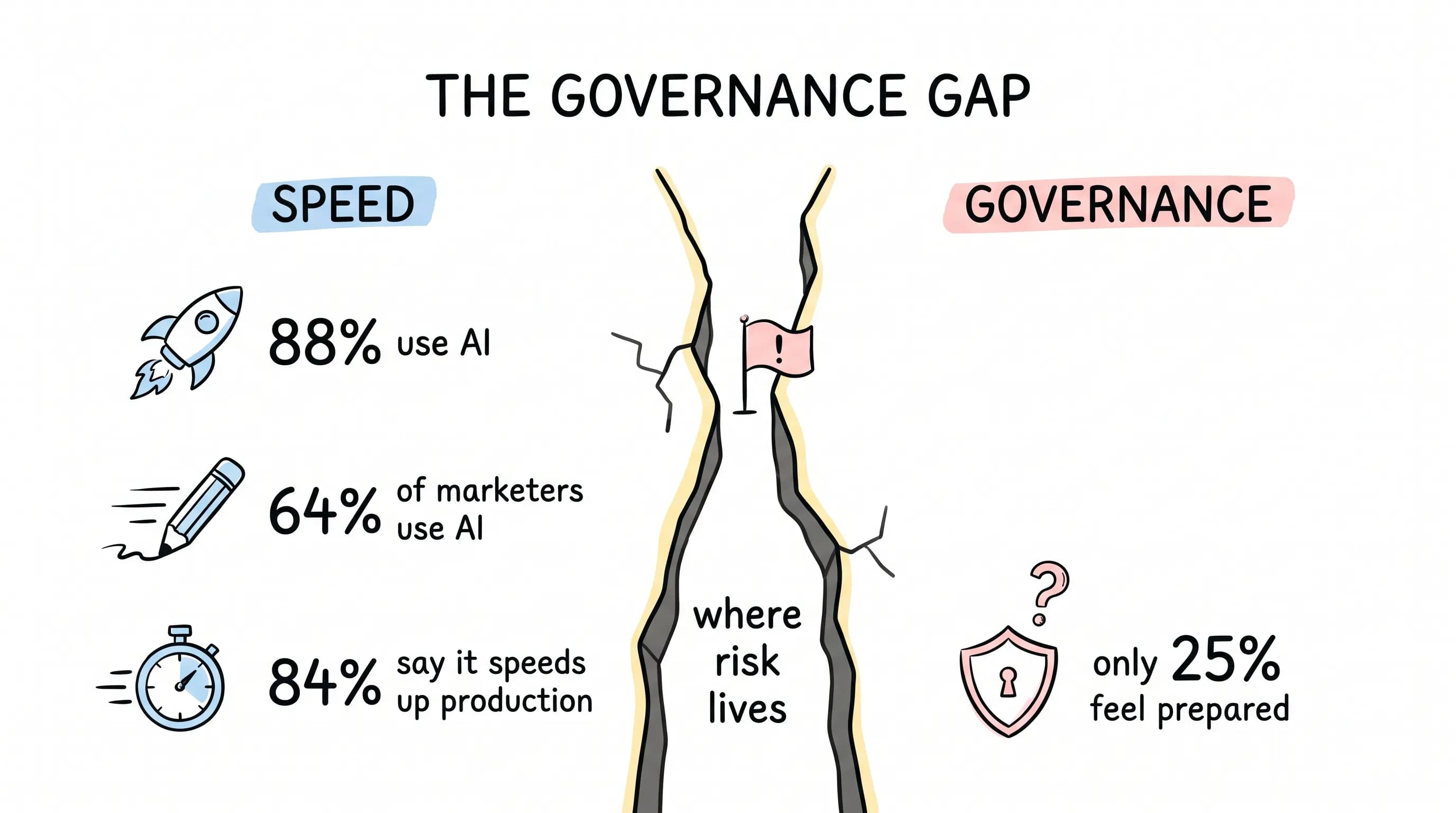
AI Makes Content at Lightning Speed — But Can You Answer "Who Approved This?"
This article looks at the gap between AI content speed and governance readiness in marketing teams, and outlines nine control points — prompt validation, brand guardrails, permissions, approval workflows, human review, versioning, IP checks, audit trails, and asset reuse — for brand-safe AI content.