
AI-Generated Ads: Should They Identify Themselves? IAB Just Wrote the Industry's First Rulebook
An explainer of the IAB's AI Transparency and Disclosure Framework, outlining which AI-involved ads require disclosure and how to label them, plus survey data on the perception gap between advertisers and young consumers.
Last week I had dinner with a friend who runs an e-commerce business. This year his company has swapped almost everything — product detail pages, posters, talking-head videos — for AI-generated output.
A few drinks in, he asked me: "Do you think I should tuck a small-print line into the corner, noting it was made by AI?"
I told him not to sweat it yet — the industry had just been handed its answer.
Earlier this year, the Interactive Advertising Bureau (IAB) released the AI Transparency and Disclosure Framework, the industry's first rulebook devoted specifically to answering which AI-involved ads must be disclosed to consumers, and which needn't be.
I went through the framework back and forth, then chewed through the survey report behind it as well. The more I read, the more I felt this is something every marketer needs to understand.
Today, in plain language, I'll break it all the way down for you.
First, the big question: does every AI ad have to carry a label?
When many people hear "AI disclosure," their first reaction is: uh-oh — from now on every image will have to be stamped "This image was AI-generated."
The IAB has stated clearly: no.
What counts as "should disclose"? The IAB drew one line: did AI touch what is "real"? And "real" means authenticity, identity, and presentation. As long as AI's involvement could leave consumers with the wrong impression, disclosure is required; if it's merely helping you retouch images or composite assets, it isn't.
Put plainly, when AI is a tool, it doesn't need to speak up; when AI is impersonating "people" and "events," it must identify itself.
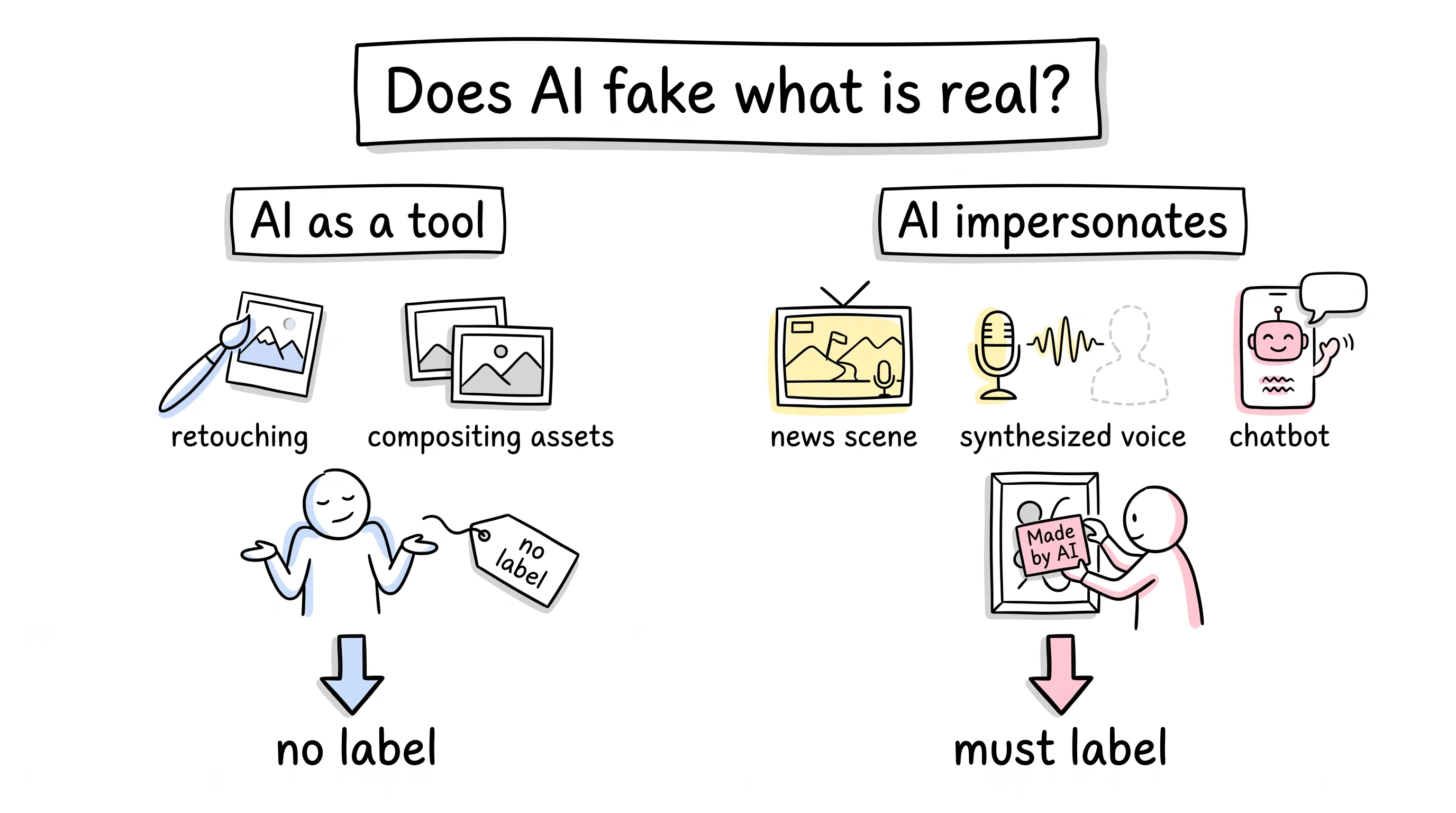
Which situations must be labeled? I've sorted them into three categories you'll get instantly.
The first category: AI-painted "news scenes." Generating images or videos from text prompts to depict real-world events, with humans doing only minor patch-up work. The event never happened, yet the footage looks as if it were really filmed — label it.
The second category: AI making people "speak." Using AI to synthesize the voice of a deceased person, making them say things they never said while alive — even if the family signed off, it must be labeled. The same goes for the living: making someone "say" what they never said or "do" what they never did requires a label. Note: ad endorsements read from a script don't count; that's performance by design.
The third category: AI passing itself off as a real person. Digital replicas, synthetic avatars, AI chatbots in ads — as long as they're simulating a real human interacting with you, label it. Digital replicas of the deceased are held to a stricter standard: any use requires disclosure.
You see, the standard really comes down to one sentence: is AI impersonating real people and real events?
How exactly to label? Two layers
The first layer: labels for consumers to see. You can use standardized text statements, or visual cues such as watermarks and on-screen badges, or make it a clickable little icon — anyone who wants to know can tap once and the information appears. One detail I find clever: the disclosure sits beside the creative rather than plastered across its face, so the ad itself stays watchable.
The second layer: labels for machines to read. Using protocols like C2PA (a content-provenance standard), the information about AI involvement is written into metadata — invisible to the human eye, plain to any system that checks, there for compliance and technical review.
It's a bit like the ingredients list plus the batch barcode on a food package: the list is for people to read, the barcode for the supply chain to check. Each does its own job.
Do consumers actually care? The data tells it straight
You might think: why go to all this trouble — consumers don't care one bit whether something is AI or not.
The IAB and the research firm Sonata Insights ran a survey asking precisely this. 505 young American consumers, plus 104 advertising executives. The results sting a little.
82% of ad executives believe young consumers (Gen Z and millennials) hold a positive view of AI advertising.
And in reality? Only 45% of those young people actually feel that way.
Eight out of ten advertisers believe young people are buying it. Among young people themselves, only four and a half out of ten.
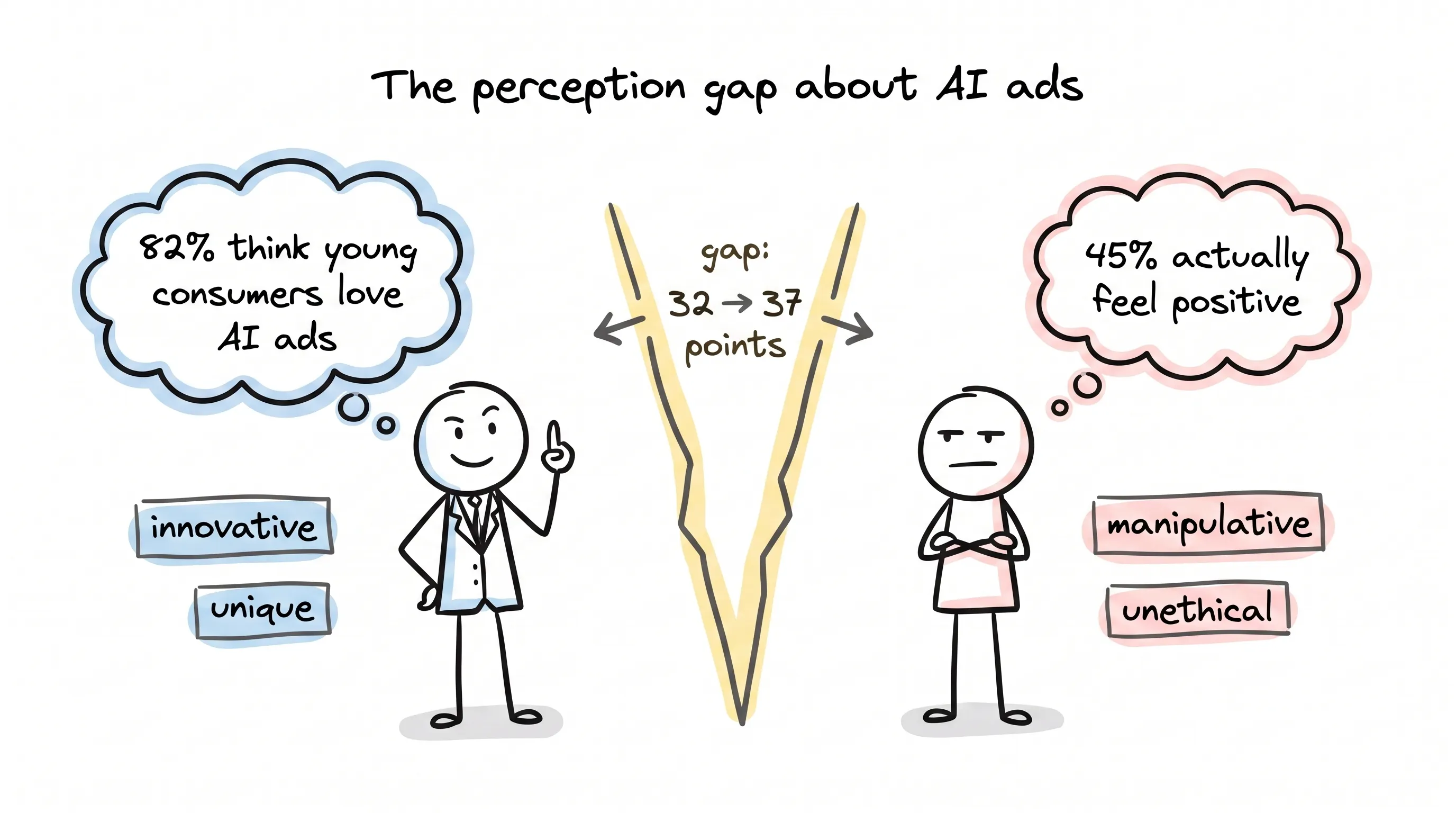
And the illusion is still widening. In 2024 the gap between the two sides was 32 percentage points; this survey put it at 37. Advertisers imagine their message landing like a gentle spring rain; what consumers feel is a steadily deepening chill.
What's worse, when the two sides describe "brands that use AI," the words they reach for belong to entirely different worlds. Advertisers think "innovative" (46%) and "unique" (44%). Consumers think "manipulative" (20%, versus only 10% on the advertiser side) and "unethical" (16% versus 7%). Among Gen Z, 39% feel averse to AI ads — roughly double the rate among millennials (20%) — and most Gen Zers say outright that brands using AI are inauthentic, out of touch, and unethical.
By now you might be thinking the AI-advertising business simply can't be done.
Hold on. The report contains one more set of numbers — in my view, the most valuable in the entire survey.
More than half of respondents want brands to spell out whether an ad is 100% AI-generated and whether it uses AI imagery or video. And 73% of young consumers say that with disclosure done clearly, their willingness to buy either goes up or doesn't budge.
In other words: putting it plainly costs you almost nothing.
What consumers resent is not AI — it's the feeling of being kept in the dark.
This is also why the IAB's vice president in charge of AI said at the launch that trust decides how far AI advertising can go — and that transparency should focus on "whether it might mislead consumers," not on slapping labels on indiscriminately until everyone goes numb.
One more ledger to settle: the regulatory kind
Now for a dose of reality. The EU's AI Act is already on its way into force; US states are rolling out related laws one after another; the major platforms are each adding their own disclosure requirements. The rules will only multiply — never shrink.
Better to get out in front than wait for regulators to push you along. The IAB, for its part, is calling on advertisers, agencies, media companies, and tech firms to publicly commit to four things: say clearly what needs saying, don't over-interrupt, keep the language consistent across the industry, and make sure ordinary people can understand it.
The companies that discipline themselves to a high standard early on will, paradoxically, be the most at ease when the rules finally land.
A final word
After dinner, I sent my friend the gist of the framework, with a single line attached:
Images and videos that are fully AI-generated: label. AI-synthesized voices, digital replicas, chatbots: label. Just using AI to retouch an image or adjust the color palette: no label. When you do label, put it alongside, write it in plain human language, and don't plaster it across the face.
A while later he replied: "Got it. Be honest where honesty is due, and it won't get in the way."
I said: exactly. Honesty has never been merely a virtue — it's also a craft.
You can't stop AI from flooding into advertising. You can stop trust from draining away.
Technology ages, tools get swapped out — but trust remains, forever, the infrastructure of business.
And may your business keep growing, and your trust keep compounding.
Continue reading
Related articles
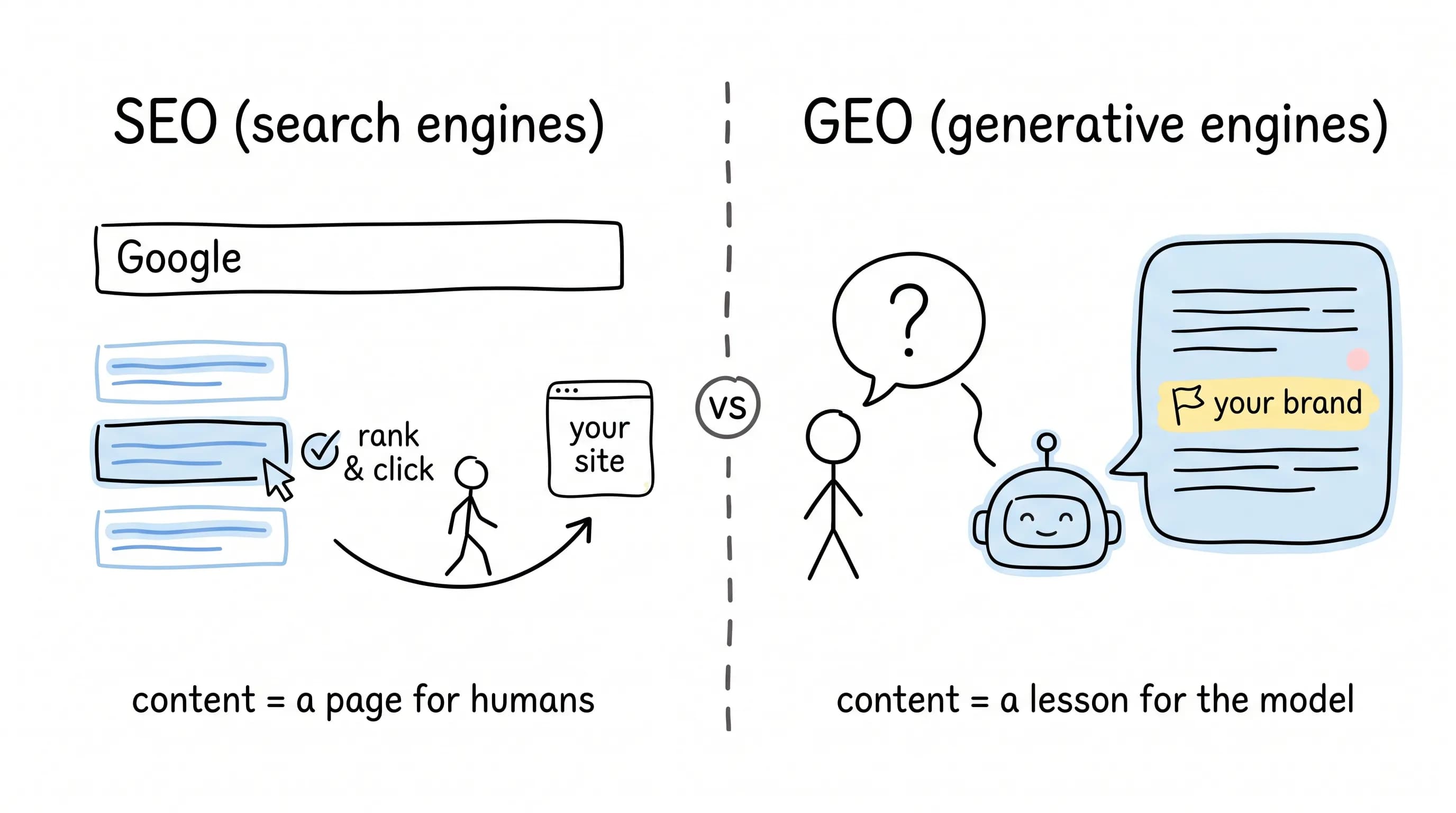
Does AI Know Your Brand? A Look at GEO, the New Craft
An explainer on GEO (Generative Engine Optimization): how AI engines like ChatGPT, Perplexity, and Gemini differ, how GEO goals and metrics diverge from SEO, and which SEO skills still carry over.
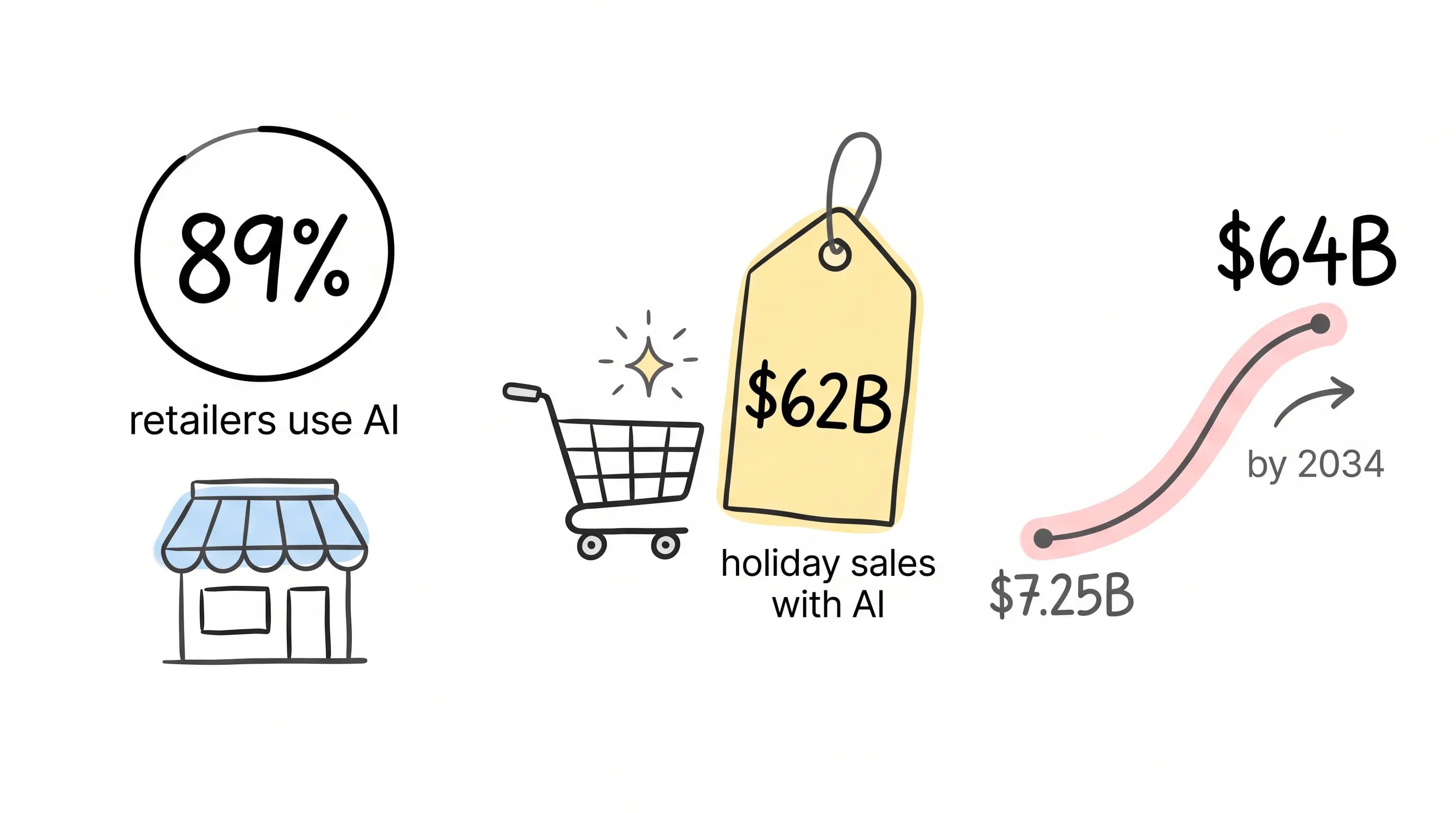
89% of Retailers Are Already Using AI. The Playbook for E-Commerce Has Changed
A learn article on AI in e-commerce: adoption context, use cases from recommendations, search, dynamic pricing, customer service, inventory, and fraud control, plus B2B applications, generative AI content, tool examples, pitfalls, and a six-step adoption path.
AI Makes Content at Lightning Speed — But Can You Answer "Who Approved This?"
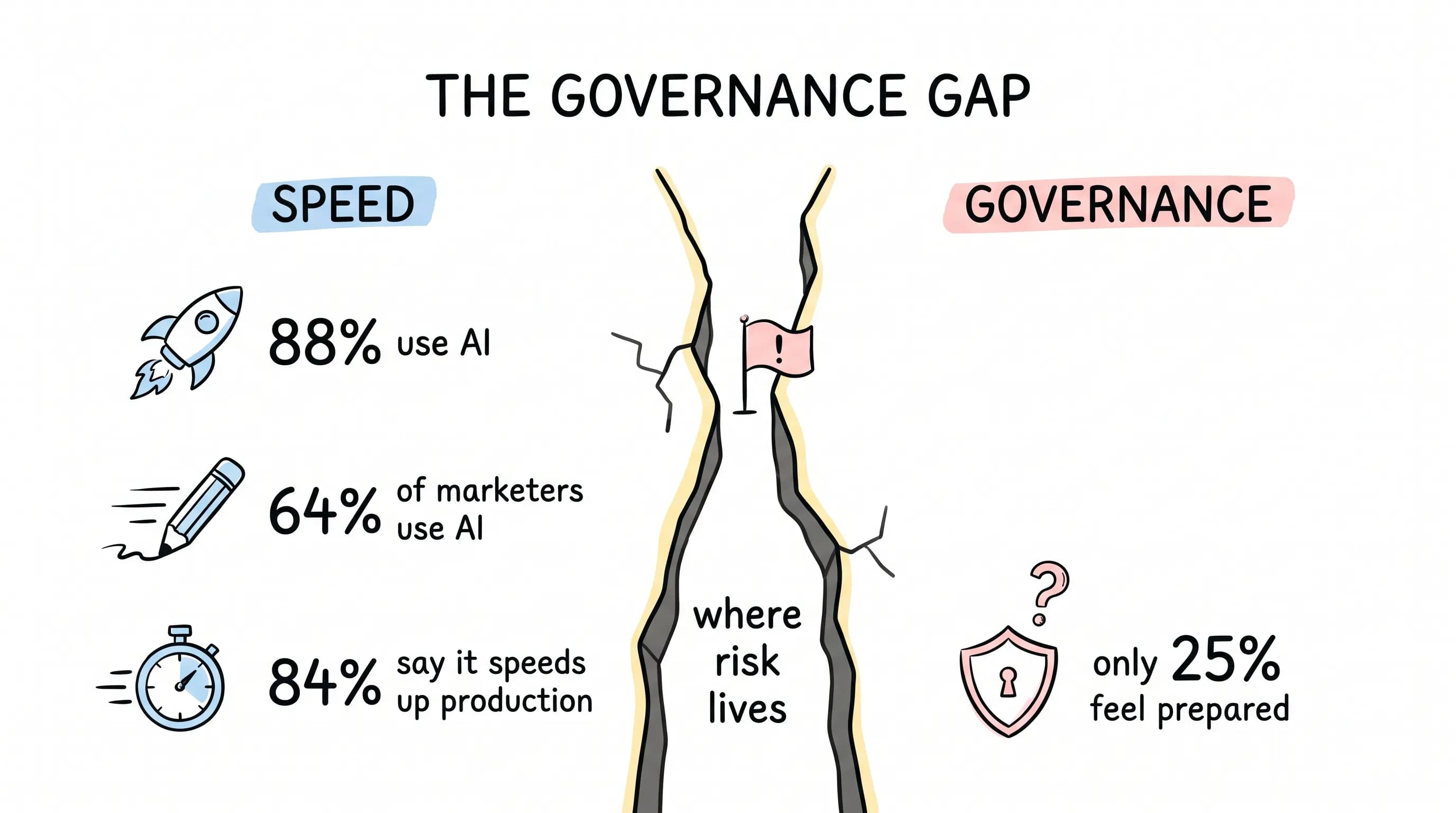
This article looks at the gap between AI content speed and governance readiness in marketing teams, and outlines nine control points — prompt validation, brand guardrails, permissions, approval workflows, human review, versioning, IP checks, audit trails, and asset reuse — for brand-safe AI content.