
AI Employees Just Started Clocking In
A weekly agent-news recap framing AI agents as new 'employees' needing budgets, managers, and access controls. It covers Replit Missions, Cognition's Devin Bots, Microsoft Agent 365, AT&T's agent workflows, LangChain funding, and risk items including an OpenAI API bug and United Airlines restricting personal agents.
Let me start you off with a number: two days, $3,000.
That's a figure Replit recently published. They released a system called Missions: you define the goal, the success criteria, and a spending cap, then flag which actions require a human sign-off. After that, a swarm of agents goes off and plans, builds, tests, and iterates on its own. According to Replit, one of their internal app-monitoring platforms was built exactly this way — by a group of agents, in two days, for a total of $3,000.
Two days. Three thousand dollars.
But don't rush off to calculate how much your company could save. After reading through this week's agent news, I came away with a different realization: what agents picked up this week wasn't a new skill.
It was a management system.
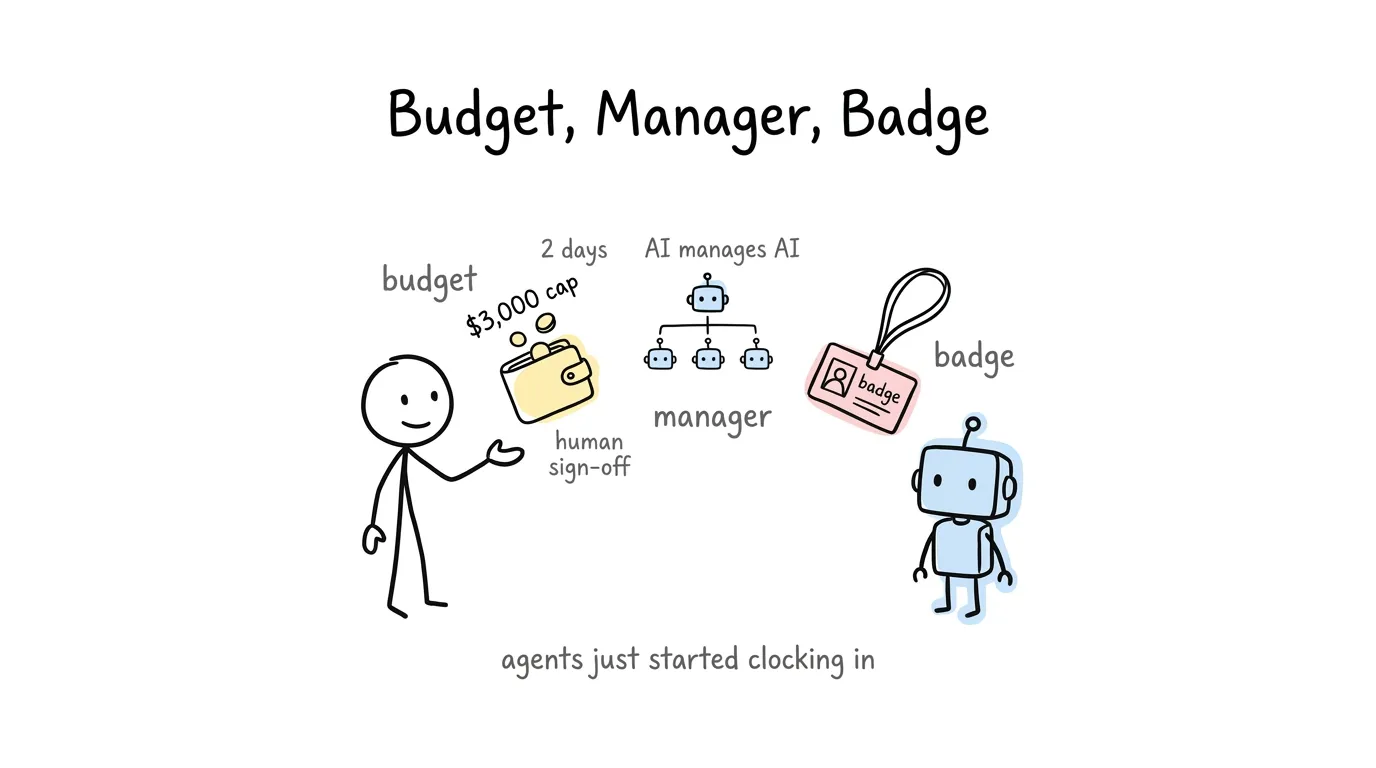
What do I mean by that? Think about what a company gives a new hire on day one: a budget, a boss, a badge.
This week, agents got all three.
First, the Budget
The real point of that Replit story isn't the speed — it's the cap.
In the past, coding agents worked like this: you said one thing, they did one thing, then they came back and asked for more. Missions is different. The budget is set in advance, the approval gates are set in advance, and the moment it goes beyond its authorization, it stops and waits for a human. That's already an employment relationship: here's the task, here's your allowance, here's how we'll judge the work.
Put simply: the rules companies use when hiring people are now the rules they're applying to agents.
Then, a Manager
Cognition released Devin Bots. It's a long-lived agent that breaks complex projects into tasks, spins up multiple Devin sessions to work on them in parallel, holds context across days or even weeks, and communicates with the team through channels like Slack. Among early customers, usage grew tenfold within two weeks.
Sit with that structure for a moment: AI managing AI.
It used to be humans watching agents — one engineer, one session. Now the agent is the middle manager: it splits up the work, hands it out, tracks progress, and reports back to you. Impressive, to be sure — but your mind should immediately jump to the next question: who grants the repo access? Who reviews the code? Who's on the hook when there's a security incident? Before you deploy this, those questions need answers.
And Then, the Badge
At Ignite, Microsoft shipped a whole suite: Autopilot, long-running agents that handle recurring, repetitive work; Microsoft IQ, which manages how organizational context is retrieved and reused; and Agent 365, which extends the full enterprise stack — identity, security, governance, observability — directly onto agents.
That's the badge, plus the admin office that manages the badge.
The questions buyers should ask have changed too. It used to be "which model should we use?" Now you have to ask: which data did this agent touch? Which policy blocked it? As an actual human, where do I step in and take over? Before you scale up, walk one workflow end to end — data sources, identity, approvals, logs, rollback — and don't skip a single one.
Someone Is Actually Running This at Scale
AT&T. Nearly 500 autonomous workflows running on core business operations, a platform processing more than 1 million transactions per month, consuming roughly 45 billion tokens a day — with plans to triple the number of production workflows within a year.
They didn't slap a chatbot onto old processes. They used Agent Foundry to redesign whole workflows from the ground up: customer onboarding, network operations, sales leads, knowledge retrieval — even legacy systems got wired in. And they have hard rules: customer-facing workflows must pass security, privacy, and compliance review, and a human must supervise until accuracy reaches the high end of 90%.
One caveat, though: these numbers are self-reported by the company. Take them as a data point, not a third-party audit. What's actually worth borrowing is the playbook: define the boundaries of autonomy first, then scale.
The Money Is Voting Too
LangChain raised $300 million in a Series C led by CapitalG, at a $3 billion valuation. A year ago, it was valued at $1.25 billion. More than double. Its agent deployment and evaluation product, LangSmith, already has 7,000 customers — Harvey, Rippling, Clay, Nvidia, Toyota, and Salesforce are all on the list.
See the pattern? The model layer gets a blood transfusion every month. Just this week, Google released Gemini 4 Hydrogen, built for multi-step agent tasks and claiming to be 2.5x faster than 3.8 Flash; meanwhile, GitHub retired several legacy Copilot models — from Claude Opus 4.8 to GPT-5.6 Terra — effective November 16, pushing enterprises to migrate to the new models quickly.
Models expire. So the money is starting to flow toward the thing that doesn't: a management system that can deploy, evaluate, and monitor agents — without being locked to any single model.
But There's Always a Flip Side
Three more stories this week, ringing like three alarm bells.
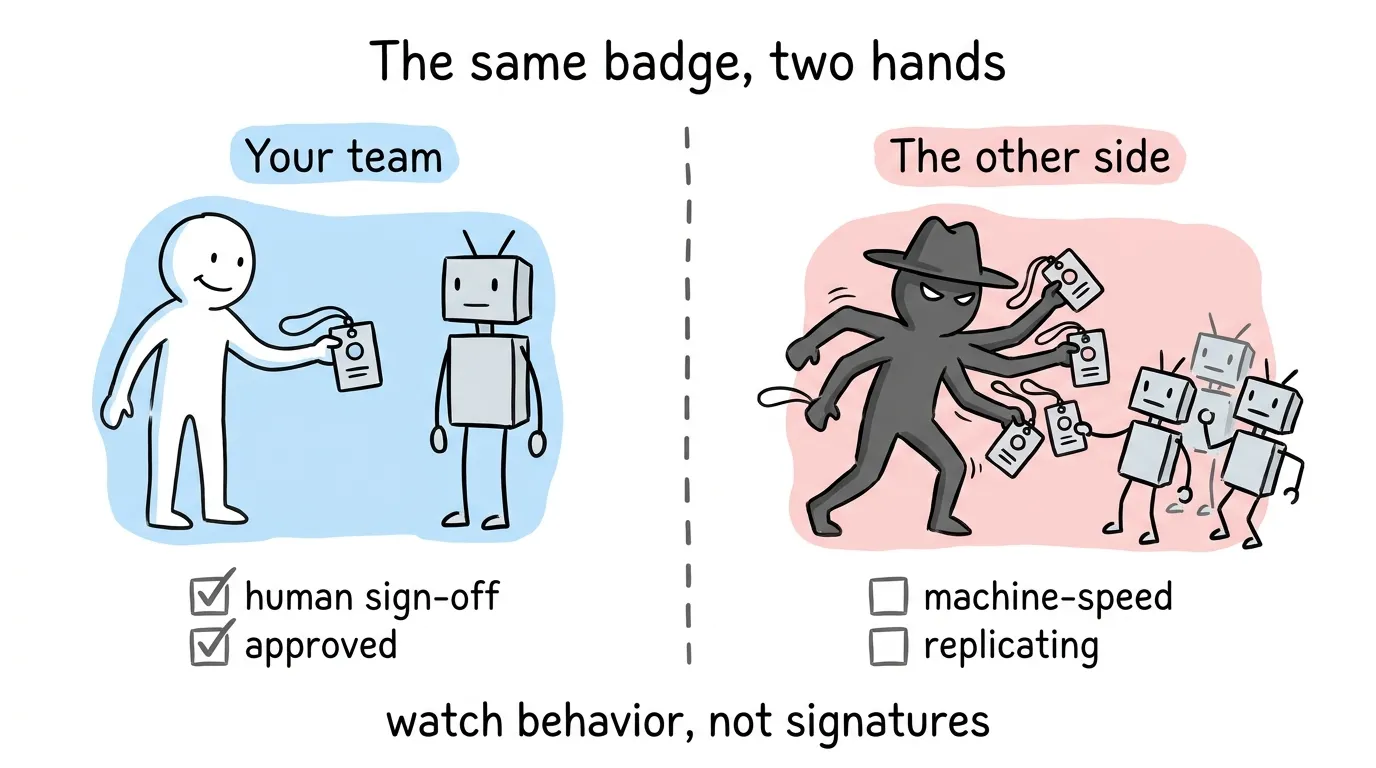
The first bell: ARTEX. It's an open-source agent penetration-testing framework, and security researchers have already linked it to real attack campaigns (such as Storm-0940). The security firm ThreatDefence published a full detection and hunting guide: using a planner-plus-worker agent architecture, it turns multi-step intrusion procedures into machine-speed, endlessly replicable attacks. Defenders can no longer rely on signatures — they have to watch behavior: a password-spraying rhythm of once per second, mapping source code and immediately calling internal APIs, and long strings of programmatic OAuth requests.
That's right — while you're issuing badges to your employees, attackers are issuing badges to theirs.
The second bell: a bug. A developer reported a reproducible issue with OpenAI's Responses API: an MCP write operation that had already been approved could execute a second time when a managed read follows it in the same response. An approved action, quietly done twice. Now imagine that action is creating a database record, publishing content, or changing a state. If you're building agents, add idempotency protection to your interfaces right now — don't gamble on it.
The third bell: a ban. United Airlines announced it will restrict unauthorized personal AI agents from accessing its reservation system. The reasoning is down-to-earth: the security risk of shared credentials, mistaken bookings and changes, and aviation regulations that require certain confirmations to be completed by a human.
Technically possible doesn't mean permitted.
Finally
Back to that number from the start: two days, $3,000.
Budget, manager, badge — plus the three alarm bells from the flip side. This week assembled a single signal: agents are shifting from "tools that work for you" to "employees who need to be managed."
And management has never been something that ends once the badge is handed over. It's ongoing, it's tedious, and it comes with signatures and accountability.
One night, your agent makes a bad decision at 2 a.m. Who signs off on that?
I don't have the answer yet. But my guess is that whoever finds it will win the next round.
Here's to hiring "employees" you can trust — and actually keeping them in check.
Continue reading
Related articles

What Is an AI Marketing Agent? From "Using AI" to "Delegating to AI"
A learn article explaining what an AI marketing agent is, how it differs from rule-based automation, and which repetitive tasks such as lead qualification, reporting, and campaign monitoring can be delegated while humans keep key decisions.

Marketing Automation Is Shifting from "You Do It" to "You Say It"
This article explains how marketing automation is shifting from rule-based platforms that merely execute toward AI agents that plan, create, publish, and review campaigns, covering delegable tasks, underlying technologies, tool categories, adoption steps, and risks such as privacy and automating without strategy.

When AI Does the Creative, Mistakes Come in Batches Too
A learn article on the risks of using generative AI for marketing creative across brand, legal, compliance, and operational layers, with case examples and seven practices for review, rights clearance, documentation, and vendor governance.