
AI Can Mass-Produce Promises. It Cannot Mass-Produce Trust.
An essay arguing that AI can scale marketing promises but not customer trust, introducing the concept of trust debt and outlining rules for responsible AI-driven marketing.
Let me start with a story.
Many years ago, I worked in entertainment marketing, helping to run a convention called KCON. That year, it was only in its second edition.
What does year two mean? It means that everyone's trust in you is still running a deficit.
Fans had to believe we could really bring in the artists they wanted to see — that the ticket would be worth every penny.
Sponsors had to believe this was a platform that could deliver real returns, not a vanity project.
Exhibitors had to believe that next year would be worth the trip back.
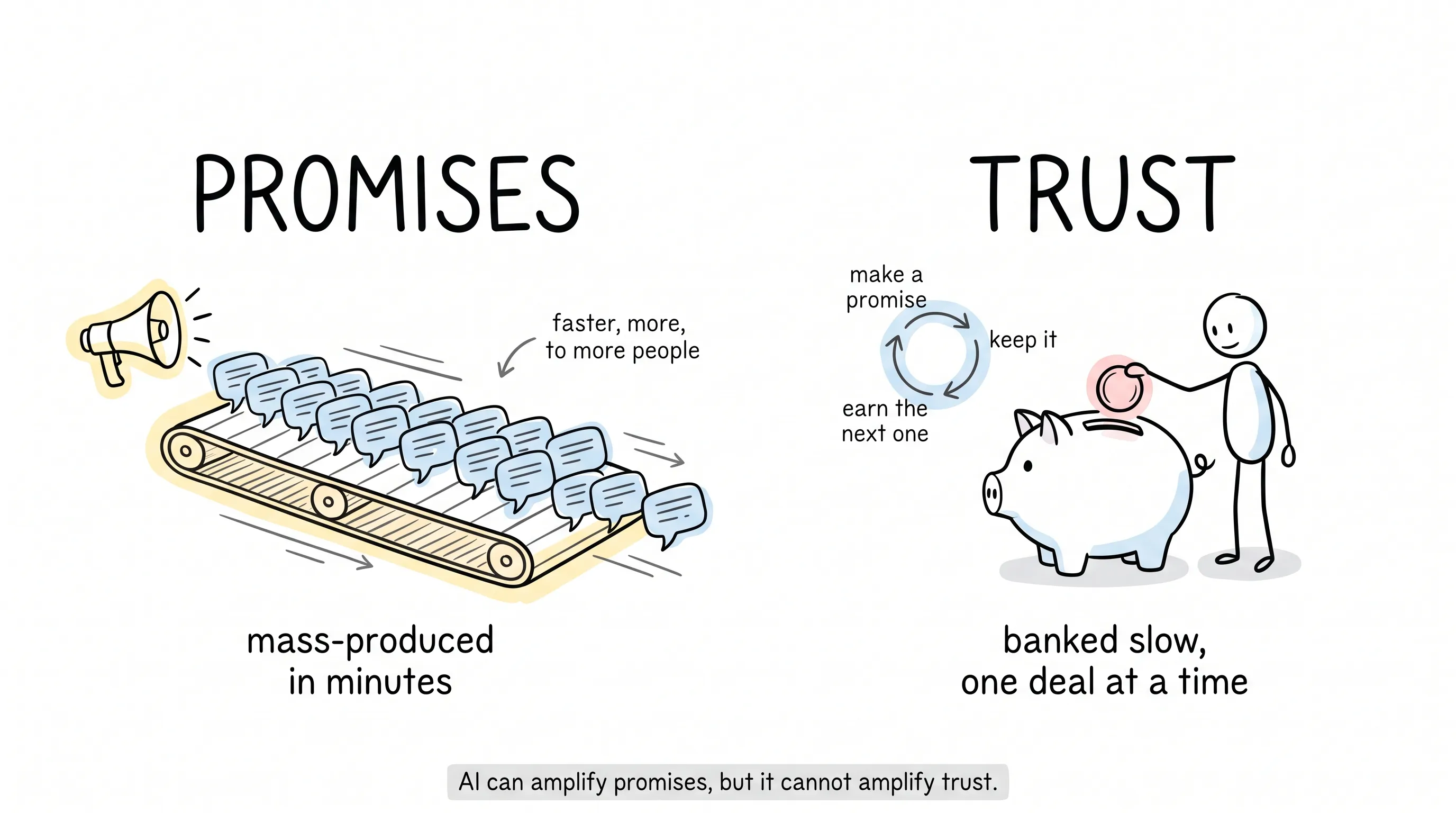
Not one of these three kinds of trust could be bought with money. All three were banked the same unglamorous way, one deal at a time: make a promise, keep it — and only then do you earn the right to make the next one.
In those years, one line stuck with me:
Attention can be manufactured fast; trust can only be banked slow.
AI Turned "Promising" Into an Assembly Line
Set that story against today, and you can see the real change AI has brought to marketing.
What can AI do now? Write emails, summarize research, personalize landing pages, generate ten versions of campaign creative in one go. Work that used to keep a team busy for hours, it turns in within minutes.
But there is one thing it cannot do:
Make your customers believe that this company understands them, does what it says, and owns its mistakes when something goes wrong.
That's right. AI can amplify your promises, but it cannot amplify your trust.
A while back, I attended a Bloomberg tech event. Onstage and off, everyone was talking about how to move AI from pilots into real business. But what stuck with me most was a seemingly contradictory pattern:
On one side, companies are pouring money into ever more complex AI. On the other side, the very same companies are still investing heavily in physical spaces, in face-to-face connection between people.
What for?
Now I understand them completely. Trust is something people need to see with their own eyes and touch with their own hands before they know what a brand is really made of. That part, you can't buy with money, and AI can't conjure it either.
What Is Trust Debt?
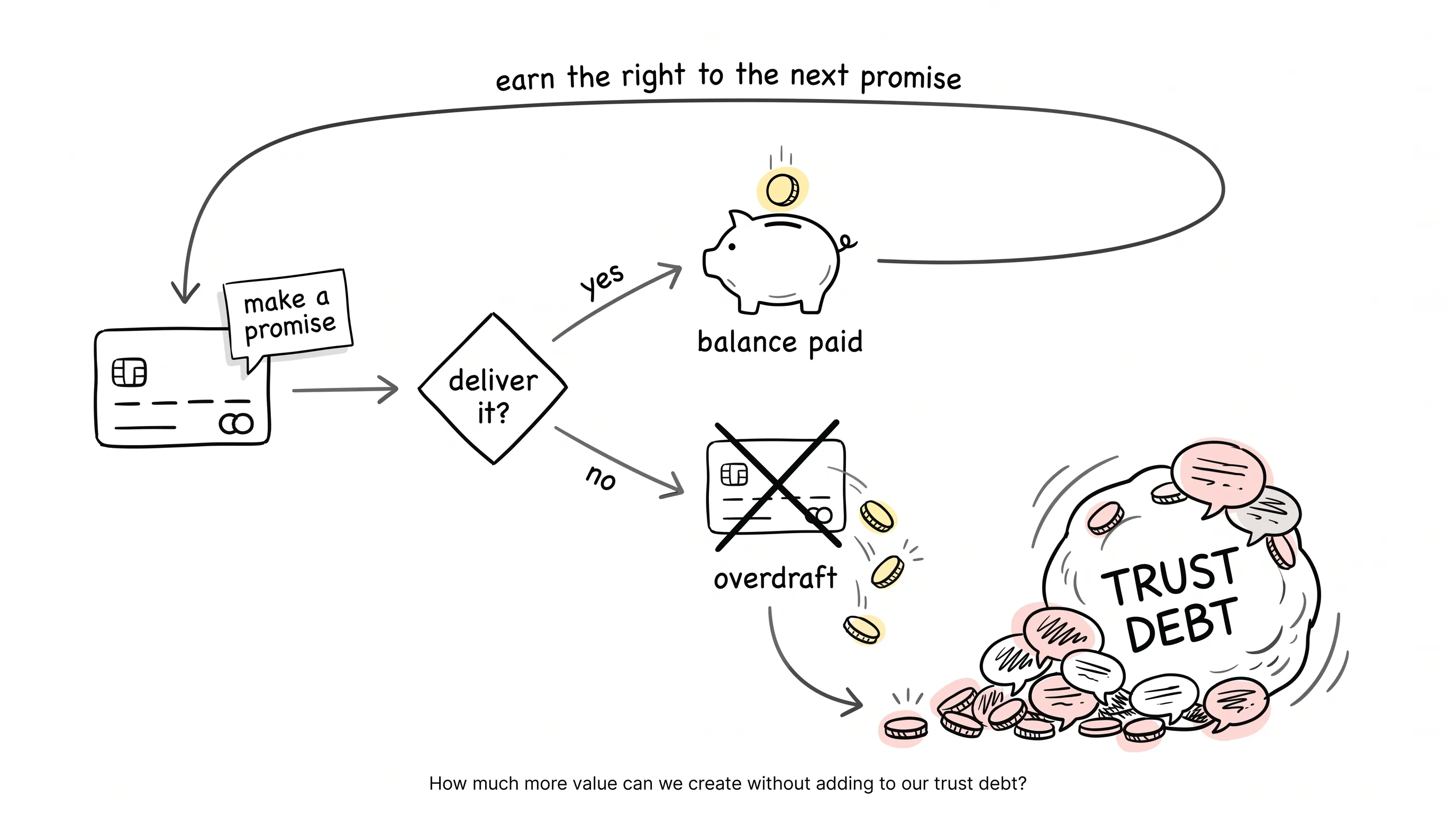
Every promise made by marketing is like a swipe of the credit card. Whether that balance gets paid off on time, or keeps snowballing, depends on whether the whole organization behind it can deliver. Pile up the overdrafts, and that is what I call trust debt.
Today I serve as global CMO of a fairly strong services company. My job has never been to produce a few more pieces of content; it is to keep brand equity, partnerships, and customer perception in step with how strong the business already is.
In building brands, we come back again and again to the same line: marketing by itself cannot manufacture trust. Marketing's job is to say the words out loud; whether those words survive in the real world or shatter on the spot depends on the delivery of the whole organization.
And AI is pulling the distance between "saying it" and "doing it" wider and wider.
Publishing more content, adding more personalization, automating more conversations — all of it has become too easy. But if the experience behind these words is uneven, what AI amplifies is exactly that unevenness.
Picture this scenario: we build a beautiful campaign around "the value of global talent," and a client is moved and comes knocking. That's the moment the real test begins. Does the person sitting down to talk understand the workforce problems behind the client's business? Can the service experience keep up with the publicity?
If it can't, that gap is debt. No amount of content can fill it.
So the question executives should really ask comes down to a single line:
How much more value can we create without adding to our trust debt?
Frequency Doesn't Buy a Relationship
After AI drove the cost of making promises down to the floor, many brands' first instinct was: say more.
So the promotions get denser, the emails pile higher, the automated conversations run longer. And on the customer's side?
Adobe published a survey in 2026: 45% of consumers said that as long as promotions come too thick and fast, even when the content itself is relevant, they will simply tune the brand out.
Round it up: nearly one in every two customers.
Stings, doesn't it? Even useful information, delivered too often, becomes an intrusion.
So what should AI actually do in marketing? Take over every task that doesn't need human judgment. Free people's hands to do the things only people can do: solving complex problems, understanding specific situations, making judgment calls, building relationships.
AI's greatest value is that it makes interactions that feel human genuinely feasible for the first time.
There's No Column for Trust on the Dashboard
Which raises the question: can trust actually be measured on a dashboard?
It can't. What most dashboards measure is "how much it cost to win a sliver of attention this time." They cannot measure the other thing: whether the next time becomes easier.
So you have to look for evidence elsewhere. I usually look at two places.
The first: recently closed deals. In the follow-up, how many rounds did you have to chase? Did the customer come back with serious questions, or did you have to push at every step? Did they pull other decision-makers into the conversation?
Pure persistence can still land a signature. But trust can spare you a lot of rounds. When marketing has already built credibility, sales can sit down and go straight to the business problems; when it hasn't, sales has to re-prove promises the customer has already seen once. That's where the time all burns.
The second: the shape of demand. Paid budgets climb year after year, but the volume of interest they buy stays flat; branded search, direct visits, referrals, repeat purchases — all perfectly still. What does that tell you? You are buying transactions, not building preference.
Not one of these metrics can measure trust with precision. But together, they answer a question far more useful than clicks and conversions:
Is our marketing making the next deal cheaper, or more expensive?
Four Rules That Come Before Output
If you accept this standard, then here are four rules I would put ahead of output volume.
First: before you publish, find your reason. Every piece of content should aim at a real customer pain point. AI's output has no upper limit; customer attention does, and it is pitifully small: put promotional content in front of someone, and they give it five seconds. Five seconds isn't even enough to finish an opening line. Content with no reason to exist is worth zero, no matter how much of it you produce.
Second: the best material is hidden inside your own company. The lost-deal post-mortems, the customer complaints, the hard-to-answer questions, the strange requests. The lessons grown out of these experiences are the one thing others cannot copy. AI can help you dig the experience out and make sense of it, but it cannot substitute for the days that created those experiences.
Third: every message sent out must have a living person responsible for it. The worst part of automation is how it dilutes responsibility. Any customer-facing message must, in the end, trace back to a specific person or team: Is it accurate? Does it match what we can actually deliver?
Fourth: before you promise, run the stress test. Think of the most uncomfortable kind of week: people pulled away, emergencies arriving in clusters, complaints queuing up. In that kind of moment, can you still deliver the line in your ad exactly as written? If yes, say it. If you can't be fully confident, then choose one of two: change the marketing, or fix the experience behind the marketing. You must choose one.
Finally
The trust around KCON back then was built exactly like this, one promise at a time.
Today, AI has handed the ability to promise "faster, more, to more people" to every one of your competitors.
The ability to deliver, it handed to no one.
That part, you still have to earn yourself, with your own two hands.
May every promise you make be backed by enough trust to hold it.
Continue reading
Related articles
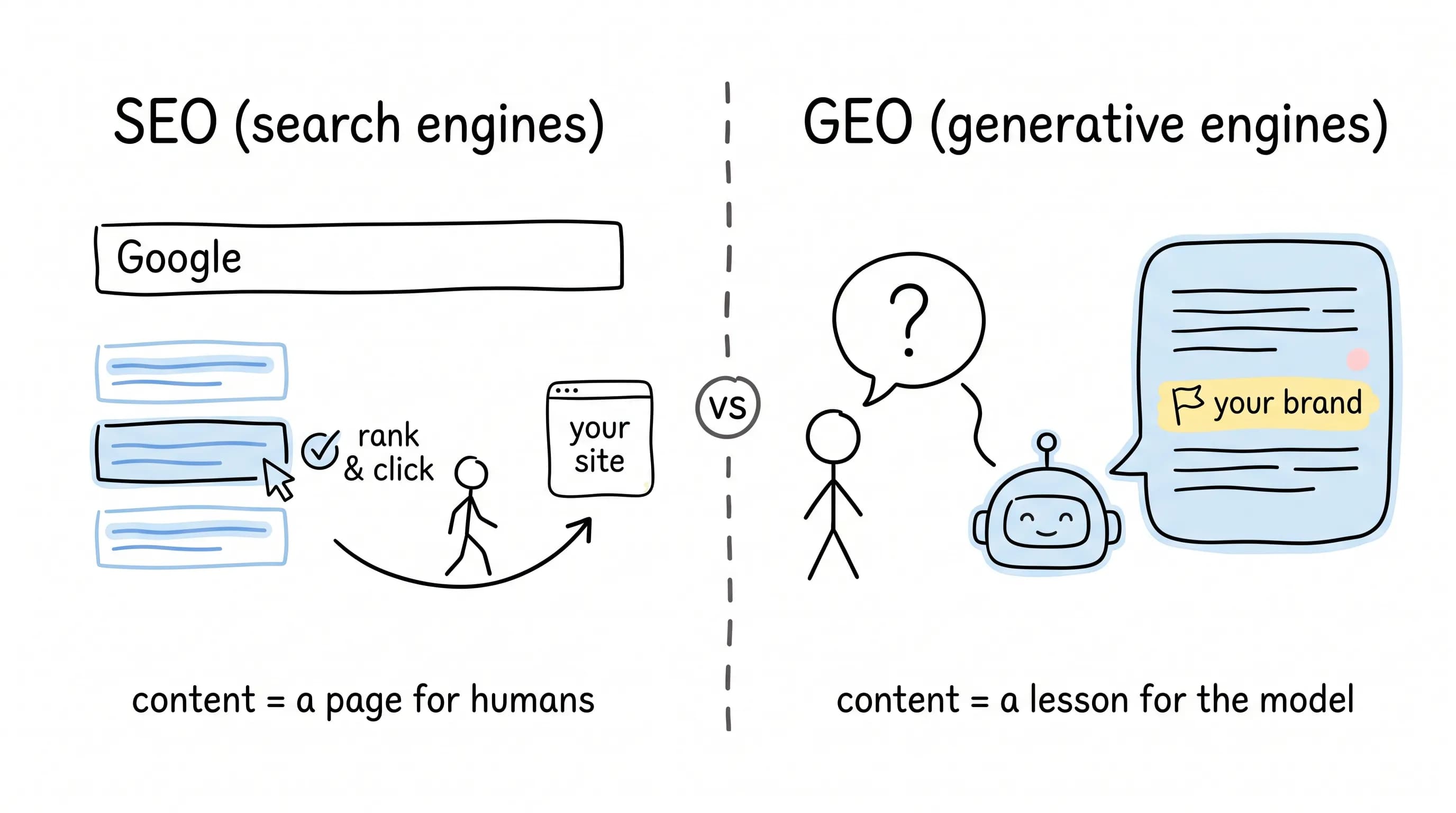
Does AI Know Your Brand? A Look at GEO, the New Craft
An explainer on GEO (Generative Engine Optimization): how AI engines like ChatGPT, Perplexity, and Gemini differ, how GEO goals and metrics diverge from SEO, and which SEO skills still carry over.
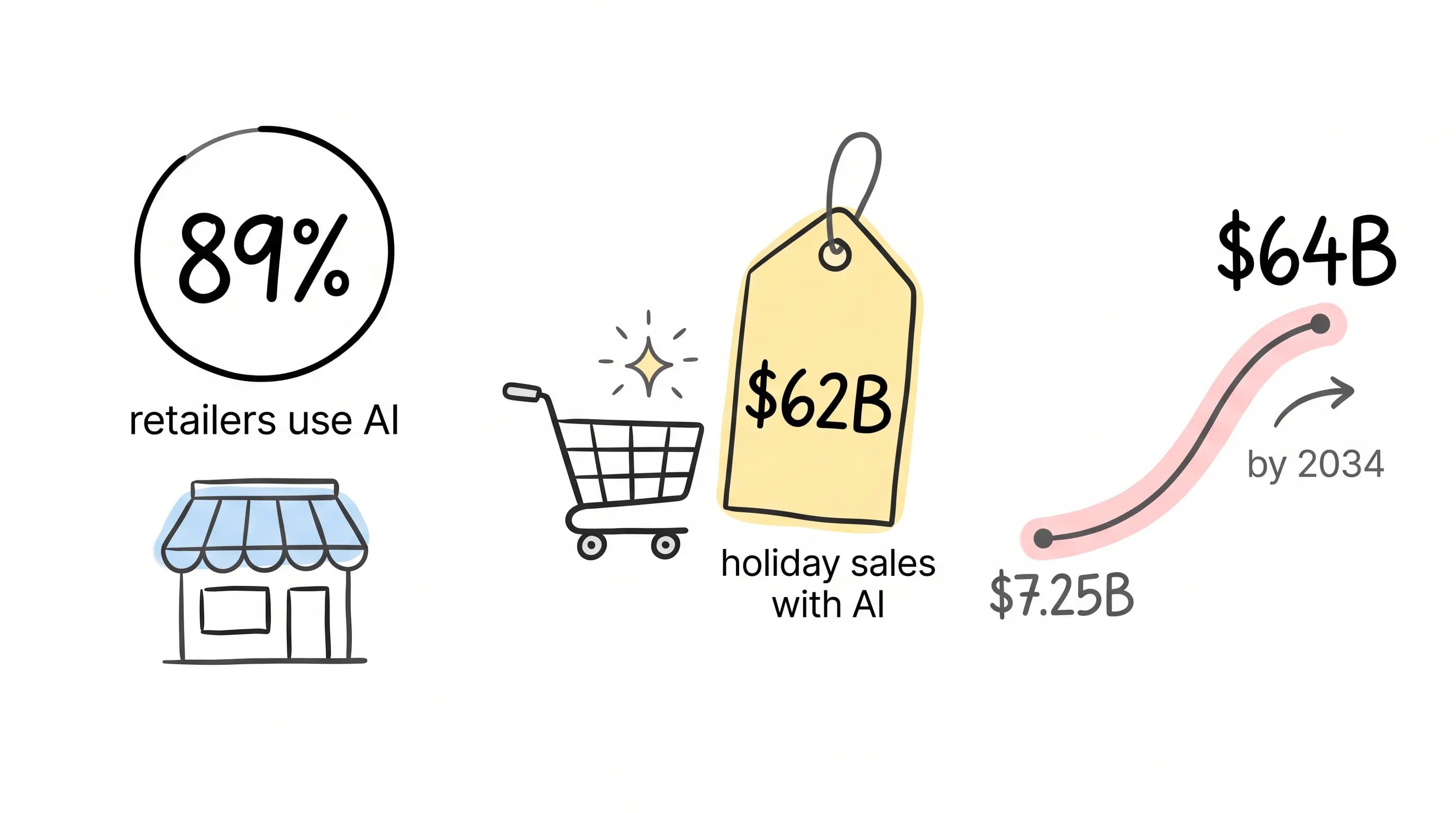
89% of Retailers Are Already Using AI. The Playbook for E-Commerce Has Changed
A learn article on AI in e-commerce: adoption context, use cases from recommendations, search, dynamic pricing, customer service, inventory, and fraud control, plus B2B applications, generative AI content, tool examples, pitfalls, and a six-step adoption path.
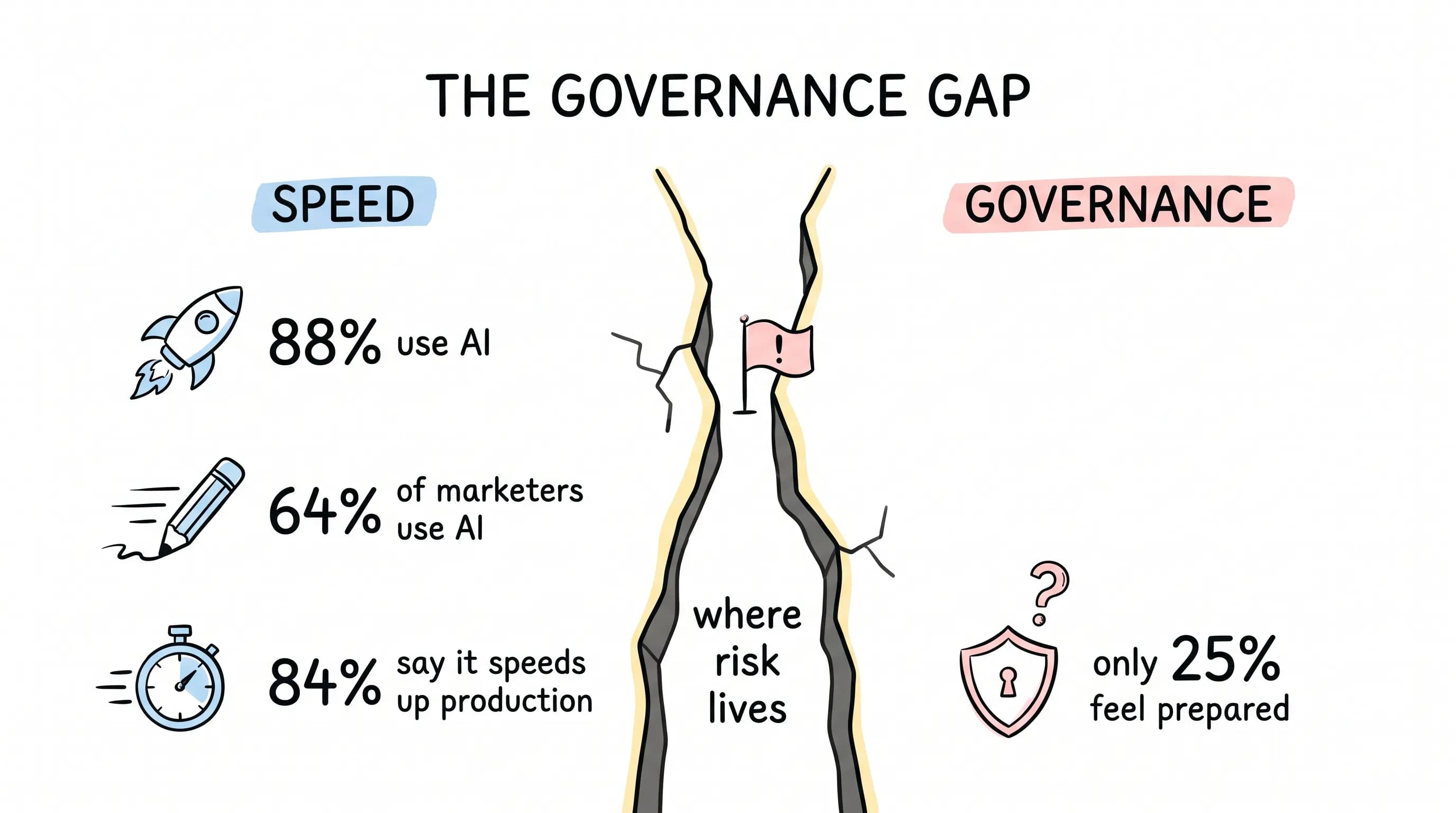
AI Makes Content at Lightning Speed — But Can You Answer "Who Approved This?"
This article looks at the gap between AI content speed and governance readiness in marketing teams, and outlines nine control points — prompt validation, brand guardrails, permissions, approval workflows, human review, versioning, IP checks, audit trails, and asset reuse — for brand-safe AI content.