
AI Ads Have No Soul? 98% of Marketing Leaders Are Planning to Spend More Anyway
This article reviews a Canva survey on AI in advertising, where most UK marketing leaders plan to increase AI spending while many consumers say AI-generated ads feel soulless. It argues that human judgment and taste should stay central to creative decisions.
A couple of days ago, I had dinner with a friend who runs an e-commerce business, and the conversation drifted to his company's ad creatives. They're almost entirely AI-generated now, he said — a hundred-plus images a night, at a cost that's practically zero.
So how are they performing? I asked.
He paused for a beat. "The click numbers are fine. It's just… something feels off about them. I can't put my finger on what."
On the way home, I happened to come across a survey Canva published this May. By the time I finished reading, I wanted to call him: that "something off" you can't name? It's not your imagination — thousands of British consumers have already confirmed it for you.
It's a substantial piece of research. Canva surveyed more than 1,400 marketing leaders and over 3,500 everyday consumers across seven countries. The UK sample alone covered 200 marketing leaders and 509 consumers.
Start with the marketing side. The numbers are startling.
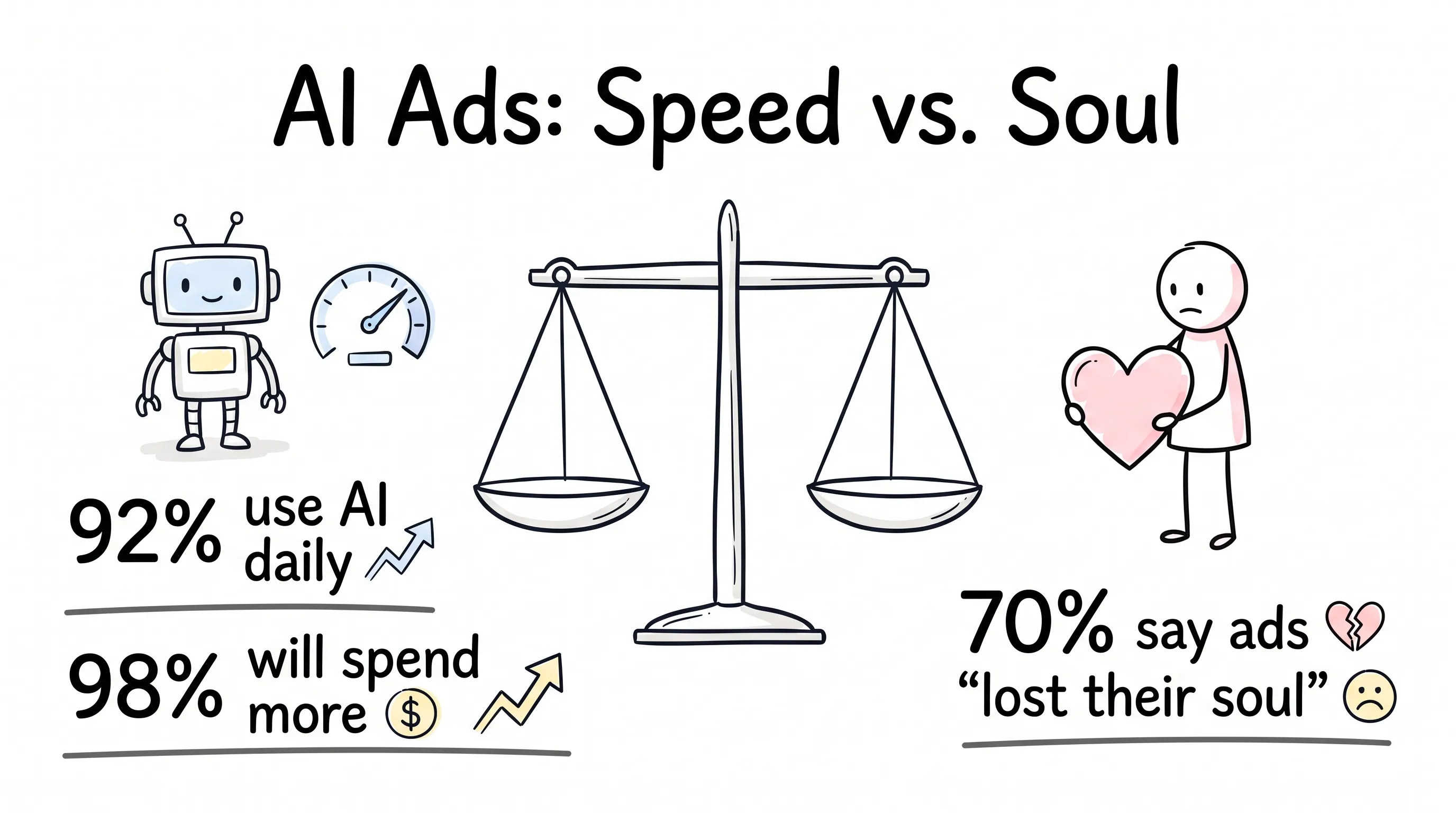
Among the UK marketing leaders surveyed, 92% said their teams already use AI in their day-to-day creative work. And 98% plan to spend even more on it.
Ninety-eight percent. Let that sink in — that's virtually everyone.
You'd think people are just using AI as a gofer of an assistant. It goes deeper. More than half of the leaders said AI plays the role of a "director" on their teams. Another 31% called it a "collaborator".
From assistant to director. That shift in status says AI has moved from being a tool to being a member of the decision-making table.
Now do the math. 94% of leaders said AI saves them at least four hours a week; 28% save more than eight.
Four hours a week is 200 hours a year — roughly 25 full working days. More than a month of one person's work, quietly taken over by AI.
And 63% of leaders said that since adopting AI, marketing now influences more business decisions.
The efficiency gains are real.
But What About the Consumer Side?
71% of UK consumers said they don't mind AI being used in ads — as long as the ads become more useful and more relevant because of it.
Sounds like a happy ending, right?
Not so fast. In the same survey, seven in ten consumers said AI-generated ads have "lost their soul". 64% put it more bluntly: you can spot these ads at a glance, so obviously synthetic it's almost funny.
Ouch. On one side, 92% of leaders charging ahead with AI; on the other, 70% of the audience saying it's soulless. Put those two numbers side by side and you have the most honest picture of marketing's central tension right now.
What's more interesting is that the yardstick consumers use to judge ads has shifted. They don't much care how an ad was made — only whether it feels real.
But touch a red line, and people get firm. 82% said that even if AI could make an ad better, they'd still rather watch one made by humans. 91% said the best ads, in the end, need a human touch. And 72% even said that knowing an ad was made entirely by humans would make them more likely to buy the product.
There's another worry: everything starts looking the same. 76% of UK consumers believe that if this continues, future ads will look increasingly like they came out of the same AI mold. On the marketers' side, 36% admitted that so-called AI slop is already a real problem.
What is AI slop? Content junk mass-produced by AI — obviously fake at a glance, carrying no useful information. Enormous output, rock-bottom quality, like an entire seasoning sachet dumped into one bowl of instant noodles — overwhelmingly salty, hard to swallow.
So What Can't AI Replace?
The leaders' answers were remarkably consistent: empathy and emotional perception, intuition about a brand, creative judgment, and the small imperfections that make a person feel human.
It's precisely those imperfections that make work look human-made.
So don't assume that adopting AI means cutting the creative team. Quite the opposite: 80% of UK marketing leaders expect creative roles to grow over the next five years. The emphasis just shifts — from execution to imagination, judgment, and direction.
Younger audiences are even more relaxed. Among Gen Z and millennials, 72% said what they care about is how an ad feels, not how it was made. Three in four said that as long as real people appear in the ad, they don't mind AI touching up images or adding effects.
But There's One Line That Can't Be Crossed
Personalization.
Nearly one in three UK consumers said that when an ad knows what they're about to buy before they've even searched for it, that's "too much". 63% said outright that they don't want brands using AI to predict what they want.
Picture the scene: a mere thought flashes through your mind, and the ads are already piling up on your phone screen. That's not being thoughtful. That's being creepy.
So what would put consumers at ease? In the survey, more than three in four UK consumers said they'd feel considerably better if companies had formal policies governing how AI is used in advertising.
What people want is refreshingly concrete: protect my data; be upfront when AI was used; promise AI won't take away people's jobs; and give me a switch to turn off AI ads. Most also want privacy controls so they can decide for themselves how much an ad is allowed to "know" about them.
Emma Robinson, who leads B2B marketing at Canva, summed it up well. The question, she said, was never whether AI belongs in marketing, but how to govern it: AI has changed how marketing gets done, but not why marketing works. Speed and scale matter — but on their own, they can't buy trust.
One more finding worth noting: 86% of UK consumers believe that one day no one will be able to tell whether an ad was made by AI — unless the brand says so. Most think that day is just a few years away.
Back to My Friend
That "something off" he couldn't name? Now we can put it into words: the ads got faster, but the soul didn't keep up.
My advice comes down to one line: let AI handle the work of efficiency, and leave the judgment, the taste, and the final call on "does this feel like us" to living, breathing people.
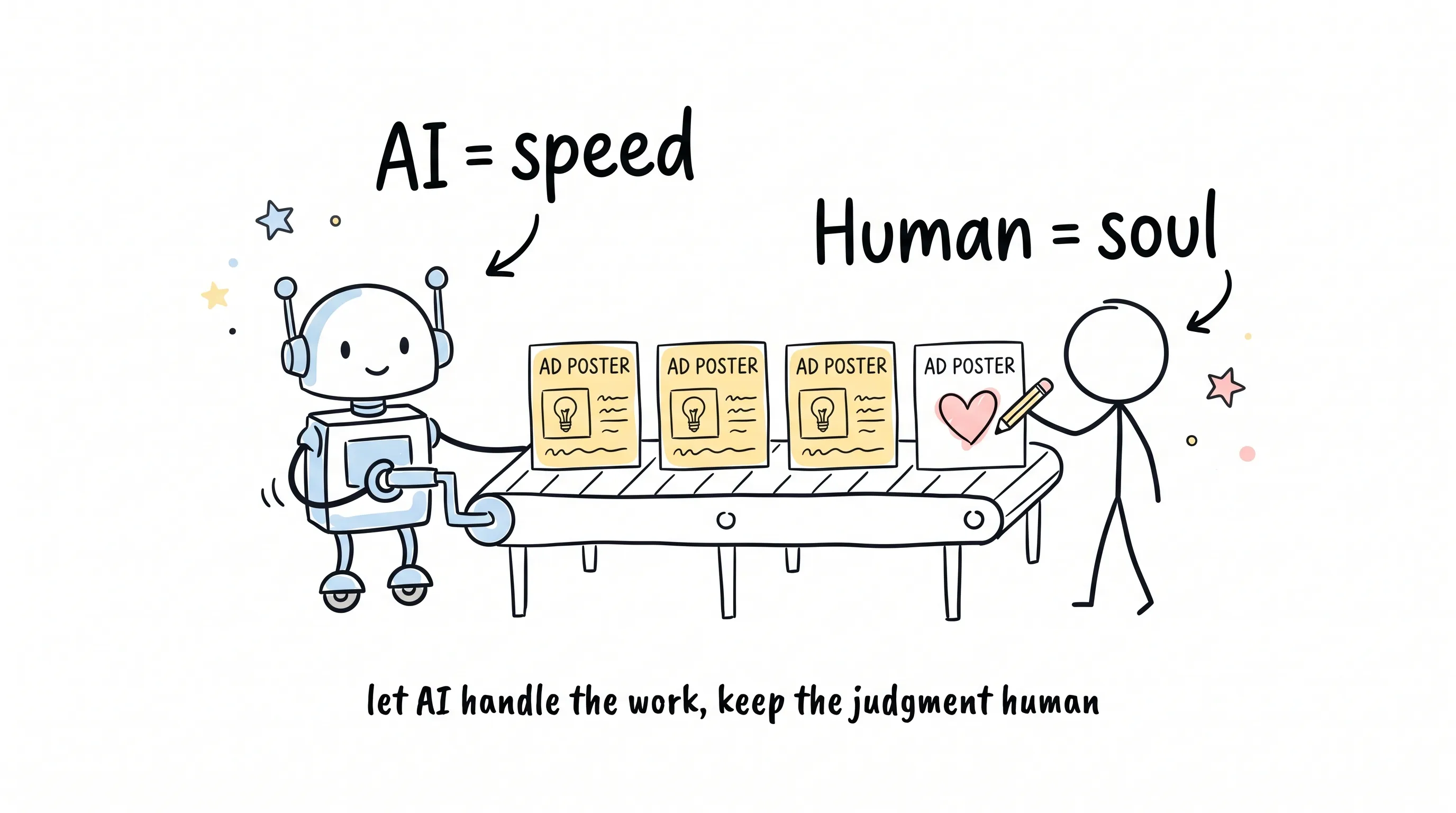
What AI has changed is how ads get made. What it cannot change is what makes an ad move people.
May every ad you make carry AI's speed — and a human's warmth.
Continue reading
Related articles
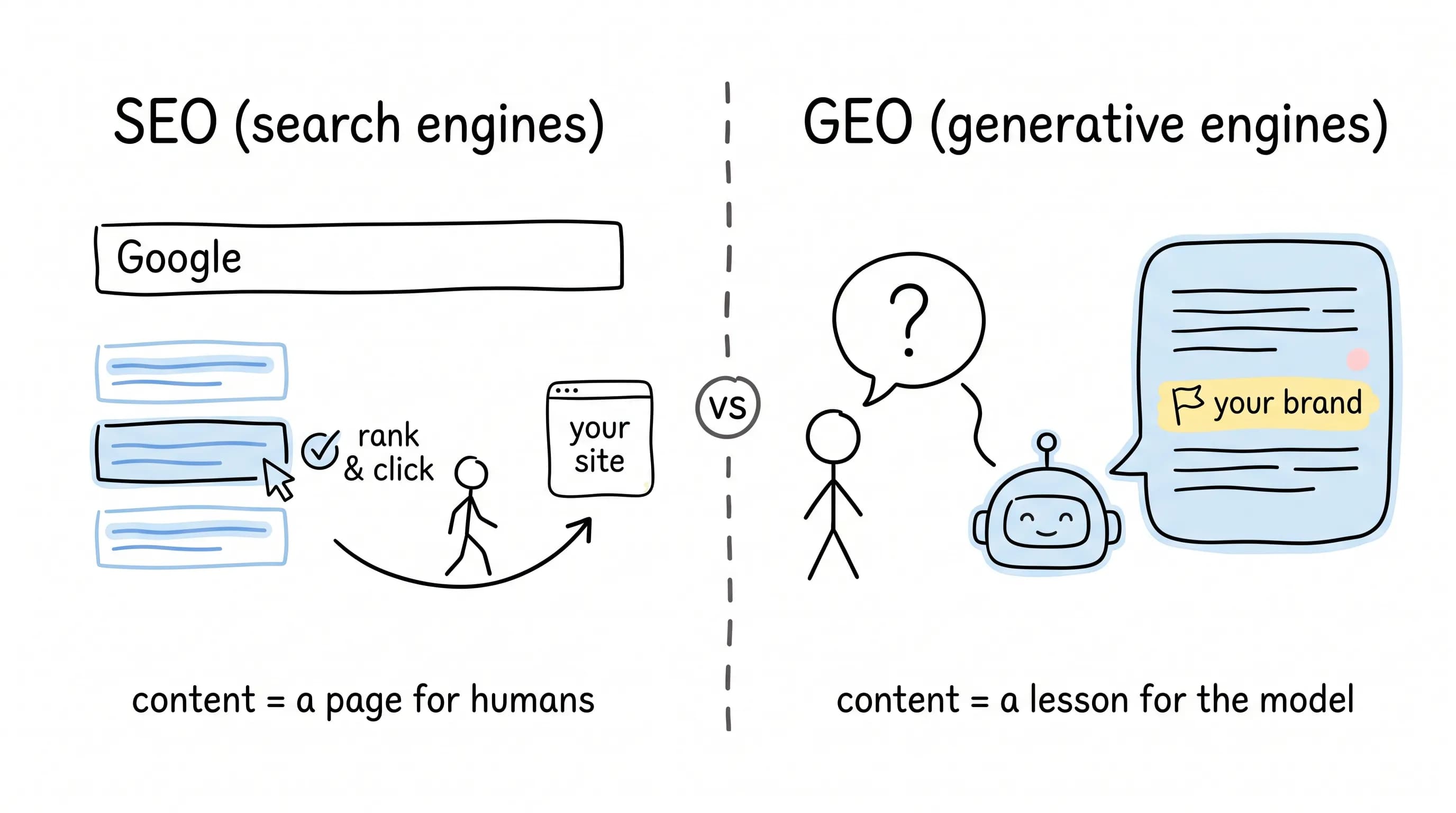
Does AI Know Your Brand? A Look at GEO, the New Craft
An explainer on GEO (Generative Engine Optimization): how AI engines like ChatGPT, Perplexity, and Gemini differ, how GEO goals and metrics diverge from SEO, and which SEO skills still carry over.
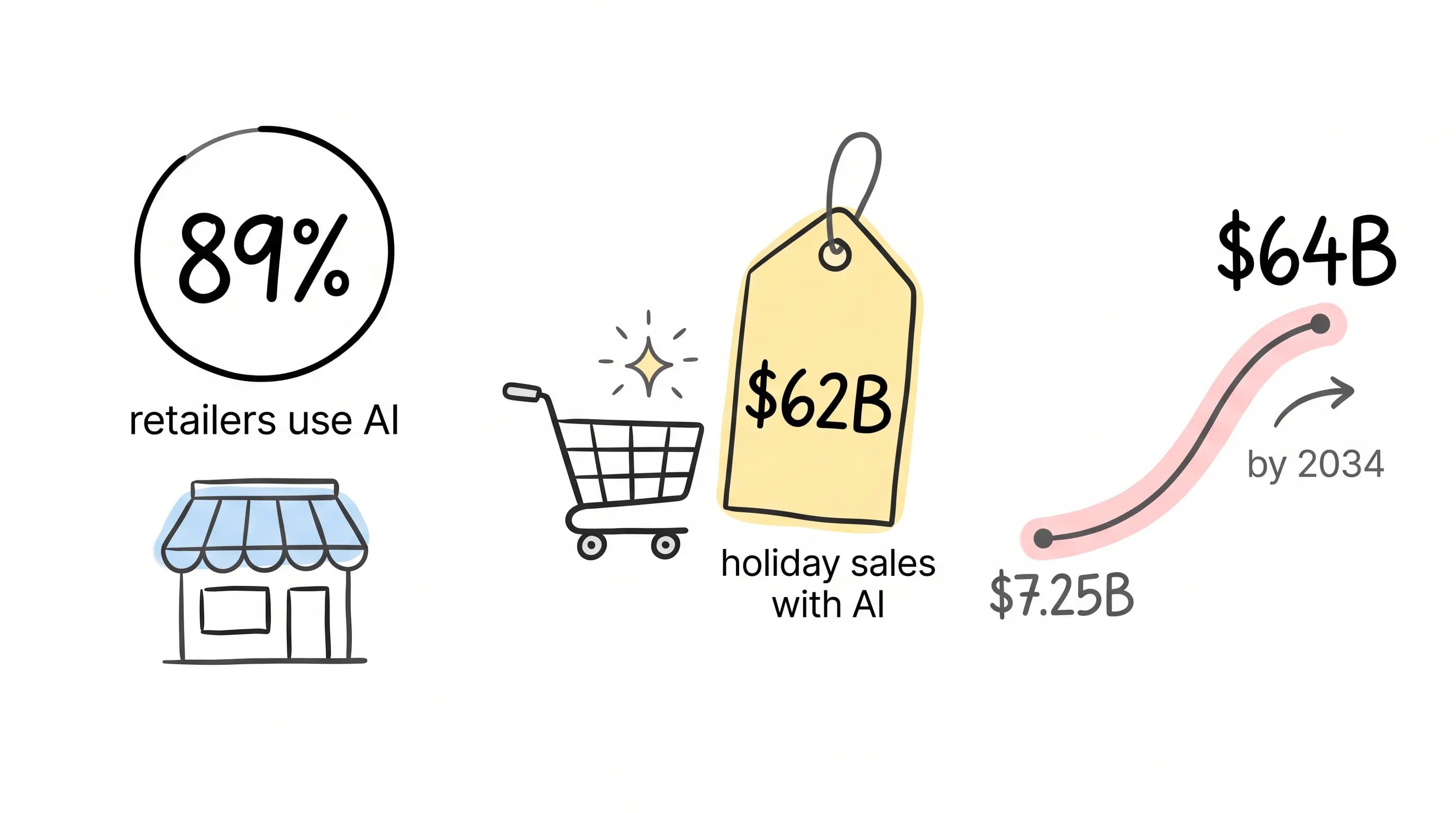
89% of Retailers Are Already Using AI. The Playbook for E-Commerce Has Changed
A learn article on AI in e-commerce: adoption context, use cases from recommendations, search, dynamic pricing, customer service, inventory, and fraud control, plus B2B applications, generative AI content, tool examples, pitfalls, and a six-step adoption path.
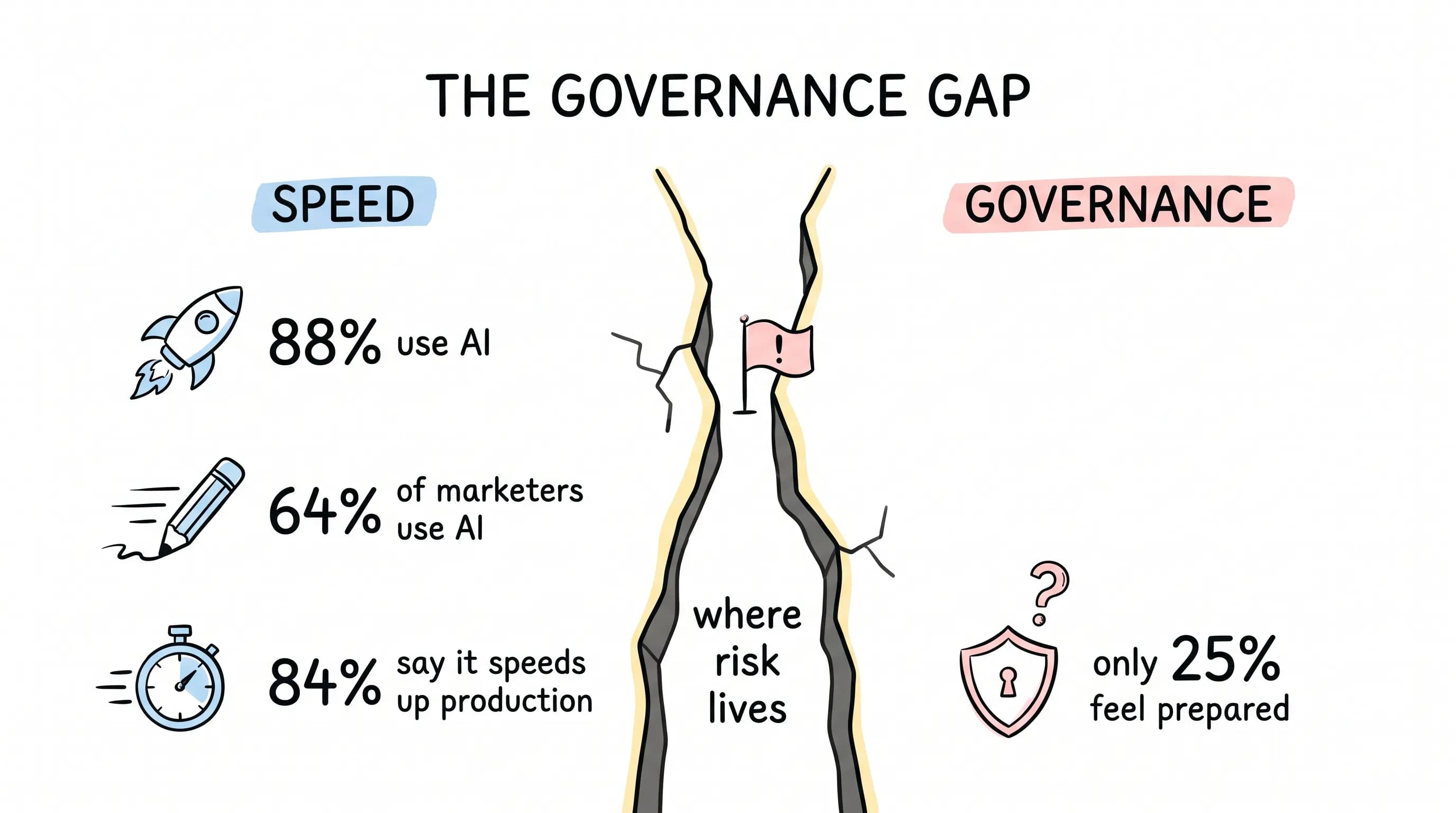
AI Makes Content at Lightning Speed — But Can You Answer "Who Approved This?"
This article looks at the gap between AI content speed and governance readiness in marketing teams, and outlines nine control points — prompt validation, brand guardrails, permissions, approval workflows, human review, versioning, IP checks, audit trails, and asset reuse — for brand-safe AI content.