
After One Conversation About AI Agents, Three of My Assumptions Fell Apart
Three assumptions about AI agents fall apart after one podcast conversation: between hype and satisfaction sits a real climb, customer experience now spans the whole shopping journey, and the answer is in the feedback loop, not the data — plus how agents replace opinions with evidence inside organizations.
A few days ago I listened to a podcast episode. The guest was an Aampe co-founder who now runs the agentic business at MoEngage. The topic: AI agents and customer experience.
Honestly, I clicked play expecting the usual corporate talking points.
By the end, several judgments I'd been taking for granted had been corrected on the spot.
Here are the three most valuable ones.
Assumption One: AI Agents Are Still Just Hype
We've all grown tired of the word "bubble" these past two years. My assumption was no different: a lot of noise, not much delivery.
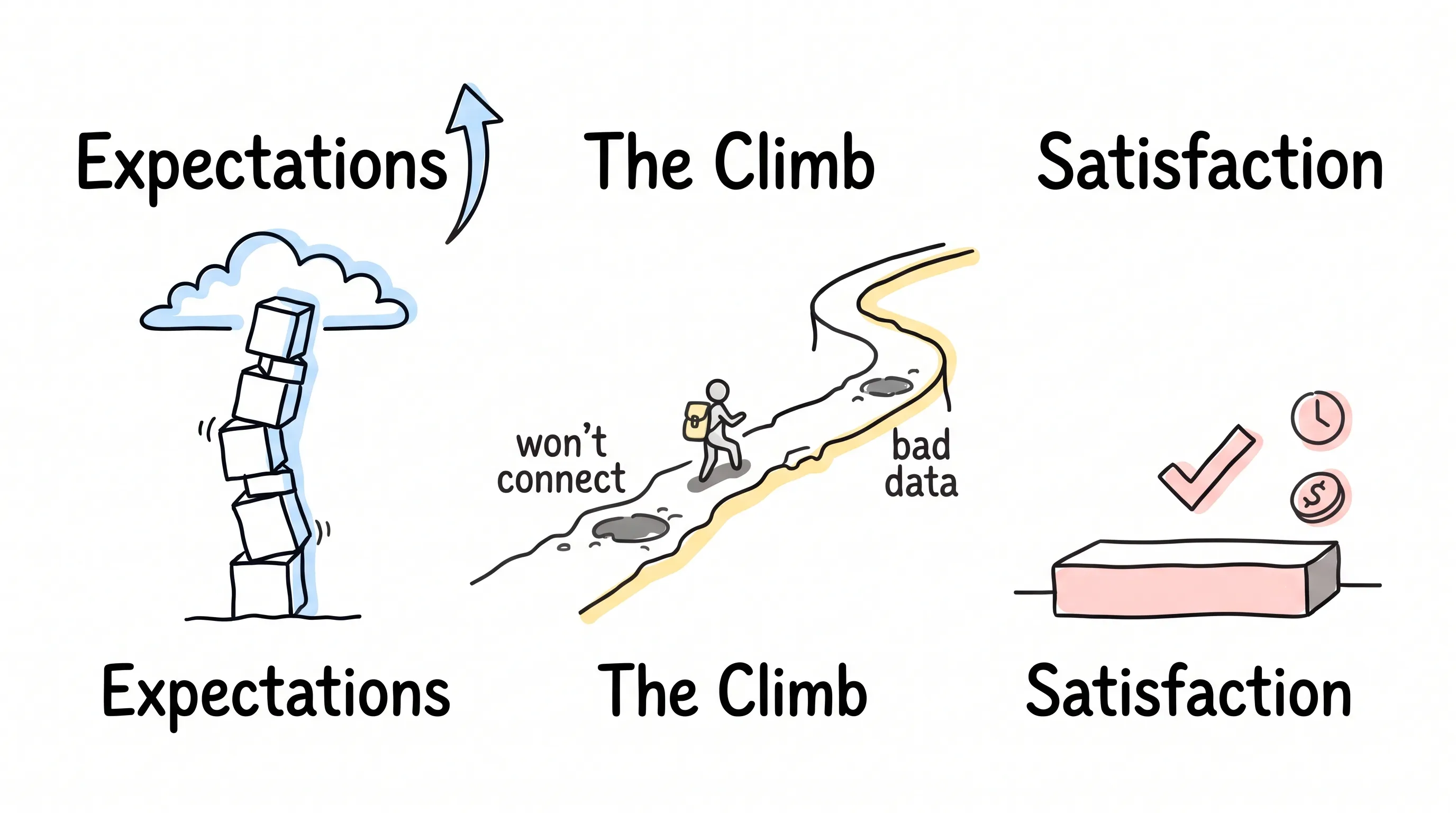
But this guest offered a remarkably precise description: between expectations and satisfaction, there's a gap.
What does "a gap" mean? The market has inflated expectations to the max, yet early teams that actually put agents to work report pretty solid satisfaction too. Between the two, though, sits a very real climb. And the climb is full of small potholes: workflows that won't connect, data that isn't fed in right.
None of these potholes are fatal. But they grind you down.
Teams look around and think: wait, where's the disruption we were promised — why is this all grunt work? And so the disappointment sets in. But if you write agents off because of it, you'd owe an apology to the teams who've got them working — they really are saving time, and really saving money.
So is this a bubble? No. Is it a done deal? Not that either.
Expectations are sky-high, satisfaction is real, and between them lies a climb no one can make for you.
Assumption Two: Customer Experience Is Just the Moment of Acquisition
The second correction concerns customer experience itself.
When we talk about customer experience, we usually mean "the moment of acquisition": did the ad get clicked, did the landing page convert.
The guest said this frame is too narrow. Consumers' expectations long ago spilled over the top of the funnel. They judge the entire shopping journey: finding you, comparing prices, ordering, delivery, after-sales — every link gets a score.
Think about your own shopping: a product page that promises the moon, shipping you can't track after checkout, a customer-service bot that runs you in circles. No matter how well you nail that first moment, your total score still gets dragged down.
In other words, customer experience hasn't stagnated — it just changed exam halls. The question used to be "can you lure people in the door?" Now it's "can you do the whole journey well?"
No wonder AI agents have a shot here. The whole journey means countless touchpoints, far more than humans can watch.
Run the numbers. A hundred thousand touches a day, each one supposed to adjust its message and timing to a person's preferences — how many can a human actually monitor? A few hundred, tops. Agents work on the scale of a hundred thousand.
The exam hall has gotten wider. Wherever there aren't enough hands, machines should step in.
Assumption Three: All the Answers Lie in the Data
This was the sharpest stretch of the whole conversation. The guest called it the biggest lie marketing tells itself.
What lie? That widely-quoted line: the answers are in your data.
Sounds perfectly reasonable, right? A few terabytes of user data sitting in the warehouse, pull a report, and out comes the answer?
That's exactly where the problem is. Static data answers "what has already happened." Marketing needs "what to do next."
What happened doesn't tell you what to do next. Because consumers change, channels change, even your competitors change.
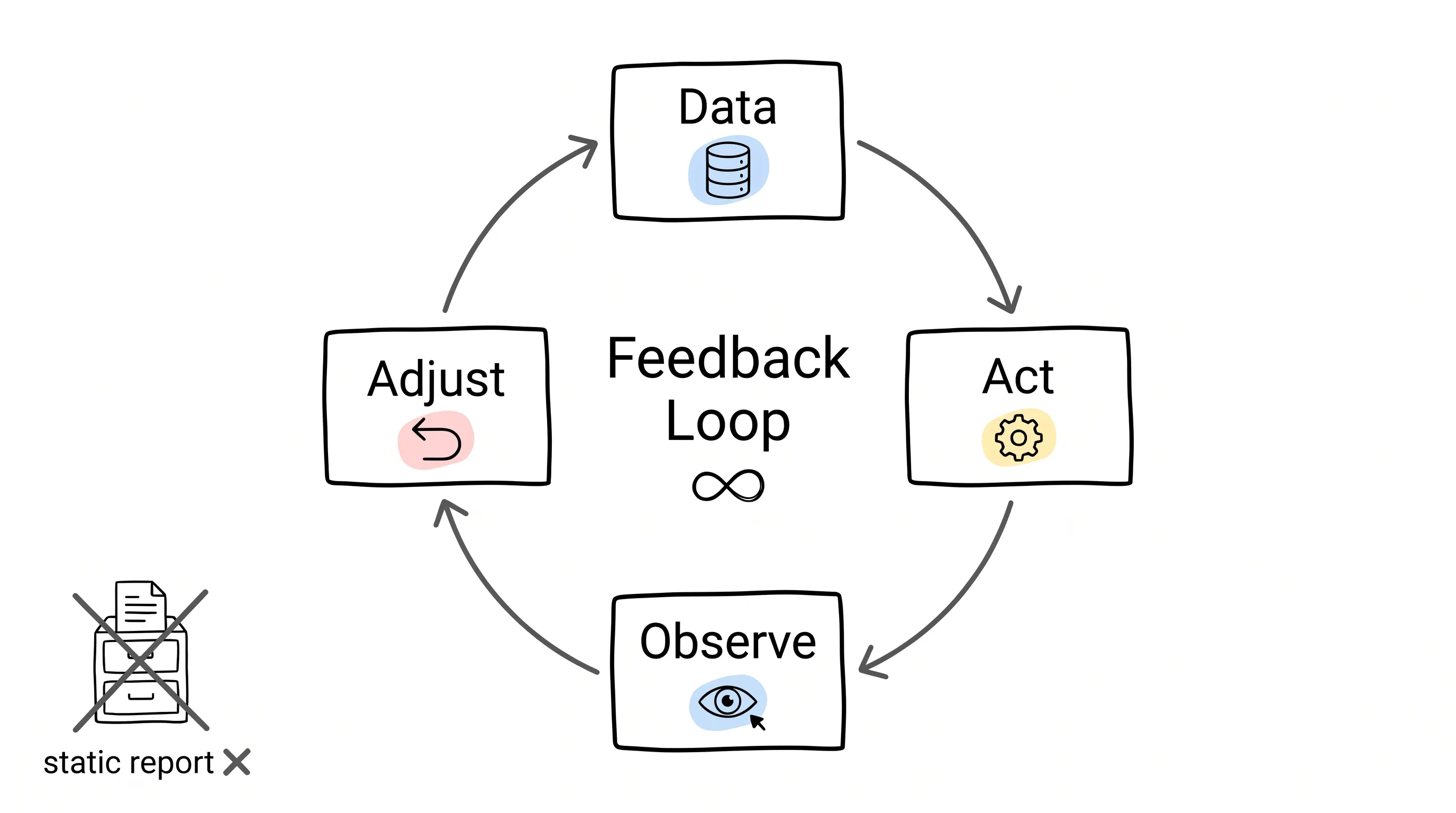
The way out? The guest's answer was two things: dynamic feedback loops, plus reinforcement learning (a method where systems learn by acting, observing the results, and adjusting).
Let me translate that into plain language. Stop treating data like a filing room. Treat it like a sparring partner.
What does that mean? Every touch, every conversion — the result becomes new data fed back into the system, so the next round of actions corrects itself. Wrong? Adjust. Adjusted? Try again.
It's like learning to drive. Memorizing the rulebook is static knowledge; out on the road, what you rely on is real-time feedback through the steering wheel, ground out pedal by pedal — a little gas, a little brake.
There's no feel for the road in a filing room. Feel for the road grows inside the loop.
The answer isn't in the data. It's in the loop.
An Unexpected Bonus
I figured the keyword of this episode would be "efficiency." Turns out there was a less-discussed one: organizational friction.
An example. Different departments arguing over one slogan — marketing wants it younger, sales wants the selling point stated outright. How did this use to get settled? A meeting, some smoothing-over, and whoever ranked highest got the final word.
Now? Write the judgment criteria into the agent's goals, let it run a version first, then discuss with the data and simulation results in hand. There's suddenly a lot less fuel for the fight, because "I think" has become "the data says."
This is the part many people don't see: AI agents don't just do the work for you — they take pressure off the organization too.
The basis of a decision has shifted from volume to evidence.
One Last Thing
When the episode ended, I closed the player — then dragged the progress bar back a good chunk and listened to the climb section again.
So well said.
I don't know which stretch of the climb your team is on.
But I hope your potholes are fewer, and your loops faster.
That's just how it feels to me. I could be wrong.
Continue reading
Related articles

What Is an AI Marketing Agent? From "Using AI" to "Delegating to AI"
A learn article explaining what an AI marketing agent is, how it differs from rule-based automation, and which repetitive tasks such as lead qualification, reporting, and campaign monitoring can be delegated while humans keep key decisions.

Marketing Automation Is Shifting from "You Do It" to "You Say It"
This article explains how marketing automation is shifting from rule-based platforms that merely execute toward AI agents that plan, create, publish, and review campaigns, covering delegable tasks, underlying technologies, tool categories, adoption steps, and risks such as privacy and automating without strategy.

When AI Does the Creative, Mistakes Come in Batches Too
A learn article on the risks of using generative AI for marketing creative across brand, legal, compliance, and operational layers, with case examples and seven practices for review, rights clearance, documentation, and vendor governance.