
Ad Buying Is Getting a New Division of Labor
An explainer on AI ad automation: how it collects, analyzes, predicts, recommends, and learns across platforms like Google Ads and Meta Ads, plus common pitfalls and adoption steps. It frames AI as handling repetitive execution while humans keep strategy and judgment.
A while back, I had dinner with an old friend who runs a cross-border e-commerce business.
Before the dishes even arrived, he flipped his phone face-down on the table and sighed: he'd dragged himself out of bed at seven in the morning to watch his dashboards, watched until ten, and still couldn't keep up.
Watching what? I asked.
He said: one for Google Ads, one for Meta Ads, plus Amazon — three dashboards to switch between all day. Hundreds of ads, and figuring out which were burning money and which were making it all came down to one pair of eyes.
And the result? A few days earlier, one creative had clearly gone stale, and he was a day and a half late noticing. A day and a half — two thousand dollars and change in budget, down the drain.
He asked me: everyone is talking about AI media buying, AI ad automation — is this thing a gimmick, or can it actually save you?
That night, I thought it through. Today I'll tell you what I found.
Why is ad buying getting more exhausting?
Think back: what was buying ads like ten years ago?
Pick a platform, write a couple of lines of copy, set a budget, maybe narrow down by a few age groups and regions. Done.
And now?
Google Ads, Meta Ads, LinkedIn Ads, YouTube — all have to be managed at once. Every platform's targeting is frighteningly powerful: interests, behaviors, purchase intent, devices, geography — hundreds of signal dimensions.
As capability grows, complexity grows with it.
How much data does a single ad generate in a day? Impressions, clicks, conversions, engagement rates, keyword performance, creative performance, regional differences... thousands of signals, without breaking a sweat.
How is a person supposed to watch all that? You can't.
And the ad game is, at its core, a contest of reaction speed. A competitor adjusts their bids at midnight, your creative starts to fatigue, an audience suddenly drifts off course — notice a day late, and that's real money burning.
Running ads by hand means pitting human reaction speed against a flood of machine-generated data. That race was never fair to begin with.
What is AI ad automation, exactly?
So what do you do? That's where AI ad automation enters the picture.
What is AI ad automation? Simply put, it's letting AI do the repetitive, high-volume, pattern-driven parts of ad operations for you: reading the data, finding the patterns, making recommendations — and in some cases executing directly on your behalf.
Here's the important distinction: this is not the same thing as traditional rules-based automation. Rules-based automation is static: you set "stop when spend passes 100," and stopping-when-spend-passes-100 is all it will ever do. AI is different. It keeps learning, finding its own patterns in your ad data.
Its way of working is roughly a loop, in five steps.
Step one, collect. It pulls in the data from Google Ads, Meta Ads and the rest — impressions, clicks, conversions, budgets, creative performance — all of it, in one place.
Step two, analyze. No more digging through reports. It tells you directly: which campaign is weakening, which audience is drifting, which creative has gone stale.
Step three, predict. Machine learning models use historical data to project what different adjustments would produce. You stop making budget calls on gut feel.
Step four, recommend. Move money from what's stalling to what's running fast, adjust bids, swap audiences, swap creatives, tweak schedules. Some platforms let you give it a look before execution; others execute automatically — your choice.
Step five, learn. Once actions run, new data flows back, and it corrects its next round of judgment. The longer you use it, the better it understands your business.
These five steps link into a circle, turning day and night without stop.
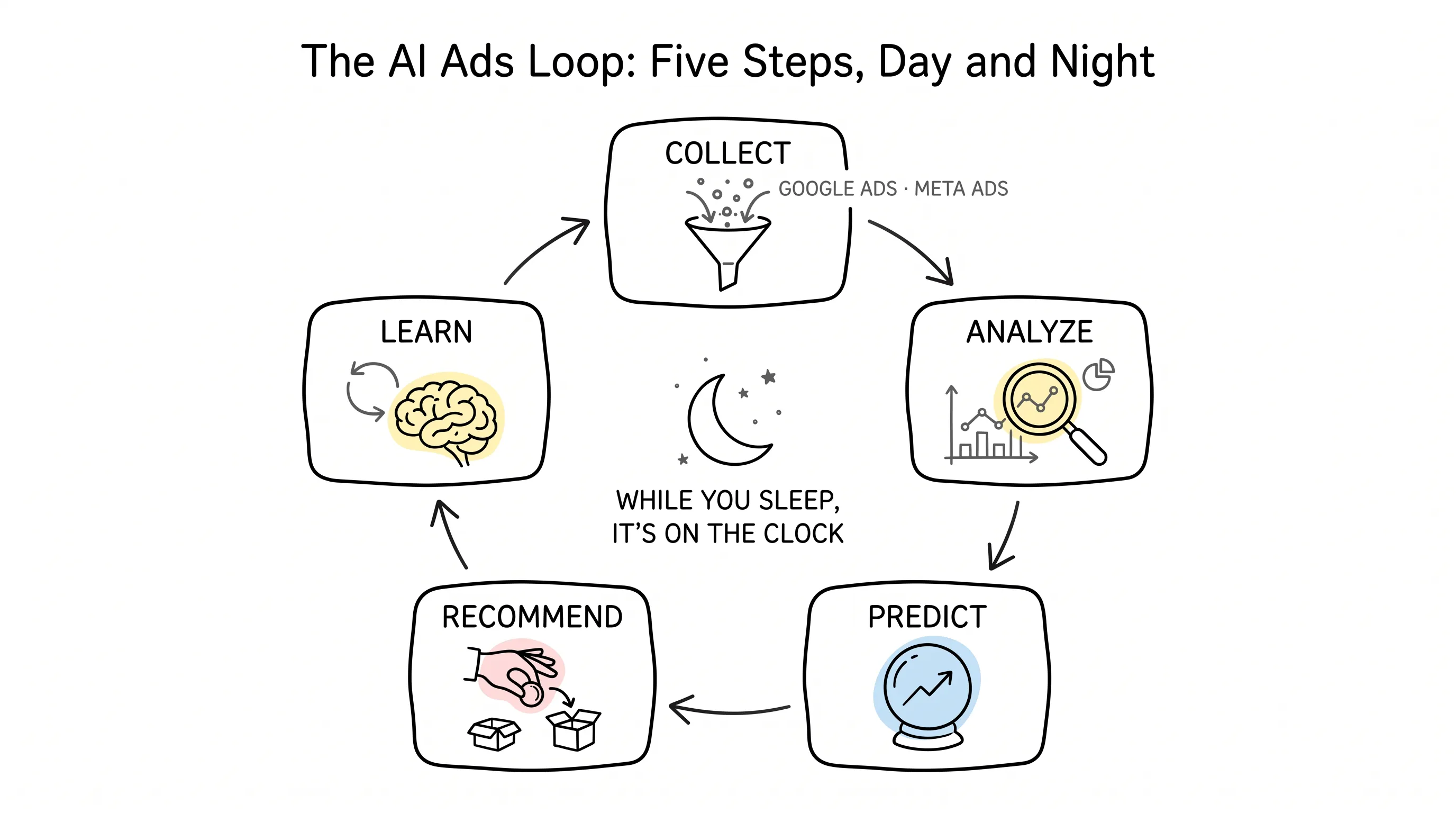
While you sleep, it's still on the clock.
What can it actually do for you?
Break it down, and a decent AI ad system does four things for you:
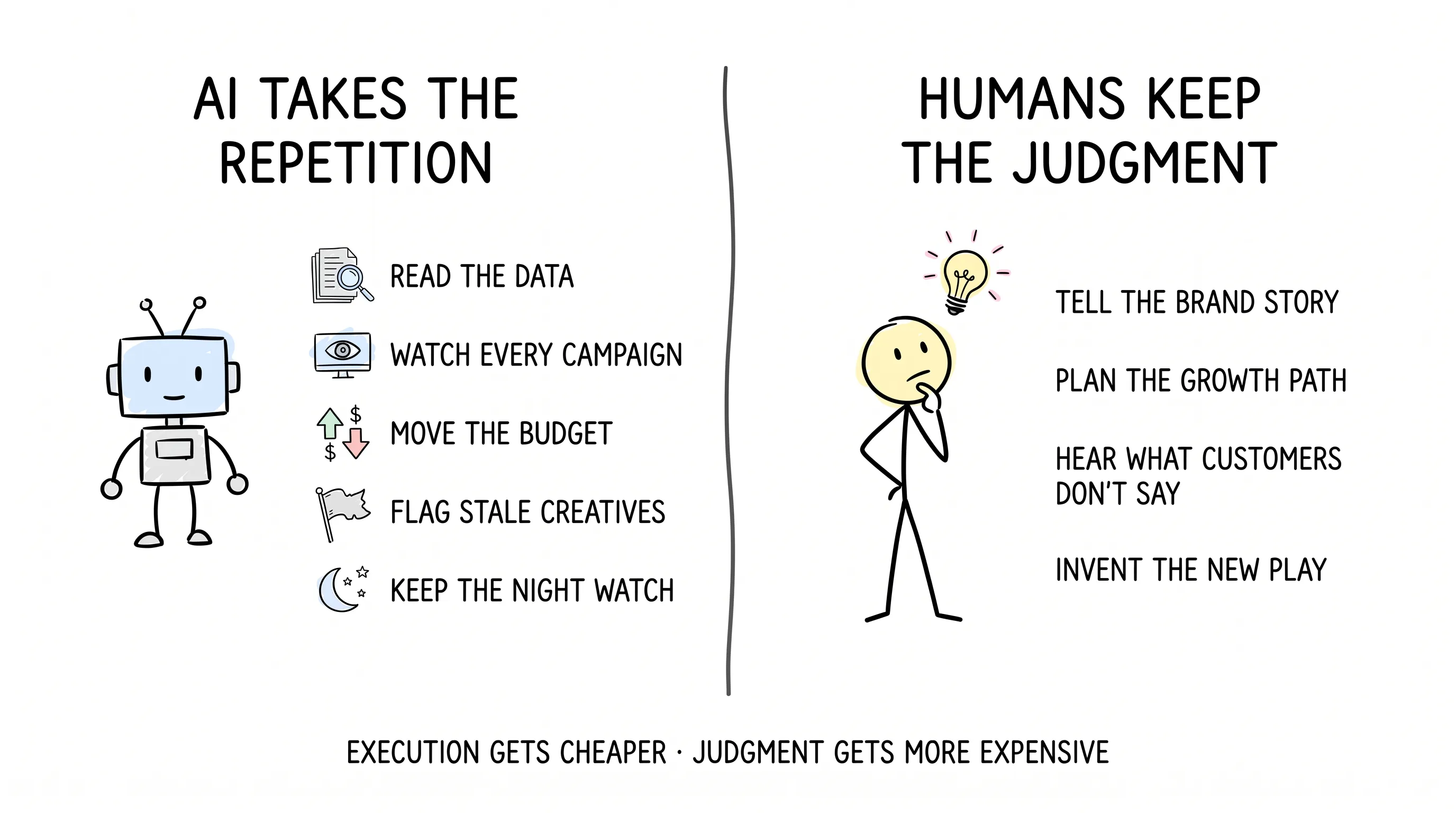
One, read your audience. Who are your customers, really? AI digs through engagement data to surface the "most likely to pay" audiences — not the handful of age-plus-region boxes you circled on intuition.
Two, manage the money. How you split budget shows a media buyer's true skill. AI watches each campaign's output and keeps moving money toward whatever is most efficient. A human can do this at most once a week; AI does it every day.
Three, judge the creatives. Which ad pulls a high click-through rate, which one's conversions are tanking, which one is starting to fatigue. The moment a creative goes stale, it flags it — before performance collapses.
Four, keep the night watch. Competition, seasonality, user behavior — the market shifts constantly. The person goes off duty; AI stays on, and reports any unusual movement the moment it happens.
Notice anything? Not one of these four things is doing strategy for you.
All of it is execution.
What do you do with the time you save?
Some will ask: if AI does all this, what does the media buyer do?
Good question. This is the part I've most wanted to get to.
First, do the math. A campaign specialist spends no less than a dozen-plus hours a week reading data, adjusting bids, and pulling reports. Hand those chores to AI — what do you do with the reclaimed hours?
The work only a human can do.
Nail down what story your brand is actually trying to tell; design next quarter's growth path; talk with customers to grasp the needs they never say out loud; think up a play nobody has tried.
AI takes over the repetition. Humans take over the judgment.
Google Ads and Meta Ads: how should you use each?
Two big platforms. Take them one at a time.
On the Google Ads side, AI mainly helps with three things. Smart bidding — dynamically adjusted on conversion data, with the goal being more conversions, a lower acquisition cost, or a higher ROAS. Keyword analysis — which words are making money, which are burning it for nothing, and which new ones are worth a try. Plus ad copy suggestions — how to change headlines and descriptions so they fit better.
Over on the Meta Ads side — that is, Facebook and Instagram — the playbook is a bit different. Creative is the soul: same audience, different creative, and results can differ several times over. AI helps you judge creatives and filter out the ones that can actually perform; helps you mine audiences from behavioral data; and keeps watch over your campaigns around the clock, raising the alarm early when something goes wrong.
Different platforms, different plays. But the direction is the same: freeing people from the "watching."
Which businesses is this for?
Basically, as long as you spend money on ads online, you're in range.
SaaS companies use it to press down acquisition costs and watch conversions. E-commerce uses it for audience segmentation, retargeting, and batch-testing creatives. Real estate uses it to find prospective buyers and cut wasted impressions. Ad agencies benefit most directly — one person managing dozens of accounts is simply unworkable without AI assistance.
Small companies may actually benefit the most. Ad buying used to be a craft that big companies staffed with whole teams. Now a small team with a few AI tools can also pull off respectable, fine-grained operations.
The tools have leveled the starting line — or at least leveled part of it.
Choosing a tool: what should you look at?
AI ad tools are a dime a dozen out there, and quality varies wildly. Here are six criteria to judge them by:
- Does it truly "optimize"? Not just show you data, but tell you what to do — and even do it for you.
- Can it manage multiple platforms in one place? Google Ads, Meta Ads, LinkedIn Ads, all viewable from a single backend — no switching back and forth.
- Does it understand creative? Can it analyze images, video, copy, CTAs — and tell you which one should be replaced?
- Are the reports automatic? You should spend your time making decisions, not making Excel.
- Can it forecast? Based on historical data, it should tell you in advance roughly where the next phase is headed.
- The most critical one: do you still have control? For every AI recommendation, you should be able to understand the reasoning, approve it, and turn it off. A black-box tool — no matter how clever — never touch it.
Number six is the most important.
Three traps — whatever you do, don't step in them
Of course, everything has a flip side. AI ad automation isn't something you plug in and it just works, and I've watched plenty of people fall into these three traps.
The first trap: treating AI as strategy.
AI can crunch data, find patterns, and do the chores, but it doesn't understand your brand's tone, or why your customers hesitate, and even less where your business should go. Hoping that installing an AI will make your ads automatically better? Dream on.
The reins of strategy must stay in human hands. Always.
The second trap: automating before your data is ready.
Everything AI can do is built on the data you feed it. If conversion tracking is installed wrong and the data is incomplete and patchy, then every recommendation it makes is like a drunk GPS — earnestly steering you into a ditch. Before automating, check first: Are the conversion events installed correctly? Is the data clean? Are the goals clear?
The third trap: installing it and walking away.
Automation doesn't mean exempt from inspection. You still have to look in once a week: Do the AI's decisions match your business logic? Is the brand voice still consistent? Is the budget being spent in the right places? AI is the co-pilot; the person sitting behind the steering wheel must not fall asleep.
How do you put it to work? Four steps
If you really want to put this to work, don't rush. Take it in order.
First, write your goals down clearly. Conversions, leads, ROAS, or a lower acquisition cost? If the goal is fuzzy, AI has no idea what to optimize toward.
Next, install your tracking solidly. Visitors, leads, closed deals — every key action has to be recorded. Only when AI knows which actions are worth money is optimization even on the table.
Then, keep testing. Try more audiences, more creatives, more landing pages. The richer the data, the faster AI learns.
Finally, layer human experience on top. AI supplies the analysis, humans supply the judgment; put the two together and you have complete ad buying.
And further out?
Ad buying is only going to get more automated from here. Creation, placement, optimization, reporting — the whole assembly line could be handed to AI.
But I'm not worried about media buyers losing their jobs.
Quite the opposite. As execution gets cheaper, judgment gets more expensive. The people who can tell a story, who understand customers, who can think clearly about the essence of the business — their value isn't being diluted; it's being magnified.
AI won't replace ad teams. What it will eliminate is the way of running ads that relies on nothing but repetitive labor.
The future won't be won by whoever has the bigger budget, but by whoever decides faster and decides more accurately.
Back to that dinner
Last month, I saw that cross-border e-commerce friend again.
He didn't change jobs, didn't hire anyone. He just built an AI-driven ad workflow. Now he spends about ten minutes every morning scanning a summary the AI has prepared — all the significant anomalies flagged — approves a few recommendations, and that's it.
He said something that left a deep impression on me: "Before, I was watching the ads. Now the ads run by themselves, and I watch."
The business of ad buying is being re-divided: machines take over the repetition; humans return to judgment.
Here's hoping you, too, can lift your head out of those backend reports a little sooner.
Continue reading
Related articles
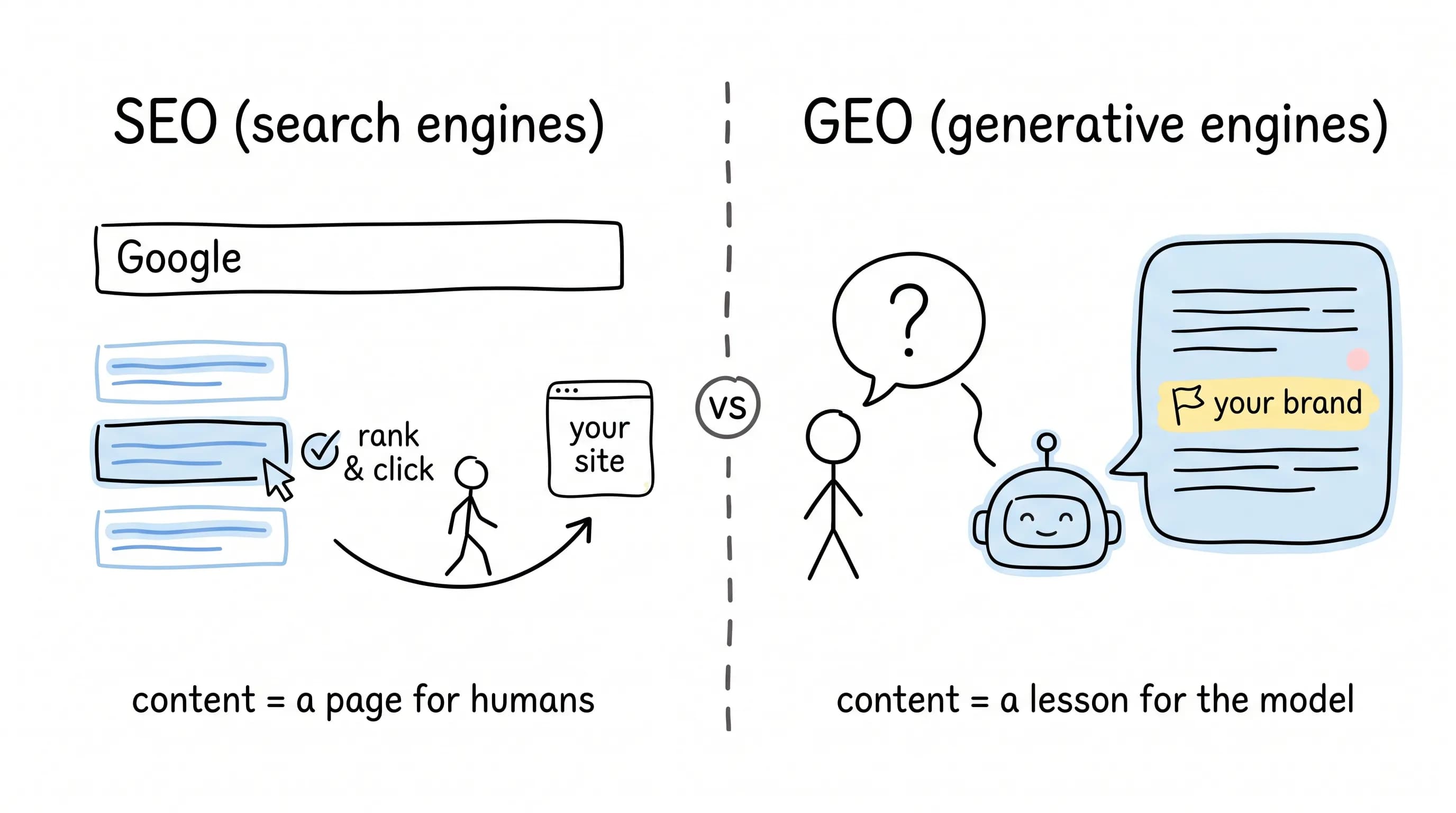
Does AI Know Your Brand? A Look at GEO, the New Craft
An explainer on GEO (Generative Engine Optimization): how AI engines like ChatGPT, Perplexity, and Gemini differ, how GEO goals and metrics diverge from SEO, and which SEO skills still carry over.
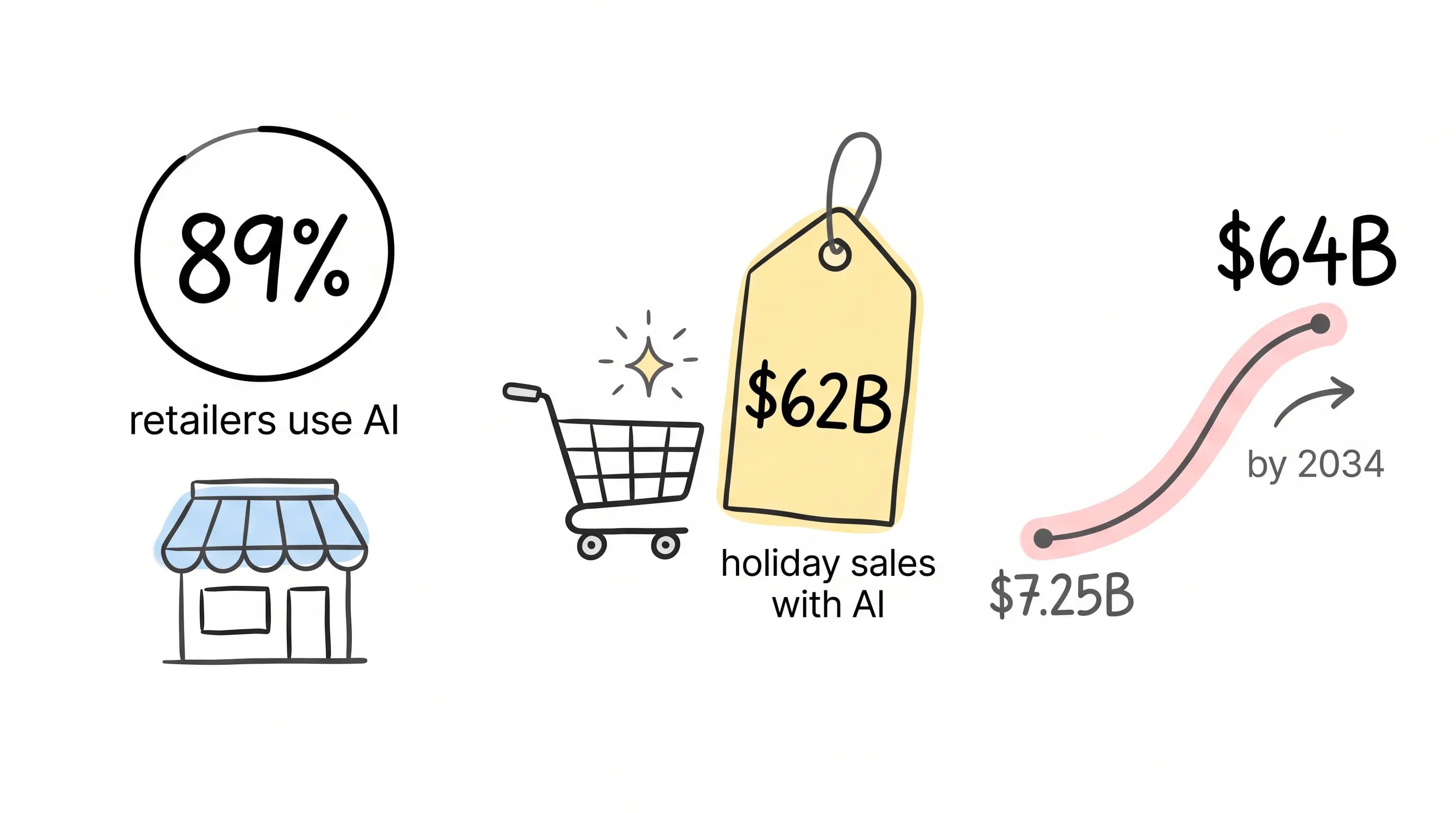
89% of Retailers Are Already Using AI. The Playbook for E-Commerce Has Changed
A learn article on AI in e-commerce: adoption context, use cases from recommendations, search, dynamic pricing, customer service, inventory, and fraud control, plus B2B applications, generative AI content, tool examples, pitfalls, and a six-step adoption path.
AI Makes Content at Lightning Speed — But Can You Answer "Who Approved This?"
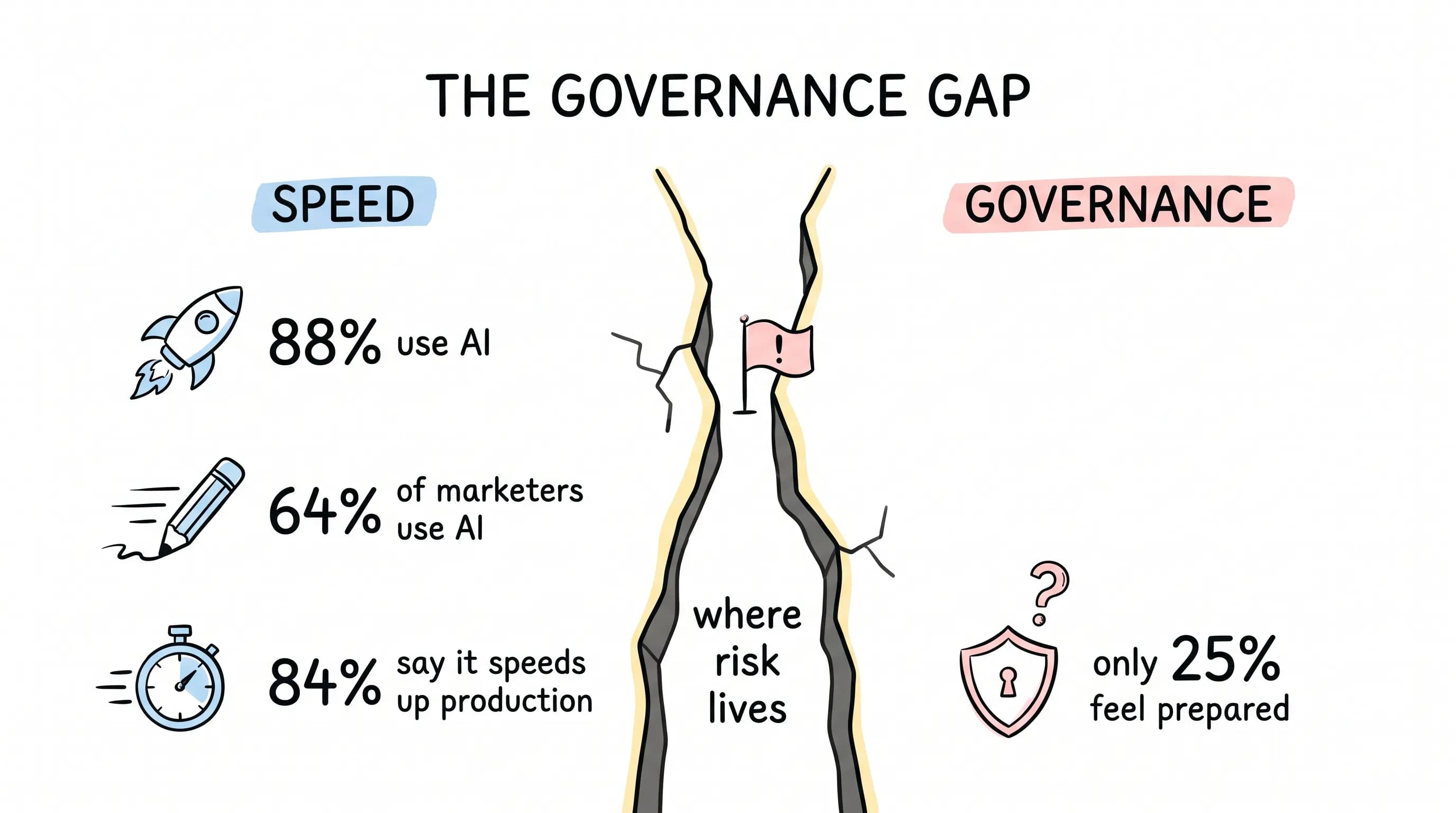
This article looks at the gap between AI content speed and governance readiness in marketing teams, and outlines nine control points — prompt validation, brand guardrails, permissions, approval workflows, human review, versioning, IP checks, audit trails, and asset reuse — for brand-safe AI content.