
90% of Teams Are Using AI — Why Do Only 10% Get Anywhere With It?
A learn article on AI maturity for marketing teams, covering a four-stage self-check, agent workflows, proprietary data as the intelligence layer, and AEO plus personalization for external visibility.
I recently read a report cover to cover: HubSpot's "2026 State of AI for Marketers," which surveyed more than 1,700 marketers.
It left me with mixed feelings.
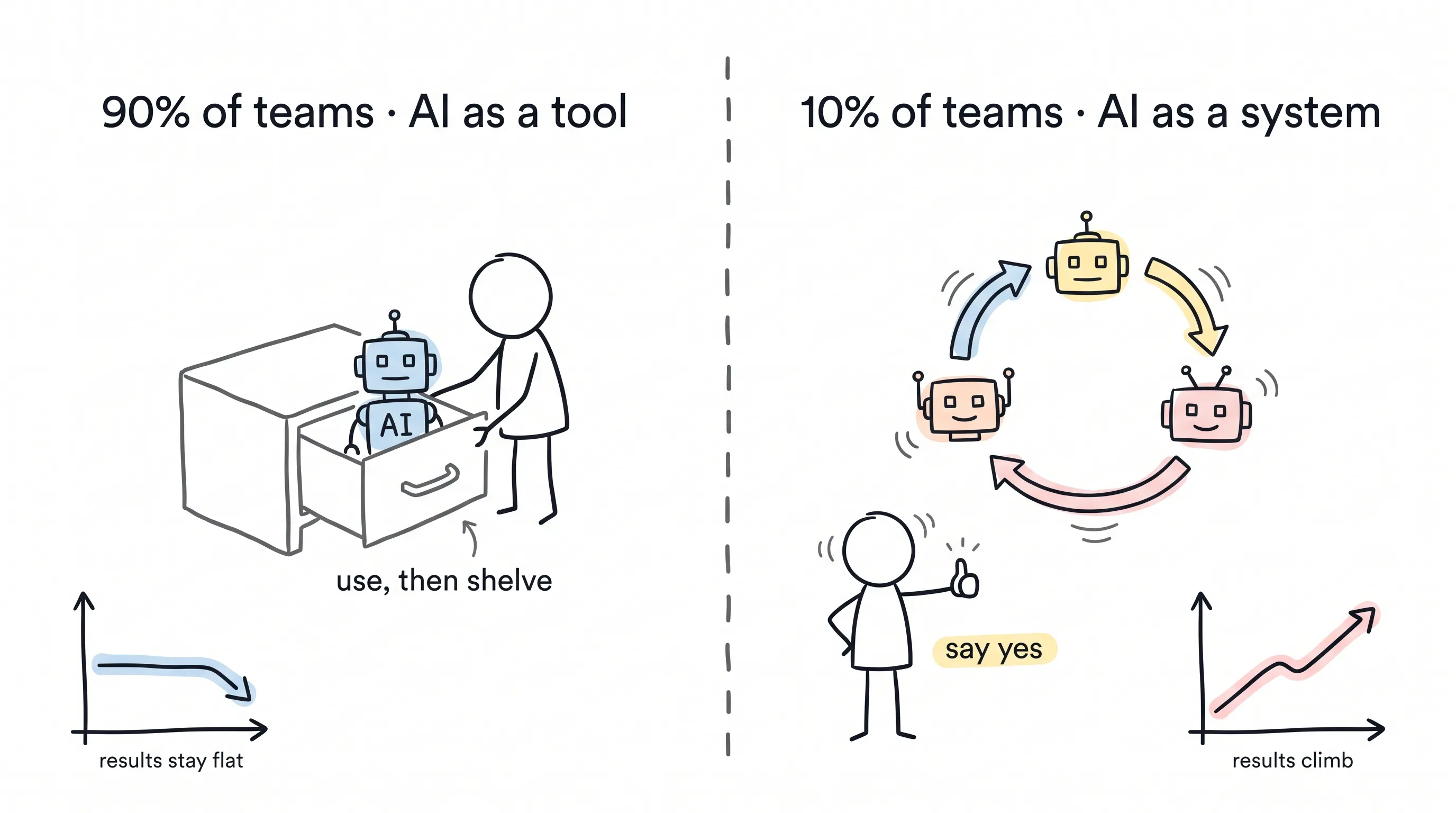
One number jumped out: only 10% of marketing teams have actually used AI to transform their business. The other 90%? They're using AI too — the fanfare just keeps getting louder, while the results stay flat.
Same tools. Why is the gap this big?
The answer is one word: maturity.
Lagging teams treat AI as a tool — use it, then put it back in the drawer. Leading teams treat AI as a system, and let it run on its own.
A Quick Self-Check: Which Stage Are You In?
What is AI maturity? Take "how well does your team use AI" and split it into four stages.
Stage one, early. AI is still stuck in experiments — occasionally brilliant, often crashing and burning.
Stage two, growth. AI has entered real workflows and delivers value, but it's still wobbly.
Stage three, mature. AI reliably delivers at several key points of the pipeline, and the team knows what to expect.
Stage four, transformation. AI becomes the foundation and starts reshaping how the whole company runs.
Of the four stages, who's the easiest one to fool? Yourself. Most teams believe they're further along than they really are. Guess what: if you can't say which stage you're in, you're probably not in stage four.
What to do? Prescribe by stage.
Still early? Don't take on too much. Pick the single most repetitive task you have and automate it completely. Most teams start with social copy and email subject lines.
In the growth stage, your bottleneck is no longer tools — it's process. Try having AI review your last three campaigns: At what point did the numbers drop? Which signal did you see — and ignore?
If you're already mature and aiming for transformation, remember one line: At this jump, piling on more AI won't help. What matters is what you feed it. More on that below.
From "Helper" to "Employee"
First, a question: what's the difference between an AI tool and an AI agent?
A tool answers when you ask. An agent takes a goal and finishes the job on its own — no need to push it along every step.
What's that difference worth? 86% of marketing departments already use agents, and 76% of those say usage has kept climbing over the past six months.
But I've watched too many teams keep two or three agents that each work in their own silo and never talk to each other. That's the ceiling for most teams.
What do the top teams do? They run four to six agents, wired into one system. People are still there — but people do exactly one thing: say yes.
Where to start? Here's a very concrete starting point: content repurposing.
You've published blog posts, right? Now hand a link to an agent and have it do four things: pull out the key points, write social copy, draft a three-line email summary, and produce a 60-second short-video script. One input, four outputs, zero manual work in between.
How hard is this? HubSpot itself built a version with Claude skills — no coding, no agent expertise required, up and running in an hour. That kind of efficiency? I tip my hat.
Step two: chain the agents together. The repurposing agent produces the material; then a distribution agent takes each piece where it needs to go. Your only job is to say yes before anything ships.
What You Feed It Decides How Well It Cooks
Agents are connected — so have you won?
Not even close.
You can have the prettiest agent orchestration in the industry and still turn out content identical to the company next door. Where's the problem? Not in the agents — in what you feed them.
The hottest AI tools right now are the same for everyone: what you have, they have too. So where does the advantage come from?
The intelligence layer. What's the intelligence layer? All the data nobody else can get and only you have: your customer data, your campaign history, your brand voice. When AI can see it, the output starts to sound like you; when it can't, the output stays generic forever.
The reality, though, is that only 25% of teams consider their data excellent. In other words, most teams are cooking with poor ingredients — and then complaining that the dish tastes bad.
The fix is dumb, but it works. Step one, take inventory: Can your AI see your CRM? Your brand guidelines? Your campaign history? Count how much it sees and how much is missing — that gap list is your roadmap. Step two, connect one data source this week. Most people start with the CRM; plenty of CRMs now plug directly into mainstream AI tools — think HubSpot and Claude. Step three, clean the data before you connect it. I know — it's the most boring chore in the whole chain. But dirty ingredients never make a good dish.
A Test Nobody Announced
Here's a number that made my stomach tighten: only 15% of companies have formally written down AI skill requirements. Meanwhile, 35% of companies have quietly started counting AI skills in hiring, performance reviews, and pay.
Do you smell what's going on here?
A lot of people are being graded on a test they never got the syllabus for.
And 53% of marketers worry that AI will hurt their jobs. The antidote sits precisely inside those two numbers.
If you're an employee, don't wait for your company to define you — make yourself visible first. Write down, line by line, which AI you use and what results it has produced, and bring that list to your next performance review. Remember: "I've written copy with AI" and "I run a content system under my supervision" are two different things.
If you lead a team, here's who the industry is scrambling to hire right now: AEO specialists and AI coaches — tied for first place. My advice: don't rush to hire from outside. That person on your team who's always quietly tinkering with AI tools has probably already done the work. All they're missing is a title and a raise.
The Machine Is Built — Now Make It Spin Fast
Everything above is about assembling the machine. But a built machine still has a speed problem.
Let me ask you: when did you last sit down and seriously look at your own campaign data?
27% of marketers say speed and agility are where AI improves things the most. Yet most companies still review results monthly. By the time you've cleared approvals and fixed the problem, the window has long gone cold.
How fast are transformation-stage teams? Weekly — even daily — data reviews, with live campaigns adjusted within hours.
You don't have to get there in one leap. Glance at your email open rates on Friday, make changes on Monday. That single habit already puts you ahead of 90% of your peers.
Why do small moves matter? Because small repairs on a live campaign compound far faster than launching a brand-new project from zero.
Turn the Machine Outward
What you have now is a fast internal machine. But speed only settles whether you're doing things right — whether it pays is decided out there.
Step one: make sure AI can find you.
People don't just search anymore. They ask AI directly, take the answer, and leave without clicking a single link. If your content isn't organized in a way AI can read and cite, you've already lost before the user ever sees your brand.
This has a name: AEO — Answer Engine Optimization. It's really the outward-facing version of that "intelligence layer" idea: packaging your data and expertise into a format AI engines can retrieve and cite.
How do you do it, concretely? Pick one article this week, move the core answer buried in the middle up to the top, and write it short and plain. AI engines only cite answers that can be pulled out without effort. By the way: a human scrolling their phone at 11 p.m. runs on exactly the same logic.
Step two: keep the people who found you.
Companies that use AI for personalization were 3x more likely to see revenue growth over the past year.
The logic isn't complicated: as the cost of producing generic content approaches zero, so does its value. Pick an audience you already own — existing customers, trial users, people who downloaded a resource — and write the next piece of content in three versions. Same message, three angles.
The Last Word
Look back, and this machine has six parts: know your stage, let agents run the workflow, feed them proprietary data, pair them with people who can use them, shorten the feedback loop, then turn the whole machine outward. AEO makes you findable; personalization makes people stay.
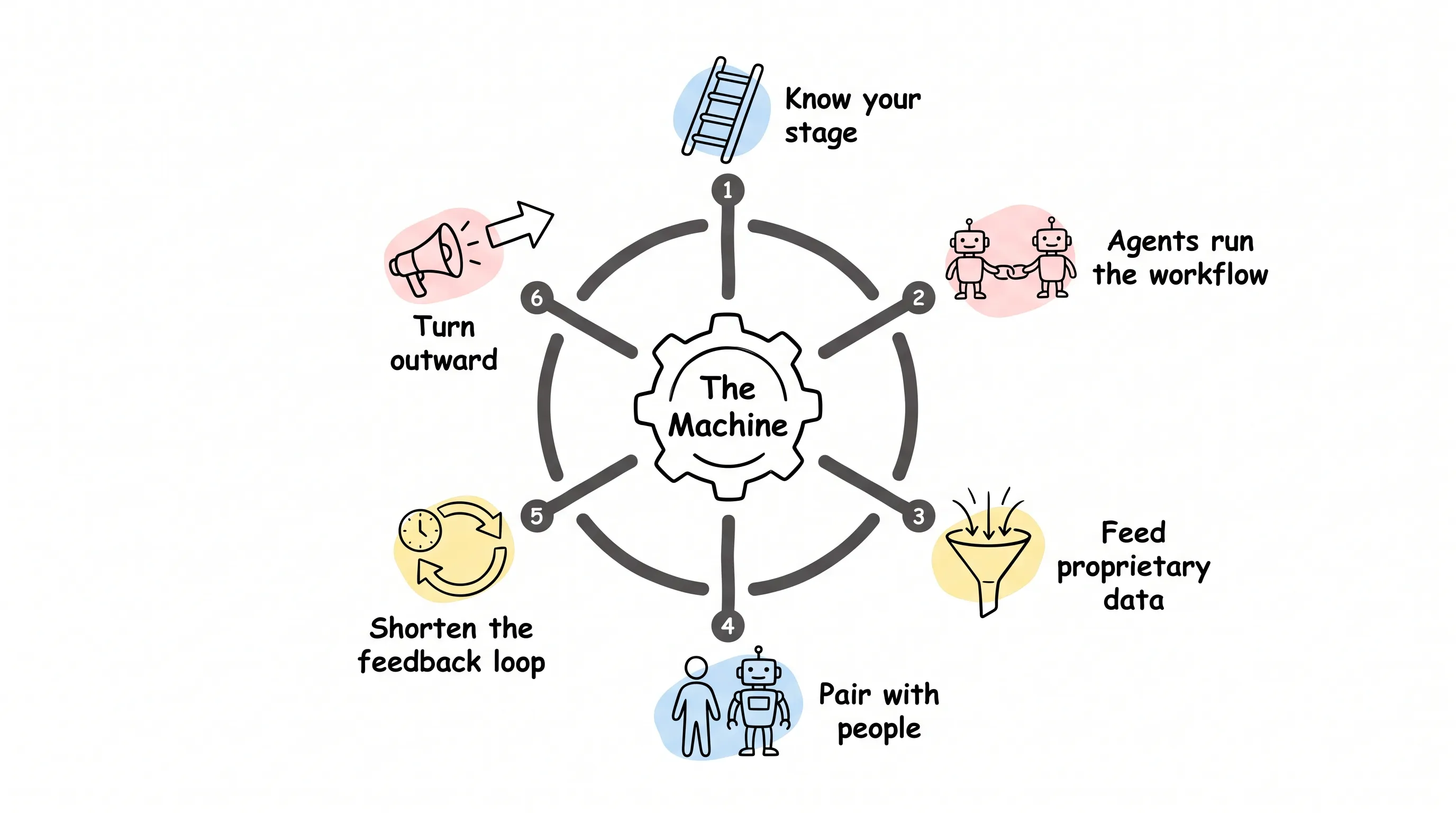
Miss one part, and the machine never spins at full speed.
If you recognized yourself in more than one place, don't panic. Knowing where you stand is exactly the first step to catching up: go back to stage one and score yourself honestly.
Oh, and today is a perfectly good starting point. Less than three months left in 2026 — enough to connect your first data source and get your first agent running.
Here's hoping that at the year-end review, you're in the 10%.
Continue reading
Related articles
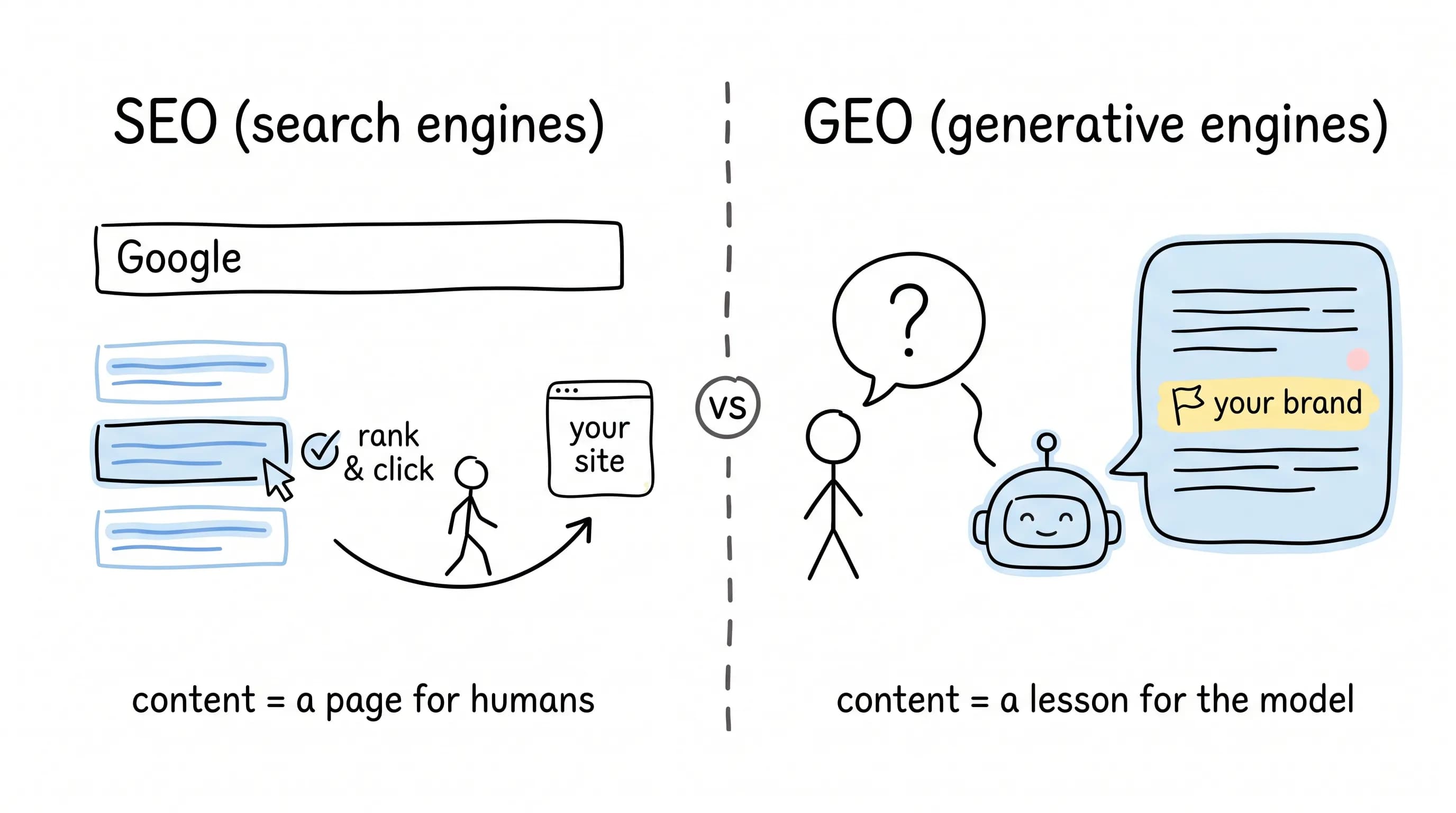
Does AI Know Your Brand? A Look at GEO, the New Craft
An explainer on GEO (Generative Engine Optimization): how AI engines like ChatGPT, Perplexity, and Gemini differ, how GEO goals and metrics diverge from SEO, and which SEO skills still carry over.
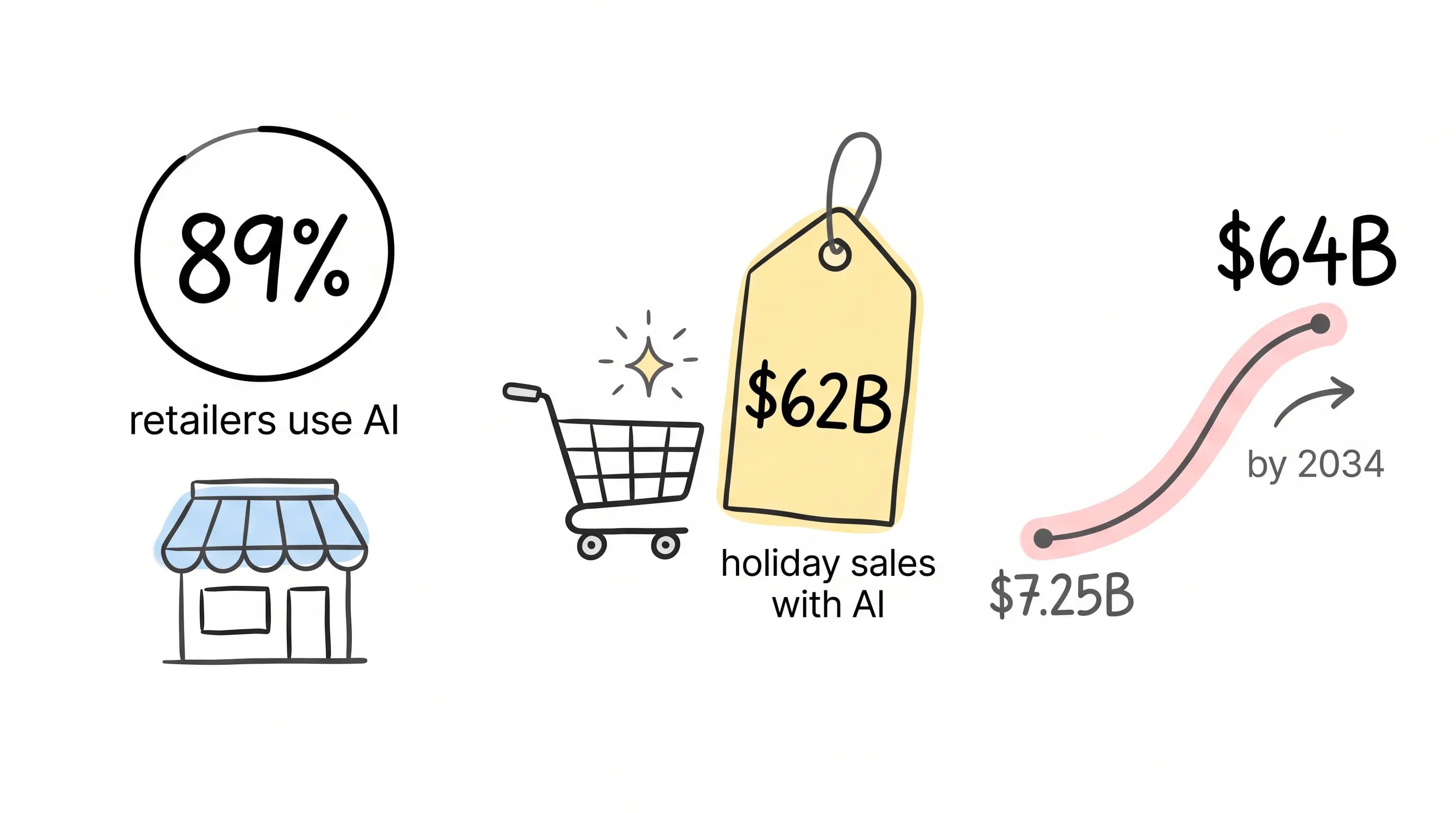
89% of Retailers Are Already Using AI. The Playbook for E-Commerce Has Changed
A learn article on AI in e-commerce: adoption context, use cases from recommendations, search, dynamic pricing, customer service, inventory, and fraud control, plus B2B applications, generative AI content, tool examples, pitfalls, and a six-step adoption path.
AI Makes Content at Lightning Speed — But Can You Answer "Who Approved This?"
This article looks at the gap between AI content speed and governance readiness in marketing teams, and outlines nine control points — prompt validation, brand guardrails, permissions, approval workflows, human review, versioning, IP checks, audit trails, and asset reuse — for brand-safe AI content.