
86% of Consumers Say: Use AI if You Like — But You'd Better Tell Me
This article reviews the Meltwater and YouGov report 'Trust in the Age of Generative AI,' surveying nearly 10,000 consumers across 7 markets. It finds 86% want AI-generated content disclosed, transparency drives brand trust, and acceptance varies by context from entertainment to news.
A while back, I saw a video in a group chat.
A product promo. Buttery-smooth camera work, every line of copy landing like a punch. Several people in the chat kept replying: this looks so premium.
Then a friend sauntered in with one line: Do you really think this was shot with a camera?
The chat went quiet.
Nobody praised how premium it looked anymore. What everyone started discussing instead was something else entirely: is this made by AI?
Embarrassingly, I couldn't tell either.
Have you noticed? The way we watch content has changed. We used to see something great and think, "That's brilliant." Now we see something great and think: is this real?
I'm not the only one who feels this way.
This April, Meltwater, a media and consumer intelligence company, teamed up with the global research-data group YouGov to release a report. The title couldn't be more blunt: Trust in the Age of Generative AI. They asked nearly 10,000 consumers across 7 markets one question: when it comes to AI-generated video, audio, images, and text — do you still trust it?
I finished the report with a single reaction: My God, this report nails what's happening right now.
Let me walk you through the most interesting numbers.
What Does "Trust Being Redefined" Actually Mean?
Start with the most striking number.
86% of consumers believe: if content is AI-generated, you should tell me, plainly and clearly.
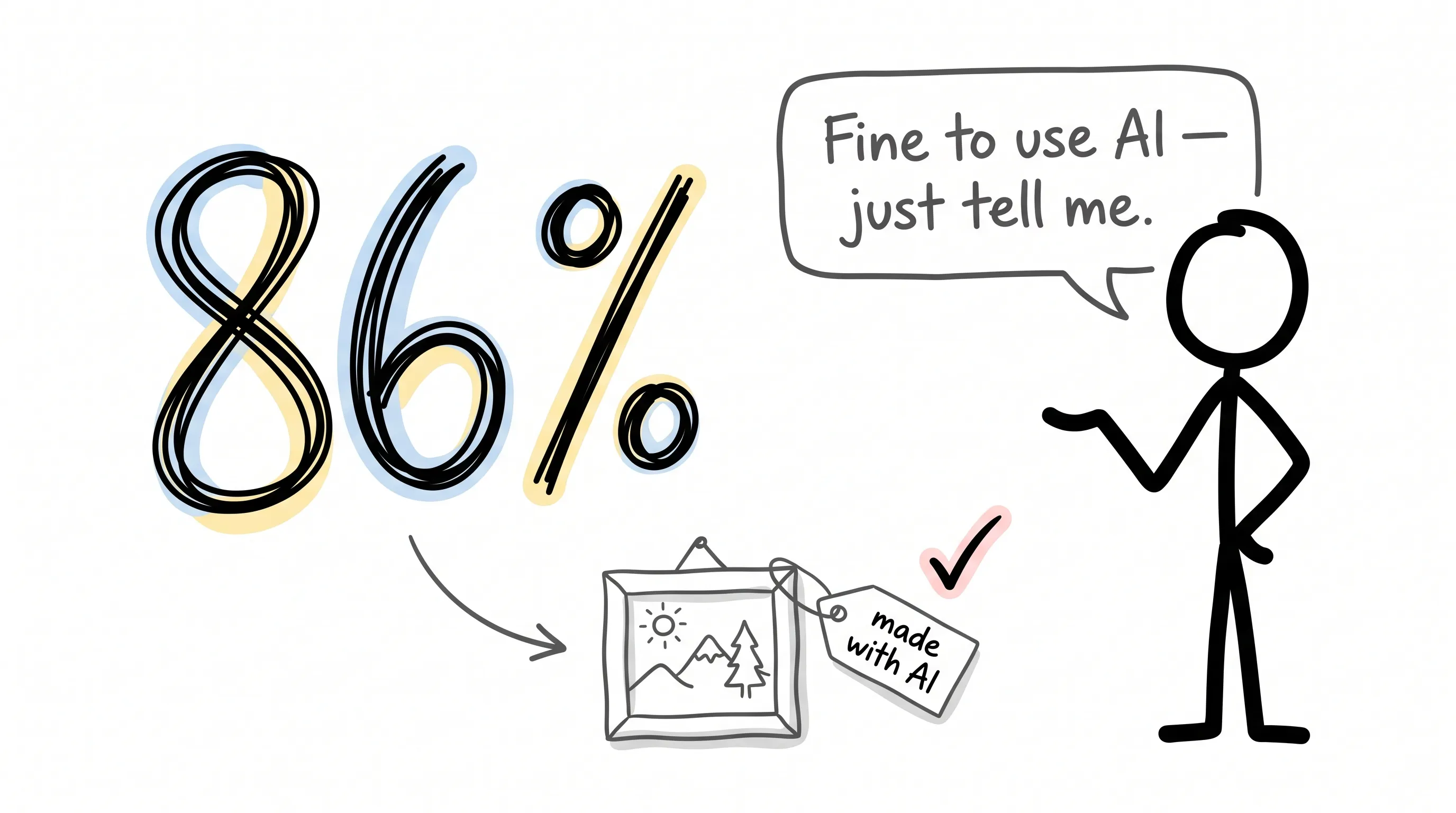
Sit with that number for a second. It doesn't mean 86% of people oppose AI, or that 86% want AI banned. It means 86% of people are saying: use it, fine. But you have to tell me.
What does "trust being redefined" look like? This.
Trust used to be built on "this is real." Faking things was too expensive, so what you saw was, most likely, real. "Real" was the default setting — no verification needed.
And now? AI has driven the cost of content production to the floor. A video that could pass for the real thing takes minutes to generate. At this point, "real" is no longer the default. It has become a scarce good.
And scarce goods need someone to step up and put a price tag on them.
The price tag is candor: this part was made with AI, here's what I used it for, here's what I didn't. Spell it out.
Plainly put, what people want was never "AI-free." What people want is "no deception."
Whether You Use It Is Secondary. How You Use It Is Everything.
So if a brand does use AI, how do consumers see it? The report has a fascinating pair of contrasting numbers.
32% say: if the content turns out to be AI-generated, I'll trust this brand less.
15% say: I'll trust it more.
Same action, two opposite outcomes.
Why? Because what decides trust is how you used it and whether you said so. Whether you used AI at all is almost beside the point.
Those who cut corners with AI and still pass it off as human-made — the day they get exposed, their trust goes to zero. Those who use AI openly to work smarter and tell you upfront? They make people feel: this company has nothing to hide, and it treats me like a grown-up.
One hides. One owns it.
The only difference is the gap between 15% and 32%. And inside that gap sits one word: transparency.
Vigilance Is the Defining Mood of This Era
But let's be honest about the hard part: this road isn't easy, because the consumer baseline is wariness.
39% say they're excited about AI. But 51% disagree.
The unexcited outnumber the excited.
73% worry about something else: misinformation everywhere, truth and fake indistinguishable.
Here's the interesting part: 58% are supremely confident. AI-generated content? I can spot it myself.
Right. Everyone believes they have a nose for fakes.
Put those two numbers side by side: on one side, "I'm afraid of being fooled"; on the other, "but nobody can fool me." That's the truest portrait of today's consumer — guard maxed out, and maxed out against the whole world.
For brands, this opens up an enormous vacancy. When everyone is suspicious of everything, a source that does exactly what it says becomes a luxury good in itself.
Whoever is willing to be the one you don't have to doubt, catches every ounce of trust everyone else loses.
Wrong Context, Great AI Still Fails
Does this mean AI content is unwelcome everywhere?
No. There's a remarkably subtle line at work here.
Same AI. In entertainment content, 53% accept it. In advertising, 47%.
But in news, it drops to 21%. In creator content, 28%.
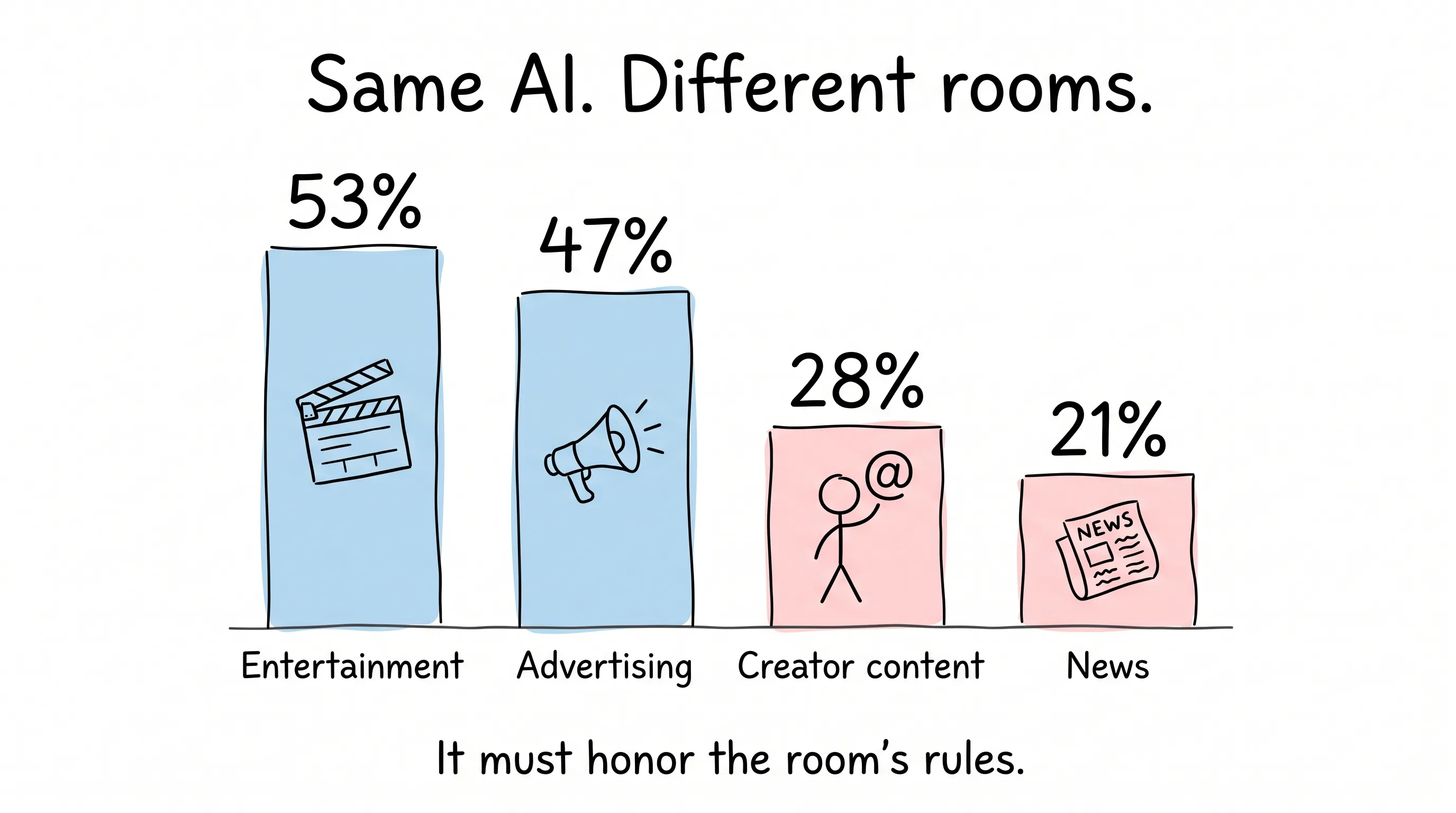
Why such a spread?
Think about it: you go to the cinema for a sci-fi film — do you quibble over whether the special effects were shot for real? Of course not. Entertainment is, by design, a performance staged for you. Creating illusions is its job.
But news? The entire value of news rests on "this actually happened." Quietly using AI in that context is undermining the very thing that makes it worth anything.
So what people are protecting is the original deal of each format: entertainment's deal is spectacle, news's deal is truth, and a creator's deal is that the person you trust truly uses what they recommend.
AI can walk into any room. But it has to honor that room's rules.
The People Doing the Talking Have Changed Too
Here's another shift — easy to overlook, but crucial.
Today, where do the truly influential conversations about AI come from?
92% come from individual creators on social media. Traditional news media: just 8%.
92 to 8.
The authority to define "what counts as AI chaos, what AI should look like" no longer sits in an institution's editorial office. It sits in the accounts of individual creators.
One rant video, one recording of a creator getting caught out, can travel further than a rigorous industry analysis. Whoever deals with users every day holds the power to distribute trust.
Now stack another trend on top: in the single year from March 2025 to February 2026, posts mentioning AI video tripled, and interactions rose 557%. Positive sentiment and engagement both outpaced every other content format.
And the wheels of this technology show no sign of slowing down.
Authenticity Is Going From Default to Scarce Good
Alright, numbers done. Back to how I actually feel.
More and more, I believe that in this AI upheaval, the asset taking the hardest hit is trust.
Producing content used to be expensive because "making it look real" was hard. Now "looking real" is the thing AI does best — a thousand versions in a minute. What's genuinely expensive now is "putting people at ease."
That's exactly the point Meltwater's Chief Product Officer was making: trust hasn't been lost; it's being redefined. Brands that use AI candidly and take responsibility for it have a chance to win deeper trust than ever before.
The YouGov executive put it the same way, in different words: generative AI has gone from novelty to everyday normal, and the line between human-made and machine-made is blurring. In the end, the winners tend to be those who win back their audience's trust — and hold onto it. How fast you adopted AI is secondary.
That's why I keep saying: don't treat "labeling AI" as a burden.
It's a step up.
Trust used to be built on "this is real." From now on, trust will be built on "I'll tell you which parts aren't."
The person brave enough to come clean is the first one trusted.
Remember that video from the beginning? I later asked my friend — was it actually made by AI?
He said: yes. But if someone had told me upfront, I might have admired the people who made it even more.
See? Consumers were never hard to please.
They just don't want to be treated like fools.
May you and I both become the person nobody has to second-guess.
Continue reading
Related articles
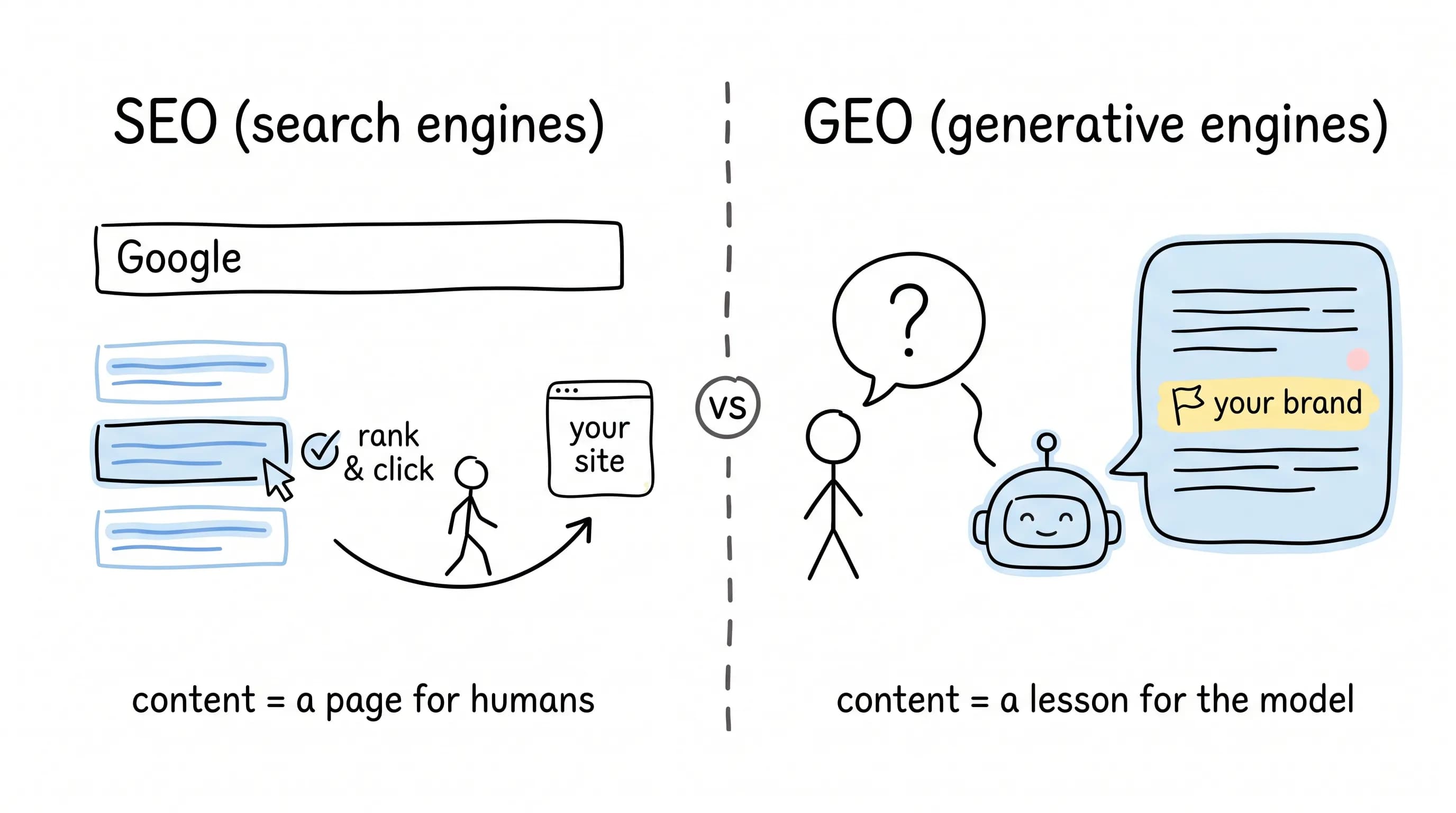
Does AI Know Your Brand? A Look at GEO, the New Craft
An explainer on GEO (Generative Engine Optimization): how AI engines like ChatGPT, Perplexity, and Gemini differ, how GEO goals and metrics diverge from SEO, and which SEO skills still carry over.
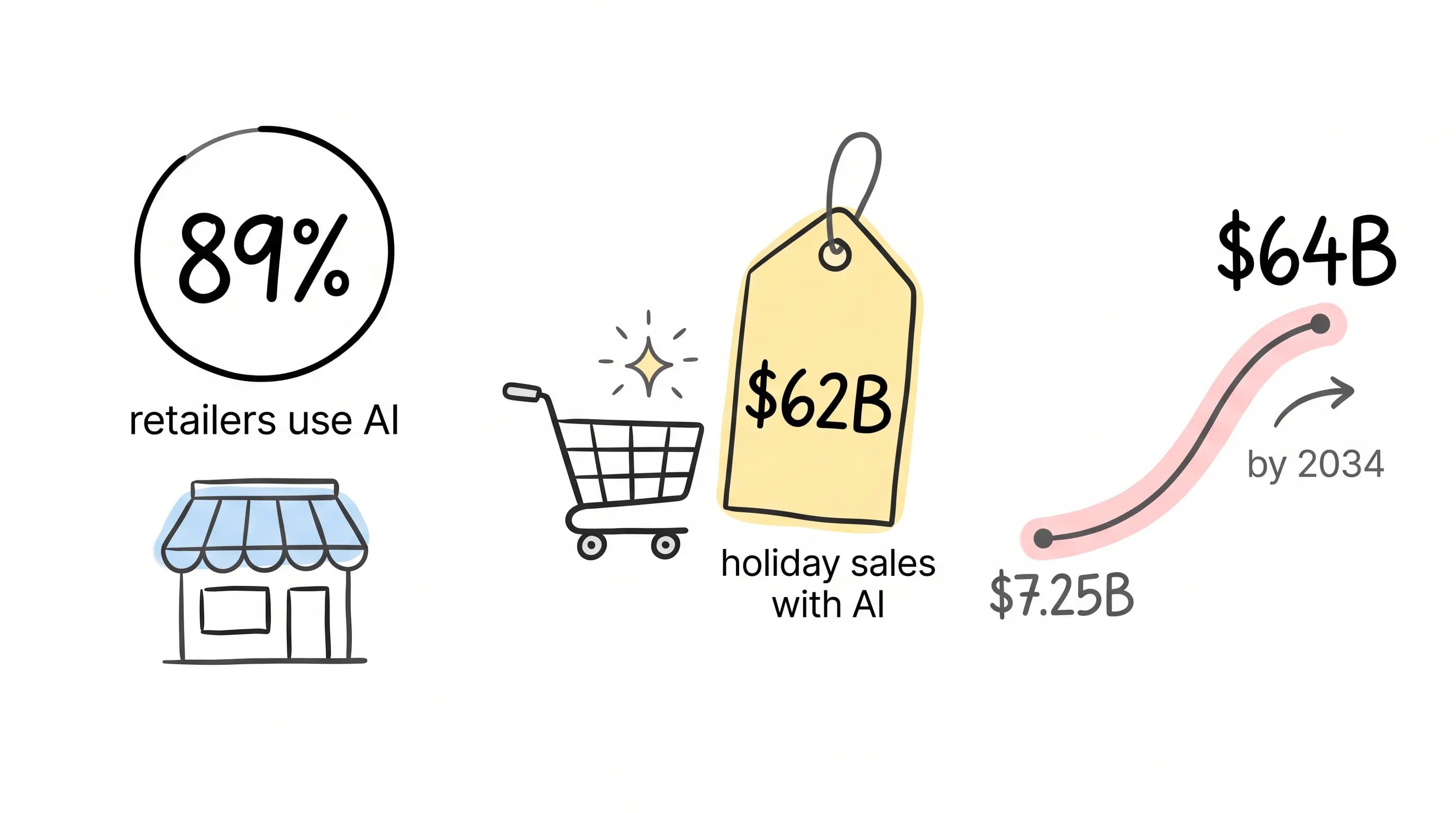
89% of Retailers Are Already Using AI. The Playbook for E-Commerce Has Changed
A learn article on AI in e-commerce: adoption context, use cases from recommendations, search, dynamic pricing, customer service, inventory, and fraud control, plus B2B applications, generative AI content, tool examples, pitfalls, and a six-step adoption path.
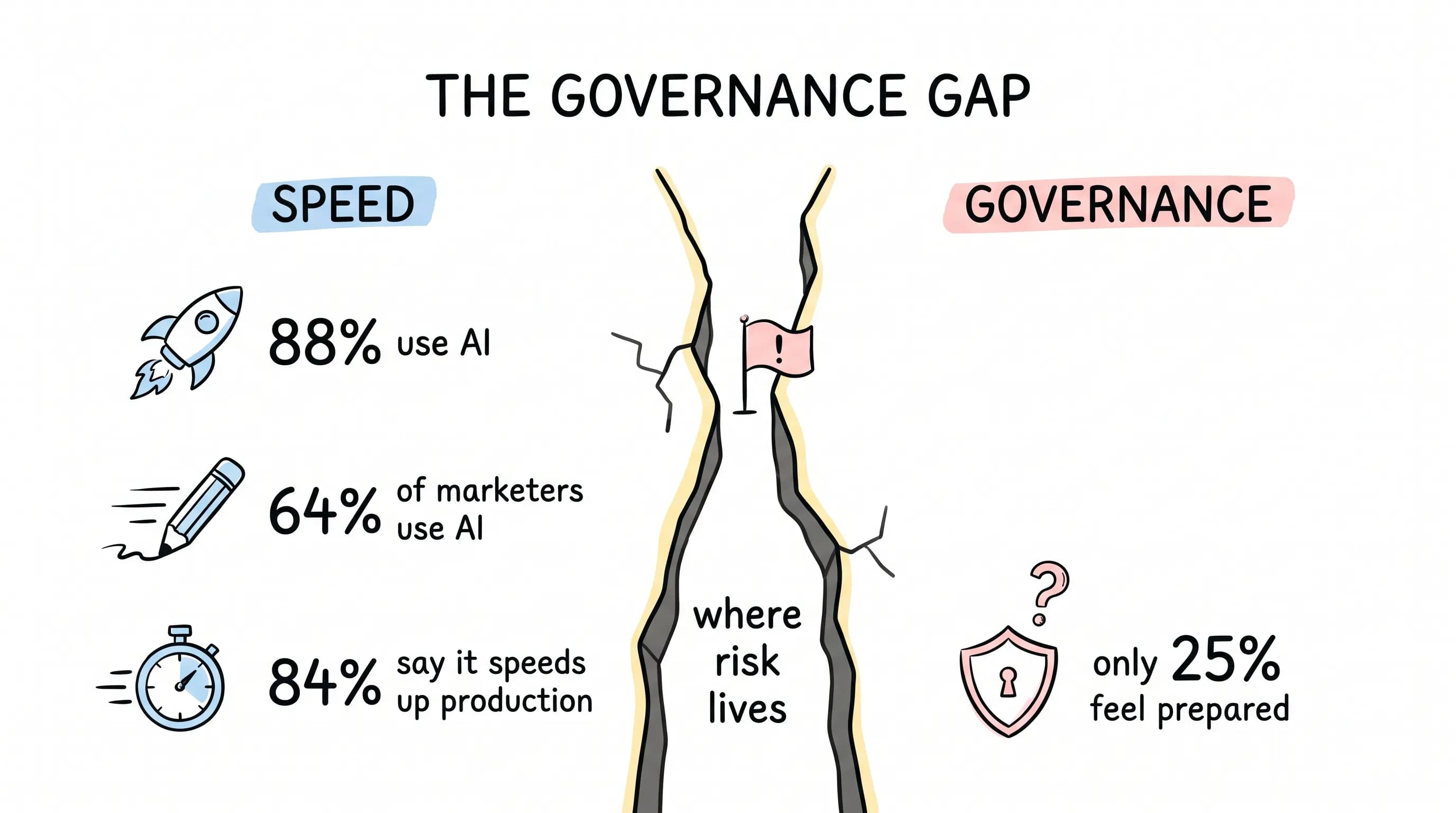
AI Makes Content at Lightning Speed — But Can You Answer "Who Approved This?"
This article looks at the gap between AI content speed and governance readiness in marketing teams, and outlines nine control points — prompt validation, brand guardrails, permissions, approval workflows, human review, versioning, IP checks, audit trails, and asset reuse — for brand-safe AI content.