
80% Say AI Works. So Why Have Only 6% of Companies Made Money From It?
An analysis of McKinsey's annual AI survey of 1,719 companies: 80% report personal efficiency gains, yet only 37% see EBIT impact and 6% are star performers. It covers agent adoption, build-vs-buy software shifts, token costs, and the leaders' playbook of growth goals and workflow redesign.
Last weekend, curled up on the couch, I read McKinsey's annual AI survey from beginning to end. Twice.
McKinsey has been running this survey for nearly ten years. This year, from May to June, they asked 1,719 companies across 97 countries. Asked every year, answered every year — like taking an annual X-ray of how the world's companies are progressing with AI.
And on this year's X-ray, one contrast jumps right out.
Eighty percent of respondents say AI has made them personally more efficient. Half say AI has helped them make better decisions.
Sounds great, right?
But.
Only 37% of companies say AI has made a positive contribution to the company's earnings. That number is exactly the same as last year's — it hasn't moved an inch. As for the star performers, the companies that have gotten major impact out of AI? They make up 6%. Last year, also 6%.
Imagine a gym where every member is raving about sore muscles and real results. Then the owner runs the year-end numbers — and revenue has grown by exactly as much as last year.
Individual productivity is rising. Company profits aren't.
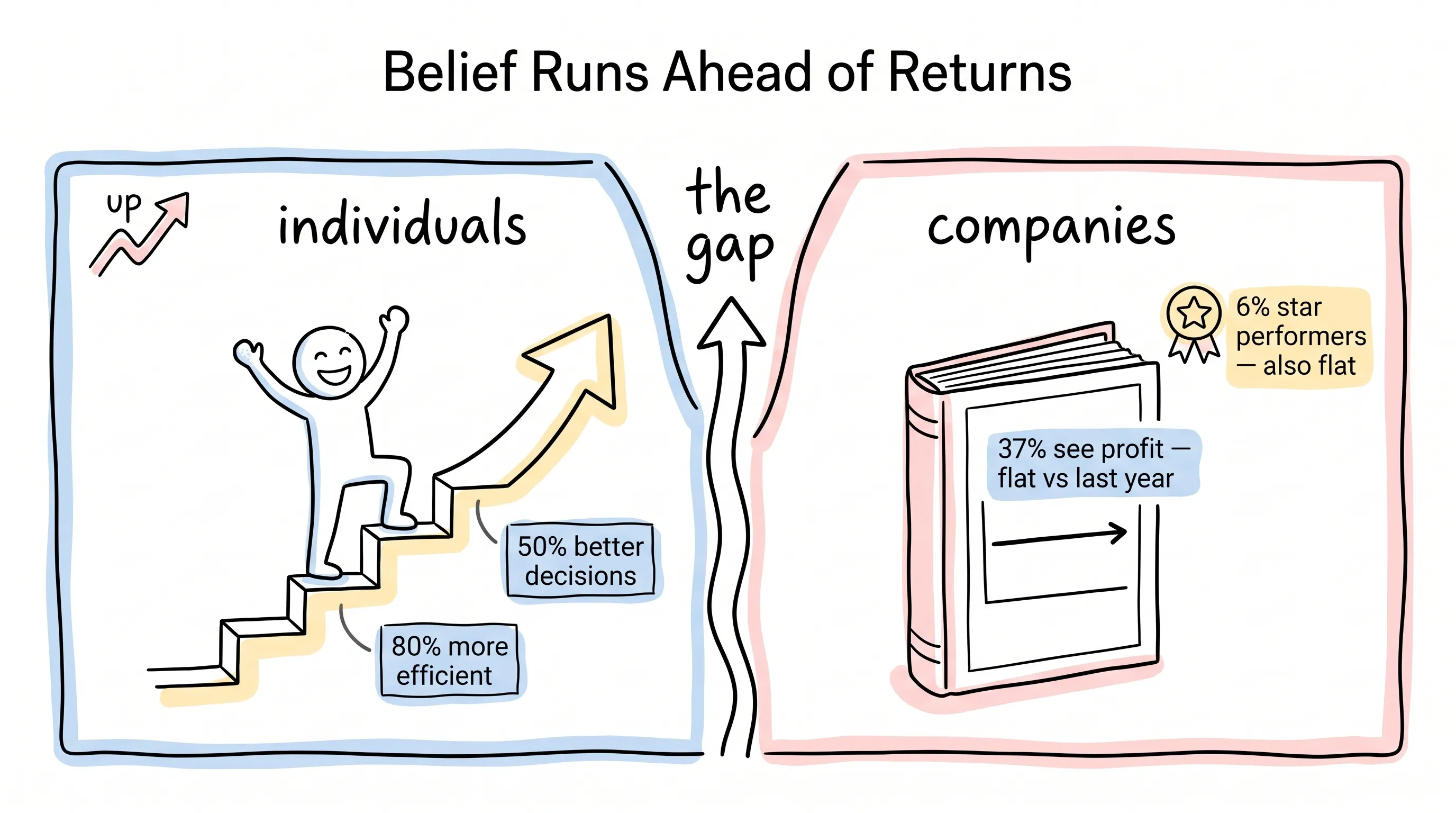
That's the most twisted-up part of the AI story this year.
First, Let's Be Clear: What Is EBIT?
EBIT, simply put, is what a company's core business actually earns once you strip out the items that have nothing to do with the main operation — interest and taxes.
It's the number you look at to tell whether a company is genuinely making money, or just making noise.
So that 37% translates into this: fewer than four in ten companies can honestly say AI has helped the core business turn a profit.
The other six in ten are using AI with great fanfare — the money just hasn't arrived yet.
The interesting part: look closer at the department level, and the money is actually moving. The functions where AI saves the most? Supply chain, customer service, and manufacturing. The ones where it earns the most? Marketing and sales, and product development.
But those bits of spare change haven't yet compounded into the big money on the income statement.
They're Genuinely Using It
You might be wondering: are companies still sitting on the fence, still running pilots?
No.
Nearly 90% of companies now use AI regularly in at least one function. At 44% of companies, AI is deployed across the entire organization. Last year, it was 38%.
Companies using AI in three or more functions have risen from 51% to 56%.
Big companies are moving faster. Among enterprises with annual revenue over $1 billion, 54% have gone enterprise-wide. Small companies? One in three.
The sharpest divide, though, is opening up around AI agents.
What's an agent? AI used to be like a customer-service rep: you ask one question, it gives one answer. An agent is different — you hand it a goal, and it breaks the task down, gets to work on its own, and finishes the job.
It's AI with hands.
Last year, 27% of large companies had deployed agents at scale. This year, 40%.
Small companies? 22%. And last year? Also 22%.
Think about that: over the same twelve months, one group sprinted from 27% to 40% while the other stood still.
That's how the gap opens up.
The work agents do varies by industry. Tech companies use them to write code; consumer goods and retail, to run marketing and sell product; carmakers and chipmakers, to manage supply chains and production. Wherever the value is greatest, that's where they get deployed first.
As for what's deployed most widely of all? Still the chatbot — 47% of companies have rolled one out company-wide. Agents aren't there yet, but they're moving fastest.
Software Is Starting to Shift From "Buy" to "Build"
Of everything in this survey, the number that made me sit up straight was this one:
32% of companies say they had planned to buy a piece of software, then found they could build it themselves with AI coding tools — and so they decided: not buying.
Nearly a third. Wow.
Tell that to any head of IT three years ago and they'd have thought you were joking. Buying software and building software were things done by two entirely different species.
Now, if they can build it, they won't buy it. Among AI star performers, that figure approaches half.
That software budget pool, I suspect, is about to start moving.
The Electricity Bill Is Starting to Sting
Of course, there's no such thing as free AI.
One in five companies admits that the operating cost of AI — token costs included — has climbed high enough to start limiting usage.
What's a token? Think of it as AI's electricity. You used to hire people: salary paid monthly, and you knew roughly what it would cost. Now AI does the work — and the meter spins like crazy. Use more, burn more.
Every category of AI tool has been pinched by this electricity bill to some degree — for each category, roughly 10% of companies report being constrained.
But here's the interesting part: even as the bill stings, investment is going up.
60% of companies say they will increase their AI investment next year. At 28% of companies, AI spending already exceeds 10% of the total IT and communications budget.
Wincing at the electricity bill — and buying more electricity anyway.
What does that tell you? Nobody thinks AI is too expensive — they just don't think it has paid for itself yet. The day it truly does, who's going to fret over the electricity bill?
One More Detail, Hidden on the Flip Side
Eighty percent say efficiency is up, half say decisions are sharper — all of it sounds like good news.
But negative experiences are rising too. Among middle managers and frontline employees, 47% say they have felt some real pain from AI.
Senior executives? 31%.
Executives keep the efficiency gains. The pressure lands on the people below.
What Did That 6% Get Right?
Back to the question we started with.
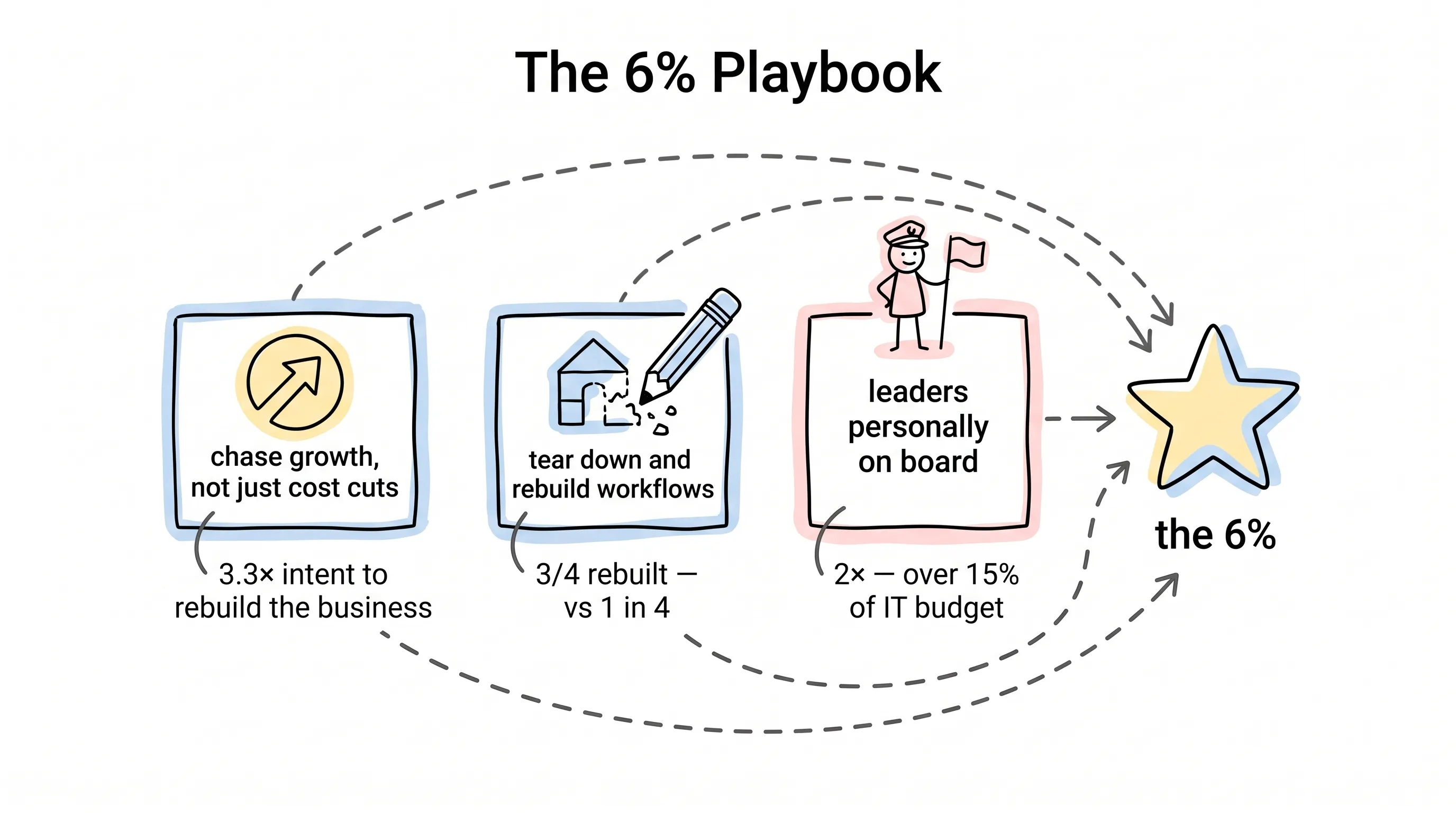
McKinsey compared the 6% of star performers with the remaining 94%. The difference isn't whether they use AI. It's three moves.
First, they set out with different goals.
What are 80% of companies using AI for? Cutting costs, raising efficiency. The star performers want those too — but at the same time, they're also using AI to chase growth and innovation. Their intent to use AI to rebuild the business from the ground up over the next three years is 3.3 times that of everyone else.
In one sentence: the others use AI to cut costs. They use AI to remake the business.
Second, they dare to tear it down and redraw.
Nearly three-quarters of star performers have torn their workflows down and rebuilt them because of AI. Last year, that figure was 55%. The other companies? One in four.
Stuffing AI into old workflows is like strapping a turbocharger onto a horse cart. What actually gets you moving is the car rebuilt from scratch.
Third, their leaders are dead serious about it.
Star performers' senior executives are twice as likely to personally lead the AI effort; twice as likely to have set up dedicated processes to measure whether AI is actually useful; and more than twice as likely to put more than 15% of the total IT and communications budget into AI. Next year, more than half of the star performers plan to raise their AI investment by another 10% or more; among other companies, only 36%.
By the way, they also use AI in more functions, and their AI risk management is more thorough.
So you see — that 6% isn't luck. It's the playbook.
A Plot Twist: All That Talk of Layoffs, and No Real Cutting
There's another stretch of the survey that's particularly interesting.
Last year, 32% of companies expected AI to shrink their headcount.
Looking back this year: over the past twelve months, only 14% of companies actually cut staff because of AI.
Less than half the expectation. Two-thirds of companies say headcount has barely moved.
But expectations keep climbing: 39% of companies expect AI to reduce total headcount next year.
Every function is running the same script. The ones that predicted reductions last year — marketing, manufacturing, strategic finance, knowledge management — counted up this year and found actual cuts ran about half the forecast.
Fear runs faster than facts.
And the individual feeling is even more telling: only 13% of people say AI makes them anxious about their career prospects.
The earth-shaking changes in the forecasts haven't taken a single step into reality. At least, not yet.
Finally, Back to the Point
Closing the report, I traced the through-line of this survey one more time. It comes down to a single sentence:
Belief in AI is running ahead of the returns.
They're using it more deeply. Investing more. Even their expectations of transformation have grown bolder.
But look at the income statement, and it's still that 37%. Still that 6%.
What turns personal productivity into company profit, in the end, is the companies brave enough to redraw the business.
Plenty of companies have installed AI. Very few have redrawn their workflows.
The gap between 6% and 94% isn't about AI. It's about the playbook.
Here's hoping you're in that 6%.
Continue reading
Related articles
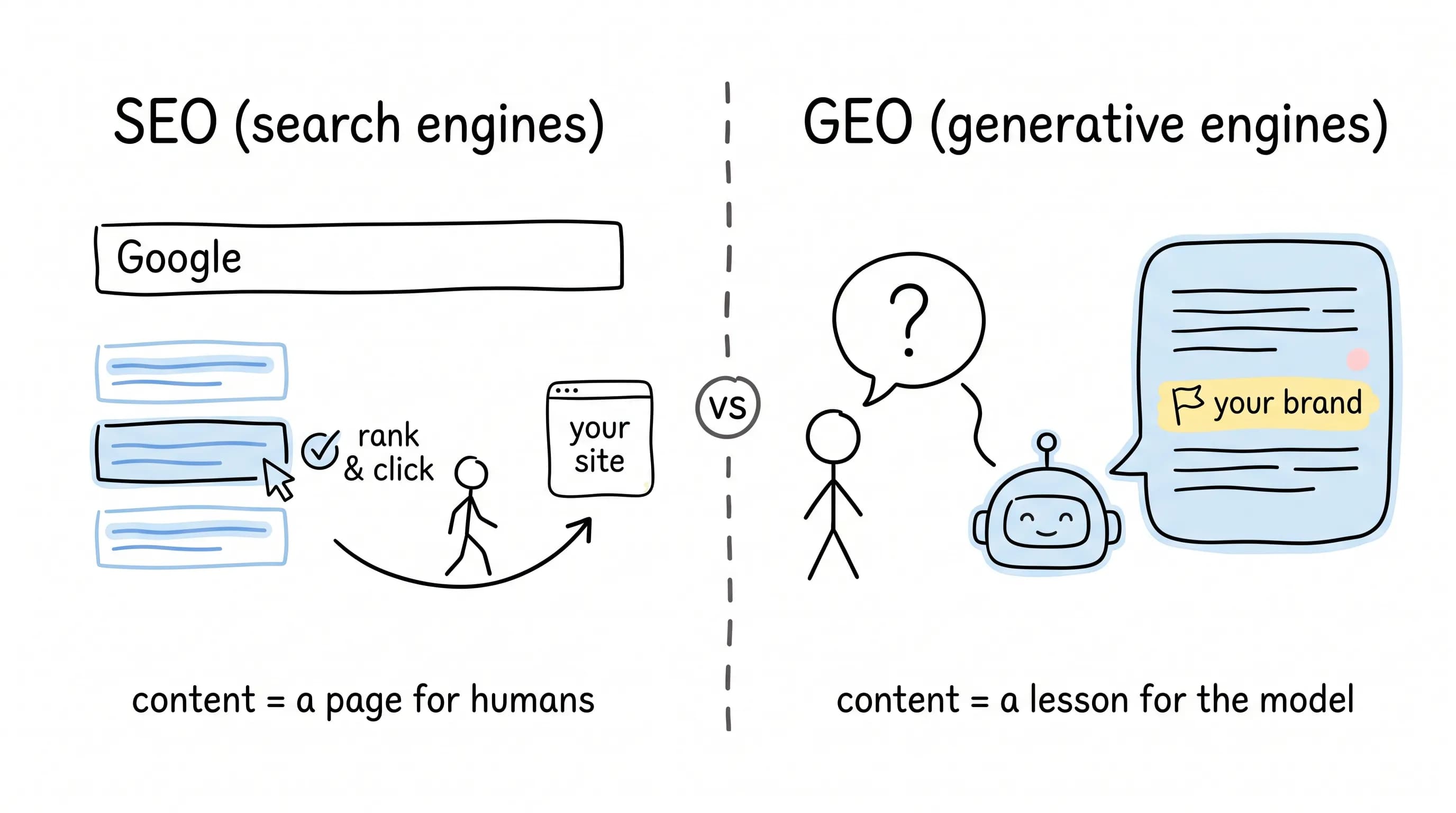
Does AI Know Your Brand? A Look at GEO, the New Craft
An explainer on GEO (Generative Engine Optimization): how AI engines like ChatGPT, Perplexity, and Gemini differ, how GEO goals and metrics diverge from SEO, and which SEO skills still carry over.
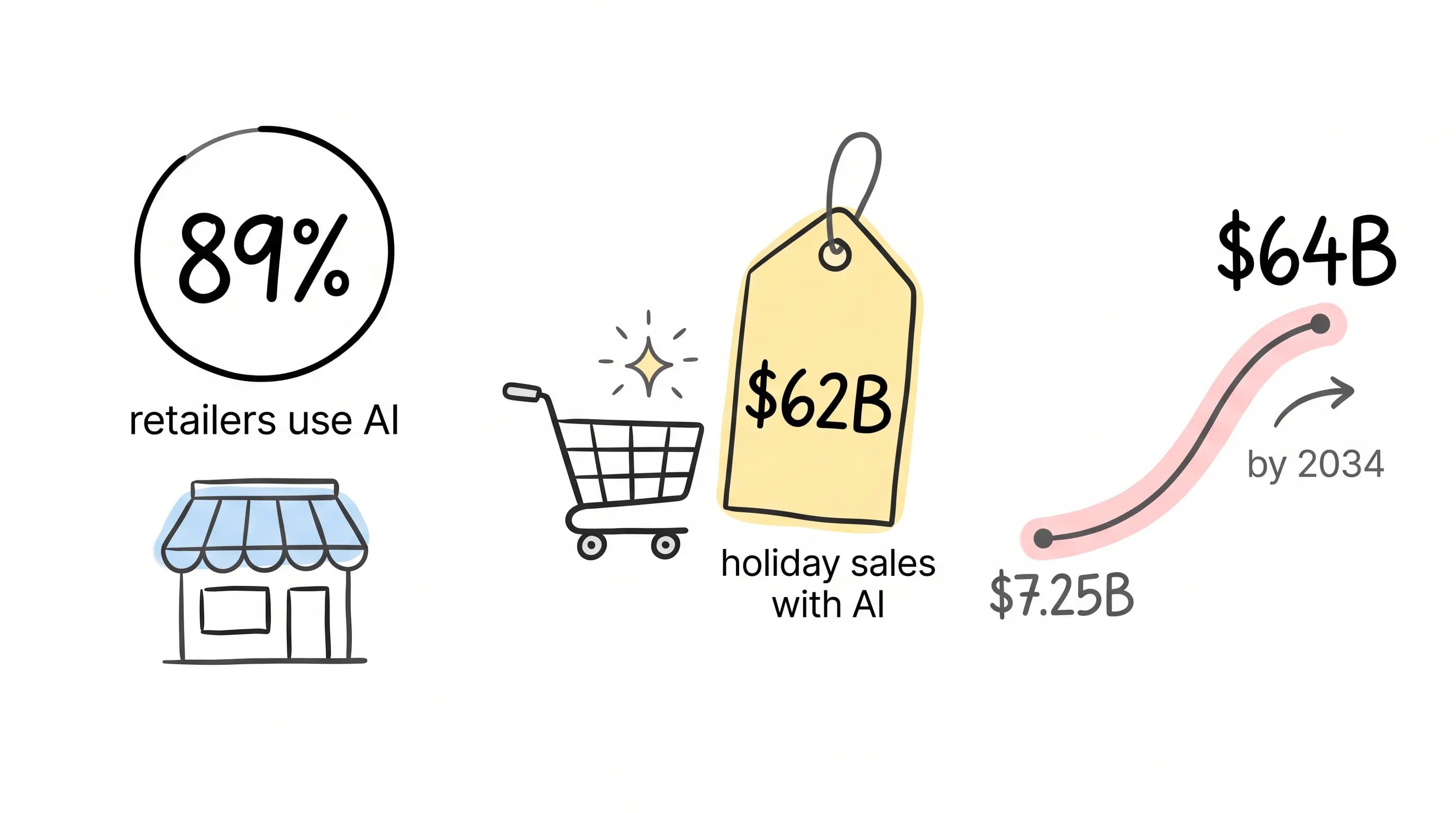
89% of Retailers Are Already Using AI. The Playbook for E-Commerce Has Changed
A learn article on AI in e-commerce: adoption context, use cases from recommendations, search, dynamic pricing, customer service, inventory, and fraud control, plus B2B applications, generative AI content, tool examples, pitfalls, and a six-step adoption path.
AI Makes Content at Lightning Speed — But Can You Answer "Who Approved This?"
This article looks at the gap between AI content speed and governance readiness in marketing teams, and outlines nine control points — prompt validation, brand guardrails, permissions, approval workflows, human review, versioning, IP checks, audit trails, and asset reuse — for brand-safe AI content.