
80% of B2B Deals Are Won Before the Buyer Ever Contacts You
A learn article arguing that most B2B buying decisions form during an anonymous research phase, so content must be built to be cited in AI answers. It covers generative engine optimization, personalization economics, and using AI with unified context.
A few days ago, a friend of mine who runs a B2B software company grabbed a drink with me and told me about something strange.
His product actually sells well — once they get a seat at the table with a customer, their win rate is strong. And yet this year, new customers have become harder and harder to land.
"Is our sales team getting worse?" he asked.
"No," I said. "You may never have entered the real game in the first place."
In the Buyer Experience Report that 6sense released in 2025, there was a number that stopped me in my tracks the first time I saw it:
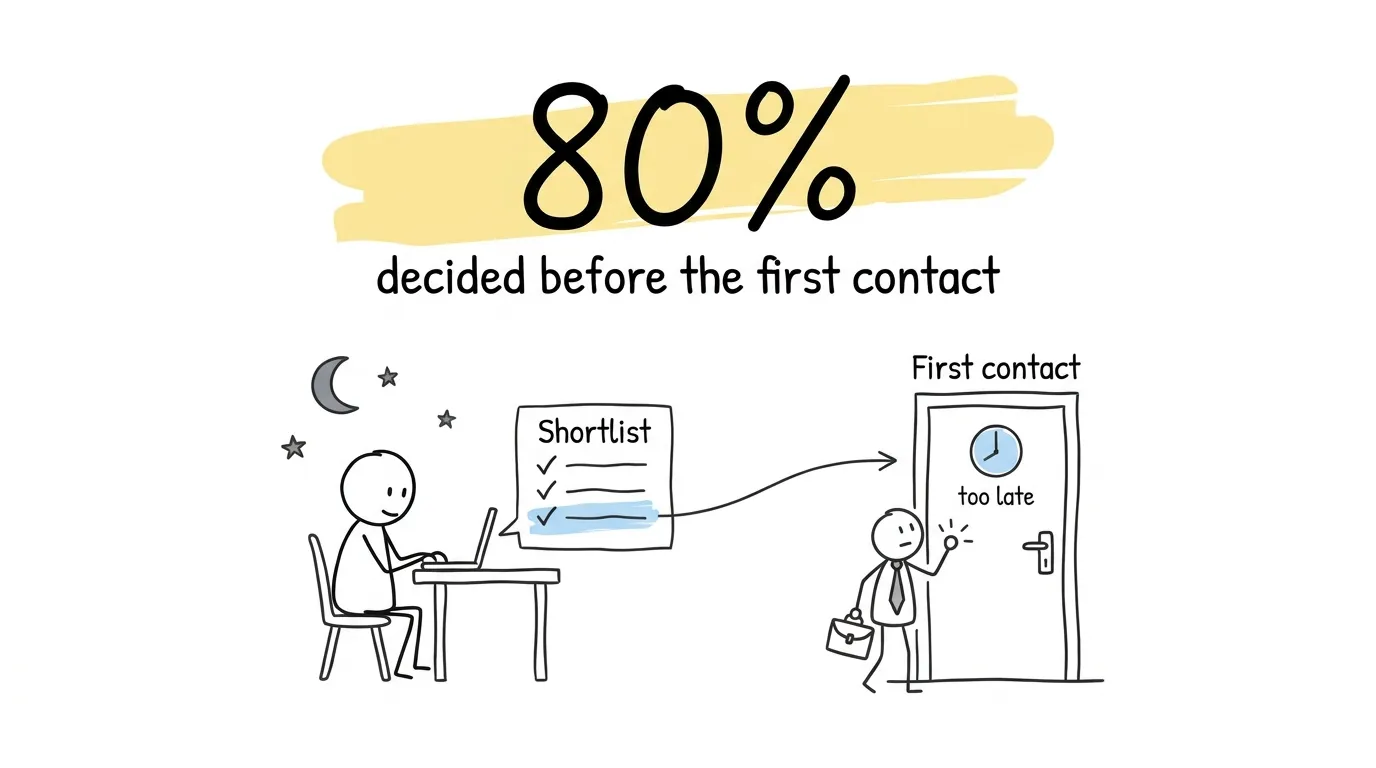
80% of B2B purchases are decided before the buyer ever contacts the vendor for the first time.
What does that mean?
It means buyers — anonymously, without revealing who they are or saying hello — complete most of their research on their own, and by the time they reach out, the decision is already made in their heads. When they contact you, they aren't coming to compare. They're coming to confirm.
What Is the "Anonymous Research Phase"?
This is the truth of B2B buying: deals aren't closed in conference rooms. They're quietly settled during a buyer's late-night solo searching.
That 6sense report contained several other findings worth tallying one by one:
- In 95% of cases, the eventual winner was already on the buyer's day-one shortlist.
- 83% of buyers have their requirements defined before they ever talk to sales.
- 60% of the buying journey is spent on independent research.
What does this mean for sales?
It means what your sales team sees is only the final shot on goal. The ninety minutes of passing and buildup before it? They weren't on the field.
Here's another interesting data point. In 2024, the average procurement cycle was 11.3 months; in 2025, it shortened to 10.1 months.
Does a shorter cycle mean buyers are doing less research?
Quite the opposite. Buyers are arriving earlier, with more thorough homework done. What's more, 58% of buyers reached out to sales earlier specifically because they needed to evaluate vendors' AI capabilities. So sales got involved sooner — but the buyer's mind was already made up. The shortlist was locked before the first phone call ever happened.
That's powerful. It's the kind of insight every B2B team should write on the wall.
So what do you do? The answer points to the same thing: content. During those anonymous months, before the buyer has raised their hand — did your content get you onto their shortlist?
Companies with a blog generate 67% more leads per month than those without one. And organic search traffic converts at 2.8 times the rate of paid traffic.
Personalization Isn't an Experience. It's Revenue.
The second ledger: personalization.
Many people think of personalization as an "experience upgrade" — a nice-to-have, icing on the cake.
McKinsey ran the numbers in Next in Personalization — that research was published in 2021, and as of early 2026, McKinsey has not released a comparably comprehensive study on the topic, so it remains the most complete one available:
- Companies that excel at personalization generate 40% more revenue than average players.
- Most companies see a 10%–15% revenue lift from personalization, a 10%–30% improvement in marketing ROI, and acquisition costs that fall by as much as 50%.
Forty percent. That's not an experience. That's a money printer.
And buyers are voting with their behavior: 71% of consumers expect brands to deliver personalized interactions, and 76% feel frustrated when they don't get them. In data compiled by Contentful in 2025, 80% of enterprises said customers who experience personalization spend more.
Think about the last time a shop clerk got your name wrong the moment you walked in and pushed a pile of things you had zero need for. How did that feel?
Personalization isn't a gift you bestow on customers. It's the baseline they demand of you.
Everyone Is Using AI — So Why Is Nobody Reading Your Content?
The third ledger is the most gut-punching one of 2026.
By 2026, 95% of B2B marketers are using AI tools. Just two years earlier, 65% of marketers still weren't using AI to write blog posts — now, only 5% hold out.
A survey Jasper ran in 2025 found that 63% of marketers were using generative AI. For what? 89% used it to generate or refine copy; 53% used it to create visual assets.
On the surface, everyone is using AI. But here's the problem:
If everyone uses the same AI, why does some content get cited and shared — while other content goes out and lands with a thud?
The difference isn't the AI. It's what you feed the AI.
Two teams, same platform, same prompts. Behind one team sits unified customer data, historical campaign performance, and competitive intelligence. Behind the other sits a blank slate.
The output is worlds apart.
Context is the variable. It determines whether AI produces content that gets cited — or content that gets ignored.
The data makes this vividly clear: 87% of users say AI has boosted their productivity, yet 12%–13% admit that over-reliance on automation has actually degraded content quality. 58% believe AI has improved content quality — but only 4% would go so far as to say AI content without human oversight deserves trust. And 43% of B2B marketers are struggling to make their content stand out in the red ocean of mass-produced AI material. McKinsey's 2025 global AI survey twisted the knife: among companies using generative AI in marketing and sales, roughly two-thirds reported revenue growth — in the range of 5% to 10%.
The most sobering contrast of all: only 21% of brands and 22% of agencies have truly integrated AI into their omnichannel personalization systems.
Put another way: 95% of people are using AI. 21% are using it right.
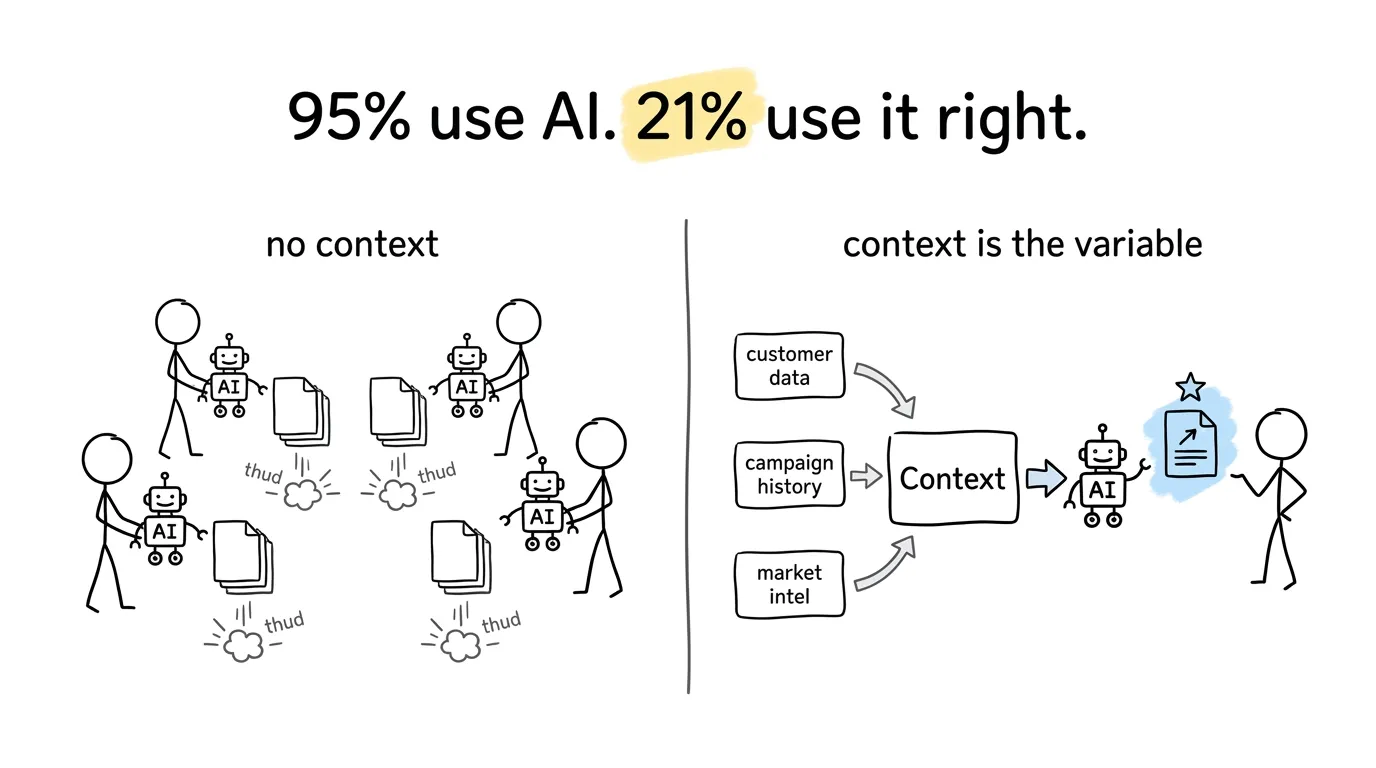
Tools like Omnibound, which build "marketing context engines," are aimed at exactly this: unifying product, customer, and market intelligence into a single context layer, so every act of AI content generation starts from one shared understanding — instead of isolated prompts that begin from scratch every time.
Buyers Have Stopped Searching for Keywords
The fourth ledger: search.
Where are buyers doing their research now? ChatGPT, Perplexity, Google's AI Mode — not just traditional search.
6sense found that 94% of B2B buyers use large language models to organize and synthesize research during the buying process. Forrester's 2025 research landed at roughly 89% — the two numbers corroborate each other.
A consumer survey Gartner conducted in October and November 2025: 51% of people have changed how they research because of generative AI. Among them, 71% have even changed how they phrase their queries — it used to be "CRM recommendations"; now it's "We're a 200-person manufacturing company that wants a CRM that integrates with our ERP. Which one should we pick?"
Sit with the difference between those two phrasings.
The first is a keyword. The second is a statement of need.
What's more, visitors arriving from AI search spend up to 3 times longer on a page than visitors from traditional search. And research TrustRadius published in 2025 found that 90% of buyers have clicked at least one cited source inside Google's AI Overviews.
Being cited by AI is becoming a new distribution channel.
The industry term for this is GEO — Generative Engine Optimization. You used to optimize content to rank high in search results; now you optimize content to be cited in AI answers.
The anonymous phase where buyers research and build their shortlists now happens inside AI answers. If you don't get cited, you don't exist.
One caveat I have to flag: some research claims AI search converts at 4.4 times the rate of traditional search — but that figure comes from secondhand aggregation, so treat it as a directional signal, not a precise number. The 3x dwell-time figure comes from a named Forrester case study and is somewhat more reliable. Both numbers point to the same conclusion: traffic from AI arrives with sharper intent.
The Way Data Gets Bought Has Changed Too
The fifth ledger: data.
Third-party cookies are fading out and privacy regulations keep tightening. Buying data and guessing is getting harder by the day.
So what will buyers give you?
eConsultancy offered one number in The Future of Marketing: 52% of consumers are willing to trade personal data for more relevant product recommendations. Another study in 2026 found that 48% of people view brands that proactively collect zero-party data more favorably.
But — and pay attention to this "but" — Deloitte's 2025 Digital Media Trends data shows that only 47% of consumers trust online services to protect their data. And 70% will walk away for good if a brand mishandles it.
One more, for everyone producing content with AI: in a Gartner survey from 2025, 78% of consumers said clearly labeling "this is AI-generated content" is very important — or the most important thing — for maintaining trust.
Do you see the structure here?
Buyers don't refuse to give you data. Buyers refuse to let you do things with their data that they don't understand. Trust is the admission ticket to the data era. Give them a transparent reason to trade, and they'll hand you the most accurate, freshest, most useful signals they have.
The Biggest Trap: You Think You've Personalized
The final ledger stings the most.
A survey StackAdapt and Ascend2 jointly released in early 2026: 87% of brands plan to increase their personalization investment in 2026. But 68% are still stuck in the early stages of execution.
Why? Not for lack of will — because their data is scattered, their tools are fragmented, and there's no unified measurement.
But that's still not the worst part. The worst part is this contrast:
- 85% of companies believe they're doing personalization well.
- Only 60% of customers agree.
That's a 25-percentage-point gap. In other words, more than half of teams are high-fiving themselves over a personalization that exists only in their imagination — while customers experience the same generic message as everyone else.
Salesforce's State of Marketing, tenth edition, hammered the point home: 83% of marketers agree that "marketing is shifting toward personalized, two-way conversations," yet only a quarter are satisfied with how they use data to power those moments. And 41% of marketers can't even measure marketing ROI across channels.
One more piece of advice, humble but effective: teams with a documented content strategy are 33% more likely to achieve higher ROI. Yes — the simple act of actually writing the strategy down.
The Takeaway
Back to that friend and our drink.
I told him: your problem isn't that sales got worse. The game moved to a new field. During those anonymous months of buyer research, you weren't even in the room. You wait until the buyer raises their hand to meet them for the first time — and 80% of deals are decided before that.
So what do you do?
Treat content as sales' forward outpost, not sales' brochure. Let buyers get to know you — and choose you — during the anonymous research phase, through your content, your citations, your personalization.
Buyers don't wait for you to knock on their door before they form an opinion of you. They form it in the search bar, in AI answers, in the homework they quietly finish alone at midnight.
Here's to always making the buyer's first list.
Continue reading
Related articles

It's 2026: Stop "Buying" AI Tools for Your Marketing Team — Start "Hiring" AI Agents
This learn article explains how AI agents differ from standalone AI tools in marketing, outlines three agent categories — build-your-own platforms, CRM-native agents, and vertical tools — and covers use cases across SEO, social media, advertising, and reporting, plus criteria for choosing one.

What Is GEO? How Your Brand Gets "Mentioned" in the Age of AI Search
An explainer on GEO (Generative Engine Optimization) for e-commerce and DTC brands: how it differs from SEO and AEO, why AI answers shape brand visibility, and eight practices covering question-focused content, consistent brand messaging, structured pages, external evidence, comparisons, and AI mention tracking.

AI Is Already Making Decisions for Your Customers. Are You on the List?
A learn article explains GEO (Generative Engine Optimization): why AI-generated answers now shape which brands customers see, and how SEO fundamentals, entity clarity, citable evidence, and monthly measurement affect visibility in AI answers.