
2026 Is Almost Over — Here's What Enterprise AI Agents Have Actually Become
This learn article reviews eight shifts in enterprise AI agents, from deterministic guardrails and context engineering to MCP interconnection, headless access, latency work, harness design, observability, and post-launch operations, using Salesforce Agentforce as its running example.
A while back, I had dinner with a friend who builds AI agents inside an enterprise.
His team has been using Agentforce for customer service for nearly two years now. The moment we sat down, he sighed: the models keep getting stronger — so why are the agents getting harder to manage?
I told him: no, that's not it. The agents aren't harder to manage — they've changed. They've changed so fast that a lot of people are still looking at them through a 2025 lens.
I went through everything published this year, combined it with his long list of complaints, and boiled the shifts happening to enterprise AI agents down to eight. The biggest takeaway from reading it all: last year, everyone was competing over whose model was smarter. This year, everyone is competing over whose agent you can actually rely on.
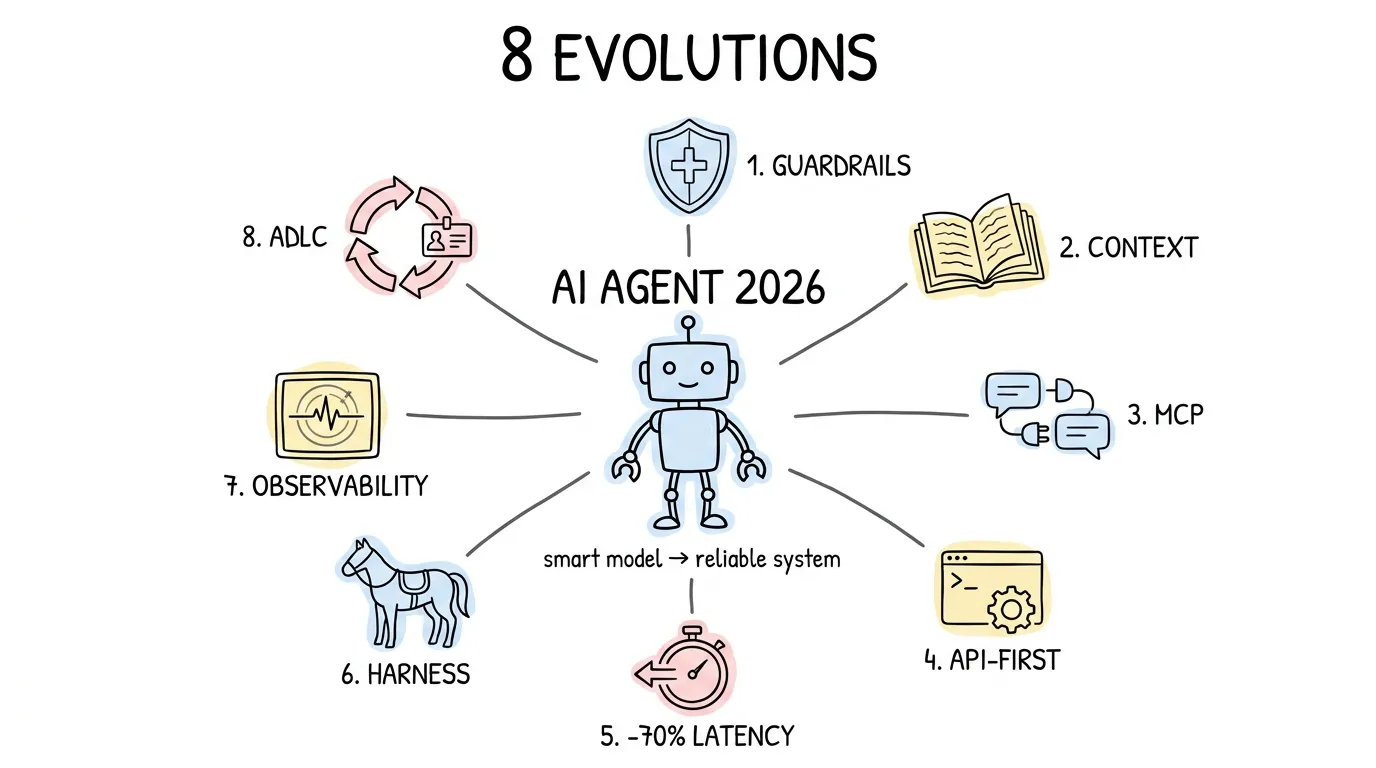
Here are the eight. One by one.
1. Start With the One That Matters Most: Determinism
What do I mean by deterministic guardrails?
Think about a bank teller. No matter how experienced the teller is, they must verify your ID before they can talk to you about your balance. That order is non-negotiable.
Agents are the same. A banking agent must verify identity first, then discuss accounts. However smart the large model is, it might "feel" that jumping straight to the balance is fine. So critical steps can't be left to the model's own judgment — they have to run on deterministic logic: if this, then that, hard-coded.
Salesforce built a scripting language called Agent Script into Agentforce for exactly this purpose. Developers write "must run in this order, must produce this result" as if/then rules and nail them down.
The feedback from early users is telling: agents went from "usually right" to "always right."
The difference between "usually" and "always" is more than one word. It's the difference between whether something can ship to production.
The model handles the cleverness. The guardrails handle the reliability. Missing either one, you don't go to production.
2. Prompt Engineering Is Expired — Context Engineering Took the Throne
What is context engineering?
People used to obsess over this question: how do I phrase things so the model answers better? That's prompt engineering.
But now you realize that whether an agent answers well often has less to do with how you ask, and more to do with what it's holding in its hands.
Which data can it see? Is the knowledge base up to date? How much context can one conversation hold? When should it go fetch what?
It's like taking an exam. No matter how artfully you answer, if you didn't bring the textbook, you're sunk. Prompt engineering optimizes the question. Context engineering optimizes the conditions for answering.
Going forward, more and more of the work of building agents will go into a single question: what kind of reference room are you setting up for it?
3. Agents Started Talking to Each Other
Not long ago, wiring an agent to an external tool meant your team hand-writing a bespoke integration. Getting agents from two different vendors to cooperate? That was a research project.
Then MCP arrived — Model Context Protocol. It's essentially a universal power socket for everything: agents calling tools, querying databases, collaborating across vendors, all through one standard port.
By the end of 2025, more than ten thousand MCP servers had been publicly deployed. MCP was later donated to the Foundation for Agentic AI, officially becoming open infrastructure.
Wow. That pace.
But once the door opens, bad actors can walk in too.
There's an attack called tool poisoning: a malicious server smuggles hidden instructions into its responses, manipulating the agent's behavior. You can't see it — and the agent just obeys.
So openness does not equal safety. Agentforce's answer is a trusted gateway: administrators decide which MCP servers an agent may touch, and every access leaves a complete audit trail.
Openness is the trend. Access control is the prerequisite.
4. Agents Don't Need an Interface
For decades, using Salesforce meant opening a browser and clicking into a page. The interface was the product.
Now? When an agent goes to work, it never looks at the interface. It cares about one thing: can I reach your data programmatically?
So Salesforce built Headless 360, exposing the entire platform through APIs and the command line. Whether the agent lives in Slack or in ChatGPT, it can read and write your CRM anytime, anywhere.
From "a person walking into the office" to "the office growing thousands of phone lines." The product didn't disappear — the interface did.
5. How They Fixed Slowness
An agent's slowness is not the same kind of slowness as traditional software's.
Traditional software is slow because a database query is slow or an API has latency. Agents are slow because of queuing: the user says one sentence, and the model has to make four back-to-back LLM calls, each waiting on the last. By the time the first word appears, an enterprise scenario can easily hit 20 seconds.
Twenty seconds. The user is long gone.
The fix? The Agentforce team didn't tune parameters. They tore down the runtime and rebuilt it. Six months, 30 systematic changes:
LLM calls before the first token came back: cut from four to two. Input safety checks no longer consult a large model — they now look up a rulebook, a deterministic filter. Topic classification was handed to a small in-house model, HyperClassifier, roughly 30 times faster than the general-purpose large model it replaced.
The result: platform-wide latency dropped 70%.
See — the key to fixing slowness isn't swapping in a stronger model. It's making it wait in fewer lines.
6. What Decides an Agent's Fate Isn't the Model — It's the Harness
What's an agent's harness? Think of a horse's tack: the reins, the saddle, the track — all of it lives outside the horse.
What data the agent can see, whose permissions it runs under, which systems it can touch, what it's explicitly forbidden to do. These things "outside the horse," taken together, determine how it performs.
An ordinary model that can see the full customer picture — purchase history, open tickets, contract terms, recent interactions all in its head — beats a brilliant model working from stale materials.
So the most important architecture decisions in an Agentforce deployment are not about which model to pick. They're whether to connect Data 360, how to configure permissions, whether the knowledge base is good enough, how the trust layer is governed.
A smart model on bad data will make mistakes with total confidence. An ordinary agent with complete data is the one where you say, "it just works."
7. Agents Got Their Own Monitoring System
When a traditional application breaks, you know the drill: read the logs, trace the request, find the error. Code is static — once it's fixed, it's truly fixed.
When an agent breaks, it's nothing like that.
It can hand you a perfectly formatted, entirely plausible answer — that answers the wrong question. No error, no alert, spotless logs. The failure is semantic, not technical. In traditional monitoring, an anomaly like "it understood the question but answered a different one" doesn't even exist as a category.
So Agentforce built Observability specifically for this: session-level tracing that captures the full reasoning path; intent classification that surfaces the questions users are asking which no agent was designed to handle; behavioral drift alerts that watch not for system errors but for odd conduct.
Old monitoring asked: "Did the program crash?" New monitoring asks: "Is it behaving normally today?"
8. Going Live Is Just the Beginning
The last one — and the one I most want you to underline.
Everyone is fixated on "how do we build the agent." But what truly decides success or failure is everything after launch.
Who is accountable for this agent? If it goes haywire at 2 a.m., who gets paged? After you change the instructions, how do you regression-test? What does a 15% human-handoff rate actually mean?
Salesforce has organized all of this into the ADLC — the Agent Development Life Cycle: from planning to iteration, every stage has clearly defined roles, metrics, tools, and responsibilities. Entirely new job titles are showing up inside it: Agent Supervisor, Agent QA Lead, AI Ops Manager, Chief AI Officer.
I love this signal.
The mark of a maturing industry isn't another new technology. It's the arrival of dedicated job titles.
Just as the emergence of "social media manager" once signaled that content had become a serious business, the emergence of "agent operations" today signals that agents have become core enterprise IT infrastructure.
Finally
Back to my friend. When we caught up later, he said one thing had finally clicked for him: building agents is like renovating a home. "Building" is the hard finish — the wiring, the walls. "Operating" is the soft finish. The hard finish you do once. The soft finish you only understand after moving in — and you keep adjusting, forever.
Strip these eight shifts down and they say one thing: in 2026, the center of competition has moved from "how smart is the model" to "how reliable is the system."
The cleverness is the model's job. The reliability is yours.
Here's to making reliability your moat.
Continue reading
Related articles

What Is an AI Marketing Agent? From "Using AI" to "Delegating to AI"
A learn article explaining what an AI marketing agent is, how it differs from rule-based automation, and which repetitive tasks such as lead qualification, reporting, and campaign monitoring can be delegated while humans keep key decisions.

Marketing Automation Is Shifting from "You Do It" to "You Say It"
This article explains how marketing automation is shifting from rule-based platforms that merely execute toward AI agents that plan, create, publish, and review campaigns, covering delegable tasks, underlying technologies, tool categories, adoption steps, and risks such as privacy and automating without strategy.

When AI Does the Creative, Mistakes Come in Batches Too
A learn article on the risks of using generative AI for marketing creative across brand, legal, compliance, and operational layers, with case examples and seven practices for review, rights clearance, documentation, and vendor governance.