
1.2 Billion People Use ChatGPT Every Week. Now Ads Are Moving In
A learn article explaining OpenAI's newly announced visual ad format testing in ChatGPT image generation, including labeling rules, measurement partners, brand-safety guardrails, and why the placement targets high purchase intent.
You ask ChatGPT to generate an image for you.
Say, a hand-drawn illustration of a weekend family dinner. The picture is being "drawn" stroke by stroke, and off to the side, a small card quietly appears: a product photo from a grocery store, with a "Learn more" button underneath.
Don't panic. This isn't a bug.
This is what OpenAI officially announced in October this year: ChatGPT is starting to test a brand-new visual ad format.
What Exactly Is a Visual Ad?
The logic of traditional advertising is interruption. You're watching a show, I drop in a 15-second spot; you're scrolling a feed, I slip in a sponsored post. The more absorbed you are, the more valuable I am.
So what's a visual ad? It's using an image to let you "see" what a product looks like, where it fits, and what it could bring to your life. You see it, you recognize it, and then you decide whether you want it.
And the ChatGPT version has an even cleverer logic: you're not being interrupted—you're in the middle of creating something.
You're planning a birthday party, generating a party poster—and right then, an ad for a custom cake shows up. Not only are you not annoyed, you might actually click through.
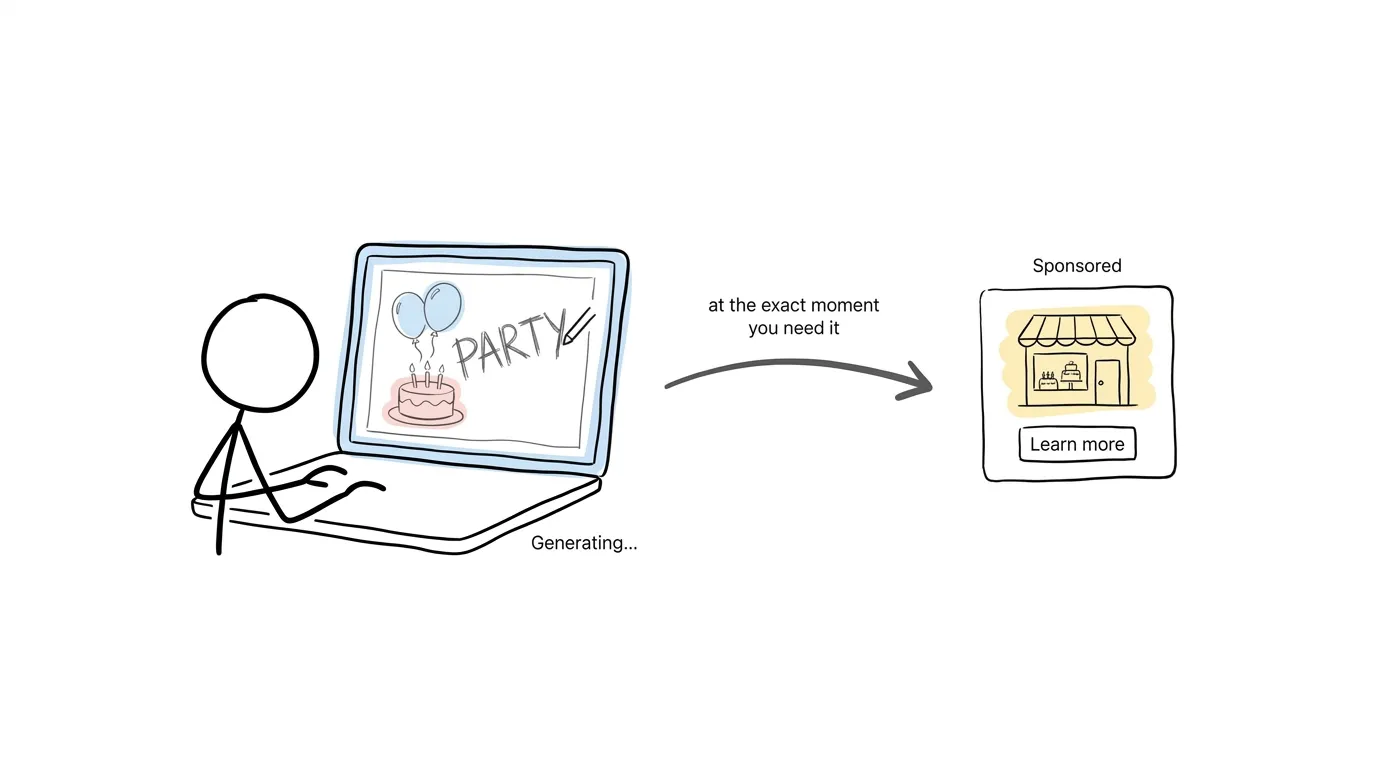
The highest form of advertising isn't grabbing attention. It's being there, at the exact moment you need it.
Will Ads Pollute the Answers?
First, the rules.
The initial test runs only in the US, only for users on the Free and Go tiers, and only within the image generation flow. Ads will be clearly labeled and kept separate from the image being generated—never mixed together.
And the most critical rule of all: ads do not affect ChatGPT's answers.
Ask it which option is better, and it answers exactly as it would have anyway. If this bottom line can't hold, everything else is wasted effort.
Why Is OpenAI Getting Into This Business?
Let's do the math.
ChatGPT reaches 1.2 billion people every week, making it the world's largest AI-native consumer platform. But subscriptions are a barrier—there will always be people who can't pay, or simply won't. Advertising lets more people use AI for free.
For OpenAI, this expands its market; for merchants, it opens up an entirely new touchpoint—users are here exploring ideas, comparing options, and making decisions.
This is the ad placement closest to purchase intent. Search ads come from someone typing in a few keywords, but an AI conversation is someone describing, in their own words, what they actually want.
What Do Advertisers Fear Most?
Not the price. It's spending the money and having no idea whether it worked.
This time, OpenAI has built out the entire "measurement" stack in one go.
Want to pipe in data? Hightouch, Tealium, and LiveRamp let conversion information flow in directly from existing systems. Want attribution? AppsFlyer, Triple Whale, Adjust, Rockerbox, Northbeam, Branch, Singular—pretty much every major player is on board. Want to figure out exactly how much incremental lift the ads actually deliver? OpenAI is running geographic experiments with Haus, Measured, and WorkMagic to test causality.
But what good are tools without proof? So here—let's walk through three real numbers.
WeightWatchers: per Rockerbox's attribution, its customer acquisition cost on ChatGPT ads came in 15.3% lower than its blended paid search baseline.
Wellness brand Dose: per WorkMagic's measurement, 67% of incremental purchases came from customers who had never bought before.
Portland Leather: per Triple Whale's data, 93% of visitors arriving from ChatGPT ads were brand-new faces.
Wow. Especially that last one.
What other channels sell you is usually repeat reach to existing customers. What this placement sells is a steady stream of new ones.
Will Ads Show Up When Someone Is Pouring Their Heart Out?
This is the question I care about most.
Picture this: it's the middle of the night, someone is having an emotional breakdown, and they're talking to ChatGPT. And then—an ad shows up?
No. OpenAI's ad placement guardrails will first assess whether the conversation is an appropriate context for ads. Emotionally vulnerable, sensitive, or unsuitable scenarios—no ads. Brands with more specific needs can also use Negative Phrases to exclude particular situations.
DoubleVerify and IAS, two independent firms, are running brand-safety evaluation pilots—they only test how well OpenAI's safety standards are being enforced, and never touch users' private conversations. IAS CEO Lidiane Jones put it precisely: as ads enter AI-native environments, what marketers want is brand safety that is durable, consistent, and able to run at scale.
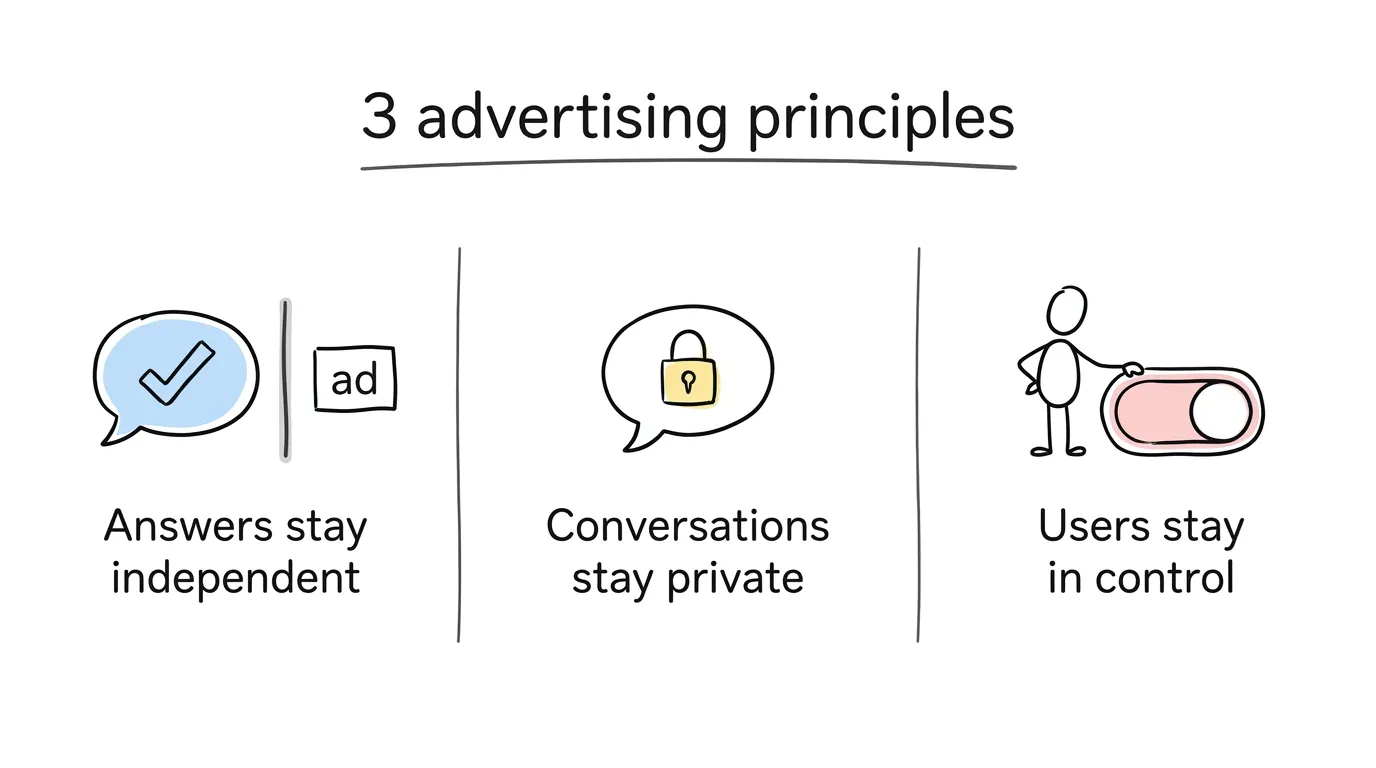
All of this hangs on OpenAI's three advertising principles:
Answers stay independent.
Conversations stay private.
Users stay in control.
Two Final Thoughts
The essence of this isn't "ChatGPT has monetized."
It's that the form of advertising is, for the first time, seriously adapting to the way people use AI: not intercepting, not interrupting, but accompanying you as you turn "the thing I want to do" into "the thing I actually did."
In the search-ad era, whoever ranked higher on the page won. In the AI era, whoever truly understands what that person wants will win.
Here's to being there, at the exact moment someone needs you.
Continue reading
Related articles

What Is GEO? How Your Brand Gets "Mentioned" in the Age of AI Search
An explainer on GEO (Generative Engine Optimization) for e-commerce and DTC brands: how it differs from SEO and AEO, why AI answers shape brand visibility, and eight practices covering question-focused content, consistent brand messaging, structured pages, external evidence, comparisons, and AI mention tracking.

AI Is Already Making Decisions for Your Customers. Are You on the List?
A learn article explains GEO (Generative Engine Optimization): why AI-generated answers now shape which brands customers see, and how SEO fundamentals, entity clarity, citable evidence, and monthly measurement affect visibility in AI answers.

Google Is Stuffing Ads Into AI Search: These Recent Stories Are Really One Story
A news roundup linking recent AI marketing stories—Google adding ads to AI Mode, Amazon's Ads Agent, ChatGPT image updates, a UK startup tracking brand mentions in AI answers, and an AI ransomware warning—arguing that control over ad data and visibility is shifting toward platforms.