
AI Marketing Daily · 2026-10-09
AI marketing daily for 2026-10-09 covering 11 items: brand measurement moving from survey panels to search, social, e-commerce, and AI prompt signals; GEO and share of model playbooks; safety guardrails for agentic ad buying; and tool roundups for ad platforms, cross-border tools, and social media uses.
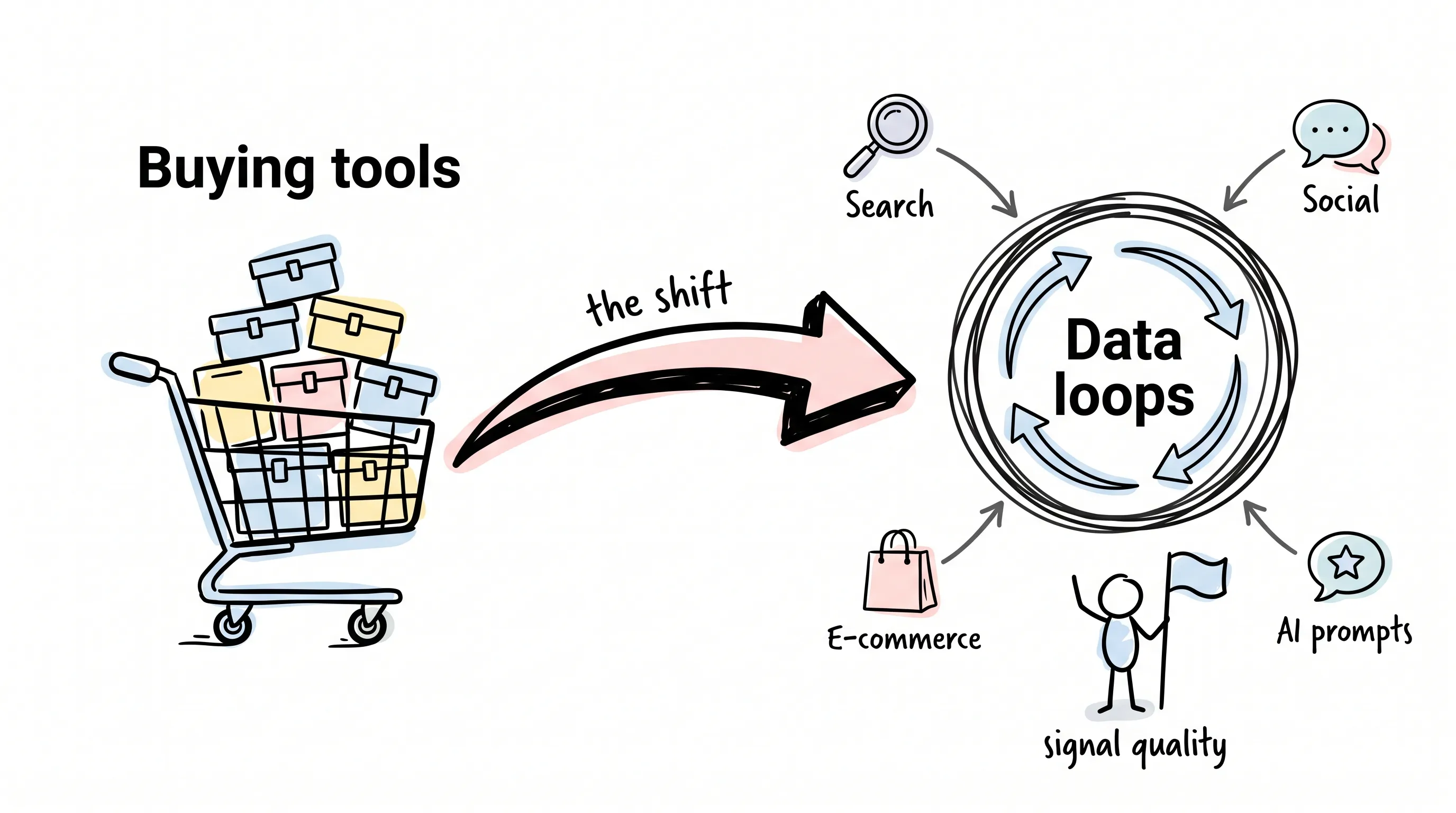
Today's 11 items share a single theme: AI marketing has moved from buying tools to building systems. PMG proposes replacing survey panels with signals from search, social, e-commerce, and AI prompts, compressing the validation cycle for brand budgets from a month down to near real time. Agentic ad buying is getting serious about safety guardrails, and GEO and share of model now have playbooks you can copy. Tool roundups piled up today — nine ad platforms, five categories of cross-border tools, seven ways to use social media. Pick what fits your needs, and when you're choosing, remember: fix your data before you buy intelligence. Short on time? Read the headline first, then the guardrails item.
🎯 Today's Headline
Brand Measurement Needs a New Source of Truth
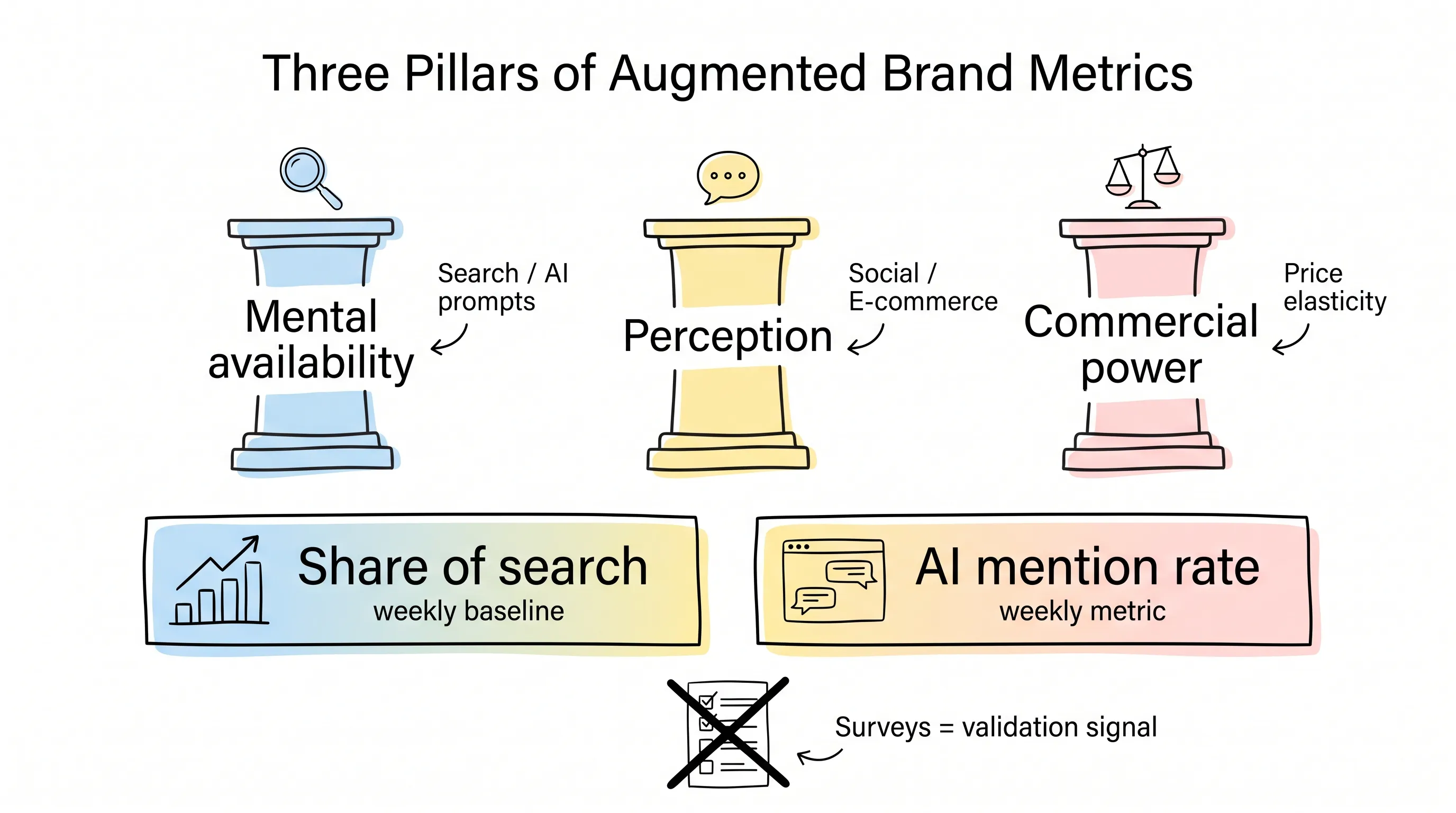
What happened. PMG's head of product Crissi Cupak wrote in MarTech arguing that the source of truth for brand measurement needs replacing. First, terminology: brand outcomes measure three layers — awareness, equity, and valuation. Awareness asks whether you've made it onto the category recall list: ask consumers which sneaker brands come to mind and see whether yours is mentioned. Equity measures how much premium the brand name adds to a product. Valuation converts that equity into dollar figures. For decades the industry measured the first two layers with panel research from Kantar, Ipsos, and NielsenIQ — in essence, sampling consumers on how they view a brand. The author takes this pipeline apart: marketing happens, consumers are exposed, perceptions shift, surveys ask, consumers recall and answer, models turn answers into metrics. Every layer of abstraction loses information. People who say they prefer local stores have their order records on Amazon; people who talk about service and comfort check prices first when they actually buy tickets. Ask a friend why they like Apple and they'll give you a fluent rational explanation, but can't say how much comes from social signals, old experiences, or twenty years of ad exposure. The author calls this information loss, and AI has changed the cost structure: models can continuously digest massive volumes of heterogeneous, unstructured data at an affordable cost, making multi-source observation realistic for the first time. Over the past few months PMG built an augmented brand metrics model on three pillars. Mental availability reads search, traffic, and AI prompt analysis to judge whether the brand has entered consumers' consideration sets. Perception comes from unstructured social and e-commerce interactions, assessed item by item, contextualized, and analyzed as a stream. Commercial power looks at price elasticity across owned channels and retail to answer how much pricing power the brand still has, with the stock price counted in as an investor vote. All signals are indexed against competitors to confirm you're seeing your own market footprint rather than category-wide fluctuation; the three pillars are not weighted equally — they are statistically weighted by each one's predictive power for revenue outcomes. AI discovery is the new observation surface: when users ask AI to recommend products without naming a brand, the AI's answer exposes the model's mental availability for that brand, which directly shapes what users consider and ultimately whether AI completes the purchase on their behalf.
Why it matters. The brand-versus-performance debate has raged for decades, and what truly stalled it was how the brand side defines success. Panel research never perfectly represented brand equity — there simply was no alternative, so self-reported data was tolerated. The author's exact words: we have spent decades defining brand equity with the data we could collect, not the data needed to understand it. AI makes continuously observing real behavior affordable for the first time, so brand health can finally be measured without detouring through consumer recall. For budget-strapped brand teams, this means brand investment can produce evidence faster — no longer the department that spends money it can't account for. This is a foundation swap for measurement, not another new metrics package.
What it means for marketers. After a brand campaign launches, brand lift research typically takes over a month to return results. In one PMG client case, a client pushed through internal resistance to launch their first high-ticket brand campaign, and the accompanying brand lift study would take a month before it started producing anything — but share of search and perception metrics could be seen changing in near real time, making the whole arc of how brand resonance grew observable as it happened. Brand budgets become defensible faster, teams can adjust spend before results are locked in, and the final research findings get downgraded to a validation signal instead of being the first time the client learns whether the money was spent well. At the job level, brand analytics roles need to add prompt-analysis and social-streaming-signal skills; people who only know survey design are watching their value shrink.
How to use this. No need to overturn existing research; start with two moves. First, build a share of search baseline for your own brand, recorded weekly with a consistent methodology — and look at it next to competitors, because on its own, category seasonality will fool you. Second, treat your brand's mention rate in AI Q&A as a weekly metric: list ten category questions, ask the major models, log the appearance rate. That is the AI-side reading of the mental availability the lead author talks about. Once these two signals run smoothly, weight each signal by its predictive power for revenue and let the data speak for itself. Questionnaires get demoted to validation signals, no longer first-hand truth: keep the big quarterly study, and hand pacing decisions to daily-level signals.
My take. The direction is right; the threshold is data engineering. Assessing social and e-commerce interactions item by item and processing them as a stream is beyond most brand teams. This capability will take root at agencies and MarTech platforms first, and for small and mid-size brands, buying the service beats building it in the short term. The article gives no cost breakdown — before committing, ask about data processing volume and fee structure, and don't get led astray by the concept pitch. What I value most is that reminder in the article: perception shifts must be read against competitors, so you don't misread a category trend as your own growth. For marketers, this month's to-do is concrete: add your brand's mention rate in AI answers to your weekly report. It's a new observation surface you can start on today.
🔗 Further reading: Read the full article
🏷 Playbooks in Practice
The WIRED AI Marketing Playbook: Three Priorities, with Real Cases
WIRED partnered with Tremendous on branded content laying out three priorities for marketing in the AI era. The opening puts the shift bluntly: for the past twenty years, the consumer journey started with a search query and ten blue links; now it increasingly starts with asking a generative AI chatbot a single question and getting one tailored answer. The backdrop figure is Adobe's July 2025 statistic: AI-driven retail traffic grew 4700% in a year. Priority one: raise your brand's visibility inside AI tools. The method: ask the major LLMs directly, research who gets recommended, track share of model, then optimize with GEO tactics — embed natural-language questions into content, organize information with HTML tables and bullet lists, publish conversational expert commentary, and keep imagery and unique selling points consistent. The reasoning isn't complicated: models' citation preferences can be influenced by content structure, and tables and Q&A formats are easier to crawl and paraphrase than long paragraphs. Doing this doesn't require a new team — adding a citation-check column to your content calendar is enough. Priority two: give traditional marketing an AI upgrade. The British Council used Midjourney and Veo3 to produce over a thousand creative variants with multi-region localization, cutting creative costs by 70%, but the underlying creative stayed human-led to keep output from sliding into AI mediocrity. The division of labor — AI handles volume, humans handle direction — is stated clearly here. Priority three: double down on human recommendation. Communities like Reddit are both a channel where consumers verify trust and a citation source for AI models; your word-of-mouth in communities feeds back into the answers AI recommends. Referral program users have 16% higher LTV, and machine learning can optimize referral timing and incentive design. As AI content floods everything, the scarcity of real human recommendation only rises — that logic holds up. The article adds one more reminder: trust sources are fragmenting, with self-claims on official websites losing weight while community discussions and third-party reviews gain it. Moving budget to follow trust is going with the current.
💬 The first of the three priorities can be done this week: list 20 questions your target customers would ask AI, run each through the major models, and record how often your brand appears. That is the first baseline for share of model. Creative variants and Reddit presence can wait for the next iteration — get the baseline first, then talk investment.
🔗 Further reading: Read the full article
GEO's Positioning: Not an SEO Replacement, a Trust Layer on Top
Nosugar Studios' GEO (Generative Engine Optimization) guide splits the evolution of search into three stages: traditional search competes for ranking, AI search competes for citations, and AI recommendation competes for being recommended. The three stages map to three optimization goals, and user behavior differs too: in search, users click links themselves; in answer engines, users take whatever answer the AI gives them; at the recommendation-engine stage, AI proactively puts the brand in front of the user. GEO is defined as making AI platforms understand, trust, and cite your content — complementary to SEO, not a replacement; your site's basic crawlability and technical health remain the prerequisite. When AI decides whether to mention a brand, it weighs six factors: clarity of information, relevance, source credibility, cross-site consistency, expertise, and content freshness. Brand authority signals come mainly from third-party mentions, media coverage, and user reviews; self-certification on your own site carries limited weight, and inconsistent information across platforms directly drags down trust scores. The guide offers seven actionable strategies built on a three-part skeleton: give a clear, quotable answer at the top of the content; keep producing around one domain to build topical authority; bring original insights others can't copy — judgment or proprietary data both count. The remaining four orbit structure: use clear heading hierarchy, regularly update old content to preserve freshness, keep messaging consistent across platforms, and actively accumulate third-party reviews.
💬 Don't open a separate GEO task force. Two additions inside your existing content process are enough: place a directly quotable answer block at the top of every piece, and check gaps against the six mention factors each quarter. Your existing SEO team can take it over with no new budget — expect the first citation movement within two weeks. Have your copywriters revise the most recent ten articles first; that pays off faster than writing new ones.
🔗 Further reading: Read the full article
Safety Guardrails for Agentic Ad Buying: Two Sets of Traffic Lights
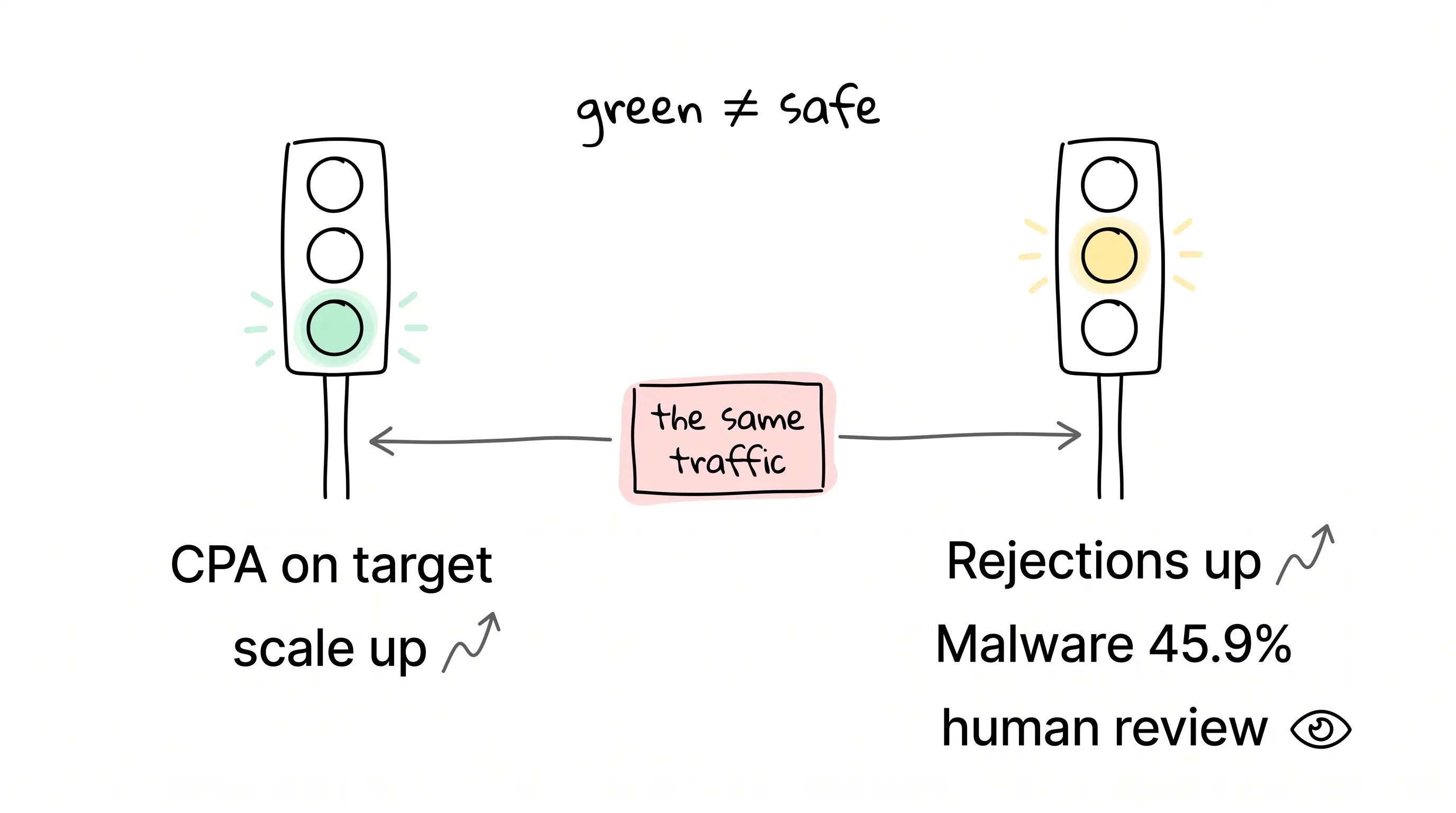
PropellerAds' piece in MarTech discusses risk control design for agentic media buying. It's sponsored content, but the data is specific, so it works fine as supplemental reading from a risk-control angle. IAB data sets the market backdrop: 96% of buyers are aware of agentic AI, 66% are increasing investment, 40% require human review, 36% require audit trails — nearly half of buyers no longer feel comfortable with fully autonomous agent decisions. The risk points are clear: AI agents can independently change bids, move budgets, and scale traffic sources, and budget and approval caps alone won't stop bad things from happening; the real question is which signals you have handed to the agent to trust. PropellerAds' own Q2 2026 audit data: total rejected traffic fell 42%, but malware's share of rejections rose from 23.3% to 45.9%, and cloaking accounted for 67.3% of suspensions — showing the overall traffic environment is getting cleaner, and the remaining rejections are increasingly concentrated in malicious plays. GeoEdge's data shows automatic redirects make up 45% of attacks, up 25% year over year — attackers are using automation too. The solution is two sets of traffic lights: one for performance signals, one for traffic quality and safety signals. The same traffic can tell different stories under the two sets of lights — a source with a good-looking CPA may already be flagged by downstream safety systems. When the performance light is green but the safety light is yellow, the pace of scaling should slow down. The piece also introduces the pre-execution confirmation mechanism in its NIKO agent: big moves ask a human first. Human review focuses on gray areas: strong performance with safety anomalies, new patterns emerging, large budget impact — routine tuning is left alone. The audit trail must be able to answer what the agent saw, which signals took effect, and why it scaled or paused, so there is a record to check when things go wrong.
💬 Get your agentic campaigns to wire safety signals into the optimization loop, not just budget caps. One executable rule is enough: any traffic source whose CPA is on target but whose rejection rate is abnormal gets scaling automatically frozen and pushed to human review. Write this into your buying SOP — configure it once and it keeps working, and when something goes wrong, the money you don't lose is real money.
🔗 Further reading: Read the full article
🏷 Marketing Tools
2026 AI Ad Management Platform Reviews: How to Choose Among Nine
Cometly published a 2026 review of AI ad management platforms covering nine of them. A note first: it's a vendor self-assessment that ranks itself first, so discount the conclusions — but the classification framework has value. The opening describes the pain realistically: advertisers managing dozens of campaigns, thousands of creatives, and countless optimization decisions across Meta, Google, TikTok, and LinkedIn. AI ad management platforms exist to eat that repetitive work — automatically adjusting bids, finding winning creatives, giving recommendations based on real data. These platforms' capabilities fall into three types: cross-platform automation, creative optimization, and attribution-driven insights. Cometly's pitch is server-side tracking plus multi-touch attribution, feeding conversion data back to improve platform algorithms; the logic is that garbage data produces garbage recommendations, and after iOS privacy restrictions, server-side tracking became the precondition for attribution accuracy — browser cookies can no longer support multi-touch attribution. Adzooma covers Google, Meta, and Microsoft with one-click optimization and automated rules, starting at $99 per month with a free tier, a fit for small and mid-size businesses starting out. Revealbot is strong at conditional rules and creative fatigue detection for Meta and TikTok, auto-warning to swap images when creatives burn out.
💬 Define the problem before picking the tool. Teams with inaccurate attribution should prioritize fixing server-side tracking — the smartest platform can't rescue dirty data. If all you want is cross-platform automated rules, one layer of Adzooma is enough; no need to take on a heavyweight attribution platform. Put two or more candidates on their free tiers for two weeks each, and test with your own campaign data. Don't trust rankings — especially rankings that rank their own product first.
🔗 Further reading: Read the full article
The Four-Step AI Ad Automation Workflow: Fix Passback First, Talk Intelligence Later
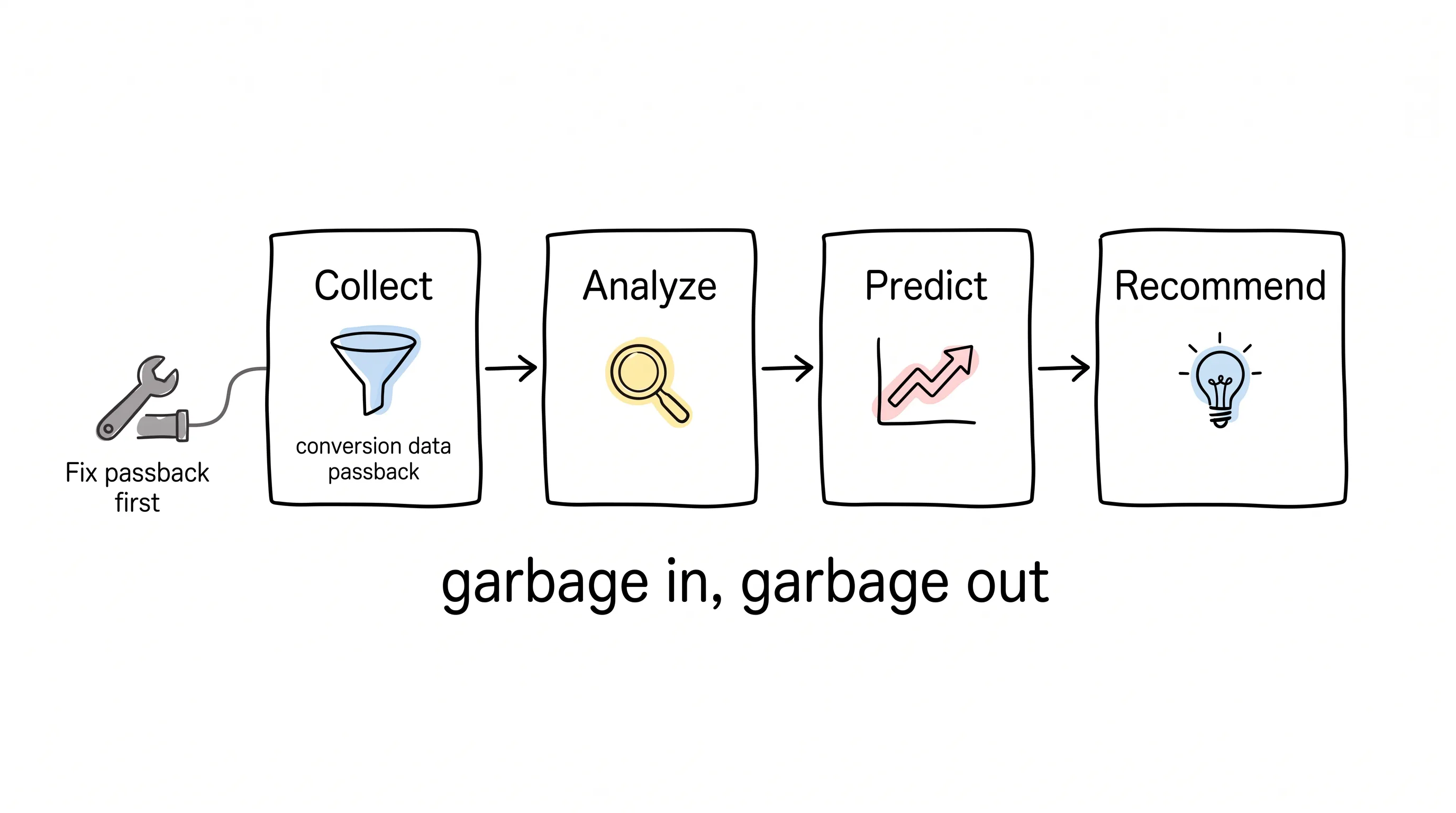
TEadifyz.ai's guide explains the definition and pipeline of AI ad automation: machine learning analyzes ad data, predicts performance, and gives optimization suggestions, covering budget reallocation, bid adjustments, audience refinement, and creative updates. The workflow has four steps: collect, analyze, predict performance, recommend optimizations. The motivation is stated plainly: a human watching thousands of signals a day inevitably lags — by the time you're off work reading reports, the budget has already been burning wrong for half a day, while AI can monitor and spot trends in real time. The positioning is right too: humans are responsible for strategy and creative, AI for repetitive optimization — the title itself carries that qualifier, it doesn't replace human strategy. Two common pitfalls are listed: over-automation and neglecting data quality, with applicability notes by business type — local merchants, e-commerce, SaaS, real estate, agencies. E-commerce emphasizes creative iteration, SaaS emphasizes lead quality; different scenarios get different configurations. The content is general knowledge with no exclusive data, and the ending funnels to its own product — suitable to read as an introductory checklist.
💬 The value of this piece is that checklist. Ask yourself one question against the four-step workflow: is your conversion data passing back cleanly and automatically? Without that step, all the AI optimization suggestions downstream are built on sand. Fixing the passback pipeline is a zero-cost action and should come before buying any paid tool. One more reminder: don't max out AI's automation scope at the start. Let it handle only micro-adjustments within 5% of budget first, run it for a month, and grant more authority once it's stable — rush it and it goes off the rails.
🔗 Further reading: Read the full article
GWI's Map of AI Social Media Tools: Sorted into Listening, Research, Creation
GWI's blog post organizes AI social media tools for 2026 by category. It opens by defining the three roles AI plays in social media: automated publishing and reporting, personalized creative, and real-time performance tracking. Category one, market research and social listening: GWI Spark is their own product, built on proprietary survey data from nearly a million consumers across 50+ markets, delivering insights through chat-style Q&A; Brandwatch and Talkwalker cover brand health monitoring, sentiment analysis, and trend alerts, suited to watching reputation and competitor moves. Category two, content creation: Jasper and the like provide copy generation with brand voice controls, so tone doesn't easily drift. The selling point is that proprietary survey data beats public data scraping — sample representativeness and freshness determine insight credibility, and scraped public data is mixed with bots and fake engagement, making cleaning costs high. Know the stance: it's a vendor blog with its own product listed first, so read with that filter on.
💬 Borrow its taxonomy for selection: sort tools into listening, research, and creation, pick one per category, and don't expect a single tool to win everywhere. Tight budget? Plug the social listening gap first — discover a trend a day late, and your hot-topic content ships a day late; in trending-page competition that delay is a real traffic difference. The trap with research tools is sampling: proprietary survey data is expensive but clean; public scraping is cheap but needs a cleaning budget. Do the total-cost math before choosing.
🔗 Further reading: Read the full article
Cross-Border E-Commerce AI Tool Map: Five Pain Points Mapped to Five Tool Categories
Meegle's topic-site guide, updated February 2026, starts with the basics — machine learning for demand forecasting, NLP for multilingual processing, predictive analytics for inventory and pricing — then gets to the point. Cross-border e-commerce pain points fall into five categories, each given a corresponding tool direction: language and culture → translation and localization like DeepL; compliance → tax handling like Avalara and TaxJar; logistics → ShipBob and Flexport; payments → Payoneer and Stripe; fraud → Riskified and Signifyd. The tool categories also cover translation, inventory, customer service bots, marketing automation, and fraud prevention, with multilingual customer-service bots pulled out separately — for cross-border inquiries across time zones, they are the best value. The case section name-drops Amazon Global Store, Tmall Global, and ASOS. The trends section mentions voice commerce, AR try-ons, blockchain provenance, and hyper-personalization. The practical advice: focus on one or two markets first, invest in localization, use data-driven marketing optimization — spreading too wide is the most common way beginners fail. The content is templated aggregation with product funneling and no original data; use it as a selection index.
💬 Cross-border teams, check yourselves against it: of the five pain points, which two currently have no tool coverage? Start with fraud prevention — every dollar lost to fraud comes straight out of pure profit, a more direct lever than lifting conversion. Compliance second: fines from tax blowups can swallow a quarter's profit at a stroke.
🔗 Further reading: Read the full article
Seven Ways to Use AI in Social Media: A Quick Skim Gets You Started
Kontentino's blog post lists seven directions where AI lifts social media marketing: data-driven decisions, including audience profiling, behavior, and engagement pattern analysis; automated content creation, via tools like Copy.ai; content polishing, via Grammarly and Hemingway; visual content generation, via Canva and Runway; social listening and trend analysis; ad targeting optimization, via AdEspresso — audience segmentation, multi-version testing, and budget optimization; and spam detection. The full content production chain is covered by AI, from first draft to polish to imagery to scheduling, and the human position has moved to topic selection and quality control. Published April 2025, liberally interspersed with its own product and third-party tool links — an SEO-style vendor blog with limited informational gain. Skim it as a starter list; no need to read deeply.
💬 The most easily overlooked of the seven uses is also the biggest money-saver: spam detection. Hand comment-section cleanup to AI and operations gets back half an hour out of every hour to reply to real people — you'll see the change in engagement rate within a week. Do this small thing first, then talk content automation. Don't reverse the order.
🔗 Further reading: Read the full article
🏷 Industry Data & Perspectives
California Management Review: The Personalization-Privacy Paradox of AI Customer Experience
UC Berkeley's California Management Review insight article gives a systematic treatment of AI-driven customer experience — academic origins, but written pragmatically. The technology side falls into six categories: big data analytics, recommendation systems, conversational agents, service robots and delivery drones, IoT, and extended reality; each maps to a block of CX capability — recommendation systems handle matching products to people, conversational agents handle pre-sale Q&A, IoT and XR handle experience extension. For journey design it cites McKinsey research: only four or five journeys truly drive satisfaction, so focus on the critical journeys rather than rebuilding the whole chain — a full-chain rollout is a resource black hole. The method: identify the critical journeys, form a cross-functional CX team, and use behavioral data rather than self-reports to understand needs. Organizationally, churn is reduced through cross-functional CX teams and journey-mapping analysis; journey mapping lays out the churn reason at every touchpoint for inspection. The article's most practical output is the 2x2 matrix of the personalization-privacy paradox, with two axes of convenience and sense of loss of control, used to plan a data-use strategy: high-convenience, low-loss-of-control practices can be used with confidence; high-loss-of-control moves either give users control or don't do them. To give an example: using past orders for recommendations is low loss of control; using microphone listening for prediction is high loss of control — the same data pipeline, with user perception worlds apart. The BCG data point is hard: only 29% of consumers believe data use has brought better service, while 75% worry about privacy — a severely mismatched input-output ratio. The article was published in March 2022; the framework still applies, judge the timeliness yourself.
💬 Clear the privacy gate before personalizing. Audit your data-use plan with this matrix: which moves make users feel out of control? Retract those first or change them into transparent, optional choices. The gap between 29% and 75% shows most personalization is running hard in negative territory — fixing it correctly is itself differentiation. Sequencing advice: journeys first, data second. Fix the churn points in your four or five critical journeys before talking about adding personalization; reverse the order and you're pouring water into a leaky bucket.
🔗 Further reading: Read the full article
HubSpot Executives in Conversation: How Top Marketers Use AI
Episode 361 of HubSpot's podcast Marketing Against the Grain: AI product lead Nicholas Holland and CMO Kipp Bodnar discuss how top marketers use AI; released September 2025, 24 minutes total. The judgment: for marketers, AI has already shifted from novel-optional to must-have, and the bottleneck has moved from tools to imagination and integration ability — everyone can get the same models, the difference lies in how you use them. Top marketers' setup is a multi-assistant division of labor, giving different contexts and roles by task — one for writing copy, one for doing analysis, one for watching competitors, one each, without cross-contamination. The word for 2026 is context: context quality determines output quality, and that is a different thing from prompt technique — the business background, constraints, and historical data you feed in are the bulk. Roles like customer service and SDRs (sales development reps) are being redefined by AI agents, with repetitive, conversation-dense jobs moving first — the two executives are aligned on this. Creative competitiveness comes from continuous practice and probing the tool's boundaries, not from the tool itself: whoever runs the tool, the person who keeps practicing still leads. The conversation name-drops HubSpot Breeze, ChatGPT, Gemini, Nano Banana, and Veo. The podcast includes product promotion — take the opinions halfway, take the practice advice in full.
💬 Context engineering can be practiced this week: run the same task once with a bare instruction and once with complete context — background, examples, constraints — and compare the output gap. The gap will be bigger than you expect, and you'll instantly know whether your time belongs to swapping tools or writing context. Just start with small tasks. Teams of more than three: write the multi-assistant division directly into job responsibilities, each person equipped with their own task assistant and context library — don't crowd into one session and pollute each other.
🔗 Further reading: Read the full article
💡 Today's Big Picture
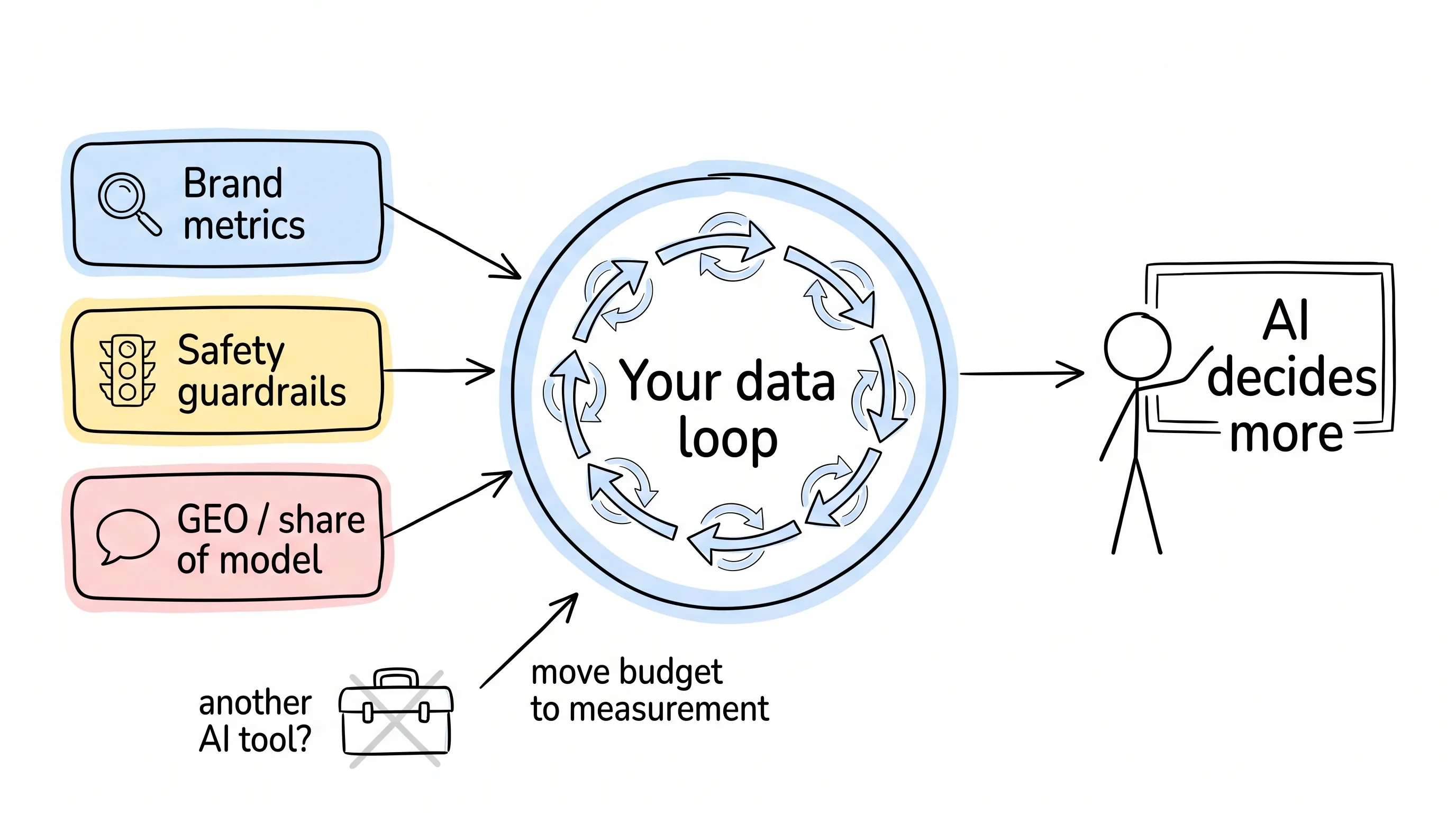
Read together, today's 11 items send a clear signal: competition in AI marketing has moved from knowing how to use tools to knowing how to build systems. The headline's augmented brand metrics twist search, social, e-commerce, and AI prompts into one measurement system; the guardrails item wires safety signals into the buying optimization loop; GEO and share of model connect your content assets to AI's citation system. Three different moves, one underlying logic: the quality of your signal and data loops determines how many decisions AI can make for you. There was plenty of single-tool news today too — nine ad platforms, five categories of cross-border tools, seven social media uses — but the counterexample they compose is clear: buy tools without fixing your data, and however smart AI's advice is, it's garbage in, garbage out. The HubSpot episode puts it even more directly: the bottleneck isn't the tools, it's imagination and context quality. There is also a hidden thread in today's material worth remembering: the weight of word-of-mouth and trust is rising across the board — Reddit is both a place where consumers verify trust and a citation source for models, privacy data handled badly will backfire on personalization, and junk traffic will pollute your attribution. One line for marketers: this month, move a bit of budget out of buying yet another AI tool and put it into measurement and data loops. The former's marginal returns are falling fast; the latter decides whether you can win the race next year. Tomorrow, we keep watching this line for new evidence.
Continue reading
Related articles

AI Marketing Daily · 2026-10-08
AI Marketing Daily for 2026-10-08 curates 20 items across AI search visibility (GEO), advertising, platform selection, cross-border e-commerce, and ROI measurement. The headline argues that strategic marketing decisions should stay with humans while AI assists execution.

AI Marketing Daily · 2026-10-07
Today's throughline is answer engine optimization (AEO — getting your brand quoted in AI answer engines).

AI Marketing Daily · 2026-10-06
AI Marketing Daily (2026-10-06) leads with SOCi survey data: US consumers using AI to find local businesses rose from 9% to 52% in a year, and 81% verify AI recommendations elsewhere. Remaining items cover AI ROI measurement, Google Ads' Rethink ROI keynote, GEO playbooks, and the EU Digital Fairness Act.