
AI Marketing Daily · 2026-10-06
AI Marketing Daily (2026-10-06) leads with SOCi survey data: US consumers using AI to find local businesses rose from 9% to 52% in a year, and 81% verify AI recommendations elsewhere. Remaining items cover AI ROI measurement, Google Ads' Rethink ROI keynote, GEO playbooks, and the EU Digital Fairness Act.
SOCi's annual survey delivers today's heaviest set of numbers: consumers using AI to find local businesses jumped nearly 6x in a single year — yet 81% verify AI recommendations elsewhere before acting. Visibility and trust are becoming separate disciplines to manage, and that is today's through-line. The remaining 13 items circle three questions: are corporate AI budgets actually making money, how do you assemble a 2026 growth playbook, and how do you defend against regulation and hallucination risk. A CEO survey, Google's official playbook, and EU legislative movement all landed on the same day — dense enough to justify a ten-minute read. Finish this one briefing and the past 24 hours of AI marketing are in your hands.
🎯 Today's Headline
Local search's 6x upheaval: AI becomes the discovery entry point, the verification loop becomes the new funnel
Local marketing company SOCi released the third edition of its Local Discovery Index, surveying more than 1,000 US consumers, with the sample weighted by age, gender, and income and a median income of about $81,600. The share of consumers using AI tools to find local businesses rose from 9% in 2025 to 52% in 2026 — nearly 6x in one year. Sixty percent of consumers now treat AI as a go-to discovery channel. The three-year trend line is unambiguous: almost nobody used it in 2024, roughly 19% had tried it by early 2025, and more than half by 2026. Users arrive both by intent and by accident: 57% deliberately use ChatGPT and 51% use Gemini, while 51% have seen AI answers at the top of Google results, 35% have clicked into AI Mode, and about a third have run into AI content on Meta platforms or inside map apps. The heavy-user profile is just as clear: usage hits 76% among people earning over $100,000 a year and 63% among millennials, far above Gen Z's 49% and baby boomers' 11%. Social platforms are turning into local search engines in parallel — the share discovering local businesses through social rose from 17% in 2024 to 55%, with Facebook leading at 73%, YouTube next at 69%, Instagram at 67%, and TikTok capturing half of social searchers.
The report's most consequential concept is the verification loop (the discover-verify-decide path consumers take across channels). A consumer finds a business on one channel, checks it on another, and makes the call on a third — and the whole circuit can take just minutes. The loop exists for a plain reason: no single channel is both comprehensive and trustworthy. AI is fast but frequently wrong — 67% of users say AI has given them incorrect local business information, and 30% actually paid a price for it. Reviews are credible but incomplete; search is comprehensive but unfiltered. Consumers are left to triangulate. Trust hasn't kept pace with usage, either: over the past year only 27% of AI users grew more trusting, 73% stayed flat or dropped, and 23% dropped outright. So after an AI recommendation, 81% of people check reviews first (33%), look at the business's social profiles (20%), run another search (16%), or cross-check across channels (12%) — only 19% go straight to the business. In other words, winning placement inside AI answers is now a necessary condition, no longer a sufficient one. The funnel has given way to the loop, and the share of the journey that last-touch attribution can explain shrinks along with it.
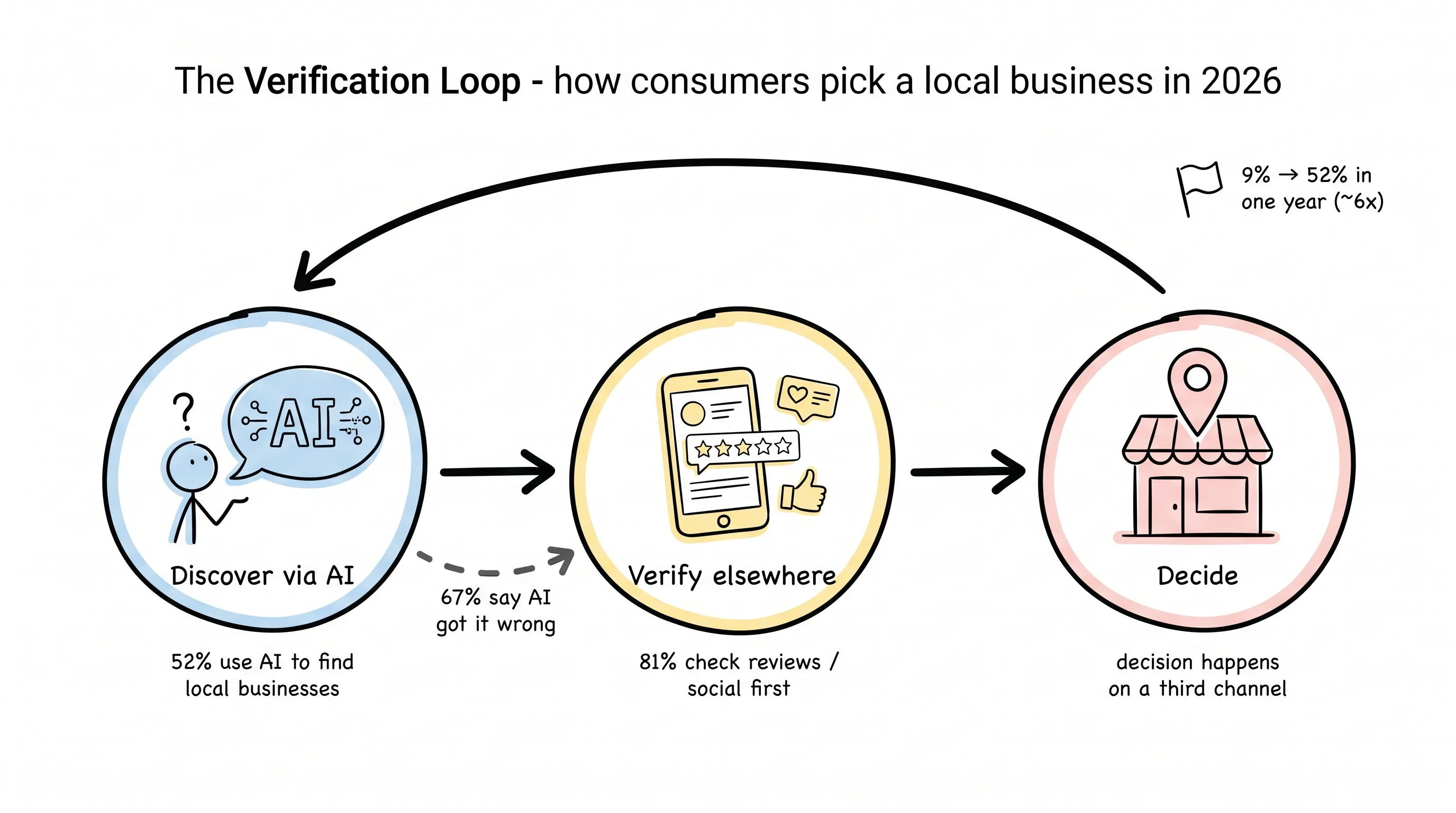
For marketers, the implication is that local visibility work becomes a fight on three fronts. The first front is brand presence inside AI answers — that is, GEO (Generative Engine Optimization). Beyond it, reviews guard the gate: 99% of consumers read reviews, 68% read them often, and 72% prefer businesses that respond to reviews — up from 65% a year ago; 65% say they're more likely to come back after a business thoughtfully replies to a negative review, and 87% say they might change a negative review to a positive one after a genuine response. Social is where the visit gets rehearsed: 43% use social media to preview what a store is actually like, and 59% have become a local store's customer because of a single post or video — among millennials, that figure reaches 70%. One easily overlooked number: 63% of consumers walk away when a business can't answer a question. If any of the three fronts thins out, consumers drop you inside the loop. Review sensitivity also tracks income: frequent review-reading climbs from 63% in the low-income group to 76% in the high-income group, and preference for businesses that respond to reviews climbs from 62% to 80%. Your most valuable customers watch reputation the hardest.
Five actions can land this week. Fold AI visibility and reputation management into a single project rather than splitting it across two teams. Audit every location's information consistency across four surfaces — AI answers, reviews, social, and maps; a single wrong field for hours, address, or services is a churn point. Stop treating review replies as scattered customer-service chores: write them into an SLA, negative reviews first, since 87% say a thoughtfully answered bad review may turn positive. Build social content store by store, one profile at a time, with no national master template — YouTube's number-two slot shows there is real demand for video that showcases the room and the craft. And respect vertical differences: AI-direct journeys run 21% in healthcare and 19% in grocery, financial services sees 20% of journeys entering through social, and in fuel and auto, 25% of journeys start in map apps. Decision factors split too: reviews and word of mouth rank first in five of eight categories, renters care most about visual assets (43%), grocery and fuel prioritize practical fields like hours and location, and finance cares most about brand credentials (34%). One template won't cover every category.
My take: this data is published with SOCi's sponsorship, and the angle needs to be stated plainly. But the 6x magnitude plus a consistent three-year methodology make the directional call broadly credible — even at a 50% haircut, it would still change budget allocation. In 2026, the dividing line in local business is no longer who bought the most paid media; it is who manages every station of the verification loop properly. AI lowered the price of being found and raised the price of being trusted. That is where small brands find their opening — and where big brands spring their leaks.
🔗 Further reading: Read the full article
🏷 Industry Data
134 CEOs come clean: 86% have never formally measured ROI on AI spending
Your AI Department released its second annual CEO survey: 134 respondents, mostly mid-sized companies with revenue between $5M and $500M, fielded in Q1–Q2 2026. Adoption is clearly up — but 86% of CEOs have never formally measured AI returns; 46% go on gut feel and 40% don't track at all. The sharpest of the eight counterintuitive findings: companies that appointed a dedicated AI leader show a 68% project failure rate, higher than the 49% when the CEO runs AI personally — yet they also show higher workflow maturity, 58% versus 36%. Failure correlates with implementation depth, not capability. Failure itself is widespread: 54% of surveyed companies have dropped at least one AI project, and the top failure causes are all project-management issues — scope set too large (33%), data not ready (28%), no success metrics defined upfront (28%) — while vendor overpromising accounts for just 15%. Among the 48 companies that bought Copilot or ChatGPT Teams, only 2% formally track ROI and half don't track at all; licenses are quietly becoming the new shelfware. The report distinguishes two modes of use, Grease and Cogs: making existing work faster is grease; replacing an entire workflow is a cog. The ten companies with verified ROI above $500,000 share one trait without exception — they hard-coded AI into specific operational processes, and not one remains at the chatbot stage. The report also answers where money is and isn't going: 68% of organizations use AI for content, yet among the most expensive repetitive labor, only 25% of companies that rank order processing as their top burden use AI in operations, and only 32% of those citing reporting use AI for financial analysis. There is a year-over-year contrast too: in 2025 CEOs' top confusion was separating hype from substance (45%); in 2026 the top blocker is data not ready and systems not connected (35%) — and it does not fade with maturity, holding at 35% in the licensed stage and 37% in the workflow stage. Industry maturity gaps are huge: 75% of tech companies have reached workflow level, while real estate and construction sit at 16% and manufacturing at 14%.
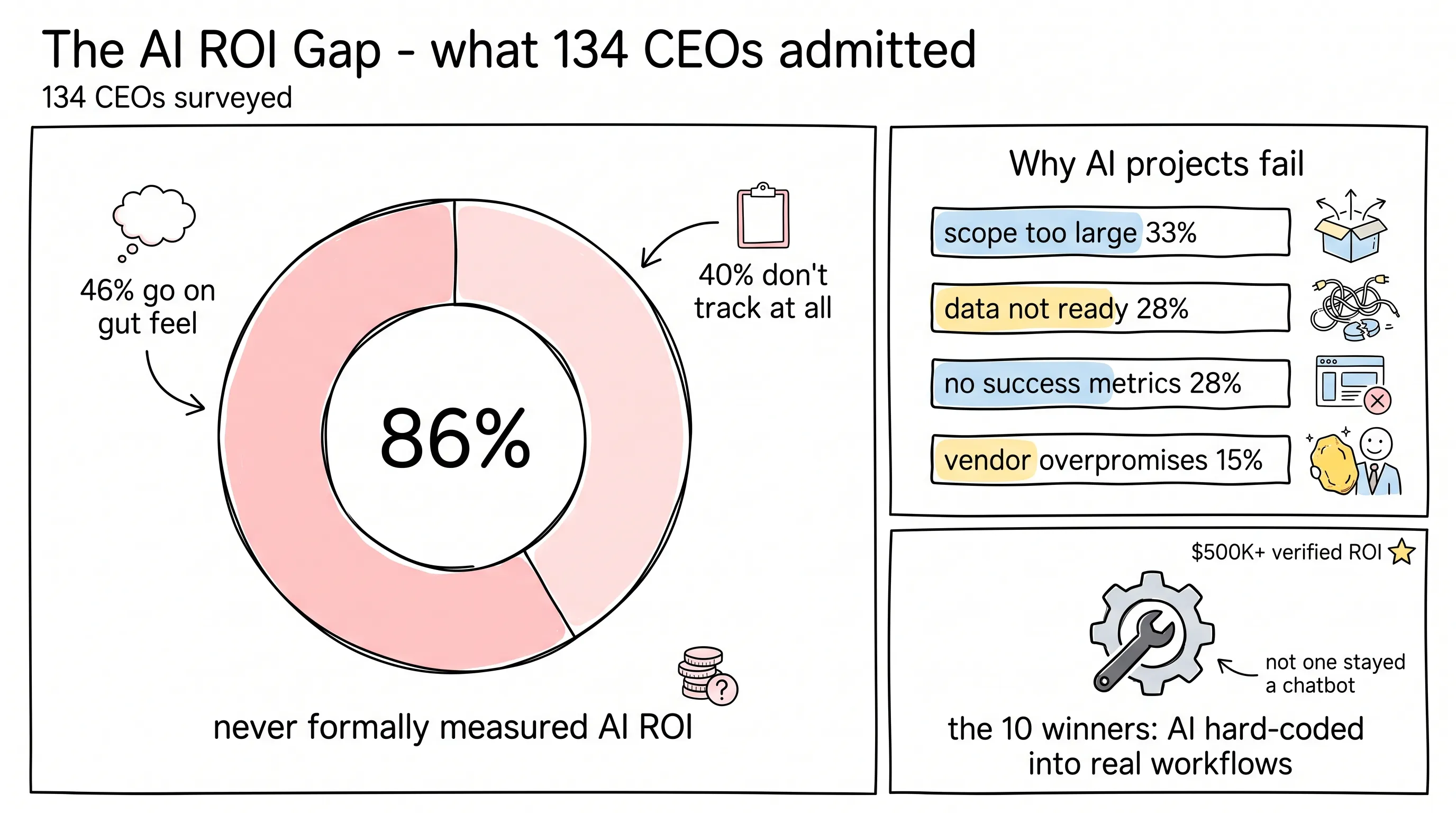
💬 Stop asking whether the team is using AI; first ask who owns the ROI definition. Two things to do this week: backfill a tracking standard for the licenses you have already bought, even the crudest hours-saved estimate; and, following the report's Atomic Units logic, pick one atomic unit from your most expensive repetitive labor and push a single end-to-end transaction through it. Small companies shouldn't feel inferior — workflow maturity is 54% below $5M in revenue and only 33% above $500M. Smaller moves faster.
🔗 Further reading: Read the full article
HubSpot's 1,700-person survey: only 10% of teams are truly using AI to transform the business
HubSpot released a 14-minute 2026 trends video based on its State of AI survey of more than 1,700 marketers. Its verdict: a maturity chasm. Only 10% of teams are genuinely using AI to transform the business, and most teams overestimate where they stand. The report splits maturity into four stages — early, emerging, established, and transformational. Early-stage teams should automate one repetitive task; the question for mature teams has shifted to what to feed the AI. The most concrete of the six recommended moves: locate your stage honestly before acting; connect AI agents into a system — 86% of marketing departments already use agents, 76% saw usage rise within six months, and top teams run four to six interconnected ones, not two or three isolated islands; and recognize that competitive advantage is moving to the intelligence layer — the CRM records, campaign history, and brand language corpus that you own and the models don't. Tools themselves are no longer a moat; ChatGPT remaining the most-used tool is precisely the proof that everyone holds the same tools. The remaining three moves are AI skill building, using AI to review where the last three campaigns lost points in order to shorten the feedback loop, and AEO (Answer Engine Optimization) plus AI personalization. The video also demos a content-repurposing agent built with Claude skills: one blog post auto-generates social copy, email summaries, and a 60-second script.
💬 Don't chase new tools yet — score your team and locate its stage. Early-stage: pick the most annoying repetitive task this week and automate it. Mid-stage: the bottleneck is already what to feed the AI, so get your CRM and brand corpus into a feedable shape. Connect the island agents, and the value doubles.
🔗 Further reading: Read the full article
AI is squeezing junior marketing roles — the column's answer is apprenticeship
MarTech columnist Milton Hwang examines the future of junior marketing and marketing operations (MOps) roles. Two framing data points: the martech landscape saw near-zero growth for the first time this year, netting just 0.79% — the industry's so-called "peak martech" — and Stanford's August study found high-AI-exposure roles suffered 19% more employment disruption. His read: junior roles are seeing growth slow, not mass layoffs. The response is to build apprenticeship into the MOps team, along three growth paths: junior tool specialists grow into martech generalists and workflow orchestrators; content people train toward brand-context generalism, ending as context engineers; and junior martech specialists advance to senior marketing engineers. The supporting mechanics are concrete: set up a staging environment with production-like data snapshots where apprentices test and audit AI outputs; run campaign reviews and context reviews the way code review works; and treat rainy-day data quality engineering as training material. What apprentices are really learning isn't tools — it's the judgment required to make calls in a production environment.
💬 People managers can start this week: assign each junior role an apprenticeship task package, beginning with auditing AI outputs. Write the review system into the process while you're at it — it is both risk control and a people-development path. Don't wait for HR to publish a role framework; let MOps run it first.
🔗 Further reading: Read the full article
🏷 Ads & Growth Playbooks
Google Ads Rethink ROI, full keynote: Google plus YouTube touch 85% of new-customer journeys
Google Ads published the full recording of its Rethink ROI 2026 keynote — nearly two hours, released in September. The whole argument hangs on one phrase: the so-called era of the hyper-empowered consumer. AI users engage with nearly 3x more touchpoints than non-AI users; brainstorming-style searches inside AI Mode are growing 30% faster than search overall; and AI is expanding exploration, not narrowing choice. In Google's own research, 4 of 5 prospects say the AI features in Google Search make them decide faster and more confidently. The official data points most worth remembering: 85% of prospect discovery journeys include Google and YouTube; 89% of prospects click a link, visit, or search after watching a relevant YouTube video — the halo effect is unmistakable; brands that run acquisition across Google plus YouTube see ROAS (return on ad spend) 37% higher, and search-heavy brands post total media ROI 36% higher than paid-social-heavy brands. The product stack is AI Max for Search, Performance Max, and Demand Gen, backed by first-party data strength, journey-aware bidding, and causal measurement — with the pitch being a predictable revenue statement for the CFO. Brendon Kraham rode the moment to declare that good SEO is good GEO.
💬 For Q4 media planning, do two things first: audit the strength and usability of your first-party data, then decide whether AI Max deserves more budget. Discount the 85% journey-coverage claim — it comes from platform self-attestation — but the post-decision search halo YouTube creates is worth a dedicated measurement line; run your own numbers to verify.
🔗 Further reading: Read the full article
ZoomInfo's B2B personalization tiering guide: the target is the account plus the buying committee
ZoomInfo published its complete 2026 guide to B2B marketing personalization. The guide's thesis is blunt: the object of B2B personalization was never the individual — it is the account plus the buying committee. Data inputs come from four classes — firmographic, technographic, intent, and behavioral — and how complete those four data classes are in your B2B stack sets the ceiling for personalization. Execution follows a three-tier model: Tier 1 gives strategic key accounts one-time deep customization, Tier 2 runs one-to-few plays for 10 to 50 similar accounts, and Tier 3 is rules-automated one-to-many. The most valuable mechanism is dynamic tier movement driven by intent data: once a Tier 3 account shows sustained competitive-research signals, it moves up to Tier 1 within weeks. The quality bar is equally blunt: true tiered personalization must change what customers see, which part they see first, and what outcome they are routed toward. Swapping only the company name in an email is mail merge, not personalization. The piece cites McKinsey (personalization leaders generate 40% more revenue), Gartner (86% of customers expect to be understood), and Madison Logic (just 5% of the buyer journey involves contact with sales).
💬 Don't rush to expand the Tier 1 list — write the intent-based promotion and demotion rules first, so budget flows automatically to accounts actively comparing vendors. One self-check: has your personalization ever changed content order? If not, it is still mail merge.
🔗 Further reading: Read the full article
Email automation: stop chasing more data and start reading silence as a signal
MarTech contributor Anna Levitin explains email automation with a barista's story: a regular forgets his cup, the barista remembers, and hands him a sleeved one the next time without being asked. Most teams don't lack data — they lack the habit of listening to the signals they already have, silence included. And silence first requires defining that customer's normal baseline, then monitoring for deviation. She sorts signals into two classes. Active signals: time from signup to first key action, depth of feature adoption, early power-user behavior, seat utilization, pricing-page visits, and support-ticket surges. Non-active signals are worth more: skipped setup steps, zero action after signup, usage decline ahead of renewal, abandonment of previously adopted features, no follow-up after a declined card, and loyalty-program suspension. Even service conversations and out-of-office replies count as minable signal sources — B2B can pull vacation and team details from out-of-office messages, while B2C can pull color preferences and replenishment intent. In execution, distinguish the two uses — triggers versus segments — and decide in four steps: define signal thresholds, choose trigger or segment, set exit conditions, and sequence priority across transactional, triggered, and promotional email with frequency capping.
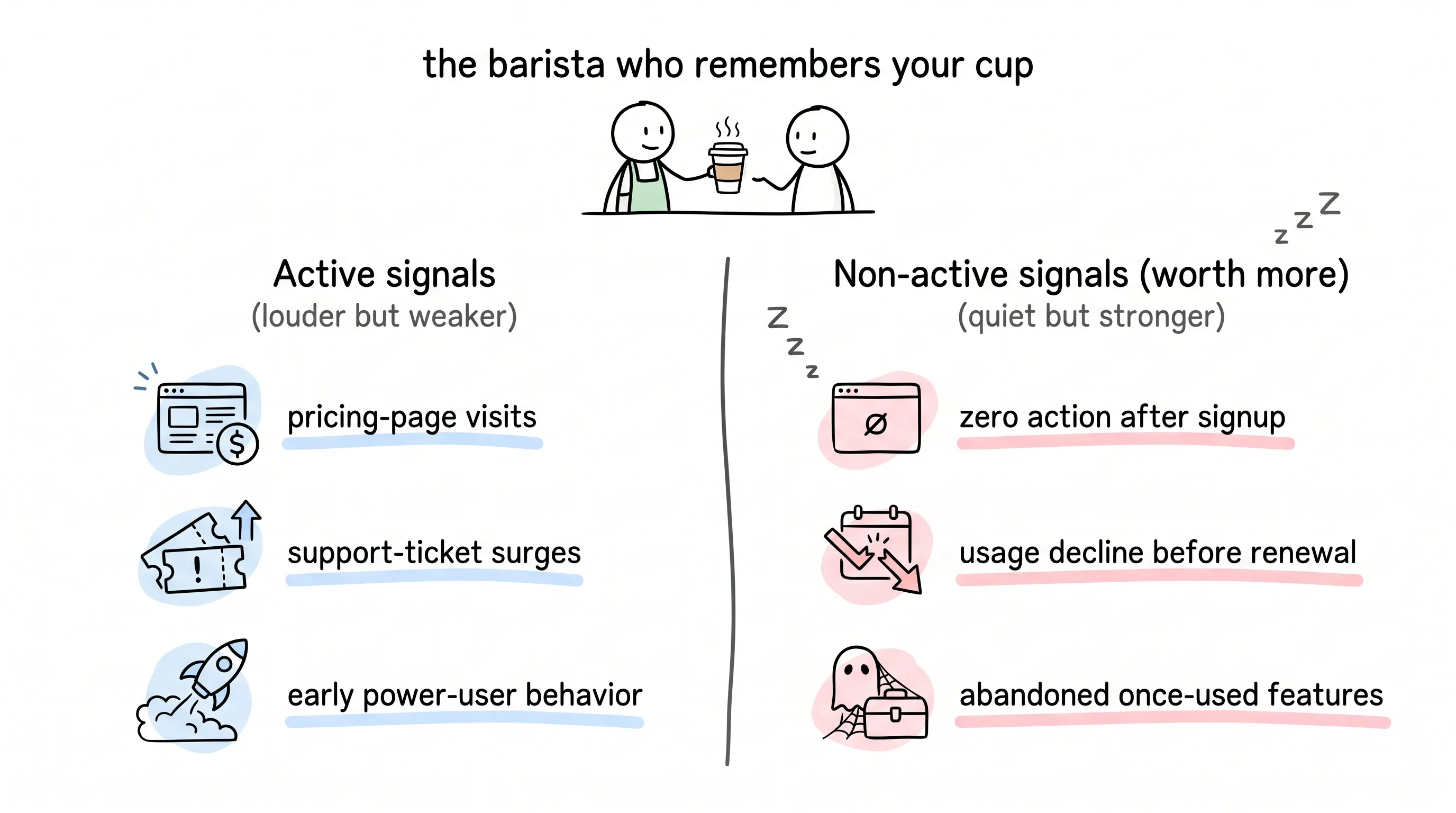
💬 This list is copy-ready, especially for SaaS and subscription e-commerce. Pick three silence signals this week and build them into triggers — zero action after signup and pre-renewal usage decline are good starters — with exit conditions and frequency caps written in at the same time. The dividing line in automation was never the model; it is whether anyone picks up the signal.
🔗 Further reading: Read the full article
🏷 AI Visibility & Content Practice
Digital PR is becoming an entity engine: high-authority media doesn't equal AI visibility
Marketing AI Institute distilled the MAICON 2026 talk by Fractl's digital PR lead Nicole Franco into a playbook at the intersection of GEO and digital PR. The direction: digital PR is shifting from telling stories to journalists to running an entity engine — treating subject-matter experts, products, and the brand as a set of entities, and using media coverage, LinkedIn amplification, bylined articles, and expert commentary as one unified system that builds expert authority across social, search, and AI. The counterintuitive point: high-authority media does not equal AI visibility. A single appearance for a food brand on All Recipes may influence an LLM's recommendations more than a general business mega-outlet would — authority is context-dependent, and the media list should be re-ranked by each model's citation preferences. The second direction: produce expert commentary at scale as a structured data asset. Journalists and models want raw, candid sound bites with real informational increment, not PR-flavored boilerplate.
💬 Pick media by LLM citation preferences, not DA score alone. Build an expert-commentary library, structured by topic and refreshed quarterly. Keep spending on the big outlets as before, but set aside a share for vertical media.
🔗 Further reading: Read the full article
Five-point GEO self-audit for multi-location brands: definitional queries won't feature you, commercial-intent queries will
Uberall lays out a GEO strategy for local marketing, aimed at multi-location and chain brands. Change the metrics first: move from SERP rankings to Share of Voice, Mention Rate, and Citation Rate — ranking thinking has no equivalent in generative engines. Focus on five areas: shift optimization targets from semantic keywords to prompts, because only commercial-intent queries like "where to buy pickleball shoes" give brands a shot at exposure while definitional queries get answered without citing brands; keep content structure consistent; invest in rich media and freshness; track brand mentions across directories, reviews, and social; and maintain continuous GEO monitoring. The piece positions GEO as a cross-functional opportunity — PR, social, brand, and sales can all contribute. At its core, GEO is engineering a brand's footprint across the whole web, and the official website is only one station along the way.
💬 This connects directly to the lead story's verification loop: GEO manages being found; reviews and social manage being trusted. Multi-location teams should run the five-point self-audit this week — close the directory and review-platform consistency gaps first, then talk about buying SOV monitoring tools.
🔗 Further reading: Read the full article
10 deployable landing pages in 30 seconds: Exit Five demos Claude skills marketing workflows live
The Exit Five podcast published its full conversation with Corey Haines, about an hour long. Corey's marketingskills.com has over 20,000 stars on GitHub, making it one of the most-cited repositories in this wave of skill engineering. Three live demos back to back: pulling real keyword data from the DataForSEO API and using a programmatic SEO skill to generate 10 deployable Next.js landing pages in about 30 seconds, then shipping them GitHub-to-Vercel in one click; using Claude to cross-reference Search Console, Fathom, and keyword data into diagnostic deliverables at the level of a five-figure SEO consultant's quote; and a RevOps skill wired into HubSpot that audits pipeline stages in the field and builds a lead scoring model. On methodology: a skill is just a markdown file — keep it under 500 lines to control context, add evals and a tools registry, and Claude connects to APIs like HubSpot and Instantly out of the box. His mindset shift: marketers go from typists to creative directors — hand off the repetitive execution, and focus human attention on creativity and experiments.
💬 This approach costs almost nothing and can be replicated this week: write one skill under 500 lines, attach three evals, and get a single step working end to end before expanding. When skills live as files, anyone on the team can run them — that is what capability reuse actually means.
🔗 Further reading: Read the full article
Three red lines for virtual influencers: when novelty fades, authenticity decides whether you stay famous
Scholars at Newcastle University Business School review the state of virtual influencers. Operationally, three types exist: independent brand collaborators like Lil Miquela, brand mascots, and entertainment characters — the three modes differ in partnership structure and monetization path. Their rise rests on three layers: maturing AI, AR, and VR technology; digital natives' social expectations of non-human identities becoming normalized; and, on the brand side, total control, freedom from physical constraints, and cost efficiency. The risks are just as clear: content with no grounding in lived experience means authenticity becomes the biggest problem once novelty wears off, and values failures have precedent — the virtual influencer Fnmeka was dropped by Capitol Records over racial stereotyping and cultural appropriation. The authors advocate effective, ethical, sustainable use and give brands a set of boundary recommendations for improving outcomes.
💬 Before trialing a virtual influencer, clear three gates: does this persona have real experience to speak from, has the values risk been reviewed, is an exit plan ready. Be especially careful with beauty and fashion — authenticity carries the heaviest weight in those categories.
🔗 Further reading: Read the full article
🏷 Regulation & Risk Governance
EU takes aim at addictive design: Digital Fairness Act proposed by year-end, misleading influencer marketing on the list
Reuters reports that European Commission President von der Leyen announced in Copenhagen that the EU will strengthen protection of minors against the addictive design of platforms like TikTok, Meta, and X, and is considering a minimum age for social platforms — the so-called "social delay" legislation. By year-end, the Commission will propose the Digital Fairness Act (DFA): banning manipulative design, addictive features, and misleading influencer marketing, while imposing strict limits on AI use in social media. Under the DSA (Digital Services Act), the EU is already investigating TikTok's infinite scroll, autoplay, and push mechanisms, Meta's weak enforcement of minor age checks, and the risks from X's deployment of Grok. Norway, France, Turkey, and the UK are pushing teen social-media restrictions in parallel, referencing Australia's precedent. For brands, the news cuts both ways: compliance costs for paid campaigns rise, and at the same time competitors who abuse influencer rhetoric are being swept off the field.
💬 If you run influencer campaigns into the EU market, do one thing this week: go through the language guidelines in your contracts, scrub exaggerated-claims and undisclosed-advertising phrasing first, then add a disclosure requirement for AI-generated assets in partnership content. The window before the DFA proposal lands is limited — run the compliance review ahead of it.
🔗 Further reading: Read the full article
Generative-AI marketing governance review: 58% are already using it, only a third have a formal policy
Universal Business Council reviews the use cases, gains, and risks of generative AI in marketing. The market: roughly $1.56 billion in 2024, projected to reach $22 billion by 2033, a compound annual growth rate around 35%. About 58% of US marketers have already folded GenAI into daily work, yet only about a third of organizations have a formal policy. Among the gains, the Michaels retail case is the most convincing: AI personalization lifted personalized-email share from 20% to 95%, email CTR rose 25%, and SMS CTR rose 41%. Productivity gains equal 5% to 15% of marketing budget, per McKinsey's estimate. Governance runs along four lines: hallucinations and unsubstantiated claims must pass verification before release, bias needs auditing, raw customer data stays out of public tools, and tests need a hypothesis — not ten random headlines piling volume from the same angle. The piece calls out a common waste: AI copy that sounds good doesn't necessarily perform, and stacking same-angle variants only burns budget.
💬 Treat the one-third figure as your timing signal to raise an internal policy. Start with the three cheapest rules: human verification before any claim goes out, no customer data pasted into public models, and a written hypothesis for every test. Do just these three and you are already ahead of most of the field.
🔗 Further reading: Read the full article
An academic paper adds the final cut: AI hallucination is marketing's invisible hazard, with three clear risk pathways
Burak Yaprak, a scholar at Istanbul Ticaret University, published a paper in the Journal of Economy Business and Management systematically examining hallucination risk from generative AI in marketing. The argument: while models like ChatGPT, Bard, Claude, and Llama 2 boost content production, personalized experiences, and data-analysis efficiency, hallucinated output looks real but is wrong — and it can flow straight into ad claims, emails, and positioning decisions, where consumers can barely tell the difference. Risk travels three paths: brand reputation damage, erosion of consumer trust, and potential legal consequences. Using literature review and case analysis, the paper offers a framework: technical detection and correction as the base layer, human oversight to guarantee accuracy, and adherence to ethical and regulatory frameworks — so brands harvest generative AI's efficiency gains without losing integrity.
💬 Limited practical value, but the citations are the point. When you are pitching an internal AI governance proposal, an academic source clears review better than blogger opinions. Quote its three risk pathways directly, pair them with the four governance lines above, and the proposal stands up.
🔗 Further reading: Read the full article
💡 Today's Takeaway
Put today's 14 items side by side and one theme surfaces: AI marketing's bottleneck has moved from the tool side to the trust side and the data side.
The lead story's verification loop states it most plainly: consumers discover through AI and verify through reviews and social. The digital PR item and the multi-location GEO item supply the corresponding production-side moves: entity operations determine whether AI can say your name, and review operations determine whether customers stay once it does. The EU's DFA and the hallucination paper mark the risk boundary — regulators watch manipulative design and misleading content, while the paper maps how hallucination incidents travel. The direction is the same on every front: every sentence you publish needs someone to stand behind it.
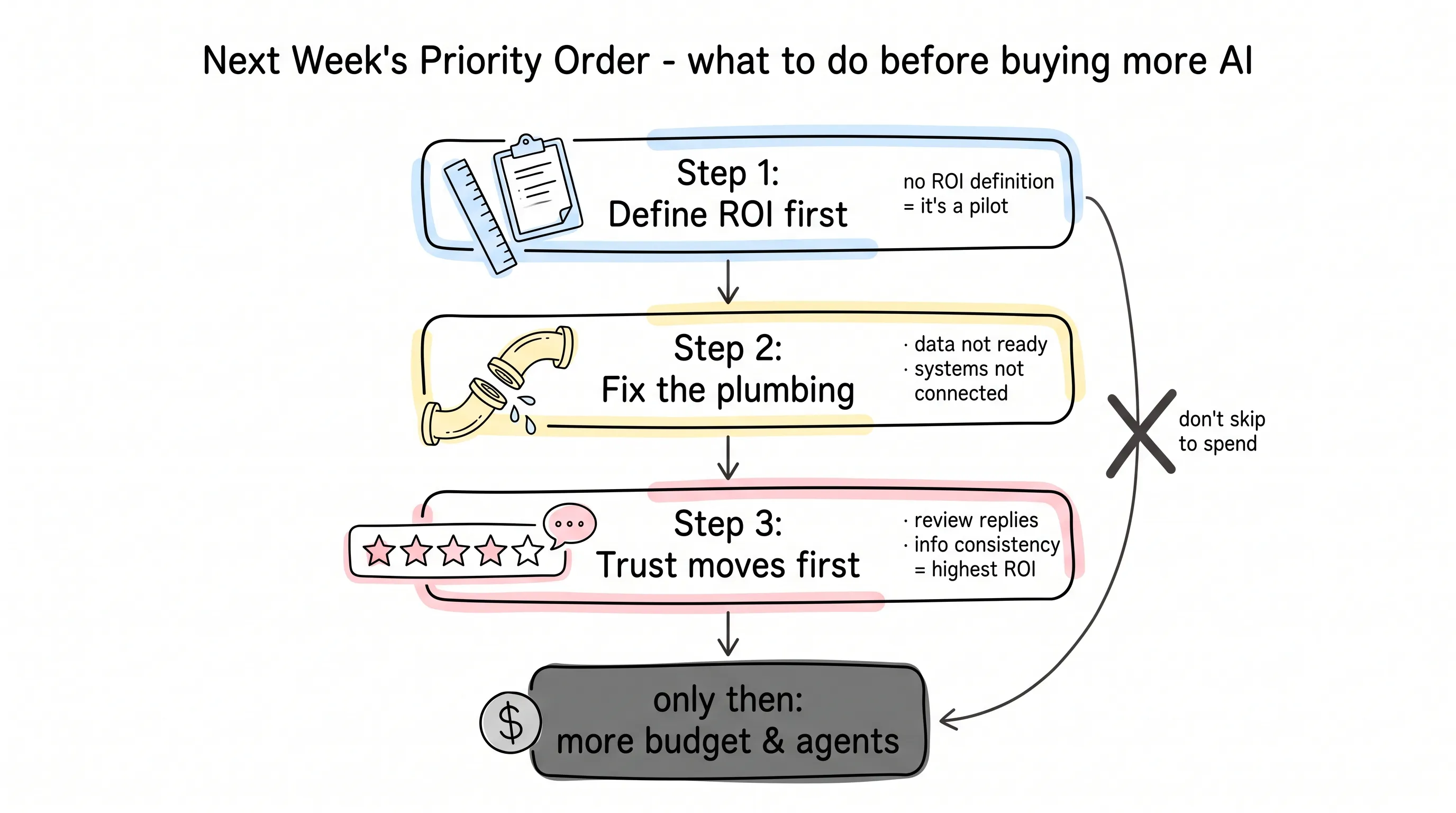
The data-side signals converge just as sharply. In the 134-CEO survey, 86% never measured ROI; in HubSpot's survey, 90% of teams sit at shallow usage. The shared cause is one and the same: data isn't ready and systems aren't connected. This isn't a model-capability problem — it is a plumbing problem. Money doesn't buy smooth execution: in the survey, companies spending over $250,000 actually posted a 73% failure rate. What money buys is more shots on goal and, eventually, the measurement discipline that failure forces on you.
Next week's priorities can be ordered like this. First, stand up the measurement definitions: any AI project without an ROI definition gets treated as a pilot, full stop. Second, close the gaps in data plumbing and signal monitoring — the email-signal list above is ready to lift as-is. Only last comes more budget and more agents. The trust side follows the same logic: review replies and web-wide information consistency are the highest-ROI moves in today's entire set of material — do those first. And leave the team one action on the skills side: write your recurring workflows into skill files and let them accumulate. Look back next quarter, and these assets will be worth more than the licenses.
Continue reading
Related articles
AI Marketing Daily · 2026-10-10
Nine stories today, one clear throughline: AI is already on the budget sheet, while most teams still can't produce the evidence.

AI Marketing Daily · 2026-10-09
AI marketing daily for 2026-10-09 covering 11 items: brand measurement moving from survey panels to search, social, e-commerce, and AI prompt signals; GEO and share of model playbooks; safety guardrails for agentic ad buying; and tool roundups for ad platforms, cross-border tools, and social media uses.

AI Marketing Daily · 2026-10-08
AI Marketing Daily for 2026-10-08 curates 20 items across AI search visibility (GEO), advertising, platform selection, cross-border e-commerce, and ROI measurement. The headline argues that strategic marketing decisions should stay with humans while AI assists execution.