
AI Marketing Daily · 2026-10-07
Today's throughline is answer engine optimization (AEO — getting your brand quoted in AI answer engines).
Today's throughline is answer engine optimization (AEO — getting your brand quoted in AI answer engines). MarTech's headline story explains how brand storytelling determines AI visibility, and HubSpot published five role-specific AEO guides in a single day — two threads converging on one signal: managing your visibility in AI search is now officially open for business. On the ads side, OpenAI is adding image ads to ChatGPT, while independent data flags a bot-click risk. Influencer marketing brings two benchmark reports and a tool roundup, and the budget data all points toward adding to positions. On governance, two hard numbers appear side by side: the moderation gap in generative AI and declining consumer trust. Twenty items, about a ten-minute read, each with hands-on commentary.
🎯 Today's Headline
How Brand Storytelling Gets Into AI Answers: Audit First, Then Unify the Wording
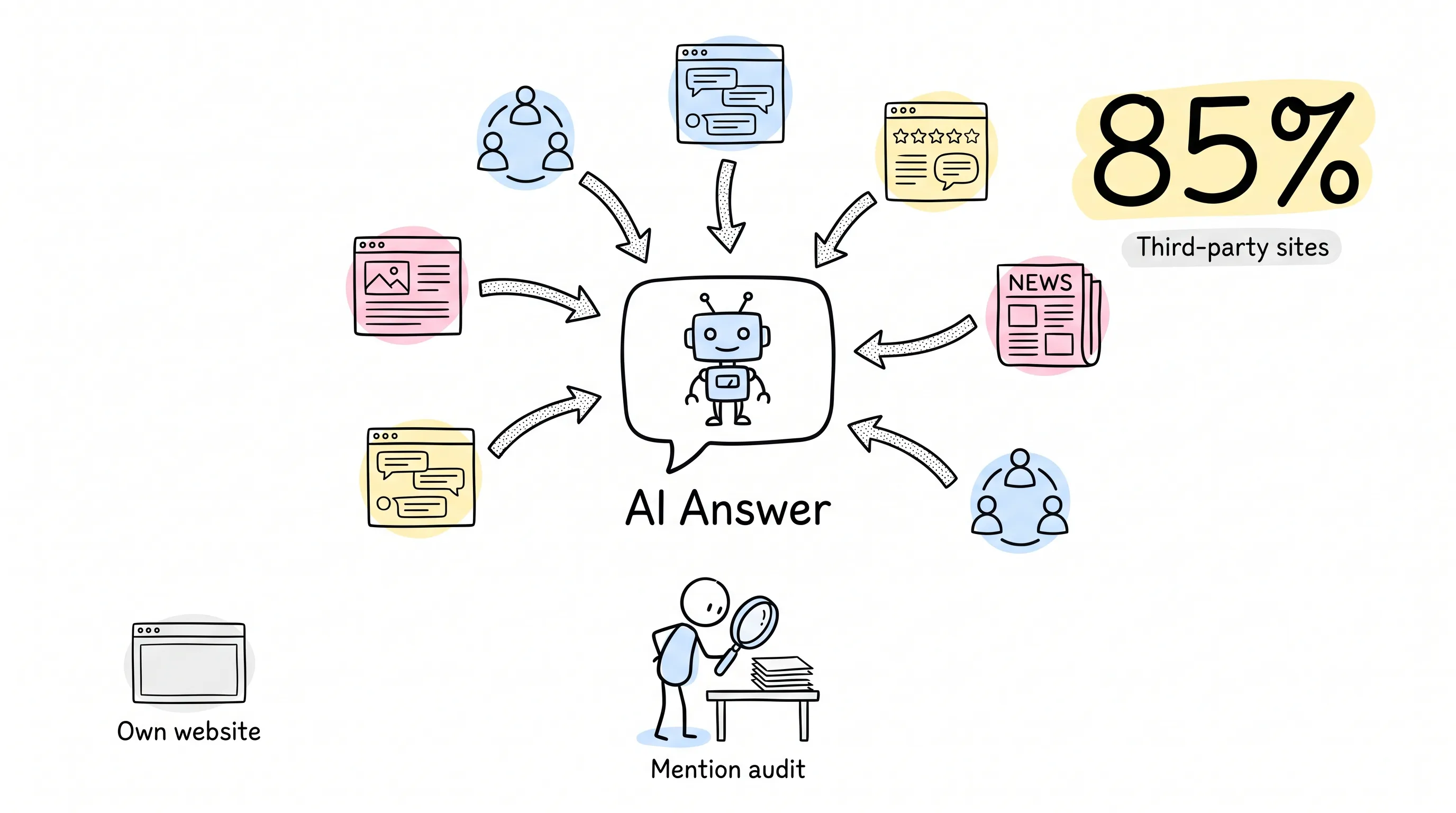
MarTech's hands-on column from October 6 ties brand storytelling directly to AI search visibility. The evidence comes from a 2025 AirOps study: across a sample of 21,311 brand mentions, 85% of brand mentions in AI answers came from third-party sites, while the brand's own domain accounted for only a sliver. In other words, when answer engines assemble your brand image, most of the material is written by other people. Author Tamara Scott offers a five-step method: clarify why your brand exists, run a brand-mention audit, update the company boilerplate across your website copy and sales/PR templates in one unified pass, add FAQs and key-point summaries to your key organic-traffic pages following SEO best practices so they serve RAG (retrieval-augmented generation) retrieval, and finally write AEO standards into your content calendar and internal documentation. The piece also cites Rand Fishkin's SparkToro experiment: his team fixed on the exact phrase makers of fine audience research software in every bio and every company description, and every AI chatbot reproduced that phrasing verbatim when introducing SparkToro.
Most teams treat AEO as a technical offshoot of SEO, fixating on structured data and crawler permissions. This study pulls the focus back to narrative: among the variables that determine AI visibility, what third-party sites say about you accounts for 85%. Entity phrasing in the knowledge graph can be deliberately planted — the SparkToro experiment is publicly verifiable proof. The article's stance is blunt: if your brand messaging is inconsistent in the knowledge graph, you barely exist to AI tools. Brand message consistency has, for the first time, a quantifiable search payoff — something previously filed away as soft work for the brand department. Most AEO discussion stops at monitoring; this piece delivers rewrite actions, from the audit table to the update cadence, ready to copy.
The impact differs by role. For brand and PR people, the audit scope expands from media lists to the sources AI answers cite — review sites, forums, editorial coverage all count. For content people, updated pages need FAQs and key-point summaries built around RAG retrieval logic. For salespeople, that three-year-old pitch deck is on the audit list too — it's a repeated touchpoint of brand language. The article adds an easily missed reminder: what current and former employees say on third-party sites also counts as brand mentions, so employer branding and AEO are now the same project — recruiting pages and employee handbooks should follow the same phrasing. Topic ideas in the content calendar that don't serve the brand narrative should be cut without hesitation; the replacements should answer the questions buyers are asking right now.
Rollout runs over four weeks. Week one: the audit — put every place your brand appears into a single table: website, templates, investor materials, third-party reviews; a byproduct is that you may surface new communities and new audiences. Week two: unify the company boilerplate — fix the touchpoints you control first, then contact outlets that quoted the old wording and ask editors to update; most editors will happily refresh old pages. Internal docs change in sync, with the employee handbook and recruiting materials written to the same brand story. Week three: set an update cadence by content type — news and trending pages refresh every 30 to 60 days, comparison and product pages every 30 to 90 days, evergreen content every 6 to 12 months; updates need substance — new data or a restructure — before search engines and RAG will credit them. Week four: write AEO checkpoints into the content calendar, and bring CTAs and audience personas onto the same narrative, so it doesn't lapse half a year later.
My take: LLMs speak by consensus — say it enough times and they believe you. If your competitors' bios and review phrasing are more consistent than yours, you can get squeezed out of AI answers. This work is inexpensive, outsourceable, and shows results faster than SEO; the friction lies in its fiddliness and cross-department reach. The original writeup of the SparkToro experiment is worth a read — five minutes to see exactly how entity phrasing gets learned by AI. The five AEO items in today's brief make a ready-made companion toolkit: run your baseline first, then talk optimization.
🔗 Further reading: Read the full article
🏷 AEO & Answer Engines
The Three-Step AEO Measurement Loop: Proactive AEO Customers See 170% Higher MQLs
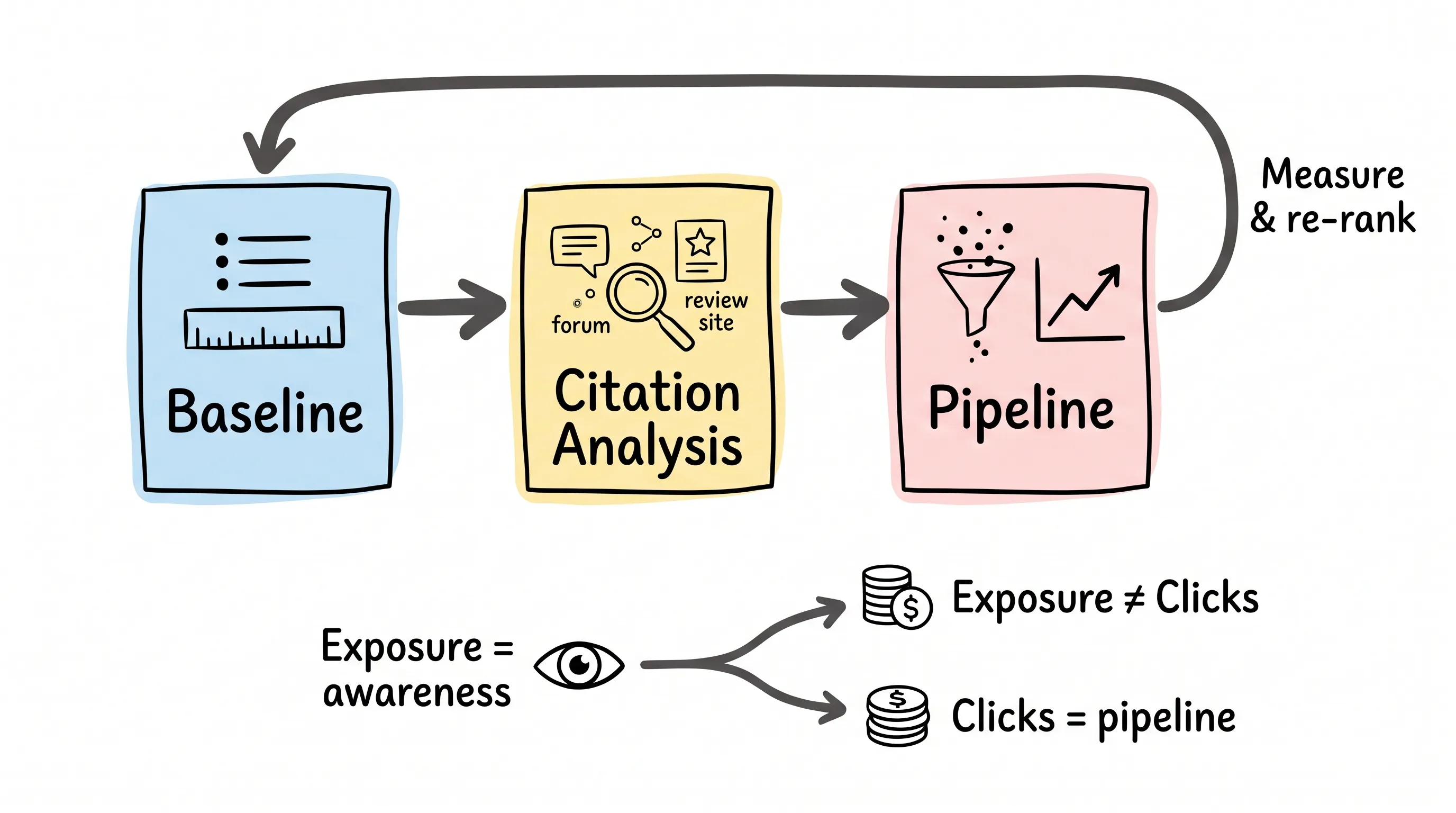
HubSpot's AEO series content-marketing entry gives content teams a three-step loop. Step one: build a baseline — check how your brand shows up in ChatGPT, Gemini, and Perplexity for category questions: presence, description, competitive comparison. Step two: use citation pattern data to prioritize content — see who AI cites, where you're missing, and decide whether to create new pages or update existing ones. Step three: measure AI referral traffic alongside pipeline — AI exposure without clicks is hard to attribute, so route clicked traffic in by AI Referrals source. The article reminds you to keep the two data types separate: exposure is awareness equity; only clicks enter the conversion sheet. HubSpot's number: customers proactively doing AEO see 170% more MQLs (marketing-qualified leads).
💬 Content teams: get that baseline run this month — ask ten category questions and note how many times you show up. 170% is vendor-reported; take it with a grain of salt. But the direction is right: if AI referrals never make it into the pipeline spreadsheet, AEO will never get budget.
🔗 Further reading: Read the full article
How AI Describes Your Brand: One Market Went From 0% to 33.5% in a Month
HubSpot's AEO series brand-marketing entry starts from this premise: answer engines assemble brand descriptions entirely from third-party content — reviews, comparison pages, forums, editorial coverage — and the assembled version often differs from what the brand itself wants to say. The framework is three steps: monitor how each answer engine describes your brand, looking at visibility scores, share of voice, and citation sources; build owned content that can shape AI positioning — positioning pages, comparison guides, category explainers; and track how AI visibility changes correlate with the awareness and consideration stages. The article lands one essential point: if your owned content isn't optimized to be quotable, the narrative gap persists. The case study is HubSpot itself: AI mention rate in the French market went from 0% to 33.5% in one month; Germany reached 17.1%.
💬 Ask every AI who you are today, compare the answers against your official boilerplate — whatever the gap, that's your narrative gap. 33.5% is a self-reported case; don't copy the speed. But positioning pages and comparison guides are two content types worth scheduling this week.
🔗 Further reading: Read the full article
Re-Rank Outreach Lists by AI Citation Influence, Not Just Domain Authority
HubSpot's AEO series outreach entry proposes a new way to rank: answer engines' citation logic differs from backlink logic — outlets cited by AI aren't necessarily high-domain-authority sites, and they may never link to you. The recommendation: use citation analysis to find the third-party channels that actually drive AI answer citations — forums, review sites, editorial outlets, community platforms all belong on the list. Most of what AI cites isn't on the traditional outreach list, so the ranking needs rebuilding: re-prioritize outreach by citation influence, and track each placement's actual pull on AI visibility with your brand visibility score, closing the feedback loop.
💬 Re-rank your outreach list by AI citation influence today — forums and vertical review sites will most likely move up. Add one KPI to traditional digital PR: 30 days after each placement, did AI visibility move?
🔗 Further reading: Read the full article
The SEO Team's AEO Roadmap: Put Tracked Prompts Into the Weekly Report
HubSpot's AEO series entry for SEO teams points out that existing rankings, traffic, and conversion metrics can't answer a new question: does the brand appear in AI answers? The roadmap is three steps: first build a baseline — which engines mention the brand, which prompts trigger it, who the citation sources are, and where you stand versus competitors; then use citation data to decide what content to create or update; finally, use AI Referrals traffic sources to connect AEO performance to leads and pipeline. One practical caution: tracked prompts run daily, so observe the data across multiple days or even weeks before drawing conclusions — single-day swings carry no signal. The definition of brand visibility score is given too: the percentage of analyzed AI answers in which the brand appears, tracked at prompt level, with AI Referrals drilling down to specific platforms and mirroring into deal records.
💬 Add two columns to the SEO weekly report starting today — AI visibility score and AI Referrals traffic — and read them alongside Google rankings. Don't call meetings over single-day prompt data; bank two weeks before deciding moves.
🔗 Further reading: Read the full article
Doing AEO Without a Marketing Team: Founders Start With Three Steps
HubSpot's AEO series entry for founders targets entrepreneurs without a marketing team, with a three-step start. Step one: use the visibility panel to get your brand's baseline in AI answers — no SEO expertise required. Step two: act directly on the prioritized recommendation list — build content, update pages, chase citation sources. Step three: connect AEO activity to your CRM's leads and opportunities to verify ROI. Unlike the other entries, this one's prioritized action list lets AEO run without a team or an agency. The number cited: AEO customers see 82% more opportunities. The article puts it plainly: ignoring how AI describes your brand is betting that your competitors aren't doing it either.
💬 Founders, don't treat AEO as a big project — baseline plus a priority list, one person can finish it in a week. 82% is likewise vendor-sourced, but for ROI let your own CRM opportunity data do the talking; you don't need anyone's averages.
🔗 Further reading: Read the full article
🏷 Ads & Buying
ChatGPT Ads Get Image Formats, and Bot Clicks Have Been Caught Red-Handed
OpenAI is adding visual formats to ChatGPT ads: image ads appear within the image-generation flow, displayed separately from the generated content; officially they don't affect the answers themselves, and small-scale US testing begins this month. The ad product previously had only sponsored placements showing advertiser name, logo, and a product link — the image format is a step toward turning it into a real ad inventory, and the official line is that ChatGPT's weekly reach has hit 1.2 billion people. Conversion measurement is opening up in parallel: Hightouch, Tealium, and LiveRamp can now pass conversion data back to ChatGPT Ads. The counterpoint is TrafficGuard's independent analysis: across three weeks of ChatGPT ad traffic from 47 advertisers, invalid click rates ranged from 0.1% to 34%. Clicks were 3.6x more likely than Google Ads to come from data centers or proxy networks, and 10x more likely to come from device configurations that couldn't exist in reality. Four hosting and proxy networks reached 25 of the 47 advertisers and contributed half of all invalid traffic (IVT), with 15 servers clicking 318 times for 5 advertisers in three weeks. The split is stark: some campaigns came out almost clean, while others are paying for traffic that will never convert. In TrafficGuard co-founder Mathew Ratty's words, automated traffic has found ChatGPT ads — organized, patient, clicking every day.
💬 Teams eyeing ChatGPT ads: wire up ad fraud monitoring before talking scale, make independent IVT data a procurement gate, and start with a small test budget. 1.2 billion weekly reach sounds big, but click quality is still an open question — don't move your core budget out of Google.
🔗 Further reading: Read the full article
Shopify AI Ad Guardrail Checklist: Own Your Ad Account and Pixel
Zeely's practical guide splits AI advertising in the Shopify context into three ownership layers: Shopify-native AI, the AI built into ad platforms, and third-party AI ad apps. The guide stresses that Shopify cannot substitute for a Meta or Google ad account — billing, policy, attribution, and account ownership all live on the platform side. Ad accounts and Pixels must be owned by you, never hosted by an app vendor. Each platform's AI levers differ in priority: Meta leans on its delivery system plus creative rotation, Google on feed quality plus value-based bidding, TikTok on Smart campaigns plus creative automation. The value of the three-layer ownership model is assigning responsibility: when something breaks, first determine whether it's Shopify's AI, the platform's AI, or the app vendor's AI — accountability and troubleshooting both depend on it. The guide also lists what AI cannot decide for you: gross margin, cash flow, discount rules, LTV, brand guardrails. Before launch, set a CPA target, a ROAS floor, and exclusion rules. Citing Meta data from January 2026: AI delivery lifted Facebook ad clicks by 3.5% and Instagram conversion rate by 3%.
💬 Before turning on AI buying, write a one-page guardrails doc — CPA ceiling, ROAS floor, exclusion terms, discount rules. Any one missing, no budget gets released. Audit ad account and Pixel ownership today: data assets handed to a vendor become hostages when it's time to switch.
🔗 Further reading: Read the full article
8 Generative AI E-Commerce Tools Launch in a Cluster: Support Response Down 40%
SEONIB rounds up 8 generative AI e-commerce tool launches from the first half of July 2026, all pointing the same direction: agentic AI taking over complex workflows. Text shipped a Shopify app unifying LiveChat, ChatBot, Inbox, HelpDesk, and WhatsApp Business into one backend; early users report common-question response times down 40%. AllyHub does browser-native automation — one demonstration becomes a reusable task asset. PixPix integrates Google Nano Banana 2 Lite to speed up product image and ad creative generation. Voiceflow gave AI agents native Shopify data access — agents can check inventory and orders in real time, with conversion up 25% in early testing. Optmyzr released an open-source AI skill for Google Ads audits — marketing automation moving from monolithic tools toward a modular skills layer.
💬 The news is from July, but the direction hasn't changed. E-commerce teams: start with support automation — response time down 40% is the easiest number to verify yourself, and only after two smooth weeks should you hook up deep integrations like agents checking inventory. For Southeast Asia and Latin America, messaging-channel consolidation is the top priority.
🔗 Further reading: Read the full article
🏷 Influencer Marketing
83% of Marketing Leaders Are Adding Influencer Budget — 80%+ Are Reallocating From Other Channels
Sprout Social's 2026 influencer marketing trends report delivers a set of budget signals: the industry will exceed $26 billion by the end of 2026 (Statista); 83% of marketing leaders plan to increase influencer budgets over the next 6 to 12 months, with over 80% reallocating from other channels. On the consumer side, 64% of social users are willing to buy more from brands their favorite influencers endorse — 76% among Gen Z. Four trends worth noting: micro and nano creators dominate engagement, with engagement rates 2 to 3 times those of top-tier creators and lower CAC — the report includes a four-tier fit table — match your creators into a tier by follower count and it's ready to use; 59% of marketers plan long-term partnerships, and 71% of influencers will discount for multi-campaign deals — the report offers a four-step structure of trials, tiered compensation, category exclusivity, and a co-creation calendar; mandatory FTC disclosure turns authenticity into a compliance issue too, with 47% of consumers naming authenticity their top quality; and performance accountability is replacing vanity metrics.
💬 Move the budget today: cut one-off big-influencer single posts, shift the money to two or three micro creators on quarterly deals, pay for performance. Bake disclosure compliance into your contract templates now — an FTC fine costs far more than what you save.
🔗 Further reading: Read the full article
Influencer Marketing Heads Toward $40 Billion in 2026, Nano Engagement 50% Higher
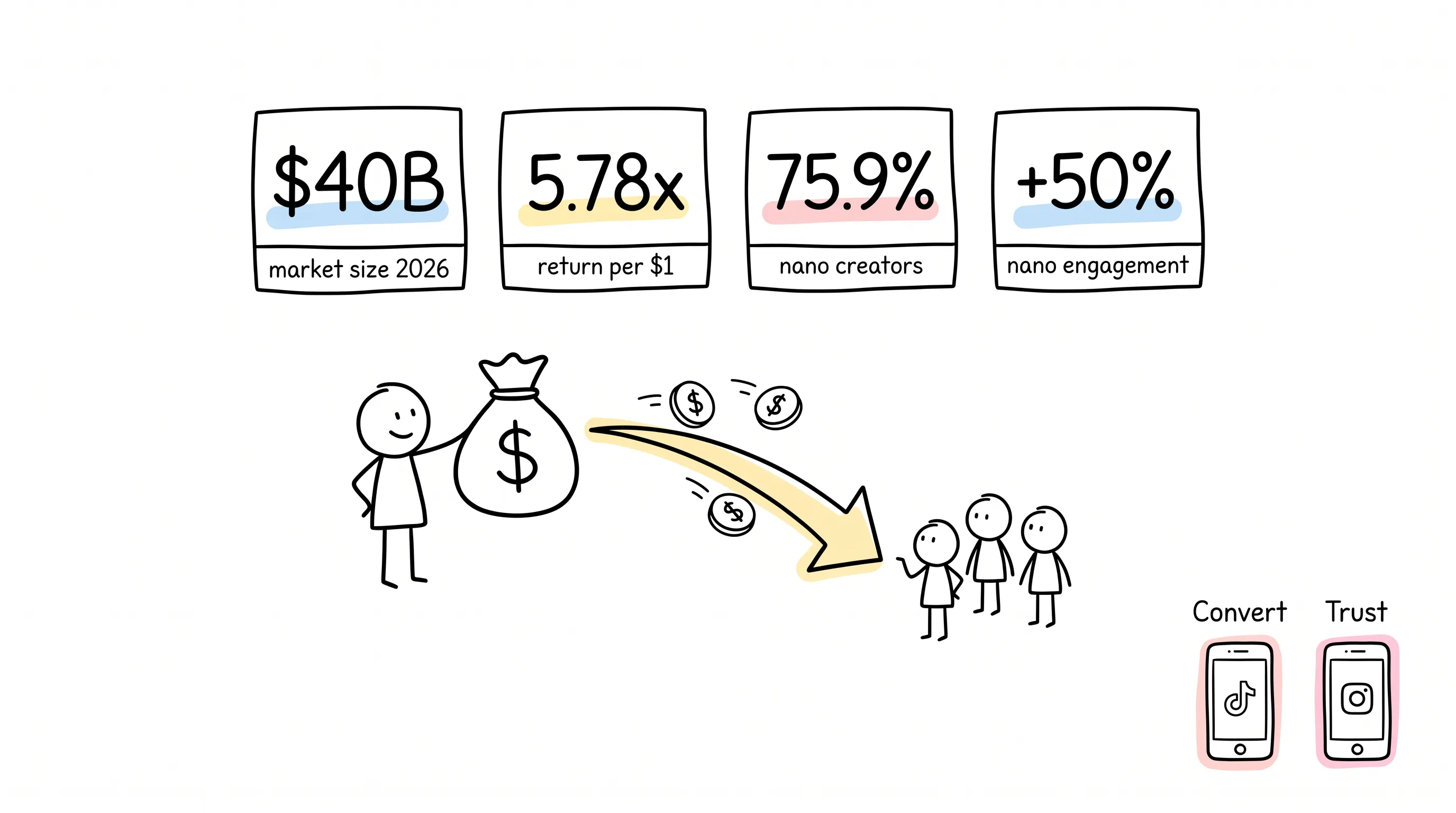
Jem Social's 2026 state of influencer marketing report is extremely data-dense. On scale: influencer marketing will break $40 billion in 2026, up from $32.55 billion last year — a 30% year-over-year rise, tripling over five years — with the creator economy overall at $234 billion. 86% of US marketers use the channel, 74% plan to add budget, the average return is $5.78 per $1 spent with top performers exceeding $18, and CPM has fallen to $2.68, down 42% year over year. The center of gravity is shifting downmarket: nano influencers (1K to 10K followers) make up 75.9% of the Instagram influencer base, with a 2.71% engagement rate — 50% higher than micro — while mid-tier feels the squeeze. Platform roles are clear: TikTok is the discovery-plus-conversion engine, with 75% of advertisers calling it their best-ROI platform and 40% of Gen Z searching TikTok before Google; Instagram is the trust layer; YouTube is the consideration layer; in B2B, LinkedIn influencer content sees 2.3x engagement and an average ROI of 520%. 93% of brands say UGC outperforms brand content; 59% already use AI for creator discovery and operations, and 48% name discovery their biggest pain point — the bottleneck is process throughput, not tools: vetting, briefing, contracting, and tagging slow the whole pipeline down. One more note for price talks: only mid-tier influencers with proven e-commerce results are still raising rates — check the track record before you negotiate.
💬 Take this report into your budget meeting — 5.78x ROI and CPM down 42% are ready-made ammunition. In execution, re-rank your creator roster first, fold nano creators into the main rotation, and give each platform its own job: TikTok for conversion, Instagram for trust.
🔗 Further reading: Read the full article
The Four-Piece AI Influencer Toolkit: Matching, Fake Followers, Prediction, Monitoring
Socially Powerful's long-form piece, updated October 1, surveys the current state of AI influencer marketing. Market data: influencer marketing grew from $21.1 billion in 2023 to a projected $32.55 billion in 2025 — a 33.11% compound annual rate — and 63% of practitioners plan to adopt AI. AI's four core functions: matching profiles to real creators, fake-follower and bot detection, pre-campaign ROI prediction, and real-time performance monitoring. CreatorIQ, Grin, and Aspire have machine learning built in. The challenges: high platform costs, incomplete data in complex scenarios, and privacy plus AI content authenticity. The article's judgment: AI excels at data-driven optimization, but real creators' storytelling and emotional connection are irreplaceable — hybrid models are the mainstream — and VC funding into AI companies already exceeded $100 billion in 2024.
💬 Of the four pieces, start with fake-follower detection — the savings are immediate and inflated orders get exposed on the spot. Profile matching and ROI prediction need accumulated data; add those after the first quarter. Small teams should watch platform fees — this line item isn't cheap.
🔗 Further reading: Read the full article
Europe Has Almost No AI Influencer Agencies: The Gap Between $6 Billion and $46 Billion
AIFLUENCE's market commentary surveys Europe's AI influencer market: the global virtual influencer market was roughly $6 billion in 2024 and is projected to reach $46 billion by 2030 — a 40.8% compound annual rate. Europe today has almost no dedicated AI influencer agencies apart from Spain's The Clueless, whose virtual influencer Aitana López earns €15,000 a month; Germany, France, Benelux, and the Nordics are all blank space. The differentiation argument: compliance is an advantage. GDPR and the EU AI Act mandate disclosure of AI-generated marketing content — a moat for natively compliant European agencies, and a retroactive-compliance maze for US-based ones. The implication for brands is more concrete: use AI-generated personas in content and there's no regional exception to the disclosure obligation — get your messaging ready before entering European markets.
💬 Brands expanding into Europe can scout compliance-first AI influencer partnerships early — supply is thin and rates haven't been bid up yet. If you're building your own virtual persona, design the disclosure mechanism into your content workflow; don't wait for the regulator's fine to retrofit it.
🔗 Further reading: Read the full article
36.7% of Marketers Worry AI Influencers Lack Authenticity
Influencer Marketing Hub's tool roundup (September update) opens with a set of attitude data: 36.7% of marketers worry that AI influencers lack authenticity, and 19% worry about consumer distrust — authenticity is consumers' second-biggest expectation of influencers. The body is a platform comparison: Upfluence is the first platform with a built-in ChatGPT assistant for influencer outreach emails, while Brandwatch uses Iris AI to replace boolean search, automatically discovering influencers and detecting trend spikes. The two split the outreach workflow — one covers sending, the other covers finding people; start your selection from whichever link in that chain you're missing. The piece carries an advertising disclosure and is positioned as a selection reference.
💬 Clear the authenticity bar before turning on AI influencers — virtual personas need to give consumers clear expectations, and mixing in real creators is the steadier play. On tools, trial Upfluence's and Brandwatch's outreach automation; the hours saved on outreach email are easy arithmetic.
🔗 Further reading: Read the full article
🏷 Marketing Tools & Platforms
MCP Is Wiring Ad Platforms Together: Google Ads Already Has 10+ Implementations
ChatForest's ecosystem survey maps where MCP is landing in advertising and marketing tech. The backdrop: Scott Brinker's 2025 landscape charted 15,384 tools, up 2,489 year over year, 77% of them AI-native — yet marketing teams still switch between platforms by hand; they buy more and more tools while execution remains manual. That gap is MCP's opportunity. MCP (Model Context Protocol) provides the unified protocol that lets AI agents connect directly to ad, SEO, analytics, email, and CMS platforms. The landscape: platforms with open APIs are adopting fast — Google Ads has 10+ implementations, Meta Ads 8+, and Google, Ahrefs, SEMrush, and HubSpot already offer official MCP servers, with TikTok launching its official Ads MCP in May 2026. The blank zones: A/B testing platforms and affiliate marketing networks. The author discloses that the content was written by an AI agent from public documentation and has not been hands-on tested.
💬 Have your engineers connect to Google Ads' or Meta's official MCP first and automate cross-platform reporting — log the hours of manual spreadsheet-pulling it saves. Don't count on A/B testing or affiliate marketing yet; there's no MCP support. The survey wasn't hands-on tested — verify before you decide.
🔗 Further reading: Read the full article
Scale Campaign Execution With AI Agents, Without Adding Headcount
HubSpot's guide draws a line between two things: traditional marketing automation executes fixed sequences, while AI agents understand context, adapt to new information, and coordinate across tools on their own. Keep the difference straight with one scenario: automation follows the checklist; an agent finds its own path when something lands off the checklist. Three capability points: running campaign workflows automatically from trigger to follow-up, shifting the execution load so team strategy can scale, and continuous monitoring and optimization. The content revolves around HubSpot's own Breeze and Agent Hub, with a very concrete first landing point: campaign workflows like signup triggers, sequence cadence, and follow-up branching are the best candidates to agentify first.
💬 Pick the single most repetitive workflow in your current campaigns to agentify first — don't flip the whole operation on day one. The hours automation saves should be explicitly redirected into strategy and new creative, or you're just spinning your wheels.
🔗 Further reading: Read the full article
Email Priced by the Click: Treasure AI Wagers Its Own Pricing on Its AI
Treasure AI launched Personalization Studio at the Agentic World 2026 conference: a real-time website personalization interface for marketers, built on unified customer data and a real-time decisioning engine, claiming a personalized campaign can be assembled in 10 minutes without waiting on data or engineering team schedules. Alongside it came an interaction-based email pricing model — fees tied to actions like clicks, where traditional email charges by the volume sent. In effect, the vendor is wagering its own pricing on its AI's decision-making. The signal underneath: data warehouses can't support real-time personalization, and the real-time decisioning layer has become the new battleground for personalization products — that layer is also the precondition for outcome-based billing to work at all.
💬 Watch this pricing signal — email budget negotiations now have a new option: ask vendors for interaction-based pricing and shift the risk to them. Before building real-time personalization in-house, check whether your data architecture can hold millisecond-level decisions.
🔗 Further reading: Read the full article
🏷 Industry Data & Risk Governance
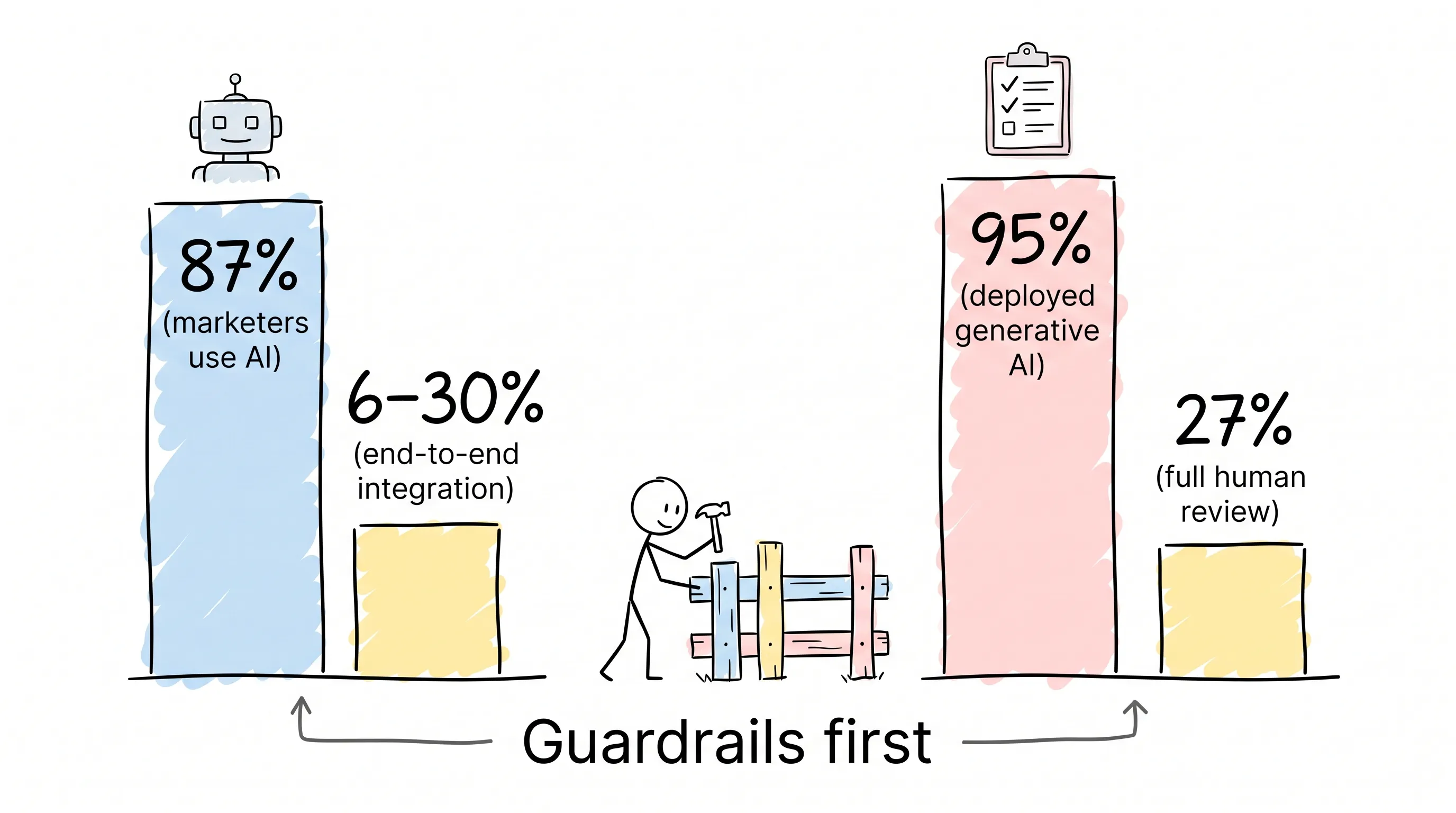
87% of Marketers Use AI — Only 6% to 30% Have End-to-End Integration
AI Stratagems' 2026 statistics aggregator pools data from Salesforce, HubSpot, McKinsey, Gartner, and BCG. It's a secondhand aggregator with some garbled formatting — cross-check against the original reports before citing externally. Adoption: 87% of marketers use generative AI in at least one workflow, up from 51% two years ago; 91% of teams use AI daily; marketers save an average of 1 hour a week, roughly 317 hours a year; AI lifts content output 42% monthly, with the earliest adopters producing at 4.1x baseline before hitting a quality ceiling 12 to 15 months in. ROI tiers by use case: campaign analysis tops out around 9x, AI content drafts 2 to 3.2x, AI video bottom of the pile at roughly 1x. Maturity is the weak point: only 6% to 30% of organizations achieve end-to-end workflow integration, 74% of enterprises struggle to scale (BCG), and the median payback period on tool investment is 4.2 months. Trust is weakening: consumer comfort with brands using AI fell from 57% to 46% in a year, and only 26% trust brands to use AI responsibly; 34% of enterprise marketing teams already have autonomous agents in production; and ClaudeBot has become the second-largest AI crawler at 13.87% of bot requests.
💬 Set the 87% figure against the 6% to 30% one for a team self-assessment: which bracket are you stuck in? Prioritize budget for high-ROI use cases — do the 9x analysis work first, and hold off on the 1x AI video. The trust data is a reminder to disclose sparingly; consumers are tightening up.
🔗 Further reading: Read the full article
95% of Enterprises Have Deployed Generative AI — 27% Apply Full Human Review
BlackFog's enterprise generative AI risk guide maps the governance gap. On scale: Bain's survey found 95% of US enterprises had adopted some form of generative AI by early 2025, production use cases doubled in a year, and 80% met or exceeded expectations; McKinsey estimates generative AI adds $2.6 to $4.4 trillion annually to the global economy, with marketing, customer service, software engineering, and R&D most affected. Governance is clearly lagging: only 27% of enterprises apply human review to all generative AI output, while 30% review less than a fifth; BlackFog's own research shows 53% of employees don't understand how the data they enter into AI gets stored. Data privacy leakage tops the five major risks — employees feed sensitive data into public tools that use it for retraining, with marketing content production and support automation the hardest hit; hallucinations, copyright, and compliance issues follow. Marketing teams need to get control of the data going in first.
💬 Hold the 27% figure up as a mirror to your own team: is anyone reviewing output, is there filtering for sensitive terms, does your support bot touch customer data? Set three input rules today — far cheaper than patching after an incident.
🔗 Further reading: Read the full article
Three Questions to Filter AI Advice: Can It Be Replicated?
MarTech's opinion column examines how to vet information sources in the AI era. The author draws an analogy to the early email-marketing-automation ecosystem: thought leaders were everywhere then too, and best practices ultimately settled out of community conversation. The test is three questions: Does the advice deviate sharply from consensus and resist replication? Did the expert show their work — process, failures, and toolchain in public? Does the advice solve a real problem? The author recounts spending three weeks failing to build a 15-agent system — that failure itself demonstrates how valuable replicability information is. AI advice fatigue is a real attention cost; for anyone without a filtering mechanism, most of what gets scrolled through in a day is noise.
💬 Run the three questions on any AI miracle story you scroll past — especially the ones flaunting revenue screenshots. Apply the same standard to what you publish: show your process and your failures; credibility beats success theater, and peers will cite you for it.
🔗 Further reading: Read the full article
💡 Today's Overview
Read together, today's twenty items point to one conclusion: marketing's execution layer is being taken over by AI while the definition of visibility is being rewritten at the same time. On visibility: the headline plus the five AEO items all say the same thing — AI answers have become the new search front page, and the phrasing of how your brand appears can now be audited, unified, and tracked quantitatively. The line that 85% of mentions come from third-party sites is worth pinning on a wall. On execution: 87% of marketers use generative AI, only 6% to 30% have end-to-end integration, 34% of teams have autonomous agents in production, MCP is wiring ad and analytics platforms into a unified protocol, and tools are scattering from monolithic apps into skills. That gap is the 2026 work list. Risk follows scale: 95% of enterprises use generative AI, only 27% apply full human review, 53% of employees don't know where their data goes, and in the very month ChatGPT ads added image formats, bot clicks were caught red-handed. Taken together, the three threads tell marketers this: before wiring AI's output and its bills into your process, build guardrails and a baseline first. One cross-item observation: HubSpot published five AEO guides in a single day and MarTech ran two in the same week — that density of vendor market-education activity is itself a signal, and the tools budget for answer engine optimization should be a line item now. The money hasn't shrunk — 83% of teams plan to add influencer budget — the spending just changed shape: nano creators, performance pay, outreach ranked by citation influence, all converging on results. The only thing you can't outsource is judgment. Nobody builds your guardrails and baselines for you.
Continue reading
Related articles
AI Marketing Daily · 2026-10-10
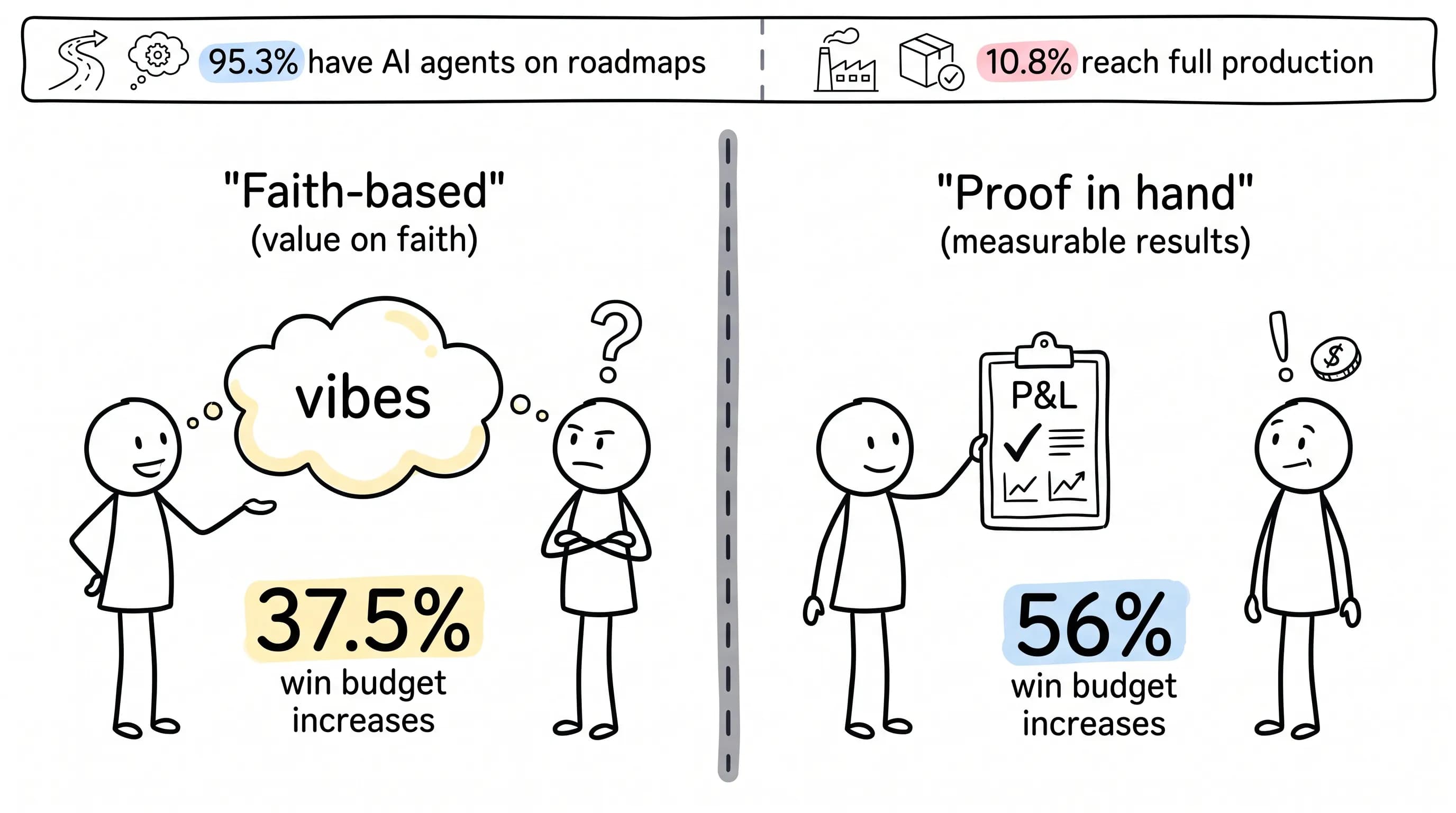
Nine stories today, one clear throughline: AI is already on the budget sheet, while most teams still can't produce the evidence.

AI Marketing Daily · 2026-10-09
AI marketing daily for 2026-10-09 covering 11 items: brand measurement moving from survey panels to search, social, e-commerce, and AI prompt signals; GEO and share of model playbooks; safety guardrails for agentic ad buying; and tool roundups for ad platforms, cross-border tools, and social media uses.

AI Marketing Daily · 2026-10-08
AI Marketing Daily for 2026-10-08 curates 20 items across AI search visibility (GEO), advertising, platform selection, cross-border e-commerce, and ROI measurement. The headline argues that strategic marketing decisions should stay with humans while AI assists execution.