
AI Marketing Daily · 2026-10-05
Daily digest of four AI marketing reads: a risk-tiered AI localization playbook covering translation, dubbing, support, and ads; a 2026 marketing automation platform top-10 ranking; an AI content marketing guide with a five-step workflow and stated tool prices; and a roundup of 15 B2B marketing AI tools.
Today's four items all point to the same thing: AI in marketing has moved past its novelty phase and into a phase of tool selection and division of labor. Teams going global now have to decide which content goes to AI and which must stay human; a platform ranking has written "agentic" into its stated ranking rationale; and tool roundups have started stating their prices honestly. Two of the four items are rankings, one is a tiering framework, and one is a B2B tool map — the sources' stances differ, yet their structures interlock. A day with no breaking news turns out to be a day for reading methodology and making plans. If your team is racing to finalize Q4 budgets or next year's tech stack, save this issue — it can go straight to work as a shortlisting draft.
🎯 Today's Headline
An AI Tiering Playbook for Going Global: How Much Human Work to Keep in Translation, Dubbing, Support, and Ad Placement
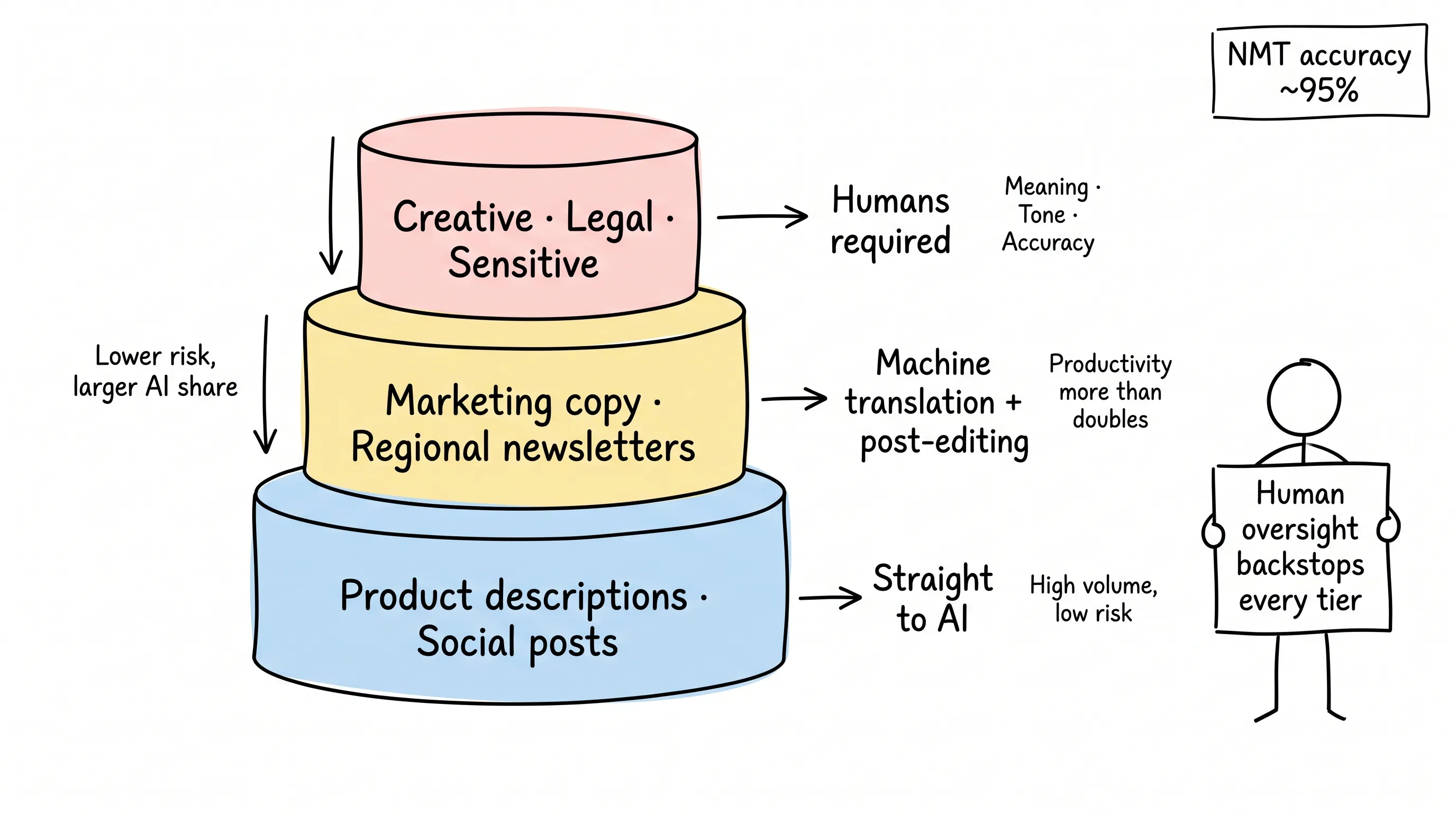
Localization vendor Acclaro published a long-form piece that breaks the rollout of AI in global marketing into five scenarios, each backed by verifiable brand case studies. On translation, it distinguishes two generations of technology: neural machine translation (NMT), in use since the 2010s, is mature and reliable at roughly 95% accuracy, and its failure points are largely predictable — but it struggles with lower-resource languages and its output reads stiff; large language models (LLMs) turn out more natural translations and perform better on low-resource languages because their training doesn't depend on massive bilingual corpora, yet their errors and biases are more common and their output harder to predict. The article never asks readers to pick a side: both technologies require human oversight as a backstop, whether through engine training, post-editing, or prompt engineering. On selection, it recommends tiering by content risk: high-volume, low-risk content such as product descriptions and social posts goes straight to AI; marketing copy and regional newsletters run on machine translation plus post-editing, citing research from Slator and arXiv that productivity more than doubles versus translating from scratch; creative, legal, and sensitive content must be translated by humans to protect meaning, tone, and cross-market accuracy — and the human effort freed up goes right back into serving exactly that content.
For video localization it lays out four paths: ADR (automated dialogue replacement) dubbing, voice cloning, translation plus speech synthesis, and end-to-end AI dubbing software. The piece cites HubSpot data: 61% of companies say time and bandwidth are the biggest challenges in video marketing, and 44% blame team size and resources — the more languages and markets, the worse both headaches get. The case study is Cadbury, which licensed the cloning of Shah Rukh Khan's voice so local store owners could add their store's name, making it look as though the actor had recorded an ad specifically for that shop. For customer service, the example is IKEA: its AI assistant Billie runs multilingual and around the clock, handling routine inquiries such as product information, recommendations, and even basic design advice; after launch it resolved 47% of customer inquiries, and the human team wasn't cut — it moved up to high-value, personalized design consultations.
On the ads and content-at-scale fronts, Coca-Cola uses AI plus a 3D asset library to quickly produce localized, brand-compliant advertising across more than 100 markets: AI first analyzes consumer habits, preferences, and cultural trends in each market. Markets are then segmented by language, region, and behavior to find which products sell where, and along the way ad copy is reworked to suit local tastes; consumer-goods trade media add that the company is also using digital twins to extend its campaigns. L'Oréal applies generative AI across 37 beauty brands, localizing messages while keeping the brand voice — feeding each region's appetite for personalized content without surrendering brand recognition. The piece closes with a privacy-compliance reminder: anonymize training data first, strip out personal information such as names and addresses, be transparent with users, and obtain explicit consent — balancing innovation against data-protection regulation. In the EU market this isn't a bonus point; it's table stakes.
The value of a framework piece like this is that it turns a running debate into a division-of-labor table. Over the past two years, marketing teams discussing AI localization mostly stalled at "can we use it?"; this piece goes straight to risk-tiered boundaries, with a brand case and hard numbers propping up every tier. 47%, 100-plus markets, 37 brands — those figures are sturdy enough for an internal project pitch. The limitations deserve equal billing: the author is a localization vendor, so the conclusions naturally tilt toward keeping language-service providers involved beyond where AI leaves off; the article's underlying draft was published in October 2022 with cases updated to 2024, and the NMT-versus-LLM comparison already looks dated from a 2026 vantage point.
For teams going global, this piece can reshape workflows directly. Content operations can start by sorting existing assets into three risk tiers: product descriptions and social posts go straight to AI, marketing copy gets a post-editing step bolted on, and legal and brand-sensitive content stays human. Media-buying teams should study Coca-Cola's approach — a 3D asset library plus AI generation turns out multi-market variants in one production pass, driving the marginal cost of asset localization down to almost nothing. Support teams can copy IKEA's division of labor: routine inquiries go to the bot while humans are trained into high-value roles such as design consultants — people aren't replaced, they move up one rung. Video teams should keep an eye on the dubbing quartet, voice cloning above all: the same voice reused across languages keeps the brand's sound consistent, at a lower cost than hiring voice actors language by language.
Rollout can be scheduled by the week. Week one: run a content inventory, list what can be AI-ized by risk tier, pilot the highest-volume product descriptions, get the machine-translation-plus-post-editing pipeline working, and validate quality in one or two lower-resource languages. Week two: settle whether post-editing is outsourced or kept in-house, log hours per thousand words, and run your own numbers against the "productivity doubles" claim — if the math doesn't close, switch engines or vendors. On the support side, first measure what share of inquiries are routine; only consider a multilingual support bot once that passes 40%, and at deployment restrict it to those three question types — product information, recommendations, and basic design advice — keeping a human channel open for complex inquiries; don't switch everything over on day one. For video dubbing, pick one proven market and trial ADR or voice cloning; secure authorization before you clone, and don't touch unauthorized celebrity voices. Write the three compliance items into your SOP now: anonymized training data, explicit on-page consent, transparency toward users — doing this late costs more than doing it early.
My take: the risk-tiering framework in this piece will outlast any specific technology choice — the technology narrative will age, risk tiering won't. The thing to guard against is treating it as a rubber-stamp answer: the author's stance and the age of the case studies both deserve a discount — best practices written by vendors always lean a little more toward services and a little less toward your budget. For most teams, copying benchmark numbers like the 47% down as internal targets and picking one market to pilot beats wading through ten vendor blog posts.
🔗 Further reading: Read the full article
🏷 Marketing Tool Selection
2026 Marketing Automation Platforms Top 10: HubSpot Takes the Top Spot as Salesforce Retells Its Story Around Agentic
Independent selection-advisory firm ElevatIQ has published its 2026 Top 10 ranking of marketing automation systems, deliberately scoped to upstream marketing automation — covering campaign orchestration, audience segmentation, journey design, lead scoring, attribution, and cross-channel engagement — with CRM-embedded marketing modules excluded. The reasoning has two layers: these embedded modules are mostly built for basic campaign execution and lead nurturing, and their depth and pace of innovation can't keep up with dedicated platforms; besides, the marketing automation category already carries low integration complexity, which suits a best-of-breed strategy — there's no need to lock yourself into a single suite. The evaluation criteria include product share, customer-acquisition strategy, roadmap depth, community and partner ecosystem, win rates, technology strategy, and investor backing; investor backing is treated as a signal of a vendor's long-term viability and R&D commitment, since funding movements directly affect whether roadmaps get delivered. The rankings span multiple industries and size bands and lean general-purpose; the ranking itself admits it was deliberately kept broad — industry-specific selection needs to be dissected further.
No. 1 HubSpot: the first choice for content-driven teams and the B2B mid-market; it acquires customers through content and its own ecosystem and invests heavily in AI and data-driven workflows; the weakness is that its operations data model can't carry enterprise-grade complex processes, so it can't serve as the transactional system of record. No. 2 Salesforce (Pardot): the vendor investing more than anyone else in the industry in agentic workflows; it no longer calls itself a marketing cloud, having retold its story as agentic marketing, and it uses a Slack community for internal and external conversational marketing — a turn from the no-reply email era toward real conversation; this narrative shift is itself an industry bellwether. No. 3 Adobe Marketo Engage: deep penetration among media and enterprise customers, campaign and event workflows built in, granular security layers — it saves pain when enterprise compliance reviews come around. No. 4 Oracle Eloqua: fits enterprise global brand consolidation and compliance scenarios such as GDPR; companies with heavy cross-border legal work should look at this tier. No. 5 Klaviyo: the deepest penetration and the deepest feature set in the Shopify and DTC ecosystems, but priced above ActiveCampaign — budget-tight DTC teams need the conversion differential to prove the premium is worth paying. No. 6 ActiveCampaign: friendly to hybrid B2B/B2C and franchise models; after its private-equity acquisition the pricing algorithm changed and its value-for-money edge has narrowed — run the numbers again before renewal. No. 7 Brevo: B2C- and Shopify-friendly; watch how it prices email volume, contact lists, and transactional emails — the bill jumps a tier as volume grows, and transactional sends such as signup verification emails being billed separately is a common trap. No. 8 Microsoft Dynamics 365: its upstream ecosystem and CMS depend on third parties; it fits companies that have already bet on the Microsoft stack. No. 9 Mailchimp: aimed at micro-businesses, pre-integrated with QuickBooks and Shopify, works out of the box; marketing teams much beyond a few dozen people will hit its feature ceiling fast. No. 10 Zoho: SMB positioning, with no gaps in feature coverage — landing pages, secure workflows, and email workflows are all there — but its closed ecosystem is the dealbreaker; the video offers the example that data vendors like ZoomInfo integrate with Salesforce and HubSpot first, while Zoho usually lands third or fourth in the queue — first because its market share isn't big enough, second because the product leans closed and third-party vendors have little appetite to integrate. The video also explains why Zoho suits small businesses: small companies demand less transaction-level data traceability and care more about ease of use and implementation budget, and Zoho is designed exactly along those lines.
The list also delivers per-scenario conclusions: for DTC pick Klaviyo or Brevo; for hybrid models pick ActiveCampaign; for global compliance pick Eloqua; for enterprise campaign marketing pick Marketo; for micro-businesses pick Mailchimp; for SMBs pick Zoho. One methodological note that selectors will find useful: integration complexity in this category is generally lower than in transactional systems, so switching platforms doesn't hurt as much — put your energy into feature fit and don't let integration fears intimidate you. The list's implicit stance is best-of-breed first: assemble a combination from specialized single points, and only consider a suite once scale makes coordination costs outweigh the benefits. The video was published in January 2026 and has just over two hundred views; the rankings rest on the consultancy's qualitative judgment rather than benchmark test data, and criteria such as investor backing and roadmap depth are directional judgments — verify current pricing and features before you select, especially since B2C platform pricing has moved considerably over the past three years.
💬 Choose your business shape first, then find your row: DTC teams should go straight to the three-layer pricing of Klaviyo and Brevo (send volume, contact lists, transactional emails) and plug in last year's actual send volumes to compute the annual cost — don't just read the sticker price; B2B mid-market teams can open a HubSpot trial this week; enterprises should put Eloqua and Marketo each through one round of compliance and campaign-scenario review. Treat the ranking as a shortlist, not a final verdict: give each vendor a two-week trial and run it on your real journeys and real email volumes. Teams already on Salesforce should take a look at the agentic plays in its Slack community — that's leverage for next year's procurement negotiation and a legitimate line item to write into this year's Q4 budget request.
🔗 Further reading: Read the full article
🏷 Content Marketing in Practice
Upwork Publishes an AI Content Marketing Guide: A Five-Step Workflow with Every Tool Price Stated
Upwork's Resource Center has published a hands-on AI content marketing guide aimed at small businesses and independent marketers, dividing AI content work into two tiers. AI-assisted means humans lead the creative while AI handles brainstorming, grammar checks, keyword research, and performance analysis; AI-generated means tools like ChatGPT and Jasper produce entire drafts straight from a prompt. The guide recommends treating the former as the main line and reserving the latter for scratch and first drafts, on the grounds that fully generated drafts tend to come out flat and off-voice, and small teams have no spare editorial capacity to backstop them. How the two tiers combine matters too: topics and frameworks are set by humans, first drafts go to AI, humans revise against brand voice and fact-check, and only then does the work move into optimization and distribution — data, quotations, and product specifications are the three zones where factual errors cluster, and they get priority in final review. This sequence is the same logic as Acclaro's risk tiering in the headline story: put humans in the judgment seat.
Tool selection is organized by use case, with each tool presented in a structured card carrying its best-fit scenario and small-business tips: for blogs plus SEO, Jasper, Surfer, and Scalenut; for converting long content into short social posts, Lately and Copy.ai; for email send-time and personalization, Seventh Sense and HubSpot; for brand-voice consistency, Grammarly Business and Writer — the latter centers on team lexicons and style guides, useful for companies running multi-brand matrices. For image generation the list carries Midjourney and Adobe Firefly; for social media automation, Predis.ai and Canva Magic Write; the SEO-optimization group is anchored by MarketMuse and Clearscope. Most of the cards' small-business tips land on the same move: use free tiers to test real output capacity before choosing a paid tier; don't pay by feature checklist — pay by hours saved. Prices are stated too: Jasper from $39 per month, Surfer from $79, Clearscope from $189, Writesonic from $16, Canva Pro at $120 per person per year. Price spreads within the same tool category can reach tenfold; Clearscope's pricing corresponds to enterprise content teams, and Surfer is very likely sufficient for a small team — the price sheet's greatest use is showing you which tier you belong to before you pay.
The workflow comes in five steps: brainstorming, writing and refinement, SEO optimization, distribution, and performance measurement, each annotated with what AI can take over: in topic selection, have AI scan trends and keyword gaps; in writing, produce first drafts and variants; in optimization, hand off to SEO tools to align with search intent; in distribution, schedule and adapt versions for each platform; in measurement, have AI aggregate reports and surface anomalies. One copyable stack comes attached: Jasper for first drafts, Surfer for keyword optimization, Canva for illustrations and social graphics, Kit for email distribution, and Semrush for monitoring rankings and traffic. Chatbots get a use case of their own — 24/7 customer service and pre-sales Q&A for small teams — grouped in with email and messaging tools like Mailchimp and Manychat. The risk boundaries are stated bluntly: AI cannot replace creative judgment or fact-checking; generated content can be flat, off-voice, or factually wrong, and every piece must pass human final review before it ships — publishing off-voice content and then retracting it costs far more than the ten extra minutes of checking at the start; and Google penalizes low-quality content regardless of whether AI generated it — the guide says it outright, a reassurance for the SEO purists. The metrics listed include target keyword rankings, blog bounce rate and time on page, email open and click-through rates, and social media engagement, with the advice to use AI tools to accelerate trend and opportunity discovery, moving the measurement cadence from monthly to weekly. The guide was published in July 2025; the title says 2026 but the body runs on a 2025 clock — prices may have changed, and it carries an Upwork funnel bias, since the platform takes a cut when businesses hire freelancers and outsourcing-collaboration scenarios keep recurring through the tool list. It works as an entry-level reference and a price cheat sheet; as a basis for decisions, it falls short.
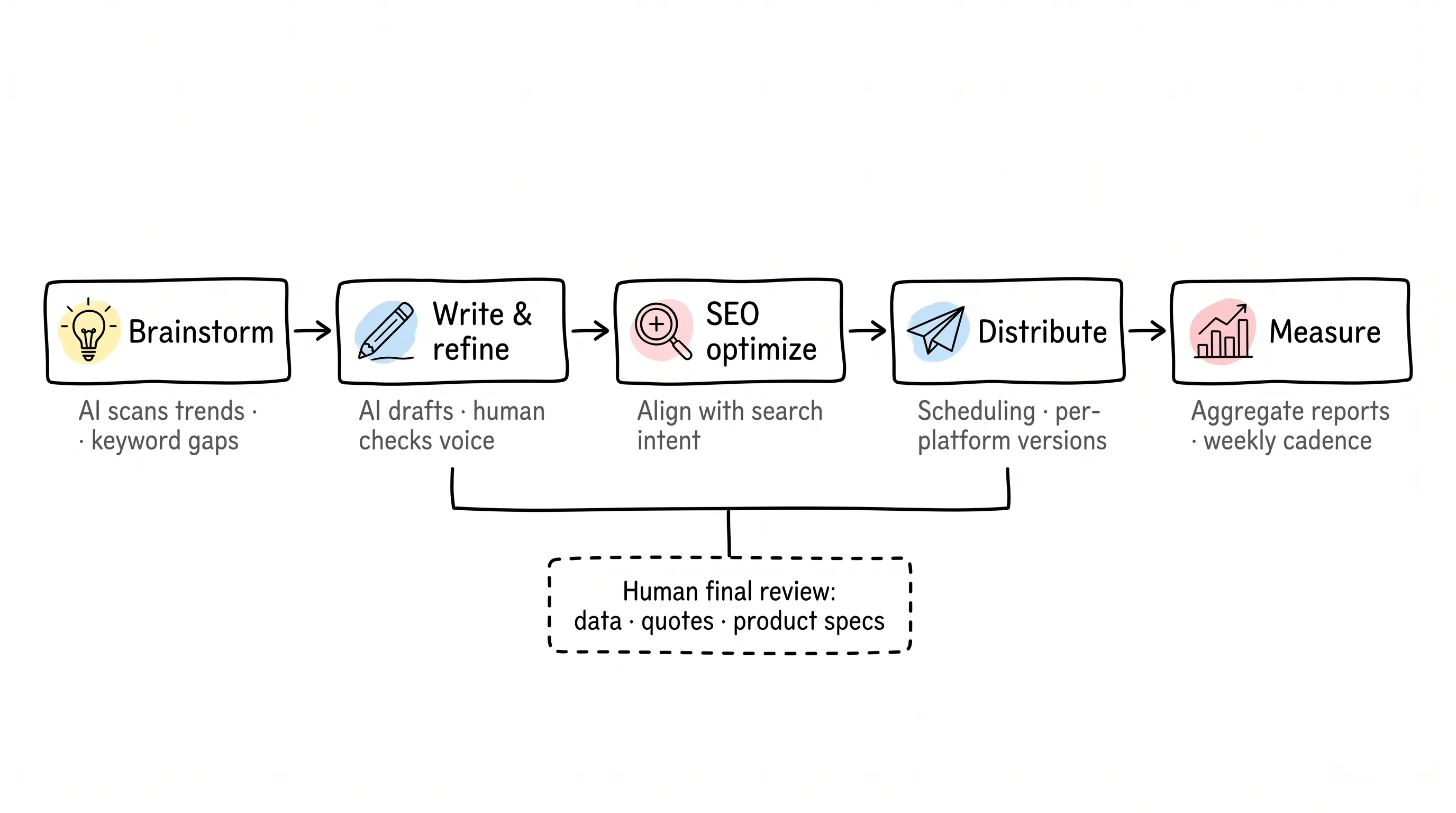
💬 Teams of three or fewer can start with that five-step stack alone; a monthly budget under $300 is enough to run one content line. Trial the blog line for four weeks first, log the actual hours each piece takes in human final review, then decide whether to add a social line. Don't let the list tempt you into buying five subscriptions at once — Clearscope alone is $189 a month, and before baselines exist for keyword rankings and bounce rate, every extra tool is a monthly fee paid for nothing. Trial order matters too: writing tools first, optimization tools second — before draft output is stable, SEO tools have nothing to optimize.
🔗 Further reading: Read the full article
🏷 B2B Growth & Sales Intelligence
A Roundup of 15 B2B Marketing AI Tools: 6sense Leads with the Dark Funnel, Einstein Add-Ons Run $50 to 200
Demand-generation vendor Vereigen Media has rounded up 15 AI tools for B2B marketing in 2026. The opening pain-point diagnosis: most B2B teams aren't short of tools — the problems are that the tools sit siloed from one another, data analysis depends on manual work, and content has grown homogeneous; marketing teams burn hours every week shuttling data between platforms, analyzing reports by hand, and writing undifferentiated content, all while guessing which prospects actually intend to buy. B2B buyer journeys have become more nonlinear and more multi-stakeholder; enterprise deal cycles often run past six months, and purchasing decisions must clear multiple committee reviews. AI's role has expanded from content generation to account prioritization, workflow automation, and cross-channel optimization, with five value points listed: eliminating guesswork, automating routine tasks, predictive lead scoring, AI search optimization, and hyper-scale personalization.
The 15 tools are grouped by three goals: content, demand generation, and marketing operations. On the content side: ChatGPT covers ideation and productivity and connects to apps like Canva and Figma, with the drawback that its outputs need expert review; Jasper runs enterprise content workflows — 50-plus templates, Agents and Chat included, image generation attached, deep integration with Surfer — but pricing is high, and vague prompts yield generic drafts; Claude's strength is deep reasoning and long documents — it can process hundreds of pages in a single pass and executes a single instruction strictly, suiting technical writing and complex briefs, though its third-party integrations trail ChatGPT's; Grammarly handles editorial quality control, plugging into Word, Gmail, and Slack, though it sometimes hands down unnecessary style advice; Surfer SEO does content optimization, feeding writing recommendations from live SERP data. On the demand-generation side: HubSpot AI does marketing automation with a smart CRM, AI writing, and site building — the free plan alone can build a basic database, and the price climbs as features switch on; Salesforce Einstein does predictive CRM — lead scoring plus a generative assistant plus conversation insights — connects to Data Cloud, carries ecosystem lock-in, and its add-on features run $50 to 200; 6sense does ABM (account-based marketing) intent detection, with the dark funnel as its signature highlight — you can see what anonymous buyers are researching before they've filled in a form or left any footprint; for ABM programs, being able to see the dark funnel and chasing leads are two different games; the shortcomings are steep pricing and complex integration with CRM and marketing automation platforms; Apollo provides sales intelligence — a claimed database of 275 million business contacts, with an AI assistant and data backfill — at prices friendly to SMBs, though data accuracy and usage limits are yours to police. On the operations side: Semrush has released an AI Toolkit that adds AI visibility tracking, while keyword research, traffic analysis, backlink analysis, and site audits remain in place — competitive research is its home turf, and premium add-ons are billed separately; Gong does revenue intelligence, converting sales calls into structured data with call summaries and sales coaching — annual fees are high, it's unfriendly to early-stage teams, and its impact on the marketing side is indirect; Drift replaces static forms with AI conversations, routing visitors in real time to the right salesperson and auto-booking meetings — its effectiveness depends on website traffic and upstream ICP (ideal customer profile) definition; Canva AI has the lowest barrier to entry — Magic Design plus Brand Kit plus background removal — usable at any company size; Adobe Firefly leads on commercially safe asset generation, integrates smoothly with Photoshop and Premiere, and can generate sound effects from text, but carries limits on prompt length, resolution caps, and monthly credit consumption; Zapier AI does no-code workflow automation — new leads entering a pipeline, Slack alerts, assets pushed to ad platforms — automating these manual handoffs, with cost at scale and complex logic as its drawbacks.
Five selection criteria are given: alignment with business goals, seamless integration with the existing tech stack, fast time-to-launch, clean compliance, and long-term returns — the first two are the most practical, because however strong a tool is, if it can't plug into existing workflows it's nothing but a demo. Combination suggestions by goal: for content marketing pick ChatGPT, Claude, Jasper, Grammarly, and Surfer; for demand generation pick HubSpot, Salesforce, and 6sense; for marketing operations pick Canva, Apollo, Semrush, Adobe, and Zapier. The piece closes with a comparison table scored item by item on purpose, ideal user, company size, and ease of onboarding — Grammarly and Canva took the top onboarding ratings, while Salesforce Einstein and 6sense are marked as purely enterprise-grade. The FAQ adds a few words for small teams: tools like ChatGPT, Grammarly, Canva, and Zapier let small teams go toe-to-toe with major brands on content capacity — with, once again, the same precondition: pick tools that match your goals before adopting. The ending lands on selecting by business goal rather than piling up a tech stack; the argument is that AI is only an accelerator, and measurable growth comes from reaching real decision-makers aligned with your ICP and from first-party data — followed by a redirect to the vendor's own demand-generation services, self-described as zero outsourcing with verified content engagement data. The author has also written an FAQ, taking the position that AI will never replace B2B marketers — it will only take over repetitive work and help small teams fight bigger brands. Read this list with the vendor's stance in mind: the tool entries themselves are secondhand synthesis with no first-hand testing, but the classification framework and the dark-funnel explanation are clearer than in most lists of the same kind.
💬 Use this list as a map, not a purchase order. Before you act, write down two things: what your ICP looks like and which stretch of the funnel is most clogged. If it's clogged in the anonymous-research stage, intent-detection tools of the 6sense type are worth the premium; if it's clogged in content capacity, fix the content line first. The suggestion is to pick two tools for a four-week trial with pipeline growth as the acceptance metric; the onboarding-difficulty column can serve as a scheduling reference — connect the low-onboarding-cost tools like Grammarly and Canva first, and leave the high-annual-fee ones like Gong until after the funnel is running. Set an acceptance number for every trial: if you can't name an improvement within four weeks, cancel — the problem of fragmented tools will not be solved by adding one more tool.
🔗 Further reading: Read the full article
💡 Today's Overview
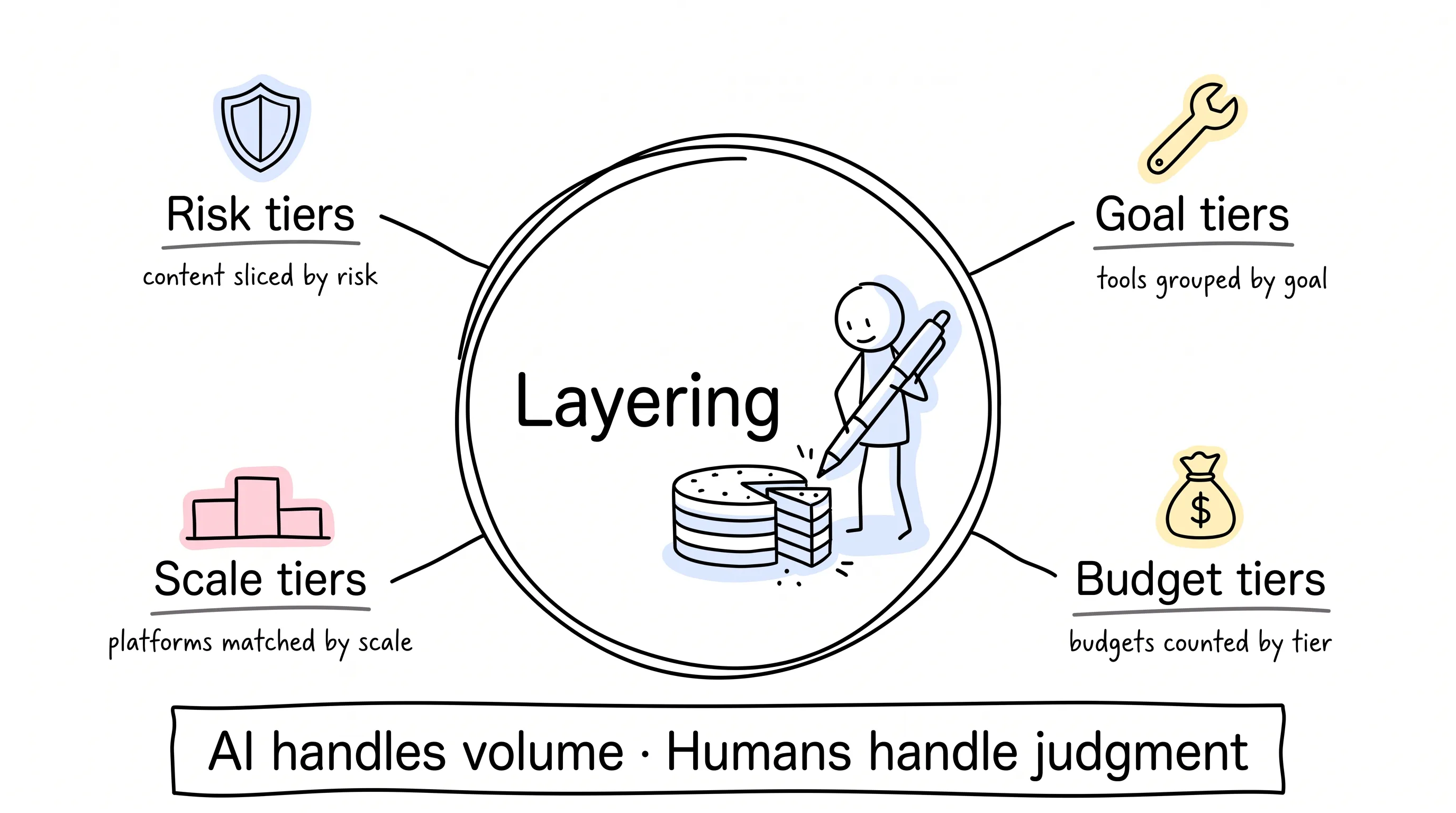
Put the four items side by side and today's theme is layering and division of labor. Acclaro draws the boundary for translation and dubbing by content risk; ElevatIQ draws the boundary for platforms by business shape; Upwork draws the boundary for tools by use case; Vereigen draws the boundary for the tech stack by funnel goal. The four sources take different stances — two are vendors, two are rankers — yet the structure of their answers is identical: layer first, then decide where AI takes over and where humans stay; the clearer the boundary, the less you spend on tools. "Layering" turned up four times today: content has risk tiers, tools have goal tiers, platforms have scale tiers, and budgets have price tiers. In 2026, marketing teams' homework has shifted from "should we use AI?" to "cut every layer clean." The cutting itself isn't hard; the hard part is holding the boundary afterward — AI-produced content that never gets a human re-review, high-value customers routed into bot channels; once these boundaries are washed away by schedule pressure, the hours saved earlier get paid back with interest. Holding the boundary is the one thing no tool can do for you — it can only be written into the process and assigned to a named person.
Humans haven't been driven out; their positions are shifting. IKEA's support staff moved into design consultation, post-editing keeps the brand voice intact, Upwork makes human final review the quality gate, and Vereigen wants genuine reach to real decision-makers. All four items are saying the same sentence: AI handles volume, humans handle judgment. That is the rare point of consensus across these four sources, and it deserves a place in the introduction of any AI rollout plan. The first step of implementation isn't buying tools, either — it's auditing your own content, platforms, and stack against today's four sorting methods, then drawing three tables: a content-risk grading table, a platform-matching table, and a funnel-gap table. The most clogged layer is where the next dollar should go.
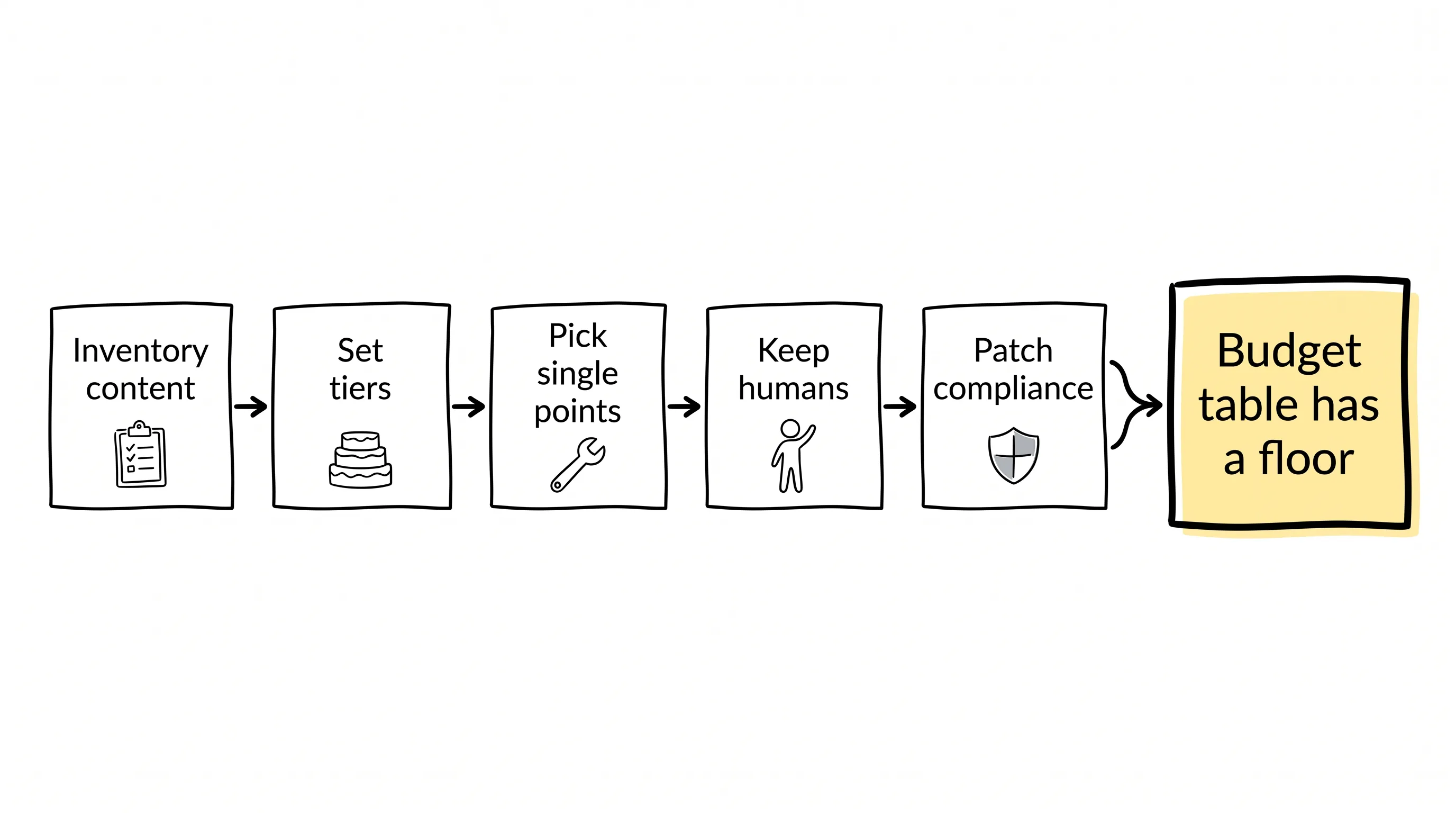
Two reminders. First, every ranking has a stance: the localization vendor leans toward human involvement, the demand-generation vendor leans toward its own services, and ElevatIQ runs on qualitative judgment — check pricing and features yourself before signing anything, all the more so since the price figures in these lists sit on a 2025 basis; a three-digit monthly fee like Clearscope's deserves a fresh round of asking whether it's still worth it. Second, a signal of the times: Salesforce has moved the category narrative from marketing cloud to agentic marketing, so in 2026, when you choose a platform, ask one more question: have agent capabilities actually landed, or did only the slide vocabulary change? The test is simple — have them demo a real workflow running on your data, and don't settle for a screen recording. No breaking news today, but the four items together make a serviceable working draft for a selection week: run the layered inventory first, then match your scenarios to the conclusions. Also worth taking away is that shared sequence: inventory the content, set the tiers, pick the single points, keep the humans, patch the compliance — finish those five steps and the budget table has a floor. Tools and tech stacks change their names every year; this sequence of thinking doesn't.
Continue reading
Related articles

AI Marketing Daily · 2026-10-09
AI marketing daily for 2026-10-09 covering 11 items: brand measurement moving from survey panels to search, social, e-commerce, and AI prompt signals; GEO and share of model playbooks; safety guardrails for agentic ad buying; and tool roundups for ad platforms, cross-border tools, and social media uses.

AI Marketing Daily · 2026-10-08
AI Marketing Daily for 2026-10-08 curates 20 items across AI search visibility (GEO), advertising, platform selection, cross-border e-commerce, and ROI measurement. The headline argues that strategic marketing decisions should stay with humans while AI assists execution.

AI Marketing Daily · 2026-10-07
Today's throughline is answer engine optimization (AEO — getting your brand quoted in AI answer engines).