
AI Marketing Daily · 2026-10-04
Daily digest of Seer Interactive's four GEO experiments on fan-out, content freshness, brand accuracy, and reverse due diligence, plus the AMA 2026 trends report's five forces for the next five to ten years. The takeaway: marketing's competitive position is shifting from grabbing placement to earning trust.
Only two stories today, but both are heavy enough to carry the show. Seer Interactive has put four original GEO (Generative Engine Optimization — getting brands retrieved and cited by AI answer engines) experiments from May to July 2026 on the table, and the data punctures two popular playbooks: chasing freshness by publishing new pages, and chasing AI rankings to grab placement. The American Marketing Association's 2026 trends report, meanwhile, draws five forces for the next five to ten years out of a Delphi (a structured forecasting method built on repeated rounds of expert voting) exercise with more than thirty practitioners. Both come from original researchers — one armed with experimental data, the other with foresight scenarios — no reposts, no mudslinging. A light news day is actually a good day to study methodology. Read both and you'll find they tell the same story: marketing's competitive position is shifting from grabbing real estate to earning trust. One hard, one soft — the hard one gives you numbers, the soft one gives you direction, and each confirms the other.
🎯 Today's Headline
Seer Interactive's Four GEO Experiments: In AI Search, Brand Placement Is Earned, Not Ranked
What happened
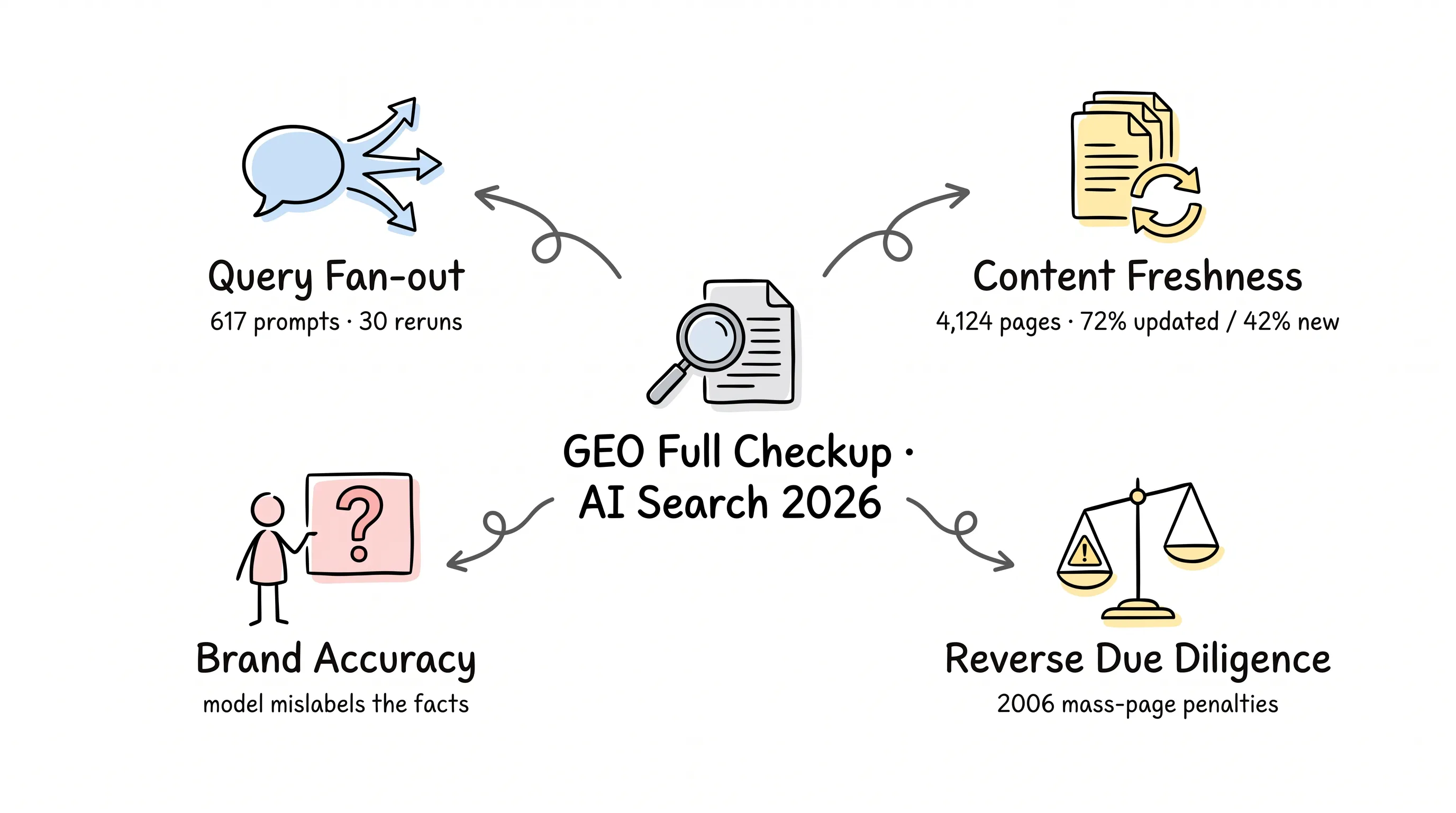
Search marketing agency Seer Interactive has pulled together four pieces of original research from May to July 2026 on its GEO research hub page, all out of its own experiments. The first takes aim at query fan-out (how one user question fans out into many hidden sub-queries an engine runs behind the scenes) in ChatGPT 5.5: 617 prompts, plus 30 reruns of a single prompt, found that brand names are showing up more and more in the fan-out sub-queries — users no longer ask which are the top GEO agencies, they name a specific agency plus a research topic. The second is a content freshness study covering 4,124 pages cited by ChatGPT, Gemini, and Perplexity between March and June; 72% had been updated within the past year, while only 42% were newly created in that window. The third is a maturity framework from Chief AI Officer Alisa Scharf: since Seer began doing GEO in 2024, it has never seen a single brand whose information is fully accurate across the various LLMs — one company with an average employee tenure of over ten years got described by a model as suffering heavy attrition, on the strength of a single negative review. The fourth is founder Wil Reynolds's reverse due-diligence playbook, built to counter the kind of one-week AI visibility case study that competitors stuff into CMO inboxes. The four pieces are written by Wil Reynolds, Nick Haigler, Sonny Vasquez, and Alisa Scharf respectively, covering retrieval mechanics, content strategy, brand information, and the industry's messier practices — together they lay out GEO's complete pipeline.
Why it matters
Taken together, the four datasets amount to a full physical for AI search optimization in 2026. The fan-out study introduces a metric most teams aren't tracking yet: brand visibility inside sub-queries. Once a brand makes it into the fan-out, you're no longer squeezing onto the same list as your rivals in the answer; you become the source being retrieved. The freshness study rewrites the basis for update cadence: the freshness LLMs reward comes from maintaining old pages, not publishing new ones — 4,124 samples make that case solid. The accuracy study stings more: the model's description of your brand may have been wrong from day one, while you keep watching share and rank. The reverse due-diligence piece invokes the old 2006 cases of Google penalizing BMW and J.C. Penney for mass page publishing, a reminder that visibility that shoots up fast can come down just as fast. Reading all four in sequence has another benefit: they hand you methods, not conclusions. The 617-prompt fan-out experiment and the 30-reruns-per-prompt routine can be rerun in any industry, for any brand. Seer has also been around the AI search block long enough — it started tracking the space in January 2023, its research has been cited repeatedly by Forbes, eMarketer, Fast Company, Search Engine Land, and Ahrefs, and it built its own AI visibility dashboard in November 2024, ahead of the mainstream rank-tracking tools.
What it means for marketers
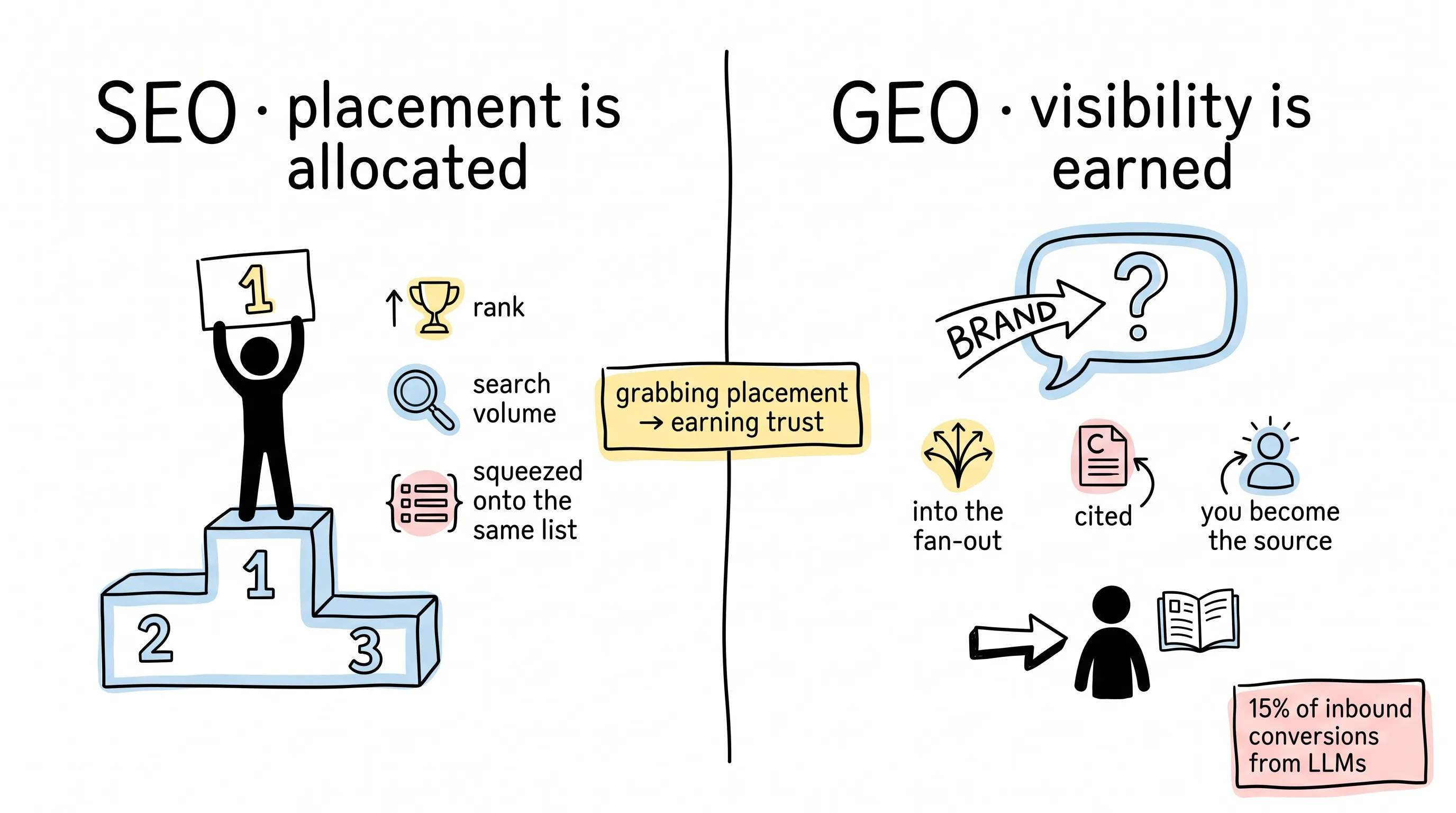
GEO and SEO are complementary but distinct channels, and Seer says it plainly: treating them as interchangeable is the most common mistake brands make right now. The old ROI formula breaks down in AI search: positions change daily, there is no reliable search volume, and personalization means the CEO sees different results than you do. Seer's own ledger shows what the channel is worth: since January 2025, 15% of inbound conversions have come from someone finding them inside an LLM. Content teams need to shift their center of gravity: maintaining existing pages now outranks publishing new ones, and cadence should be set by citation data, not gut calls. Brand teams pick up a new chore: watching how each model describes you. Distortions like solid employee tenure getting reported as high churn will never fix themselves. Seer also posts three positions on the hub page, worth copying onto the team wall: models reward proof, not claims — your content has to live up to what you say you are; audiences are turning into raw material — build fans, not traffic; everything will change, test everything, assume nothing. Mapped onto an organization, these three lines carve out the division of labor for content, brand, and experimentation respectively. Budget holders should stay sharp too: if an agency pitches visibility gains stacked from mass-produced listicle content, ask one more question — what happens when models start penalizing that kind of content? Seer's own research headline says the listicle window is closing.
How to act on it
Several moves you can make this week. First, build a fan-out visibility ledger: pick 20 to 30 business-relevant prompts, rerun each multiple times, and log how often the brand appears in sub-queries and answers — this signal arrives earlier than category rank. Next, don't rush into new topic ideas; pull the list of pages LLMs actually cite, check how many have been updated, and set your maintenance cadence from your own data. A brand-attribute accuracy audit belongs on the calendar too: verify the models' key statements about your company line by line, and fix wrong information before talking about share. When a one-week-results case study lands, run three steps: look at what pages they actually published, verify the visibility spike is still there, then hold it against those two 2006 mass-publishing penalties. Swap the dashboard over to Seer's new signal set: AI share of voice, citation frequency, branded search growth, direct traffic, and AI referral conversions — connect everything that can be tied to business outcomes. No need for heavy tooling spend yet: Seer partners with Scrunch for visibility tracking, so log a baseline with off-the-shelf tools first, then decide whether to build in-house. If budget is tight, do the accuracy audit and the fan-out ledger first — the former is a prerequisite, the latter a leading indicator.
My take
The most valuable thing in these four studies isn't any specific number — it's that the angle of vision has changed. In the SEO era, placement was allocated: rank high and traffic flows. In the GEO era, visibility must be won. The moment your brand name appears inside a retrieval question, you stop being a competitor and become the source itself. Seer has been at this for over three years and still calls its work experiments; the CEO says if anyone claims to hold a GEO silver bullet, he turns and runs. That posture is more reassuring than any methodology. The price of trusting quick fixes — this industry paid that bill once in 2006. Don't pay tuition on the same lesson twice.
🔗 Further reading: Read the full article
🏷 Industry Data
AMA 2026 Trends Report: Five Forces Reshaping Marketing for the Next Five to Ten Years
The American Marketing Association (AMA) has published the landing page for its 2026 Future of Marketing Trends Report, identifying five forces that will reshape the marketing industry over the next five to ten years: the age of autonomous agents, consumer discovery shifting to scrolling, portfolio careers and the liquid workforce, sustainable innovation, and brand trust in a fragmented world. The report's baseline judgment: AI will take over a large share of transactional marketing, and human creativity, cultural understanding, and authentic storytelling become the brand's primary differentiators.
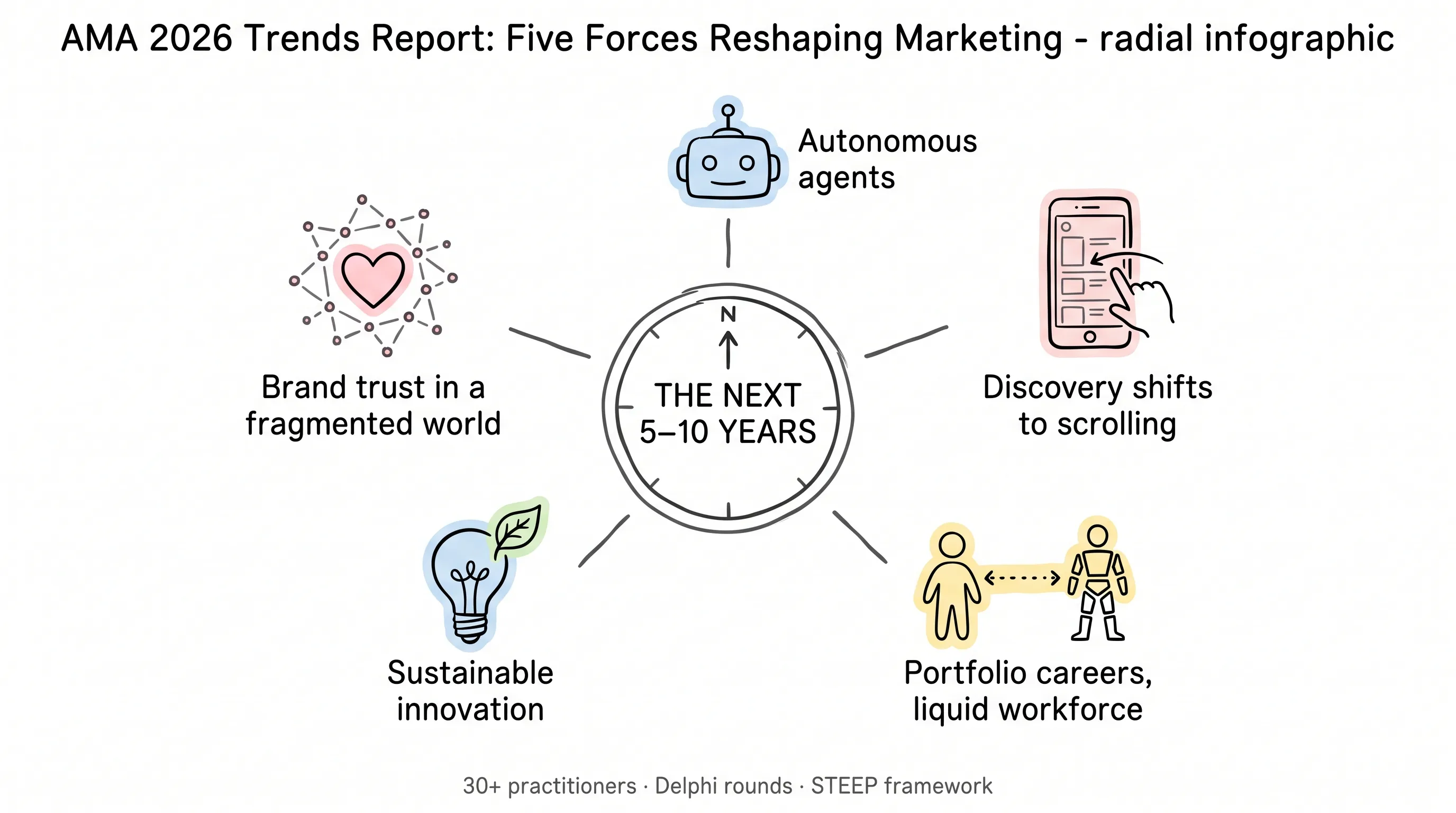
Methodologically, this report breaks from the usual trend roundup. Rather than running one survey and averaging it, between May and August 2025 it had more than thirty marketing practitioners first train in strategic foresight methods, then independently nominate trends, and — through multiple rounds of voting and discussion — use the STEEP framework to scenario out the future across social, technological, economic, environmental, and political dimensions. The foresight panel is mostly North American practitioners with global representation mixed in, drawn from organizations including Google, Ogilvy, Uber, NYU, and UNC Health, spanning client side and agency side, B2B and B2C, and companies of different sizes. The panel's selection criteria are also on the page: weight toward senior leadership backgrounds, balanced by diversity across industries, functions, company sizes, and employment models. Every member is a practitioner sitting inside or right next to a marketing team, and some also carry the perspective of academic researchers and educators. The research is led by Jen OBrien, AMA's director of research and innovation, with writing support from Amy Gwiazdowski, AMA's VP of communications, and Latha Sarathy, founder of SALIENT HQ.
Each trend comes with evidence-based guidance on how to respond. The report also makes a point of what sets it apart: most trend reports aggregate survey data and show what's popular right now; this one asks its panel to look past today's fads for the signals quietly reshaping the industry, then scenarios out what the industry looks like when those signals become the norm. One practical caveat: the full report requires a member login or lead capture to download; the landing page offers only the five trend names and a free executive summary PDF, with the actual evidence and action lists behind the paywall.
💬 How marketers should use this: the right way to approach an official trends report like this is as planning input, not conclusions to recite. Its most valuable part is precisely the methodology — judgments converged on through repeated voting by thirty-plus senior practitioners are far steadier than any single executive's instinct. Before doing 2027 planning, translate each of the five forces into a question about your own business, then decide which two deserve a project. We're close to the 2027 budget cycle, so the timing is right. Don't take on all five — the report itself doesn't ask you to; pick the one or two closest to your business and run small experiments, which beats wholesale adoption. A word for agency colleagues: this report's structure naturally breaks into a series of client briefings, one trend per issue with one of your own case studies attached — that saves a big chunk of topic-planning hours.
🔗 Further reading: Read the full article
Extended Interpretation 1: What Each of the Five Trends Actually Means
Full disclosure up front: the complete report is still behind the paywall, so what follows is based on the landing page's public information and the trend names themselves — it's my inference, not a restatement of the report. Each trend gets three layers: the judgment, the operational implication for teams, and one starter move.
The age of autonomous agents. The report ranks it first, with the judgment that AI will automate most transactional marketing. The key word is transactional: bid adjustments, batch creative variants, data reports, routine replies — work with clear rules gets eaten first. What's left for humans is the two ends: judgment that sets direction and standards, and the relationships and narrative machines can't replace. Here's a test: how fast transactional work gets automated depends on what system permissions and data interfaces agents can be granted, not purely on how smart the models are — whatever permissions flow through gets automated first; what doesn't falls to people. The direct implication for teams is that job descriptions need rewriting: when hiring, whether someone can direct agents to do the work matters more than whether they can execute by hand. The starter move: split each week's work into two columns — agent-able and human-only — and count how many hours the first column frees up this year; one person can finish that inventory in half a day. One more note for management: don't rush to cut headcount with the hours automation saves; invest them first in foundational work like accuracy audits. Savings applied in the wrong place are savings wasted.
Consumer discovery shifts to scrolling. The path to being discovered has moved from the search box to the thumb — feeds, recommendation pages, and AI conversations now own the discovery moment. This is the flip side of Seer's fan-out research in the headline: the way users ask is changing, and so is the chance for brands to be pulled into the question. In scroll scenarios the distance between discovery and action is razor-thin; content's role shifts from seeding-style recommendation posts to ready-to-use answers on sight — if you can't give a reason to stop within the first two seconds, you might as well not have published, and the yardstick for evaluating content should move from completion rate toward what the user got solved on the spot. But pace varies by category: for high-frequency, low-ticket categories this shift is already urgent; durable-goods decision categories will migrate a beat slower, so where to move budget depends on which bucket you're in. SEO teams shouldn't rush to liquidate search assets either — discovery paths are changing, but the base of pages models crawl and cite is still the same stack. Brace for attribution surprises too: a lot of scroll-driven traffic never enters the standard attribution window, so leave slack in the data and don't read real growth as noise. The starter move: re-classify your content library by discovery scenario, marking what's built for search, what's built for scrolling, and what serves both.
Portfolio careers and the liquid workforce. The narrative of holding one job title for life is coming apart; marketing careers are becoming combinations of skills, and corporate staffing is getting more liquid. My read: this opens a window for AI marketing teams — the versatile person who combines AI operations, data literacy, and storytelling will out-compete the single-skill specialist. On the company side, rather than filling every capability gap through hiring, blend outside experts with internal squads: team up by project, disband when it ends, and let the capability live on in the retrospective docs. Reviews have to change with it — combined contributions can't be captured by a single metric, so milestone-by-milestone small-step acceptance fits better than the annual mega-review. Job postings deserve a rewrite too: spelling out the actual tool stack and project types attracts the right people better than a pile of titles. For individuals the move is more direct: turn your AI workflow skills into work you can show — a portfolio career only assembles if you have pieces to combine. The risk sits in plain sight: combination means shallower depth per skill, so keep at least a few end-to-end specialists on the team to give the mix a skeleton.
Sustainable innovation. Sustainability sitting near the front of the trend list signals it has moved from brand-PR supporting role to innovation mainline. In an AI-marketing context a new issue emerges: the compute cost of mass content production will sooner or later land in front of clients and regulators. A low-cost starting point: audit the energy and duplication of your AI production line and cut the auto-generated content nobody reads — that saves compute and credibility in one stroke, and it's doable within six months. One caution: green narratives need data behind them; vague eco-talk in a fragmented world gets checked line by line, and can boomerang into lost trust — not worth it. Brands that think sustainability and AI together are still rare, so early movers get a quiet window — more narrative room now than next year.
Brand trust in a fragmented world. The more channels fragment, the more trust costs. Information sources are scattered across countless platforms and conversations; users don't remember where you posted what — only what the model and their friends say about you. This dovetails exactly with the headline's brand-accuracy research: once a model's description of you is wrong, no official page in a fragmented world can correct it instantly. Operationally you can start with a model-statement ledger: screenshot what the major models say about your brand, archive it, review quarterly, and if the error grows, someone has been tampering with your information environment somewhere — one person can build that ledger in a day. By the way, don't screenshot only the models you like; capture all of them, because distortion often hides in the one you rate lowest. Trust is no longer maintained campaign by campaign — it's maintained day by day — and of the five trends, this may be the one most worth writing into annual goals.
Extended Interpretation 2: How to Turn a Trends Report into Next Quarter's Moves
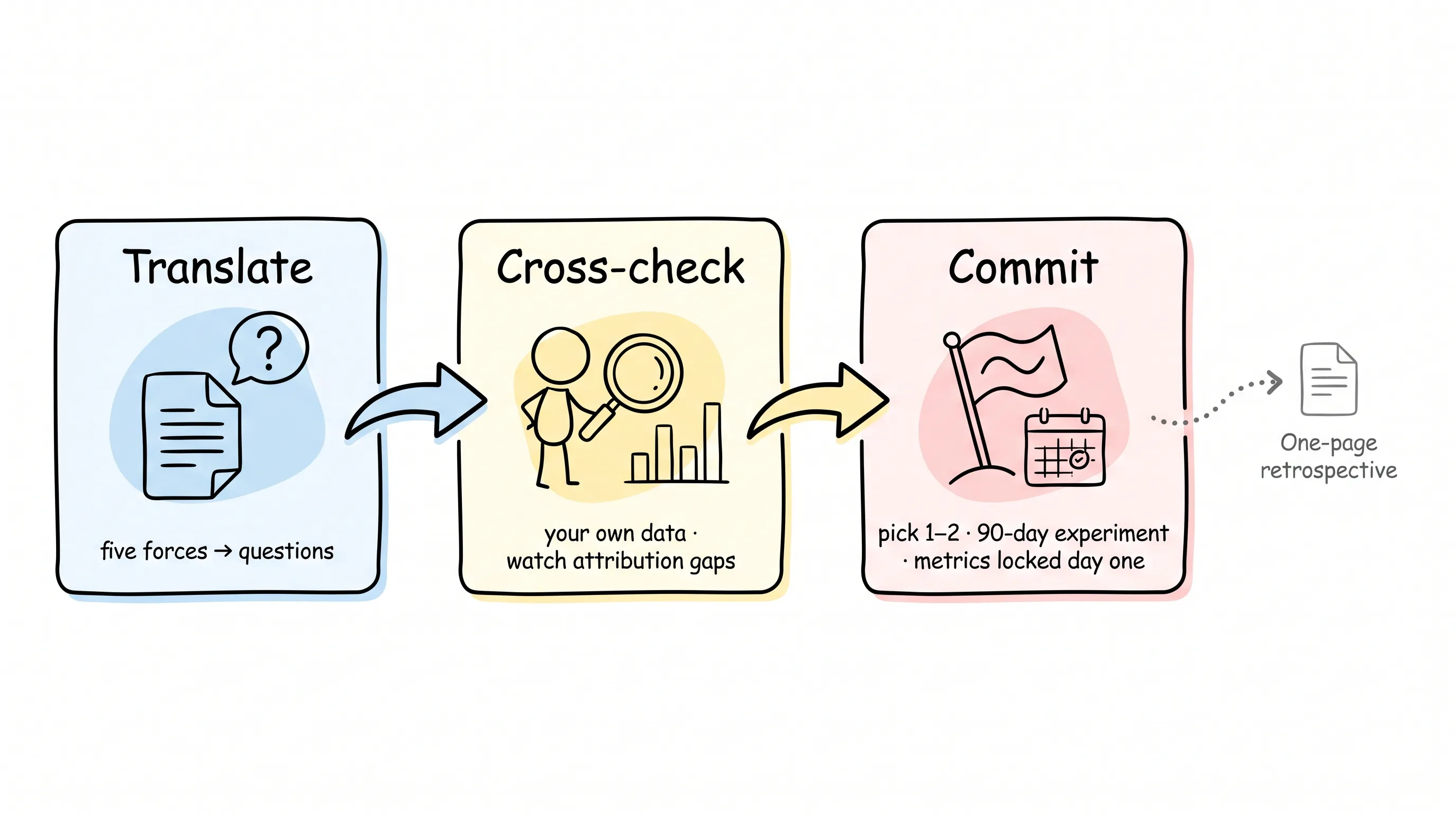
Reading a trends report and doing nothing is reading it for nothing. Three steps. Step one, translate: turn each of the five forces into a question about your own business — "the age of autonomous agents" becomes "which of our marketing tasks can we hand to agents within six months," "discovery shifts to scrolling" becomes "what share of our content budget is designed for scrolling." Only once you've turned the report into questions does it have anything to do with you. Restraint when writing them: all five makes fifteen questions' worth — start with the three most uncomfortable ones; if a question comes out and nobody will claim it, the report isn't relevant to you yet, so set it aside. Step two, cross-check: validate against existing evidence — look at how feeds and AI referrals are shifting within your own traffic mix, and use your own data to judge whether this force has hit you. Watch one trap when cross-checking: a shift invisible in your data hasn't necessarily failed to happen — your analytics instrumentation may simply not cover the new path. The attribution gap around AI referral traffic is an industry-wide ailment; don't conclude "no need to move" from incomplete attribution. Step three, commit: pick one or two forces and run 90-day experiments, with metrics and acceptance criteria locked in writing on day one — an experiment that changes metrics midway never happened. Whether it succeeds or fails, write a one-page retrospective; accumulate those and you have your team's own trend-judgment record, worth more than any report money can buy. Whatever you do, don't turn this into an all-hands study session — a trend seminar that produces no action is pure man-hours on fire. On scheduling: do the translating and cross-checking two weeks before the planning meeting, lock the project picks at the meeting itself, run the 90-day experiment snug against the quarter, and get the retrospective out before the next planning round — then the rhythm flows. When your own data looks thin, use public research like Seer's as the reference frame: assume industry averages first, then adjust item by item — don't sit idle waiting for complete data.
Extended Interpretation 3: How to Read the Experimental and the Foresight Schools Together
Read the headline's experimental research against this foresight report and you can see how the methods complement each other. Seer belongs to the experimental school — grab ready-made data and attribute, 617 prompts, 4,124 pages, every conclusion rerunnable and verifiable. AMA belongs to the foresight school — thirty-plus people voting in rounds to scenario the world five years out, giving direction, not numbers. Each school has blind spots: experimental conclusions have short shelf lives — one model version bump and everything needs retesting; the fan-out pattern measured today may look different next version. Foresight has strong direction but the landing rhythm is yours to estimate: the report says five to ten years, your budget covers one year, and no one does that conversion for you.
In practice there's a triangulation method: the trends report tells you where to look, experimental data tells you where things stand now, and your own ledger tells you whether it concerns you. Commit to a project only when you have all three, and the odds of betting wrong shrink a lot. Direction without the status quo and you end up doing year-five work in year one, burning money where the market hasn't arrived; the status quo without direction and you sprint faster and faster down an old track, only to find the track gone. Today's two materials complete the first two; the third sits in your own analytics tools and can be pulled by mid-morning. Set a rerun cadence too: rerun fan-out and citation experiments quarterly, add an extra round after any major model version release, and a monthly pass over your own ledger data is enough — too often and you burn people and budget; too rarely and the conclusions go stale.
Extended Interpretation 4: Splitting the Moves by Role
Finally, break the moves down by role so the weekly meeting can assign them directly. The CMO-level move: put both materials on the 2027 planning agenda with a one-page discussion slot each, and decide in the room which trends enter the budget — and write down why for the ones that don't, nothing left hanging. Content leads should run the inventory: list the heavily cited old pages into a maintenance queue — this move holds under both materials' logic and is today's highest-ROI action. SEO teams then get the fan-out ledger running: a first version monitoring 30 prompts can ship this week, manual reruns first, automation once it's smooth. Brand teams claim the accuracy audit: verify model statements line by line, trace the sources of wrong information, fix what can be fixed, and at minimum know where the errors live. The individual move is smallest and fastest: search your own brand across a few mainstream AI assistants and see how they introduce you — ten minutes of work, and you see first-hand distortion live, after which you'll understand why the accuracy audit ranks ahead of share. Once the assignment sheet goes up, build in a mechanism: ten minutes at each weekly meeting to walk everyone's progress — trend implementation most often dies in the awkward silence of nobody looking back.
Extended Interpretation 5: The Three Most Common Ways to Misread This Report
The most common misreading first: treating the five forces as five parallel urgent action items and doing all five at once. The report describes forces taking shape over five to ten years, and they have an order — the agent era and the discovery shift are already in front of us, the liquid workforce is halfway, and sustainability and trust rebuilding run later. Do all five at once and the usual outcome is shallow dabbles on every front, none carried through, budget spread thin and results spread thinner.
Another misreading: treating the five-to-ten-year timeline as a roadmap, as if deliverables were due next year. A foresight report gives direction, not project milestones. Force year-five judgments onto this year's quarterly targets and the team gets pushed into talking concepts instead of doing work — all that's left at the end is slides. The correct use is to back-cast from the timeline: if a judgment holds in five years, what early sprouts should exist this year? Hunt for sprouts, not end states.
And one more: using the AMA name as an endorsement. Write "industry authorities believe" into your deck and the report is demoted to a poster slogan. The authority's value lies in credible method — the Delphi conclusions themselves say they're scenario inference. Carry that premise when you retell it; it persuades more than name-dropping, and the audience actually trusts it more.
The same method dodges all three misreadings: with each trend, ask one more question — at what point will this intersect with my business? Set aside what doesn't intersect yet; start immediately where the intersection has already happened. The question isn't hard. What's hard is admitting some trends have nothing to do with you for now — that steadiness is worth more than chasing every hot topic.
💡 Daily Takeaway
Put today's two stories side by side and the theme is one sentence: marketing's competitive position has moved from grabbing placement to earning trust. Seer's experimental data shows you how trust is accounted — models cite maintained old pages, sources with accurate statements, brands that appear inside retrieval questions. AMA's foresight scenarios show you why trust keeps getting more expensive — once agents take over transactional work, the human-only assets of creativity, cultural understanding, and authentic storytelling become the differentiators. One gives measurement and tactics, the other direction and rationale; together they make a complete pair — one hand for the numbers, one for the direction.
There's a quieter signal too. Both materials stress the human position, but neither pulls humans out of production: Seer says maintaining old pages is a craft; AMA says cultural understanding and authentic storytelling are the differentiators. Read together, what's scarce in 2026 isn't people who can direct AI, it's people who can serve as the yardstick for AI. "Models reward proof, not claims" appeared twice today — worth writing on the team bulletin board. And one observation quieter still: both stories put weight on the word accurate — one watches the accuracy of what models state about you, the other weighs authentic narrative. Accuracy is replacing volume as the brand's new foundation.
It lands on two lines of action. Move your dashboard from placement metrics to accuracy and citation metrics — brand-attribute accuracy, fan-out visibility, and citation frequency first; and move the center of work from mass output to maintenance and narrative — move existing-page update schedules up the calendar, and put human judgment into the places machines can't reach. A light news day hands back the time you'd spend skimming feeds; turn these two lines into calendar items — you can start tonight.
Continue reading
Related articles

AI Marketing Daily · 2026-10-09
AI marketing daily for 2026-10-09 covering 11 items: brand measurement moving from survey panels to search, social, e-commerce, and AI prompt signals; GEO and share of model playbooks; safety guardrails for agentic ad buying; and tool roundups for ad platforms, cross-border tools, and social media uses.

AI Marketing Daily · 2026-10-08
AI Marketing Daily for 2026-10-08 curates 20 items across AI search visibility (GEO), advertising, platform selection, cross-border e-commerce, and ROI measurement. The headline argues that strategic marketing decisions should stay with humans while AI assists execution.

AI Marketing Daily · 2026-10-07
Today's throughline is answer engine optimization (AEO — getting your brand quoted in AI answer engines).